PROPOSAL WRITING
OKIDI OSCAR P’OKELLO
BPHARM, MPS
Introduction
&
Background
Body of proposal (introduction &
methods)
 Main purpose
 To provide the necessary background or context for your
research problem
 Explain the background & rationale for the
research by
 surveying the literature
 Summarising the current state of the fields knowledge
on the topic
 Showing how the proposed work will further that
knowledge
 Explain the purpose, significance & specific
objectives of the proposed research
 Describe in detail, the methodology to be used
and if necessary, explain the rationale behind
these methodological choices.
Introduction
 …is format and detailed statement of
intent of the researcher
…..presents and justifies a plan of action
and shows the investigation plan
Introduction
The main purpose of the introduction is to provide the necessary
background or context for your research problem. How to frame the
research problem is perhaps the biggest problem in proposal writing.
However, try to place your research question in the context of either a
current "hot" area, or an older area that remains viable.
Secondly, you need to provide a brief but appropriate historical
backdrop.
Thirdly, provide the contemporary context in which your proposed
research question occupies the central stage.
Finally, identify "key players" and refer to the most relevant and
representative publications. In short, try to paint your research
question in broad brushes and at the same time bring out its
significance.
Introduction
The introduction generally covers the following elements:
 State the research problem, which is often referred to as the purpose of the study
 Provide the context and set the stage for your research question in such a way as
to show its necessity and importance
 Present the rationale of your proposed study and clearly indicate why it is worth
doing
 Briefly describe the major issues and sub-problems to be addressed by your
research.
 Identify the key independent and dependent variables of your experiment.
Alternatively, specify the phenomenon you want to study
 State your hypothesis or theory, if any. For exploratory or phenomenological
research, you may not have any hypotheses. (Please do not confuse the
hypothesis with the statistical null hypothesis.)
 Set the delimitation or boundaries of your proposed research in order to provide
a clear focus.
 Provide definitions of key concepts. (This is optional.)
Introduction
• In the introduction you should:
– 􀂃 define or identify the general topic, issue or area
of concern
– 􀂃 point out overall trends in what has already
been published
– 􀂃 Present the case for the new study with a
sentence like “In this study……….”
• Essentials
– Wide reading of subject area
– Relevant current literature
– Electronic resources available
Introduction
Question to be asked Steps to be taken Elements of the step
What is the problem?
Why should it be studied?
Selection and statement of
the problem
-Problem identification
- Problem prioritization
- Justification
What information is already
available?
Literature review -Sources
-Reviewing
Why do conduct research?
What is the achievement of
the research?
Formulation of aim and
objectives
-- Aim, goals
-General and specific objectives
- Hypothesis
How to carry out the
research?
How to collect data and
information?
Wherefrom to collect data and
information?
Research methodology -Variables
- Types of the research
- Data collection techniques
- Sampling
- Data analysis process, plan
-Data processing plan
-Data interpretation process, plan
Introduction
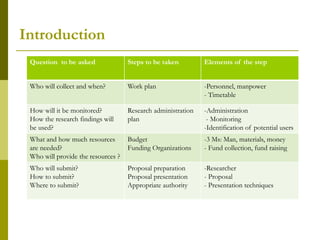
Question to be asked Steps to be taken Elements of the step
Who will collect and when? Work plan -Personnel, manpower
- Timetable
How will it be monitored?
How the research findings will
be used?
Research administration
plan
-Administration
- Monitoring
-Identification of potential users
What and how much resources
are needed?
Who will provide the resources ?
Budget
Funding Organizations
-3 Ms: Man, materials, money
- Fund collection, fund raising
Who will submit?
How to submit?
Where to submit?
Proposal preparation
Proposal presentation
Appropriate authority
-Researcher
- Proposal
- Presentation techniques
Background
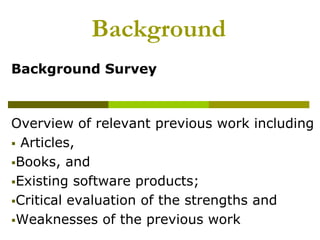
Background Survey
Overview of relevant previous work including
 Articles,
Books, and
Existing software products;
Critical evaluation of the strengths and
Weaknesses of the previous work
Background
Bearing in your mind that the first impression is the
last impression, you need to present your introduction
as clearer as possible—leaving no ambiguities.
This is the entrance of your paper through which
your reader will travel a journey of reading.
 If your introduction is attractive, your reader will
get much interested into your words till the last full
stop is reached.
Background
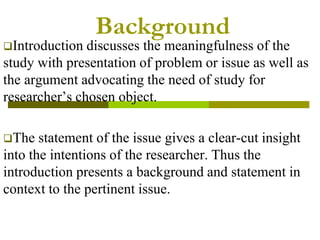
Introduction discusses the meaningfulness of the
study with presentation of problem or issue as well as
the argument advocating the need of study for
researcher’s chosen object.
The statement of the issue gives a clear-cut insight
into the intentions of the researcher. Thus the
introduction presents a background and statement in
context to the pertinent issue.
Common Mistakes in Proposal Writing
 Failure to provide the proper context to frame the research question
 Failure to delimit the boundary conditions for your research
 Failure to cite landmark studies
 Failure to accurately present the theoretical and empirical contributions by other
researchers
 Failure to stay focused on the research question
 Failure to develop a coherent and persuasive argument for the proposed research
 Too much detail on minor issues, but not enough detail on major issues
 Too much rambling -- going "all over the map" without a clear sense of
direction. (The best proposals move forward with ease and grace like a seamless
river.)
 Too many citation lapses and incorrect references
 Too long or too short.
(Paul T. P. Wong, Ph.D., C.Psych. Research Director, Graduate Program in
Counselling Psychology, Trinity Western University, Langley, BC, Canada)
END

5. Introduction and background.ppt

  • 1.
    PROPOSAL WRITING OKIDI OSCARP’OKELLO BPHARM, MPS
  • 2.
  • 3.
    Body of proposal(introduction & methods)  Main purpose  To provide the necessary background or context for your research problem  Explain the background & rationale for the research by  surveying the literature  Summarising the current state of the fields knowledge on the topic  Showing how the proposed work will further that knowledge  Explain the purpose, significance & specific objectives of the proposed research  Describe in detail, the methodology to be used and if necessary, explain the rationale behind these methodological choices.
  • 4.
    Introduction  …is formatand detailed statement of intent of the researcher …..presents and justifies a plan of action and shows the investigation plan
  • 5.
    Introduction The main purposeof the introduction is to provide the necessary background or context for your research problem. How to frame the research problem is perhaps the biggest problem in proposal writing. However, try to place your research question in the context of either a current "hot" area, or an older area that remains viable. Secondly, you need to provide a brief but appropriate historical backdrop. Thirdly, provide the contemporary context in which your proposed research question occupies the central stage. Finally, identify "key players" and refer to the most relevant and representative publications. In short, try to paint your research question in broad brushes and at the same time bring out its significance.
  • 6.
    Introduction The introduction generallycovers the following elements:  State the research problem, which is often referred to as the purpose of the study  Provide the context and set the stage for your research question in such a way as to show its necessity and importance  Present the rationale of your proposed study and clearly indicate why it is worth doing  Briefly describe the major issues and sub-problems to be addressed by your research.  Identify the key independent and dependent variables of your experiment. Alternatively, specify the phenomenon you want to study  State your hypothesis or theory, if any. For exploratory or phenomenological research, you may not have any hypotheses. (Please do not confuse the hypothesis with the statistical null hypothesis.)  Set the delimitation or boundaries of your proposed research in order to provide a clear focus.  Provide definitions of key concepts. (This is optional.)
  • 7.
    Introduction • In theintroduction you should: – 􀂃 define or identify the general topic, issue or area of concern – 􀂃 point out overall trends in what has already been published – 􀂃 Present the case for the new study with a sentence like “In this study……….” • Essentials – Wide reading of subject area – Relevant current literature – Electronic resources available
  • 8.
    Introduction Question to beasked Steps to be taken Elements of the step What is the problem? Why should it be studied? Selection and statement of the problem -Problem identification - Problem prioritization - Justification What information is already available? Literature review -Sources -Reviewing Why do conduct research? What is the achievement of the research? Formulation of aim and objectives -- Aim, goals -General and specific objectives - Hypothesis How to carry out the research? How to collect data and information? Wherefrom to collect data and information? Research methodology -Variables - Types of the research - Data collection techniques - Sampling - Data analysis process, plan -Data processing plan -Data interpretation process, plan
  • 9.
    Introduction Question to beasked Steps to be taken Elements of the step Who will collect and when? Work plan -Personnel, manpower - Timetable How will it be monitored? How the research findings will be used? Research administration plan -Administration - Monitoring -Identification of potential users What and how much resources are needed? Who will provide the resources ? Budget Funding Organizations -3 Ms: Man, materials, money - Fund collection, fund raising Who will submit? How to submit? Where to submit? Proposal preparation Proposal presentation Appropriate authority -Researcher - Proposal - Presentation techniques
  • 10.
    Background Background Survey Overview ofrelevant previous work including  Articles, Books, and Existing software products; Critical evaluation of the strengths and Weaknesses of the previous work
  • 11.
    Background Bearing in yourmind that the first impression is the last impression, you need to present your introduction as clearer as possible—leaving no ambiguities. This is the entrance of your paper through which your reader will travel a journey of reading.  If your introduction is attractive, your reader will get much interested into your words till the last full stop is reached.
  • 12.
    Background Introduction discusses themeaningfulness of the study with presentation of problem or issue as well as the argument advocating the need of study for researcher’s chosen object. The statement of the issue gives a clear-cut insight into the intentions of the researcher. Thus the introduction presents a background and statement in context to the pertinent issue.
  • 13.
    Common Mistakes inProposal Writing  Failure to provide the proper context to frame the research question  Failure to delimit the boundary conditions for your research  Failure to cite landmark studies  Failure to accurately present the theoretical and empirical contributions by other researchers  Failure to stay focused on the research question  Failure to develop a coherent and persuasive argument for the proposed research  Too much detail on minor issues, but not enough detail on major issues  Too much rambling -- going "all over the map" without a clear sense of direction. (The best proposals move forward with ease and grace like a seamless river.)  Too many citation lapses and incorrect references  Too long or too short. (Paul T. P. Wong, Ph.D., C.Psych. Research Director, Graduate Program in Counselling Psychology, Trinity Western University, Langley, BC, Canada)
  • 14.