Introduction
A general overview
Purpose
• The introduction to a paper is a very important section,
  in that it sets the expectations of the reader. While there
  is no one formula for a good introduction, in general, an
  introduction to a formal paper of this type should
  accomplish the following:
An introduction should attract
the reader's attention.
• Magazine and newspaper articles often accomplish this
  with brief but interesting anecdotes, questions that
  capture the reader's curiosity, something of personal
  relevance to the reader, or other apt quotations,
  provocative questions, or statements.

• Very often just raising the interesting issue that your
  thesis explores is enough to pull your reader in.
It should be explicit
After having read the introduction, the reader should have
no doubt about what the central point of your paper is.
It should be significant
You should convince your audience that it should care
about what you have to say, though attention to relevance
and significance is part of constructing a successful thesis.
It can give a preview
Writers often summarize in a brief list of three or so points how
you are going to back up your thesis, so as to prepare the reader
and improve the reader's recognition and retention of those
points.
Not a place for long
background
A common impulse is to start a paper with the story of when a
person was born, or with some historical background. However,
unless some brief information is necessary to understand the
terms within or significance of the thesis, save the background
for your next paragraph.
Not too long
An introduction should be a single paragraph, at least for the
length of papers for this class. A page-long intro is usually too
long -- half a page or less is good. If your opening anecdote is a
long one, you don't have to finish it in the introduction -- just
introduce enough of it to get the reader's attention and establish
the significance of your thesis. You can finish it in the body of the
paper. (In fact, such a "teaser" is a common device of newspaper
feature writers.)
Not a dictionary definition
We're not interested in how Webster's defines "Postmodernism."
We are interested in YOUR take on it.
Not a grand generalization
The cliché of the "pyramid form" introduction often leads to
uninteresting sentences that begin with "Since the beginning of
time..." or "Throughout history...". Showing the significance of
your thesis does not mean that you have to demonstrate its
importance in the history of art or tie it to some universal
observation.
Parts of an Introduction
• Hook
• Background/Definition
• Thesis
Hook (To attract the reader)

 1.   Pose a specific question that will invite the reader to keep
      reading for the answer - a provocative question works well to
      engage readers, so long as it doesn't put them off
 2.   Choose statistics that you expect will surprise your reader or
      that go against the common belief about a topic
 3.   Tell a short, interesting anecdote (or story) related to the topic
 4.   Provide an interesting (and relevant) quote
 5.   Develop an unusual or unexpected comparison
Definition and Background
• It is not a place for a dictionary definition or a long
  background BUT
  • You need to give enough information for the reader to
    understand your thesis.
  • You need to anticipate for a differing definition for your topic
Thesis
• Thesis has three parts
  1. Significance
  2. Your opinion
  3. Your reasons or process
Thesis – Significance
• Does my thesis pass the "So what?" test?
• Tell the reader, why your opinion or paper is
  important?
Thesis – Opinion
• Do I answer the question?
• Have I taken a position that others might
  challenge or oppose?
• Is my thesis statement specific enough?
• Thesis statements that are too vague often do
  not have a strong argument.
Process
• Does my thesis pass the "how and why?" test?
• Process can guide the reader and show your
  organization before they start reading your
  paper
Sample Thesis (Opinion and
Process)
• A thesis STATES A POINT TO BE MADE, not
  just a topic or a question:
   • Less effective:
   • We need to protect nature
 • More effective:
   • Protecting our forests is important due to its
     ability to deter erosion, keep green house
     gases low and provide substance for our
     ecosystem
Sample Cont.
 • Less effective:
   • This paper is a comparison of McDonalds
     and Burger King burgers.
 • More effective:
   • While McDonalds is cheaper the flame
     broiled burgers of Burger King is juicer and is
     more flavorful.
Sample Cont.
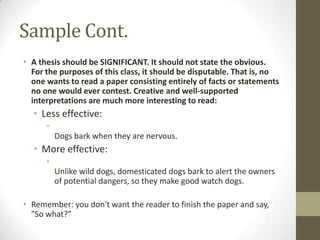
• A thesis should be SIGNIFICANT. It should not state the obvious.
  For the purposes of this class, it should be disputable. That is, no
  one wants to read a paper consisting entirely of facts or statements
  no one would ever contest. Creative and well-supported
  interpretations are much more interesting to read:
  • Less effective:
      •
          Dogs bark when they are nervous.
  • More effective:
      •
          Unlike wild dogs, domesticated dogs bark to alert the owners
          of potential dangers, so they make good watch dogs.

• Remember: you don't want the reader to finish the paper and say,
  "So what?"
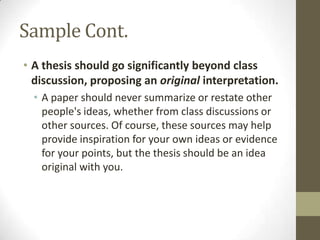
Sample Cont.
• A thesis should go significantly beyond class
  discussion, proposing an original interpretation.
  • A paper should never summarize or restate other
    people's ideas, whether from class discussions or
    other sources. Of course, these sources may help
    provide inspiration for your own ideas or evidence
    for your points, but the thesis should be an idea
    original with you.
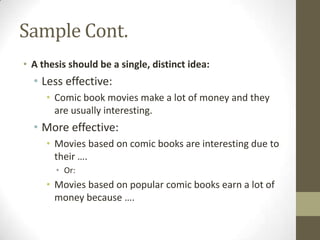
Sample Cont.
• A thesis should be a single, distinct idea:
  • Less effective:
     • Comic book movies make a lot of money and they
       are usually interesting.
  • More effective:
     • Movies based on comic books are interesting due to
       their ….
       • Or:
     • Movies based on popular comic books earn a lot of
       money because ….
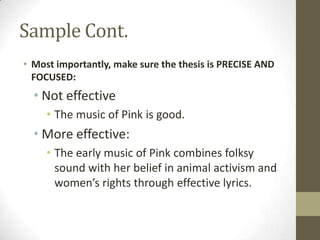
Sample Cont.
• Most importantly, make sure the thesis is PRECISE AND
  FOCUSED:
  • Not effective
     • The music of Pink is good.
  • More effective:
     • The early music of Pink combines folksy
       sound with her belief in animal activism and
       women’s rights through effective lyrics.
NEXT
• Please go to the WIKI for a more detailed description and
  examples

Introduction

  • 1.
  • 2.
    Purpose • The introductionto a paper is a very important section, in that it sets the expectations of the reader. While there is no one formula for a good introduction, in general, an introduction to a formal paper of this type should accomplish the following:
  • 3.
    An introduction shouldattract the reader's attention. • Magazine and newspaper articles often accomplish this with brief but interesting anecdotes, questions that capture the reader's curiosity, something of personal relevance to the reader, or other apt quotations, provocative questions, or statements. • Very often just raising the interesting issue that your thesis explores is enough to pull your reader in.
  • 4.
    It should beexplicit After having read the introduction, the reader should have no doubt about what the central point of your paper is.
  • 5.
    It should besignificant You should convince your audience that it should care about what you have to say, though attention to relevance and significance is part of constructing a successful thesis.
  • 6.
    It can givea preview Writers often summarize in a brief list of three or so points how you are going to back up your thesis, so as to prepare the reader and improve the reader's recognition and retention of those points.
  • 7.
    Not a placefor long background A common impulse is to start a paper with the story of when a person was born, or with some historical background. However, unless some brief information is necessary to understand the terms within or significance of the thesis, save the background for your next paragraph.
  • 8.
    Not too long Anintroduction should be a single paragraph, at least for the length of papers for this class. A page-long intro is usually too long -- half a page or less is good. If your opening anecdote is a long one, you don't have to finish it in the introduction -- just introduce enough of it to get the reader's attention and establish the significance of your thesis. You can finish it in the body of the paper. (In fact, such a "teaser" is a common device of newspaper feature writers.)
  • 9.
    Not a dictionarydefinition We're not interested in how Webster's defines "Postmodernism." We are interested in YOUR take on it.
  • 10.
    Not a grandgeneralization The cliché of the "pyramid form" introduction often leads to uninteresting sentences that begin with "Since the beginning of time..." or "Throughout history...". Showing the significance of your thesis does not mean that you have to demonstrate its importance in the history of art or tie it to some universal observation.
  • 11.
    Parts of anIntroduction • Hook • Background/Definition • Thesis
  • 12.
    Hook (To attractthe reader) 1. Pose a specific question that will invite the reader to keep reading for the answer - a provocative question works well to engage readers, so long as it doesn't put them off 2. Choose statistics that you expect will surprise your reader or that go against the common belief about a topic 3. Tell a short, interesting anecdote (or story) related to the topic 4. Provide an interesting (and relevant) quote 5. Develop an unusual or unexpected comparison
  • 13.
    Definition and Background •It is not a place for a dictionary definition or a long background BUT • You need to give enough information for the reader to understand your thesis. • You need to anticipate for a differing definition for your topic
  • 14.
    Thesis • Thesis hasthree parts 1. Significance 2. Your opinion 3. Your reasons or process
  • 15.
    Thesis – Significance •Does my thesis pass the "So what?" test? • Tell the reader, why your opinion or paper is important?
  • 16.
    Thesis – Opinion •Do I answer the question? • Have I taken a position that others might challenge or oppose? • Is my thesis statement specific enough? • Thesis statements that are too vague often do not have a strong argument.
  • 17.
    Process • Does mythesis pass the "how and why?" test? • Process can guide the reader and show your organization before they start reading your paper
  • 18.
    Sample Thesis (Opinionand Process) • A thesis STATES A POINT TO BE MADE, not just a topic or a question: • Less effective: • We need to protect nature • More effective: • Protecting our forests is important due to its ability to deter erosion, keep green house gases low and provide substance for our ecosystem
  • 19.
    Sample Cont. •Less effective: • This paper is a comparison of McDonalds and Burger King burgers. • More effective: • While McDonalds is cheaper the flame broiled burgers of Burger King is juicer and is more flavorful.
  • 20.
    Sample Cont. • Athesis should be SIGNIFICANT. It should not state the obvious. For the purposes of this class, it should be disputable. That is, no one wants to read a paper consisting entirely of facts or statements no one would ever contest. Creative and well-supported interpretations are much more interesting to read: • Less effective: • Dogs bark when they are nervous. • More effective: • Unlike wild dogs, domesticated dogs bark to alert the owners of potential dangers, so they make good watch dogs. • Remember: you don't want the reader to finish the paper and say, "So what?"
  • 21.
    Sample Cont. • Athesis should go significantly beyond class discussion, proposing an original interpretation. • A paper should never summarize or restate other people's ideas, whether from class discussions or other sources. Of course, these sources may help provide inspiration for your own ideas or evidence for your points, but the thesis should be an idea original with you.
  • 22.
    Sample Cont. • Athesis should be a single, distinct idea: • Less effective: • Comic book movies make a lot of money and they are usually interesting. • More effective: • Movies based on comic books are interesting due to their …. • Or: • Movies based on popular comic books earn a lot of money because ….
  • 23.
    Sample Cont. • Mostimportantly, make sure the thesis is PRECISE AND FOCUSED: • Not effective • The music of Pink is good. • More effective: • The early music of Pink combines folksy sound with her belief in animal activism and women’s rights through effective lyrics.
  • 24.
    NEXT • Please goto the WIKI for a more detailed description and examples

Editor's Notes

  • #3 What do you do if the first 20 minutes of a movie is boring? You turn it off. You introduction is the same.
  • #16 Does my thesis pass the "So what?" test? If a reader's first response is, "So what?" then you need to clarify, to forge a relationship, or to connect to a larger issue.Tell the reader, why your opinion or paper is important?
  • #17 Do I answer the question? Re-reading the question prompt after constructing a working thesis can help you fix an argument that misses the focus of the question. Have I taken a position that others might challenge or oppose? If your thesis simply states facts that no one would, or even could, disagree with, it's possible that you are simply providing a summary, rather than making an argument.Is my thesis statement specific enough?Thesis statements that are too vague often do not have a strong argument. If your thesis contains words like "good" or "successful," see if you could be more specific: why is something "good"; what specifically makes something "successful"?
  • #18 Does my thesis pass the "how and why?" test? If a reader's first response is "how?" or "why?" your thesis may be too open-ended and lack guidance for the reader. See what you can add to give the reader a better take on your position right from the beginning.Process can guide the reader and show your organization before they start reading your paper