Introduction to Lead
Dr. Ghizal Fatima, PhD
Assistant Professor
Department of Biotechnology
Era’s Lucknow Medical College and Hospital
E-mail: ghizalfatima8@gmail.com
2
•Lead poisoning is the most serious environmental
health threat.
•Worldwide, approximately 120 million people
are overexposed to lead (Pb)…
• That’s 3 times the number affected by
HIV/AIDS…
with 99% of those overexposed living in
Developing Nations.
Today, >80% of all lead used in the world goes into
lead-acid batteries…
currently <20% of all lead batteries are collected by
the manufacturer resulting in the proliferation of
backyard smelters and recyclers
contributing to lead poisoning and environmental
contamination.
A hundred years ago, the human body was believed to be composed
of just 14 elements: oxygen, hydrogen, carbon, nitrogen, phosphorus,
sulfur, calcium, magnesium, sodium, potassium, chloride, fluorine,
silicon and iron.
In recent times, we’ve added many metals and minerals to the list of
the essential components of our existence, some of which you may
have never even heard. The most surprising findings have been the
fact that we desperately require tiny amounts of hyper-trace
elements to make the thousands of cellular processes work.
BACKGROUND
• Over the past 40 years the US FDA has created a list of such
“essential” minerals, some minerals have been considered
poisonous, and then found to be essential.
• Even a natural form of any mineral may be toxic when overdosed
or when improperly balanced with other minerals, but minerals are
especially risky in the form of man-made derivatives of
manufacturing processes.
Sources Of Lead
• Lead Paint
• Dust, Soil
• Water
• Industry
• Traditional Ethnic Remedies
Occupational Workers
– Lead smelters
– Painter/decorators
– Battery recycling jobs
– Stain-glass workers
– Jewellery makers
– Bronze workers etc...
Lead
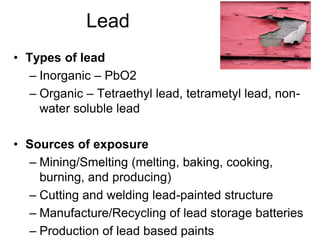
• Types of lead
– Inorganic – PbO2
– Organic – Tetraethyl lead, tetrametyl lead, non-
water soluble lead
• Sources of exposure
– Mining/Smelting (melting, baking, cooking,
burning, and producing)
– Cutting and welding lead-painted structure
– Manufacture/Recycling of lead storage batteries
– Production of lead based paints
Lead - Absorption
Orally Consumed Lead Absorbed
In Place of Calcium
CHILDREN – 30-50% OF LEAD
ADULTS – 5-10% OF LEAD
Increased During Pregnancy
Nutritional deficiencies increase
absorption
(high fat diets, iron, calcium)
VITAMIN D (from sun) INCREASES
Lead
• Correlation between blood lead levels and
clinical effects
– < 40 ug/dl – usually none
– 40 – 80 ug/dl – mild symptoms
– > 80 ug/dl – severe manifestation such as
convulsions
Neuronal System
Hyperirritability
Ataxia
Convulsions
Coma etc.
Respiratory System
Alteration in
pulmonary functions
CV System
Increase in blood pressure
G.l. System
Abdominal pain
Constipation
Cramps
Nausea
Vomiting
Weight loss
Hematological System
Anemia,
Decrease in ALAD and
ferrochelatase enzyme
activity,
Increase in blood ALA and
protoporphyrin levels.
Hepatic System
Decrease in
cytochrome p450
enzyme activity.
Renal System
Proximal tubular nephropathy
Glomerular sclerosis
Interstitial fibrosis.
Other effects: Pb interferes
with the conversion of vitamin
D to its hormonal form, 1,25-
dihydroxyvitamin D.
Toxic Effects of Pb on Biological Systems in Human
No specific ingestion route–an India scenerio.
we eat it,
we drink it, and
we breathe it.
0
0.5
1
1.5
2
2.5
3
3.5
4
4.5
Paint Color
XRFleadreading,mg/cmsq.
Comparison of Lead Content of New Paint
by Color (based on 3rd coat readings)
Where children play are loaded with lead
Would you like have any child to play with
this ?
• Population in India is more than three times that
of USA
(U.S. 303,051,750 India 1,129,866,154)
• Land area in India is one third that of USA
• Problems are nine folds in India
• Pollution growth rate is also high
• Economic demand is also very high
Indian Vs U.S senario
In response to this problem we
have created…
Lead in India
One hundred thousand metric Tons of lead was used
annually in India as on 2003.
It is on increase every year on geometrical progression
Most of it is going for lead acid battery production for both
domestic and overseas usage.
Recycling is incomplete resulting in environmental problem
Lead Poisoning Epidemic
In Developing Countries
• The World Health Organization estimates that 120
million people are overexposed to lead and 99 percent of
the most serious cases are in the developing world.
• Children most severely effected (school performance,
IQ, mental retardation, anemia, GI tract, kidney damage
& other symptoms)
BLOOD LEAD LEVELS > 10UG/DL
USING ASV
AGE >12 Y <12 Y Comments 2005
• NATION 40.2% 51.4% Increasing
• BANGALORE15.8% 39.9% Increasing no change
• CALCUTTA 40.0% 55.7% Increasing
• CHENNAI 52.0% 66.8% Increasing
• DELHI 64.7% 54.1% Decreased
• MUMBAI 76.1% 61.8% Decreased
• NATION (<12 YRS) (>20 = 12.6%) (>30 = 2.7%) (>40 =1.3%)
THUPPIL ET ALL 1999 TGF
Is lead present in water ?
• Below 10, below 15 or upto 50 ug/L
• Is it over 50 going up to 150 ug / L
• What is the solution?
Lead Acid Battery
Almost 80% of all the lead now used in many
parts of the world is for the production of lead-
acid batteries.
It is unfortunate that in India and other
developing countries the environmental friendly
recycled lead is of much lower proportion in lead
acid battery manufacturing.
Costs of Lead Poisoning
• The estimated cost of lead poisoning among children in
India is over 600 million dollars (U.S.) per year
• Additional costs for adults excluded: gastrointestinal
disorders, anemia, reproductive effects (including birth
defects), cancer, kidney damage, and cardiovascular
disease (resulting from elevated blood pressure).
The savings from
implementing the
certification program is over
20 million dollars for a 10
year period
Thousands in India
Thousands of land mines are found in developing countries
Heavy metal in Ayurvedic Herbal
Medicine Products
• In India 2000 years ago Ayurvedic medicines originated
as HMP’s.
• Approximately 80% of India’s over 1 billion population
use.
• Heavy metal has become part of traditional medicines.
• Need for regulations and GMP on an urgent basis.
12/10/2020 Lucknow UP Referral Centre
launch
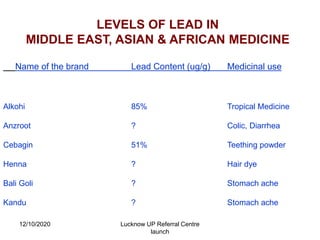
LEVELS OF LEAD IN
MIDDLE EAST, ASIAN & AFRICAN MEDICINE
Name of the brand Lead Content (ug/g) Medicinal use
Alkohi 85% Tropical Medicine
Anzroot ? Colic, Diarrhea
Cebagin 51% Teething powder
Henna ? Hair dye
Bali Goli ? Stomach ache
Kandu ? Stomach ache
LEVELS OF LEAD IN
CHINESE MEDICINE
Name of the brand Lead Content (ug/g) Medicinal use
Cordyceps 412-20,000 ug/g Tropical/herbal Medicine
Poying Tan 7.5 mg/dose General
Bo Bow Sen 1000mg/g Hyperactivity
LEVELS OF LEAD IN
MEXICAN AND CENTRAL AMERICAN MEDICINE
Name of the brand Lead Content (ug/g) Medicinal use
Albayalde or Albayaidle 93% Vomiting & Colic
Apathy & lethargy
Alarcon, azarcon, Coral luiga,
Maria luisa, ruida 95% ,,
Greeta 97% Vomiting and colic
Why lead is found in medicines
• Accidental discovery that lead increases
shelf life of the preparations.
• Makes it tastier
• Increases weight per unit volume
And many more justifications are given
Lead Poisoning: An Indian
Perspective
• Lead through spices
• Lead through cultural activities
• Lead exposure as a result of socio
economic barrier
• Lead at home
• Lead as a tool
• Lead as a resource material in unethical
activities.
Lead map
• Lead map of city indicate areas and lead
related activities (high risk for lead
poisoning)
• Prevents chances of children exposed to
high risk zones with adequate
precautionary measures.
Additional data on birth certificate
• In all at high risk during pregnancy with
elevated blood lead levels.
• Cord blood lead determined and indicated
on the birth certificate to ensure timely
action.
• This will ensure follow up during growth
and development
Facts which needs attention
Why people with same genetic background
are differentiated by same levels of lead
exposure?
Lead based industrial worker projects this
problem to you and me
Facts which needs attention
Will lead become another essential trace
mineral?
Lesson learnt from our past with copper
which was toxic to life and essential trace
mineral today.
Facts which needs attention
Why children with varying nutritional status
respond to lead exposure differently.
Is it just their height and hand to mouth
activity or beyond
Facts which needs attention
Can we have lead safe society?
Through properly designed and
developed lead map of a city.
Looking for coordinators
• NRCLPI invites collaborators
• Funding agencies
• Policy makers
• Research scientists
• Technology
• Data bank
Let us join and make it possible and solve.
Thank you
For your kind involvement
and let us join hand in
making lead safe society
Mechanisms Of Lead Toxicity
• Lead-Calcium Interactions
• Lead-Protein Interactions
• Lead-Dopamine Systems
Interactions
• Lead-Opioid Systems Interactions
Battery recycling worker Family
Children
Pb

INTRODUTION TO LEAD

  • 1.
    Introduction to Lead Dr.Ghizal Fatima, PhD Assistant Professor Department of Biotechnology Era’s Lucknow Medical College and Hospital E-mail: ghizalfatima8@gmail.com
  • 2.
    2 •Lead poisoning isthe most serious environmental health threat. •Worldwide, approximately 120 million people are overexposed to lead (Pb)… • That’s 3 times the number affected by HIV/AIDS…
  • 3.
    with 99% ofthose overexposed living in Developing Nations. Today, >80% of all lead used in the world goes into lead-acid batteries…
  • 4.
    currently <20% ofall lead batteries are collected by the manufacturer resulting in the proliferation of backyard smelters and recyclers contributing to lead poisoning and environmental contamination.
  • 5.
    A hundred yearsago, the human body was believed to be composed of just 14 elements: oxygen, hydrogen, carbon, nitrogen, phosphorus, sulfur, calcium, magnesium, sodium, potassium, chloride, fluorine, silicon and iron. In recent times, we’ve added many metals and minerals to the list of the essential components of our existence, some of which you may have never even heard. The most surprising findings have been the fact that we desperately require tiny amounts of hyper-trace elements to make the thousands of cellular processes work. BACKGROUND
  • 6.
    • Over thepast 40 years the US FDA has created a list of such “essential” minerals, some minerals have been considered poisonous, and then found to be essential. • Even a natural form of any mineral may be toxic when overdosed or when improperly balanced with other minerals, but minerals are especially risky in the form of man-made derivatives of manufacturing processes.
  • 7.
    Sources Of Lead •Lead Paint • Dust, Soil • Water • Industry • Traditional Ethnic Remedies
  • 8.
    Occupational Workers – Leadsmelters – Painter/decorators – Battery recycling jobs – Stain-glass workers – Jewellery makers – Bronze workers etc...
  • 9.
    Lead • Types oflead – Inorganic – PbO2 – Organic – Tetraethyl lead, tetrametyl lead, non- water soluble lead • Sources of exposure – Mining/Smelting (melting, baking, cooking, burning, and producing) – Cutting and welding lead-painted structure – Manufacture/Recycling of lead storage batteries – Production of lead based paints
  • 10.
    Lead - Absorption OrallyConsumed Lead Absorbed In Place of Calcium CHILDREN – 30-50% OF LEAD ADULTS – 5-10% OF LEAD Increased During Pregnancy Nutritional deficiencies increase absorption (high fat diets, iron, calcium) VITAMIN D (from sun) INCREASES
  • 11.
    Lead • Correlation betweenblood lead levels and clinical effects – < 40 ug/dl – usually none – 40 – 80 ug/dl – mild symptoms – > 80 ug/dl – severe manifestation such as convulsions
  • 12.
    Neuronal System Hyperirritability Ataxia Convulsions Coma etc. RespiratorySystem Alteration in pulmonary functions CV System Increase in blood pressure G.l. System Abdominal pain Constipation Cramps Nausea Vomiting Weight loss Hematological System Anemia, Decrease in ALAD and ferrochelatase enzyme activity, Increase in blood ALA and protoporphyrin levels. Hepatic System Decrease in cytochrome p450 enzyme activity. Renal System Proximal tubular nephropathy Glomerular sclerosis Interstitial fibrosis. Other effects: Pb interferes with the conversion of vitamin D to its hormonal form, 1,25- dihydroxyvitamin D. Toxic Effects of Pb on Biological Systems in Human
  • 13.
    No specific ingestionroute–an India scenerio. we eat it, we drink it, and we breathe it.
  • 14.
    0 0.5 1 1.5 2 2.5 3 3.5 4 4.5 Paint Color XRFleadreading,mg/cmsq. Comparison ofLead Content of New Paint by Color (based on 3rd coat readings)
  • 15.
    Where children playare loaded with lead
  • 16.
    Would you likehave any child to play with this ?
  • 17.
    • Population inIndia is more than three times that of USA (U.S. 303,051,750 India 1,129,866,154) • Land area in India is one third that of USA • Problems are nine folds in India • Pollution growth rate is also high • Economic demand is also very high Indian Vs U.S senario
  • 18.
    In response tothis problem we have created…
  • 19.
    Lead in India Onehundred thousand metric Tons of lead was used annually in India as on 2003. It is on increase every year on geometrical progression Most of it is going for lead acid battery production for both domestic and overseas usage. Recycling is incomplete resulting in environmental problem
  • 20.
    Lead Poisoning Epidemic InDeveloping Countries • The World Health Organization estimates that 120 million people are overexposed to lead and 99 percent of the most serious cases are in the developing world. • Children most severely effected (school performance, IQ, mental retardation, anemia, GI tract, kidney damage & other symptoms)
  • 21.
    BLOOD LEAD LEVELS> 10UG/DL USING ASV AGE >12 Y <12 Y Comments 2005 • NATION 40.2% 51.4% Increasing • BANGALORE15.8% 39.9% Increasing no change • CALCUTTA 40.0% 55.7% Increasing • CHENNAI 52.0% 66.8% Increasing • DELHI 64.7% 54.1% Decreased • MUMBAI 76.1% 61.8% Decreased • NATION (<12 YRS) (>20 = 12.6%) (>30 = 2.7%) (>40 =1.3%) THUPPIL ET ALL 1999 TGF
  • 22.
    Is lead presentin water ? • Below 10, below 15 or upto 50 ug/L • Is it over 50 going up to 150 ug / L • What is the solution?
  • 23.
    Lead Acid Battery Almost80% of all the lead now used in many parts of the world is for the production of lead- acid batteries. It is unfortunate that in India and other developing countries the environmental friendly recycled lead is of much lower proportion in lead acid battery manufacturing.
  • 25.
    Costs of LeadPoisoning • The estimated cost of lead poisoning among children in India is over 600 million dollars (U.S.) per year • Additional costs for adults excluded: gastrointestinal disorders, anemia, reproductive effects (including birth defects), cancer, kidney damage, and cardiovascular disease (resulting from elevated blood pressure). The savings from implementing the certification program is over 20 million dollars for a 10 year period
  • 26.
  • 27.
    Thousands of landmines are found in developing countries
  • 28.
    Heavy metal inAyurvedic Herbal Medicine Products • In India 2000 years ago Ayurvedic medicines originated as HMP’s. • Approximately 80% of India’s over 1 billion population use. • Heavy metal has become part of traditional medicines. • Need for regulations and GMP on an urgent basis.
  • 29.
    12/10/2020 Lucknow UPReferral Centre launch LEVELS OF LEAD IN MIDDLE EAST, ASIAN & AFRICAN MEDICINE Name of the brand Lead Content (ug/g) Medicinal use Alkohi 85% Tropical Medicine Anzroot ? Colic, Diarrhea Cebagin 51% Teething powder Henna ? Hair dye Bali Goli ? Stomach ache Kandu ? Stomach ache
  • 30.
    LEVELS OF LEADIN CHINESE MEDICINE Name of the brand Lead Content (ug/g) Medicinal use Cordyceps 412-20,000 ug/g Tropical/herbal Medicine Poying Tan 7.5 mg/dose General Bo Bow Sen 1000mg/g Hyperactivity
  • 31.
    LEVELS OF LEADIN MEXICAN AND CENTRAL AMERICAN MEDICINE Name of the brand Lead Content (ug/g) Medicinal use Albayalde or Albayaidle 93% Vomiting & Colic Apathy & lethargy Alarcon, azarcon, Coral luiga, Maria luisa, ruida 95% ,, Greeta 97% Vomiting and colic
  • 32.
    Why lead isfound in medicines • Accidental discovery that lead increases shelf life of the preparations. • Makes it tastier • Increases weight per unit volume And many more justifications are given
  • 33.
    Lead Poisoning: AnIndian Perspective • Lead through spices • Lead through cultural activities • Lead exposure as a result of socio economic barrier • Lead at home • Lead as a tool • Lead as a resource material in unethical activities.
  • 34.
    Lead map • Leadmap of city indicate areas and lead related activities (high risk for lead poisoning) • Prevents chances of children exposed to high risk zones with adequate precautionary measures.
  • 35.
    Additional data onbirth certificate • In all at high risk during pregnancy with elevated blood lead levels. • Cord blood lead determined and indicated on the birth certificate to ensure timely action. • This will ensure follow up during growth and development
  • 36.
    Facts which needsattention Why people with same genetic background are differentiated by same levels of lead exposure? Lead based industrial worker projects this problem to you and me
  • 37.
    Facts which needsattention Will lead become another essential trace mineral? Lesson learnt from our past with copper which was toxic to life and essential trace mineral today.
  • 38.
    Facts which needsattention Why children with varying nutritional status respond to lead exposure differently. Is it just their height and hand to mouth activity or beyond
  • 39.
    Facts which needsattention Can we have lead safe society? Through properly designed and developed lead map of a city.
  • 40.
    Looking for coordinators •NRCLPI invites collaborators • Funding agencies • Policy makers • Research scientists • Technology • Data bank
  • 41.
    Let us joinand make it possible and solve.
  • 42.
    Thank you For yourkind involvement and let us join hand in making lead safe society
  • 43.
    Mechanisms Of LeadToxicity • Lead-Calcium Interactions • Lead-Protein Interactions • Lead-Dopamine Systems Interactions • Lead-Opioid Systems Interactions
  • 44.
    Battery recycling workerFamily Children Pb