Deciphering the role of Ocimum
sanctum on inflammatory cytokines
and oxidative stress parameters in
Indian Diabetes patients
Dr. Ghizal Fatima
Assistant Professor,
Department of Biotechnology,
Era Medical College and Hospital
• As of 2016, an estimated, 415 million people
had diabetes worldwide. From 2012 to 2016,
approximately 1.5 to 5.0 million deaths each
year resulted from diabetes.
• Therefore, in the present study we examined
the inflammatory cytokines and oxidative
stress levels before and after supplementation
of fresh tulsi leaves in Diabetes patients.
• Holy basil, also known as tulsi, is a herb that's
native to Indian and known to be a significant
part of Ayurvedic medicines. They could be
used in managing diabetes and blood sugar
too.
• Tulsi leaves are known as elixir of life because
of their diverse healing properties. From
warding off some of the most common
ailments, strengthening immunity, to fighting
bacterial & viral infections-the benefits of tulsi
are multifarious. This herb is said to improve
pancreatic beta-cell function and insulin
secretion, and further increases the uptake of
glucose by muscle cells.
• As per a study conducted by Nottingham
University, the researchers involved 60 people
with type-2 who continued their usual
medication throughout the trial. Half lot took
250mg capsules of holy basil per day for up to 90
days.
• Significantly greater improvements in glucose
control occurred in those taking tulsi plus their
usual medications.
• Spikes in blood glucose levels after eating also
improved significantly. Tulsi leaves are said to
have hypoglycaemic properties, which lower
blood sugar levels and help prevent
complications of diabetes.
• While it has been a celebrated herb since time
immemorial, tulsi is said to manage diabetes.
Diabetes is a major lifestyle disease is
prevalent in the country. It is marked by
fluctuations in blood sugar levels in the
body. Most health experts vouch for holy basil
to stabilise blood sugar levels.
• The leaves, stems and seeds of the tulsi plant
are edible and are used in numerous Indian
delicacies. Not only does the leaf adds flavour
to the dishes, but is said to preserve and
enhance the properties of the food. It has
anti-inflammatory properties that can prove
to be a cure to various diseases.
Method:
• Dietary supplementation of fresh tulsi leaves
in a dose of 5-6 leaves for 8 weeks have been
given to 40 Diabetes patients in the early
morning and before going to bed. The patients
were under strict diabetes control diet
following proper 24 hr. circadian rhythm.
• Blood samples were drawn before and after
the treatment with tulsi leaves.
• Blood glucose levels were measured by
CareSens N Blood Glucose Test Kit.
• Inflammatory cytokines were determined by
measuring the levels of tumor necrosis factor
alpha (TNF-α), interleukin 8 (IL-8), IL-6 in
serum and oxidative stress parameters like
Lipid Peroxides (LPO), nitric oxide (NO) and
Protein carbonyl in plasma.
RESULTS
• Before the treatment:
• Concentrations of TNF-α (p<0.005), IL-8, IL-6
(p<0.005) were found to be significantly
higher in Diabetes patients.
• After oral supplementation with tulsi leaves:
• Blood sugar levels were found to be lower.
Also, the inflammatory cytokines and
oxidative stress parameters were found lower.
160
170
180
190
200
210
220
Befor After
Blood sugar level before and after treatment
Series1
6.92
6.94
6.96
6.98
7
7.02
7.04
7.06
7.08
7.1
7.12
Before After
HbA1c levels before and after giving Ocimum Sanctum
Clinical and Biochemical Characteristics among Study and Control groups
Parameters Study with S.=40
[mean ± SD]
Patients without
S.=40
[mean ± SD]
P-value
Age (years) 34.7±9.8 32.8±10.5 N.S
ESR 27.2±9.7 24.9±8.2 N.S
ALT 39.8±14.1 37.6±14.4 N.S
Oxidative Parameters
Study with S.(n=40)
(Mean ± SD)
Patients without
suppli. (n=40)
(Mean ± SD)
P-Value
Lipid Peroxides (LPO)
3.31±0.57 4.24±0.85
p<0.005
Protein carbonyl group
1.90±0.45 2.82±0.56
p<0.005
Oxidative stress parameters among Study and Control groups
Antioxidative parameters among Study and Control groups
Antioxidative Parameters
Study (n=40)
(Mean ± SD)
Control (n=40)
(Mean ± SD)
P-Value
Catalase
39.0±5.1 31.3±3.0 p<0.005
Glutathione peroxidase
(GPx)
28.2±3.7 22.7±2.9 p<0.005
Glutathione Reductase
(GR)
28.4±4.2 24.1±3.9 p<0.005
Pearson correlation analysis in Lipid Peroxides (LPO), Protein carbonyl
group with age and VAS
Parameters Groups Age VAS
r r
Lipid Peroxides (LPO)
STUDY 0.084 0.033
Control 0.043 0.129
Protein carbonyl group
STUDY 0.038
0.034
Control -0.064
0.115
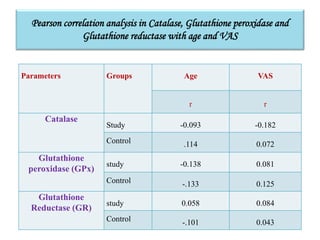
Pearson correlation analysis in Catalase, Glutathione peroxidase and
Glutathione reductase with age and VAS
Parameters Groups Age VAS
r r
Catalase
Study -0.093 -0.182
Control .114 0.072
Glutathione
peroxidase (GPx)
study -0.138 0.081
Control -.133 0.125
Glutathione
Reductase (GR)
study 0.058 0.084
Control -.101 0.043
Biochemical
Parameters
Study with
supplementation
(n=40)
(Mean ± SD)
Group without
supplementation
(n=40)
(Mean ± SD)
P-Value
IL-6 9.7±2.3 12.7±3.9 <0.05
IL-8 56.2±10.6 62.8±13.3 <0.05
TNF-α
8.3±4.4 13.4±6.1
<0.05
Comparison of serum IL-6, TNF-alpha and IL-8 in study and other group
CONCLUSION
• Tulsi leaf not only led to significant lowering of
blood glucose levels in test group, but also
resulted in marked reduction of inflammatory
cytokines and oxidative stress parameter levels.
• The leaves were found to possess both
superoxide and hydroxyl free radical scavenging
action.
• The present observations establish the efficacy of
tulsi leaves in lowering blood glucose levels and
antioxidant property appears to be
predominantly responsible for hypoglycemic
effect.
• Despite the lack of large-scale or long term
clinical trials on the effect of tulsi in humans, the
findings from 24 human studies published to date
suggest that the tulsi is a safe herbal intervention
that may assist in normalising glucose, blood
pressure and lipid profiles, and dealing with
psychological and immunological stress.
• Furthermore, these studies indicate the daily
addition of tulsi to the diet and/or as adjunct to
drug therapy can potentially assist in prevention
or reduction of various health conditions and
warrants further clinical evaluation.
• LIMITATIONS
• The limitation of this study was the sample size.
We need good sample size to draw much better
conclusion.
• Therefore, an interventional study is
recommended with a large sample size to address
the question of whether supplementation of Tulsi
leaves along with proper following of circadian
rhythm with diet control can lead to decrease in
severity of diabetes.
• Furthermore, supplementation of the regular
treatment with Tulsi may lead to development of
therapeutic strategies for its prevention and
treatment.
Era’s Lucknow Medical College
and Hospital,

tulsi in diabetes

  • 1.
    Deciphering the roleof Ocimum sanctum on inflammatory cytokines and oxidative stress parameters in Indian Diabetes patients Dr. Ghizal Fatima Assistant Professor, Department of Biotechnology, Era Medical College and Hospital
  • 2.
    • As of2016, an estimated, 415 million people had diabetes worldwide. From 2012 to 2016, approximately 1.5 to 5.0 million deaths each year resulted from diabetes. • Therefore, in the present study we examined the inflammatory cytokines and oxidative stress levels before and after supplementation of fresh tulsi leaves in Diabetes patients.
  • 3.
    • Holy basil,also known as tulsi, is a herb that's native to Indian and known to be a significant part of Ayurvedic medicines. They could be used in managing diabetes and blood sugar too.
  • 4.
    • Tulsi leavesare known as elixir of life because of their diverse healing properties. From warding off some of the most common ailments, strengthening immunity, to fighting bacterial & viral infections-the benefits of tulsi are multifarious. This herb is said to improve pancreatic beta-cell function and insulin secretion, and further increases the uptake of glucose by muscle cells.
  • 5.
    • As pera study conducted by Nottingham University, the researchers involved 60 people with type-2 who continued their usual medication throughout the trial. Half lot took 250mg capsules of holy basil per day for up to 90 days. • Significantly greater improvements in glucose control occurred in those taking tulsi plus their usual medications. • Spikes in blood glucose levels after eating also improved significantly. Tulsi leaves are said to have hypoglycaemic properties, which lower blood sugar levels and help prevent complications of diabetes.
  • 6.
    • While ithas been a celebrated herb since time immemorial, tulsi is said to manage diabetes. Diabetes is a major lifestyle disease is prevalent in the country. It is marked by fluctuations in blood sugar levels in the body. Most health experts vouch for holy basil to stabilise blood sugar levels.
  • 7.
    • The leaves,stems and seeds of the tulsi plant are edible and are used in numerous Indian delicacies. Not only does the leaf adds flavour to the dishes, but is said to preserve and enhance the properties of the food. It has anti-inflammatory properties that can prove to be a cure to various diseases.
  • 8.
    Method: • Dietary supplementationof fresh tulsi leaves in a dose of 5-6 leaves for 8 weeks have been given to 40 Diabetes patients in the early morning and before going to bed. The patients were under strict diabetes control diet following proper 24 hr. circadian rhythm. • Blood samples were drawn before and after the treatment with tulsi leaves.
  • 9.
    • Blood glucoselevels were measured by CareSens N Blood Glucose Test Kit. • Inflammatory cytokines were determined by measuring the levels of tumor necrosis factor alpha (TNF-α), interleukin 8 (IL-8), IL-6 in serum and oxidative stress parameters like Lipid Peroxides (LPO), nitric oxide (NO) and Protein carbonyl in plasma.
  • 10.
    RESULTS • Before thetreatment: • Concentrations of TNF-α (p<0.005), IL-8, IL-6 (p<0.005) were found to be significantly higher in Diabetes patients. • After oral supplementation with tulsi leaves: • Blood sugar levels were found to be lower. Also, the inflammatory cytokines and oxidative stress parameters were found lower.
  • 11.
    160 170 180 190 200 210 220 Befor After Blood sugarlevel before and after treatment Series1
  • 12.
  • 13.
    Clinical and BiochemicalCharacteristics among Study and Control groups Parameters Study with S.=40 [mean ± SD] Patients without S.=40 [mean ± SD] P-value Age (years) 34.7±9.8 32.8±10.5 N.S ESR 27.2±9.7 24.9±8.2 N.S ALT 39.8±14.1 37.6±14.4 N.S
  • 14.
    Oxidative Parameters Study withS.(n=40) (Mean ± SD) Patients without suppli. (n=40) (Mean ± SD) P-Value Lipid Peroxides (LPO) 3.31±0.57 4.24±0.85 p<0.005 Protein carbonyl group 1.90±0.45 2.82±0.56 p<0.005 Oxidative stress parameters among Study and Control groups
  • 15.
    Antioxidative parameters amongStudy and Control groups Antioxidative Parameters Study (n=40) (Mean ± SD) Control (n=40) (Mean ± SD) P-Value Catalase 39.0±5.1 31.3±3.0 p<0.005 Glutathione peroxidase (GPx) 28.2±3.7 22.7±2.9 p<0.005 Glutathione Reductase (GR) 28.4±4.2 24.1±3.9 p<0.005
  • 16.
    Pearson correlation analysisin Lipid Peroxides (LPO), Protein carbonyl group with age and VAS Parameters Groups Age VAS r r Lipid Peroxides (LPO) STUDY 0.084 0.033 Control 0.043 0.129 Protein carbonyl group STUDY 0.038 0.034 Control -0.064 0.115
  • 17.
    Pearson correlation analysisin Catalase, Glutathione peroxidase and Glutathione reductase with age and VAS Parameters Groups Age VAS r r Catalase Study -0.093 -0.182 Control .114 0.072 Glutathione peroxidase (GPx) study -0.138 0.081 Control -.133 0.125 Glutathione Reductase (GR) study 0.058 0.084 Control -.101 0.043
  • 18.
    Biochemical Parameters Study with supplementation (n=40) (Mean ±SD) Group without supplementation (n=40) (Mean ± SD) P-Value IL-6 9.7±2.3 12.7±3.9 <0.05 IL-8 56.2±10.6 62.8±13.3 <0.05 TNF-α 8.3±4.4 13.4±6.1 <0.05 Comparison of serum IL-6, TNF-alpha and IL-8 in study and other group
  • 19.
    CONCLUSION • Tulsi leafnot only led to significant lowering of blood glucose levels in test group, but also resulted in marked reduction of inflammatory cytokines and oxidative stress parameter levels. • The leaves were found to possess both superoxide and hydroxyl free radical scavenging action. • The present observations establish the efficacy of tulsi leaves in lowering blood glucose levels and antioxidant property appears to be predominantly responsible for hypoglycemic effect.
  • 20.
    • Despite thelack of large-scale or long term clinical trials on the effect of tulsi in humans, the findings from 24 human studies published to date suggest that the tulsi is a safe herbal intervention that may assist in normalising glucose, blood pressure and lipid profiles, and dealing with psychological and immunological stress. • Furthermore, these studies indicate the daily addition of tulsi to the diet and/or as adjunct to drug therapy can potentially assist in prevention or reduction of various health conditions and warrants further clinical evaluation.
  • 21.
    • LIMITATIONS • Thelimitation of this study was the sample size. We need good sample size to draw much better conclusion. • Therefore, an interventional study is recommended with a large sample size to address the question of whether supplementation of Tulsi leaves along with proper following of circadian rhythm with diet control can lead to decrease in severity of diabetes. • Furthermore, supplementation of the regular treatment with Tulsi may lead to development of therapeutic strategies for its prevention and treatment.
  • 22.
    Era’s Lucknow MedicalCollege and Hospital,