AnastasiaTrekles, Ph.D.
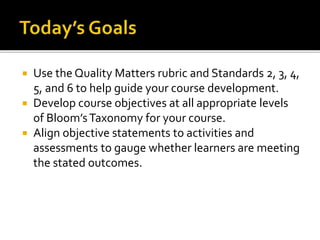
 Use the Quality Matters rubric and Standards 2, 3, 4,
5, and 6 to help guide your course development.
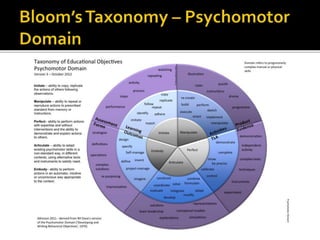
 Develop course objectives at all appropriate levels
of Bloom’sTaxonomy for your course.
 Align objective statements to activities and
assessments to gauge whether learners are meeting
the stated outcomes.
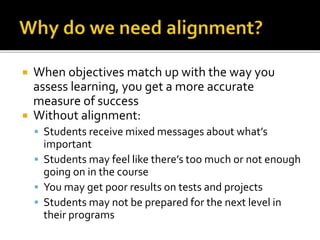
 When objectives match up with the way you
assess learning, you get a more accurate
measure of success
 Without alignment:
 Students receive mixed messages about what’s
important
 Students may feel like there’s too much or not enough
going on in the course
 You may get poor results on tests and projects
 Students may not be prepared for the next level in
their programs
 Aligning course objectives, activities, and
assessments may sound harder than it is
 Often you can build the activities right into
the objective statement
 If an activity doesn’t match up with an
objective, then it’s not worth doing (adjust
accordingly!)
 The Course Blueprint can help you lay out
your objectives and match to appropriate
activities and assessments in a visual way
 A quick review…
 The ABCD Objectives Formula:
 Audience: who are the learners?
 Behavior: what do you want to be able to observe them
doing?
 Condition: under what conditions will they do this?
 Degree: to what degree must they perform to be
successful?
 For example: After the course, students will be able to
discuss at least three major outcomes from the
American CivilWar, including social and political
implications.
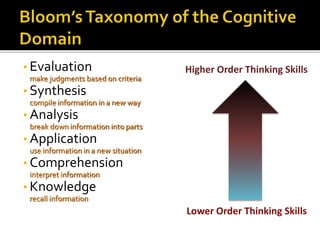
• Evaluation
make judgments based on criteria
• Synthesis
compile information in a new way
• Analysis
break down information into parts
• Application
use information in a new situation
• Comprehension
interpret information
• Knowledge
recall information
Lower Order Thinking Skills
Higher Order Thinking Skills
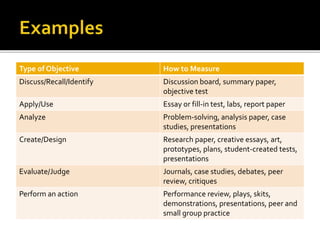
Type of Objective How to Measure
Discuss/Recall/Identify Discussion board, summary paper,
objective test
Apply/Use Essay or fill-in test, labs, report paper
Analyze Problem-solving, analysis paper, case
studies, presentations
Create/Design Research paper, creative essays, art,
prototypes, plans, student-created tests,
presentations
Evaluate/Judge Journals, case studies, debates, peer
review, critiques
Perform an action Performance review, plays, skits,
demonstrations, presentations, peer and
small group practice
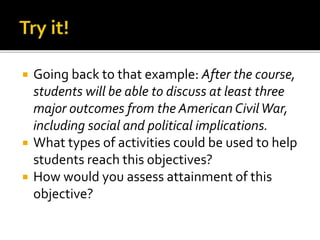
 Going back to that example: After the course,
students will be able to discuss at least three
major outcomes from the American CivilWar,
including social and political implications.
 What types of activities could be used to help
students reach this objectives?
 How would you assess attainment of this
objective?
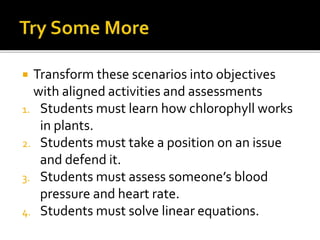
 Transform these scenarios into objectives
with aligned activities and assessments
1. Students must learn how chlorophyll works
in plants.
2. Students must take a position on an issue
and defend it.
3. Students must assess someone’s blood
pressure and heart rate.
4. Students must solve linear equations.
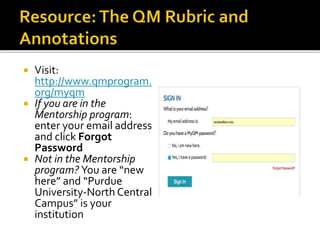
 Visit:
http://www.qmprogram.
org/myqm
 If you are in the
Mentorship program:
enter your email address
and click Forgot
Password
 Not in the Mentorship
program? You are “new
here” and “Purdue
University-North Central
Campus” is your
institution
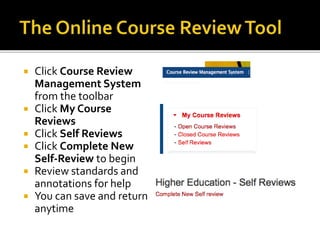
 Click Course Review
Management System
from the toolbar
 Click My Course
Reviews
 Click Self Reviews
 Click Complete New
Self-Review to begin
 Review standards and
annotations for help
 You can save and return
anytime
 Carnegie MellonAssessment page:
http://www.cmu.edu/teaching/assessment/h
owto/basics/objectives.html
 University of Colorado assessment tutorial:
http://www.ucdenver.edu/faculty_staff/facult
y/center-for-faculty-
development/Documents/Tutorials/Assessme
nt/index.htm
Reach us at:
 pncolt@pnc.edu
 Twitter and Facebook: @PNCOLT
 http://www.pnc.edu/distance for all
workshop notes, links, and training needs

Alignment: Objectives and Assessments

  • 1.
  • 2.
     Use theQuality Matters rubric and Standards 2, 3, 4, 5, and 6 to help guide your course development.  Develop course objectives at all appropriate levels of Bloom’sTaxonomy for your course.  Align objective statements to activities and assessments to gauge whether learners are meeting the stated outcomes.
  • 3.
     When objectivesmatch up with the way you assess learning, you get a more accurate measure of success  Without alignment:  Students receive mixed messages about what’s important  Students may feel like there’s too much or not enough going on in the course  You may get poor results on tests and projects  Students may not be prepared for the next level in their programs
  • 4.
     Aligning courseobjectives, activities, and assessments may sound harder than it is  Often you can build the activities right into the objective statement  If an activity doesn’t match up with an objective, then it’s not worth doing (adjust accordingly!)  The Course Blueprint can help you lay out your objectives and match to appropriate activities and assessments in a visual way
  • 5.
     A quickreview…  The ABCD Objectives Formula:  Audience: who are the learners?  Behavior: what do you want to be able to observe them doing?  Condition: under what conditions will they do this?  Degree: to what degree must they perform to be successful?  For example: After the course, students will be able to discuss at least three major outcomes from the American CivilWar, including social and political implications.
  • 6.
    • Evaluation make judgmentsbased on criteria • Synthesis compile information in a new way • Analysis break down information into parts • Application use information in a new situation • Comprehension interpret information • Knowledge recall information Lower Order Thinking Skills Higher Order Thinking Skills
  • 9.
    Type of ObjectiveHow to Measure Discuss/Recall/Identify Discussion board, summary paper, objective test Apply/Use Essay or fill-in test, labs, report paper Analyze Problem-solving, analysis paper, case studies, presentations Create/Design Research paper, creative essays, art, prototypes, plans, student-created tests, presentations Evaluate/Judge Journals, case studies, debates, peer review, critiques Perform an action Performance review, plays, skits, demonstrations, presentations, peer and small group practice
  • 10.
     Going backto that example: After the course, students will be able to discuss at least three major outcomes from the American CivilWar, including social and political implications.  What types of activities could be used to help students reach this objectives?  How would you assess attainment of this objective?
  • 11.
     Transform thesescenarios into objectives with aligned activities and assessments 1. Students must learn how chlorophyll works in plants. 2. Students must take a position on an issue and defend it. 3. Students must assess someone’s blood pressure and heart rate. 4. Students must solve linear equations.
  • 12.
     Visit: http://www.qmprogram. org/myqm  Ifyou are in the Mentorship program: enter your email address and click Forgot Password  Not in the Mentorship program? You are “new here” and “Purdue University-North Central Campus” is your institution
  • 13.
     Click CourseReview Management System from the toolbar  Click My Course Reviews  Click Self Reviews  Click Complete New Self-Review to begin  Review standards and annotations for help  You can save and return anytime
  • 14.
     Carnegie MellonAssessmentpage: http://www.cmu.edu/teaching/assessment/h owto/basics/objectives.html  University of Colorado assessment tutorial: http://www.ucdenver.edu/faculty_staff/facult y/center-for-faculty- development/Documents/Tutorials/Assessme nt/index.htm
  • 15.
    Reach us at: pncolt@pnc.edu  Twitter and Facebook: @PNCOLT  http://www.pnc.edu/distance for all workshop notes, links, and training needs