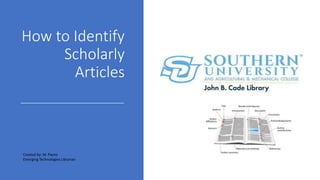
How to Identify
Scholarly
Articles
Created by: M. Payne
Emerging Technologies Librarian
Scholarly Articles
Most scholarly articles share a few specific traits that make them easy
to recognize, especially compared to popular articles. The following
description of a scholarly article is intended to be general, and may not
describe every scholarly article, but should help you become more
familiar with identifying them. Keep in mind that, aside from the
abstract and the list of references, the different sections described
below may or may not be clearly labeled in each article. Often this
varies by discipline. The sections in italics below are found almost
exclusively in articles based on primary research, usually from the
sciences or social sciences.
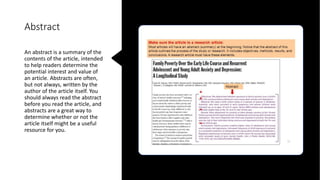
Abstract
An abstract is a summary of the
contents of the article, intended
to help readers determine the
potential interest and value of
an article. Abstracts are often,
but not always, written by the
author of the article itself. You
should always read the abstract
before you read the article, and
abstracts are a great way to
determine whether or not the
article itself might be a useful
resource for you.
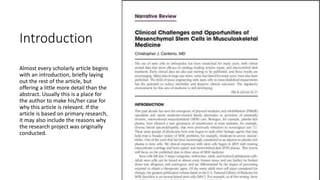
Introduction
Almost every scholarly article begins
with an introduction, briefly laying
out the rest of the article, but
offering a little more detail than the
abstract. Usually this is a place for
the author to make his/her case for
why this article is relevant. If the
article is based on primary research,
it may also include the reasons why
the research project was originally
conducted.
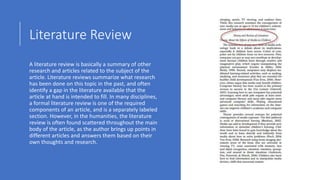
Literature Review
A literature review is basically a summary of other
research and articles related to the subject of the
article. Literature reviews summarize what research
has been done on this topic in the past, and often
identify a gap in the literature available that the
article at hand is intended to fill. In many disciplines,
a formal literature review is one of the required
components of an article, and is a separately labeled
section. However, in the humanities, the literature
review is often found scattered throughout the main
body of the article, as the author brings up points in
different articles and answers them based on their
own thoughts and research.
Methodology
Found in papers based on primary
research, this section describes the
methods used to conduct the
research. This allows other
researchers to evaluate the validity
of the methods used, and also shares
needed information if they wish to
conduct a similar study themselves.
Findings
This section is found in papers based on primary
research, and gives some of the raw data that
was obtained during the research process. This
section often contains graphs and tables, which
are supported by text describing the results
more clearly.
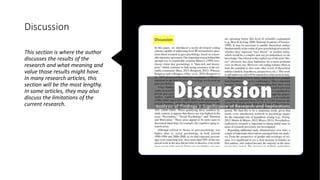
Discussion
This section is where the author
discusses the results of the
research and what meaning and
value those results might have.
In many research articles, this
section will be the most lengthy.
In some articles, they may also
discuss the limitations of the
current research.
Further Research
Many research articles include a call for others to contribute by
suggesting future research projects expanding on the research just
described. This might include similar studies conducted in different
environments for verification, or suggestions based on the limitations of
the previous research.
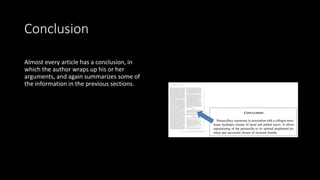
Conclusion
Almost every article has a conclusion, in
which the author wraps up his or her
arguments, and again summarizes some of
the information in the previous sections.
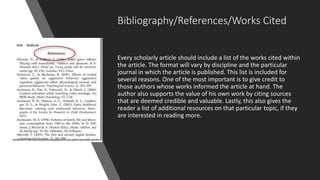
Bibliography/References/Works Cited
Every scholarly article should include a list of the works cited within
the article. The format will vary by discipline and the particular
journal in which the article is published. This list is included for
several reasons. One of the most important is to give credit to
those authors whose works informed the article at hand. The
author also supports the value of his own work by citing sources
that are deemed credible and valuable. Lastly, this also gives the
reader a list of additional resources on that particular topic, if they
are interested in reading more.

How to identify scholalry research articles

  • 1.
    How to Identify Scholarly Articles Createdby: M. Payne Emerging Technologies Librarian
  • 2.
    Scholarly Articles Most scholarlyarticles share a few specific traits that make them easy to recognize, especially compared to popular articles. The following description of a scholarly article is intended to be general, and may not describe every scholarly article, but should help you become more familiar with identifying them. Keep in mind that, aside from the abstract and the list of references, the different sections described below may or may not be clearly labeled in each article. Often this varies by discipline. The sections in italics below are found almost exclusively in articles based on primary research, usually from the sciences or social sciences.
  • 3.
    Abstract An abstract isa summary of the contents of the article, intended to help readers determine the potential interest and value of an article. Abstracts are often, but not always, written by the author of the article itself. You should always read the abstract before you read the article, and abstracts are a great way to determine whether or not the article itself might be a useful resource for you.
  • 4.
    Introduction Almost every scholarlyarticle begins with an introduction, briefly laying out the rest of the article, but offering a little more detail than the abstract. Usually this is a place for the author to make his/her case for why this article is relevant. If the article is based on primary research, it may also include the reasons why the research project was originally conducted.
  • 5.
    Literature Review A literaturereview is basically a summary of other research and articles related to the subject of the article. Literature reviews summarize what research has been done on this topic in the past, and often identify a gap in the literature available that the article at hand is intended to fill. In many disciplines, a formal literature review is one of the required components of an article, and is a separately labeled section. However, in the humanities, the literature review is often found scattered throughout the main body of the article, as the author brings up points in different articles and answers them based on their own thoughts and research.
  • 6.
    Methodology Found in papersbased on primary research, this section describes the methods used to conduct the research. This allows other researchers to evaluate the validity of the methods used, and also shares needed information if they wish to conduct a similar study themselves.
  • 7.
    Findings This section isfound in papers based on primary research, and gives some of the raw data that was obtained during the research process. This section often contains graphs and tables, which are supported by text describing the results more clearly.
  • 8.
    Discussion This section iswhere the author discusses the results of the research and what meaning and value those results might have. In many research articles, this section will be the most lengthy. In some articles, they may also discuss the limitations of the current research.
  • 9.
    Further Research Many researcharticles include a call for others to contribute by suggesting future research projects expanding on the research just described. This might include similar studies conducted in different environments for verification, or suggestions based on the limitations of the previous research.
  • 10.
    Conclusion Almost every articlehas a conclusion, in which the author wraps up his or her arguments, and again summarizes some of the information in the previous sections.
  • 11.
    Bibliography/References/Works Cited Every scholarlyarticle should include a list of the works cited within the article. The format will vary by discipline and the particular journal in which the article is published. This list is included for several reasons. One of the most important is to give credit to those authors whose works informed the article at hand. The author also supports the value of his own work by citing sources that are deemed credible and valuable. Lastly, this also gives the reader a list of additional resources on that particular topic, if they are interested in reading more.