What is Abstract?
Similar Synonyms
Abstract: Mostly used in “Scientific context”. Formal requirement for
publication, as the initial section of a scientific paper. Often times if you
find scientific papers online, it is just the abstract that is available.
Executive Summary shows up most often in a “Business Context”, or
sometimes also in a political context. (MBA)
Synopsis again could be exchanged directly for "summary" in most
contexts. It has a slightly more formal feel, and shows up in the
literature and the arts a bit more frequently than other contexts.
Overview is similar in literal meaning to "summary". It has a slight
informality to it.
What is Abstract?
Abstract summarizes a larger work. It is a brief summary of a research
paper, thesis, dissertation, etc. An abstract is typically found at the
beginning of a document and it acts as an introduction and review of
the whole document.
It may contain information about the background, purpose, results, and
contents of the work. An abstract typically contains four elements:
research focus, research methods, results, main conclusions and
recommendations.
most of the research articles available online are in the form of
abstracts, the readers can decide whether they want to purchase the
article by reading the abstract. Thus, it can be said that abstracts help
the readers to decide whether they should invest time and money in
reading the whole article.
Purpose of Abstract
The purpose of the summary is to give a brief overview of the
whole report. Although it is placed immediately after the title,
it is written last. It is not necessary to give detailed
information in the summary. It must be brief, the summary
should be written in complete sentences, not as notes.
Characteristics of Abstract
• It usually comes after the title page.
• It should be maximum of 1-2 pages.
• Summarize the problems you’re trying to solve.
• It is written last.
• It should be written in the complete sentence, not as notes.
• It doesn’t contain any photos.
• It should be followed by 7Cs.
Abstract types
There are basically two types of abstracts:
1) Descriptive/limited abstracts: Simply provides a description of the
content of the abstract (purpose, method, scope).
2) Informative abstracts: it contains the description of the content, but
it also contains the results, conclusions and the recommendations
of the author.
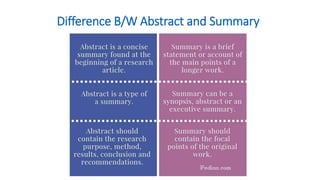
Difference B/W Abstract and Summary

Abstract or executive summary

  • 1.
  • 2.
    Similar Synonyms Abstract: Mostlyused in “Scientific context”. Formal requirement for publication, as the initial section of a scientific paper. Often times if you find scientific papers online, it is just the abstract that is available. Executive Summary shows up most often in a “Business Context”, or sometimes also in a political context. (MBA) Synopsis again could be exchanged directly for "summary" in most contexts. It has a slightly more formal feel, and shows up in the literature and the arts a bit more frequently than other contexts. Overview is similar in literal meaning to "summary". It has a slight informality to it.
  • 3.
    What is Abstract? Abstractsummarizes a larger work. It is a brief summary of a research paper, thesis, dissertation, etc. An abstract is typically found at the beginning of a document and it acts as an introduction and review of the whole document. It may contain information about the background, purpose, results, and contents of the work. An abstract typically contains four elements: research focus, research methods, results, main conclusions and recommendations. most of the research articles available online are in the form of abstracts, the readers can decide whether they want to purchase the article by reading the abstract. Thus, it can be said that abstracts help the readers to decide whether they should invest time and money in reading the whole article.
  • 4.
    Purpose of Abstract Thepurpose of the summary is to give a brief overview of the whole report. Although it is placed immediately after the title, it is written last. It is not necessary to give detailed information in the summary. It must be brief, the summary should be written in complete sentences, not as notes.
  • 5.
    Characteristics of Abstract •It usually comes after the title page. • It should be maximum of 1-2 pages. • Summarize the problems you’re trying to solve. • It is written last. • It should be written in the complete sentence, not as notes. • It doesn’t contain any photos. • It should be followed by 7Cs.
  • 6.
    Abstract types There arebasically two types of abstracts: 1) Descriptive/limited abstracts: Simply provides a description of the content of the abstract (purpose, method, scope). 2) Informative abstracts: it contains the description of the content, but it also contains the results, conclusions and the recommendations of the author.
  • 7.