ABSTRACTING
PRESENTED BY,
ANIT JOJI GEORGE
IIIrd SEM M. PHARM
DEPT. OF PHARMACEUTICS
RESEARCH METHODOLOGY & BIOSTATISTICS 1
ABSTRACT
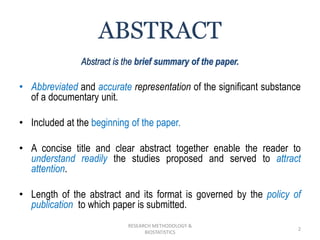
• Abbreviated and accurate representation of the significant substance
of a documentary unit.
• Included at the beginning of the paper.
• A concise title and clear abstract together enable the reader to
understand readily the studies proposed and served to attract
attention.
• Length of the abstract and its format is governed by the policy of
publication to which paper is submitted.
RESEARCH METHODOLOGY &
BIOSTATISTICS
2
RESEARCH ABSTRACT
• Communicate research findings and contributions to
the works of field studied.
• Preparation of abstract is done after completing the
research thesis or report.
• Two forms:
i. Abstarct provided in the main body of the research
report in the form of last chapter of thesis
ii. Prepared separately in booklet form
RESEARCH METHODOLOGY &
BIOSTATISTICS
3
TYPES OF ABSTRACT
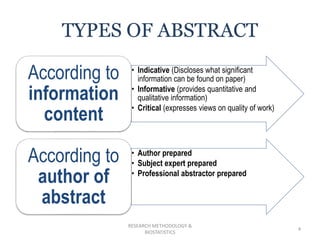
• Indicative (Discloses what significant
information can be found on paper)
• Informative (provides quantitative and
qualitative information)
• Critical (expresses views on quality of work)
According to
information
content
• Author prepared
• Subject expert prepared
• Professional abstractor prepared
According to
author of
abstract
RESEARCH METHODOLOGY &
BIOSTATISTICS
4
RESEARCH METHODOLOGY &
BIOSTATISTICS
5
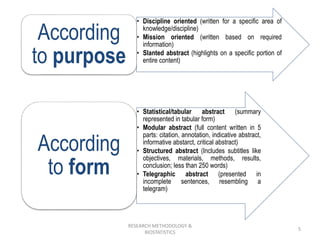
• Discipline oriented (written for a specific area of
knowledge/discipline)
• Mission oriented (written based on required
information)
• Slanted abstract (highlights on a specific portion of
entire content)
According
to purpose
• Statistical/tabular abstract (summary
represented in tabular form)
• Modular abstract (full content written in 5
parts: citation, annotation, indicative abstract,
informative abstarct, critical abstract)
• Structured abstract (Includes subtitles like
objectives, materials, methods, results,
conclusion; less than 250 words)
• Telegraphic abstract (presented in
incomplete sentences, resembling a
telegram)
According
to form
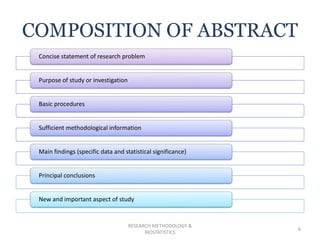
COMPOSITION OF ABSTRACT
Concise statement of research problem
Purpose of study or investigation
Basic procedures
Sufficient methodological information
Main findings (specific data and statistical significance)
Principal conclusions
New and important aspect of study
RESEARCH METHODOLOGY &
BIOSTATISTICS
6
CONSIDERATIONS IN ABSTRACT
WRITING
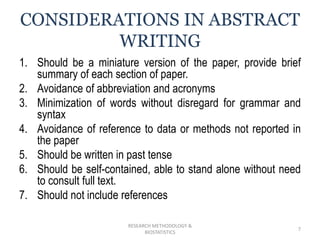
1. Should be a miniature version of the paper, provide brief
summary of each section of paper.
2. Avoidance of abbreviation and acronyms
3. Minimization of words without disregard for grammar and
syntax
4. Avoidance of reference to data or methods not reported in
the paper
5. Should be written in past tense
6. Should be self-contained, able to stand alone without need
to consult full text.
7. Should not include references
RESEARCH METHODOLOGY &
BIOSTATISTICS
7
NEED OF AN ABSTRACT
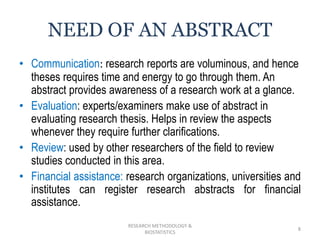
• Communication: research reports are voluminous, and hence
theses requires time and energy to go through them. An
abstract provides awareness of a research work at a glance.
• Evaluation: experts/examiners make use of abstract in
evaluating research thesis. Helps in review the aspects
whenever they require further clarifications.
• Review: used by other researchers of the field to review
studies conducted in this area.
• Financial assistance: research organizations, universities and
institutes can register research abstracts for financial
assistance.
RESEARCH METHODOLOGY &
BIOSTATISTICS
8
GOOD ABSTRACT
RESEARCH METHODOLOGY &
BIOSTATISTICS
9
• Simple and clear language
• Economical device to communicate contributions of research
work
• Avoid repetition of research studies
• Brings name of researcher in the field through significant
contributions
• Helps to review similar studies without the loss of energy and
time
• Provides basis for preparing research papers
• Help surmount language barrier
• Aid in preparing bibliographies
Yogesh Kumar, Singh. "Fundamentals of Research
Methodology and Statistics." (2019).
World Health Organization. A practical guide for
health researchers. 2004.
https://www.slideshare.net/sheilawebber/abstracting
RESEARCH METHODOLOGY &
BIOSTATISTICS
10
REFERENCES
RESEARCH METHODOLOGY &
BIOSTATISTICS
11

Abstracting

  • 1.
    ABSTRACTING PRESENTED BY, ANIT JOJIGEORGE IIIrd SEM M. PHARM DEPT. OF PHARMACEUTICS RESEARCH METHODOLOGY & BIOSTATISTICS 1
  • 2.
    ABSTRACT • Abbreviated andaccurate representation of the significant substance of a documentary unit. • Included at the beginning of the paper. • A concise title and clear abstract together enable the reader to understand readily the studies proposed and served to attract attention. • Length of the abstract and its format is governed by the policy of publication to which paper is submitted. RESEARCH METHODOLOGY & BIOSTATISTICS 2
  • 3.
    RESEARCH ABSTRACT • Communicateresearch findings and contributions to the works of field studied. • Preparation of abstract is done after completing the research thesis or report. • Two forms: i. Abstarct provided in the main body of the research report in the form of last chapter of thesis ii. Prepared separately in booklet form RESEARCH METHODOLOGY & BIOSTATISTICS 3
  • 4.
    TYPES OF ABSTRACT •Indicative (Discloses what significant information can be found on paper) • Informative (provides quantitative and qualitative information) • Critical (expresses views on quality of work) According to information content • Author prepared • Subject expert prepared • Professional abstractor prepared According to author of abstract RESEARCH METHODOLOGY & BIOSTATISTICS 4
  • 5.
    RESEARCH METHODOLOGY & BIOSTATISTICS 5 •Discipline oriented (written for a specific area of knowledge/discipline) • Mission oriented (written based on required information) • Slanted abstract (highlights on a specific portion of entire content) According to purpose • Statistical/tabular abstract (summary represented in tabular form) • Modular abstract (full content written in 5 parts: citation, annotation, indicative abstract, informative abstarct, critical abstract) • Structured abstract (Includes subtitles like objectives, materials, methods, results, conclusion; less than 250 words) • Telegraphic abstract (presented in incomplete sentences, resembling a telegram) According to form
  • 6.
    COMPOSITION OF ABSTRACT Concisestatement of research problem Purpose of study or investigation Basic procedures Sufficient methodological information Main findings (specific data and statistical significance) Principal conclusions New and important aspect of study RESEARCH METHODOLOGY & BIOSTATISTICS 6
  • 7.
    CONSIDERATIONS IN ABSTRACT WRITING 1.Should be a miniature version of the paper, provide brief summary of each section of paper. 2. Avoidance of abbreviation and acronyms 3. Minimization of words without disregard for grammar and syntax 4. Avoidance of reference to data or methods not reported in the paper 5. Should be written in past tense 6. Should be self-contained, able to stand alone without need to consult full text. 7. Should not include references RESEARCH METHODOLOGY & BIOSTATISTICS 7
  • 8.
    NEED OF ANABSTRACT • Communication: research reports are voluminous, and hence theses requires time and energy to go through them. An abstract provides awareness of a research work at a glance. • Evaluation: experts/examiners make use of abstract in evaluating research thesis. Helps in review the aspects whenever they require further clarifications. • Review: used by other researchers of the field to review studies conducted in this area. • Financial assistance: research organizations, universities and institutes can register research abstracts for financial assistance. RESEARCH METHODOLOGY & BIOSTATISTICS 8
  • 9.
    GOOD ABSTRACT RESEARCH METHODOLOGY& BIOSTATISTICS 9 • Simple and clear language • Economical device to communicate contributions of research work • Avoid repetition of research studies • Brings name of researcher in the field through significant contributions • Helps to review similar studies without the loss of energy and time • Provides basis for preparing research papers • Help surmount language barrier • Aid in preparing bibliographies
  • 10.
    Yogesh Kumar, Singh."Fundamentals of Research Methodology and Statistics." (2019). World Health Organization. A practical guide for health researchers. 2004. https://www.slideshare.net/sheilawebber/abstracting RESEARCH METHODOLOGY & BIOSTATISTICS 10 REFERENCES
  • 11.