IMRD & Other
Common Scholarly
Source Formats
What is IMRD?
01
In short, IMRD is a common scholarly
source format. It is most typically used in
the sciences or social sciences.
Becoming familiar with its format will
make it easier for you to critically read
and find the information most crucial for
your own research project.
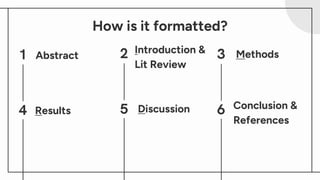
How is it formatted?
Abstract
Introduction &
Lit Review
Results Discussion
Methods
Conclusion &
References
1
4
2
5
3
6
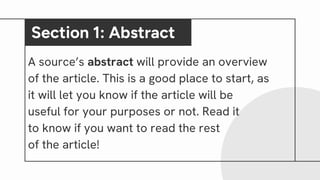
A source’s abstract will provide an overview
of the article. This is a good place to start, as
it will let you know if the article will be
useful for your purposes or not. Read it
to know if you want to read the rest
of the article!
Section 1: Abstract
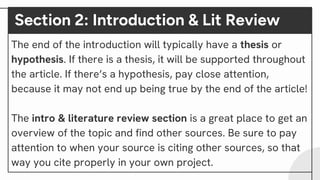
Section 2: Introduction & Lit Review
The end of the introduction will typically have a thesis or
hypothesis. If there is a thesis, it will be supported throughout
the article. If there’s a hypothesis, pay close attention,
because it may not end up being true by the end of the article!
The intro & literature review section is a great place to get an
overview of the topic and find other sources. Be sure to pay
attention to when your source is citing other sources, so that
way you cite properly in your own project.
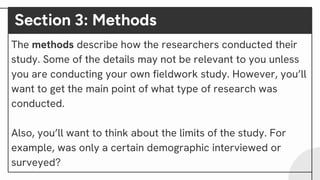
Section 3: Methods
The methods describe how the researchers conducted their
study. Some of the details may not be relevant to you unless
you are conducting your own fieldwork study. However, you’ll
want to get the main point of what type of research was
conducted.
Also, you’ll want to think about the limits of the study. For
example, was only a certain demographic interviewed or
surveyed?
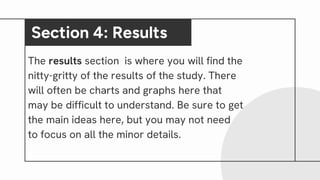
The results section is where you will find the
nitty-gritty of the results of the study. There
will often be charts and graphs here that
may be difficult to understand. Be sure to get
the main ideas here, but you may not need
to focus on all the minor details.
Section 4: Results
The discussion is where to focus the most
of your energy when reading an IMRD
formatted article. This section is where the
author tells you what the results mean and
why they are important. So, spend lots of
time going over this section.
Section 5: Discussion
Section 6: Conclusion & References
Some articles will have a separate conclusion. Some will
have it with the discussion. One thing to look for in the
conclusion is a suggestion for future research. This part can
help you justify your own research study in a proposal or
fieldwork paper.
The references section will show all of the sources used in
the article. Don’t forget to look for other useful sources on
the reference list or works cited page!
What are other
common formats
of scholarly
sources?
02
Arts and Humanities Articles
Within the Arts and Humanities, scholarly articles are set
up more like essays, rather than scientific experiments.
Because of this, there is typically not a standard format.
Many authors will often have their own unique headings to
split up their papers or articles.
This is because in the Humanities scholars are making
logical arguments based on evidence rather than
conducting experiments.
Arts and Humanities Articles, cont.
Despite this, the following sections are generally (but not
always) included in humanities scholarly articles:
● Abstract: brief summary, usually included
● Introduction: provides background and a thesis
“statement” that is typically longer than a sentence
● Discussion/Conclusion: runs through the entire article
and does not have a separate section like the science
● Works Cited: list of resources used by the author(s)
Academic books will typically cover one
topic in quite a bit of depth. They can be
useful if you’re looking to explore a specific
topic from different angles. Chapters
will often explore a specific aspect
of a larger topic.
Books / Book Chapters
Understanding
common source
formats can help you
navigate scholarly
sources with more
ease!

IMRD Slideshow- reading common scholarly source formats

  • 1.
    IMRD & Other CommonScholarly Source Formats
  • 2.
  • 3.
    In short, IMRDis a common scholarly source format. It is most typically used in the sciences or social sciences. Becoming familiar with its format will make it easier for you to critically read and find the information most crucial for your own research project.
  • 4.
    How is itformatted? Abstract Introduction & Lit Review Results Discussion Methods Conclusion & References 1 4 2 5 3 6
  • 5.
    A source’s abstractwill provide an overview of the article. This is a good place to start, as it will let you know if the article will be useful for your purposes or not. Read it to know if you want to read the rest of the article! Section 1: Abstract
  • 6.
    Section 2: Introduction& Lit Review The end of the introduction will typically have a thesis or hypothesis. If there is a thesis, it will be supported throughout the article. If there’s a hypothesis, pay close attention, because it may not end up being true by the end of the article! The intro & literature review section is a great place to get an overview of the topic and find other sources. Be sure to pay attention to when your source is citing other sources, so that way you cite properly in your own project.
  • 7.
    Section 3: Methods Themethods describe how the researchers conducted their study. Some of the details may not be relevant to you unless you are conducting your own fieldwork study. However, you’ll want to get the main point of what type of research was conducted. Also, you’ll want to think about the limits of the study. For example, was only a certain demographic interviewed or surveyed?
  • 8.
    The results sectionis where you will find the nitty-gritty of the results of the study. There will often be charts and graphs here that may be difficult to understand. Be sure to get the main ideas here, but you may not need to focus on all the minor details. Section 4: Results
  • 9.
    The discussion iswhere to focus the most of your energy when reading an IMRD formatted article. This section is where the author tells you what the results mean and why they are important. So, spend lots of time going over this section. Section 5: Discussion
  • 10.
    Section 6: Conclusion& References Some articles will have a separate conclusion. Some will have it with the discussion. One thing to look for in the conclusion is a suggestion for future research. This part can help you justify your own research study in a proposal or fieldwork paper. The references section will show all of the sources used in the article. Don’t forget to look for other useful sources on the reference list or works cited page!
  • 11.
    What are other commonformats of scholarly sources? 02
  • 12.
    Arts and HumanitiesArticles Within the Arts and Humanities, scholarly articles are set up more like essays, rather than scientific experiments. Because of this, there is typically not a standard format. Many authors will often have their own unique headings to split up their papers or articles. This is because in the Humanities scholars are making logical arguments based on evidence rather than conducting experiments.
  • 13.
    Arts and HumanitiesArticles, cont. Despite this, the following sections are generally (but not always) included in humanities scholarly articles: ● Abstract: brief summary, usually included ● Introduction: provides background and a thesis “statement” that is typically longer than a sentence ● Discussion/Conclusion: runs through the entire article and does not have a separate section like the science ● Works Cited: list of resources used by the author(s)
  • 14.
    Academic books willtypically cover one topic in quite a bit of depth. They can be useful if you’re looking to explore a specific topic from different angles. Chapters will often explore a specific aspect of a larger topic. Books / Book Chapters
  • 15.
    Understanding common source formats canhelp you navigate scholarly sources with more ease!