


Practical implications
of
thinking and acting differently
Doctor of Management (Ph.D) Mikkel H Brahm
Head of Architecture, Nordea | Digital Banking
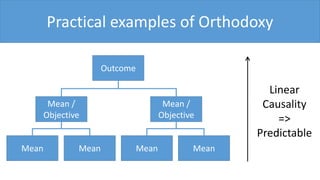
Practical examples of Orthodoxy
Outcome
Mean /
Objective
Mean /
Objective
Mean Mean MeanMean
Linear
Causality
=>
Predictable
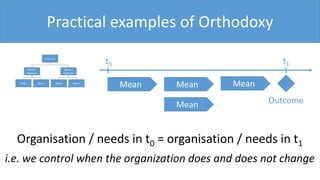
Practical examples of Orthodoxy
Mean Mean
Mean
Mean
Outcome
Organisation / needs in t0 = organisation / needs in t1
i.e. we control when the organization does and does not change
t0 t1
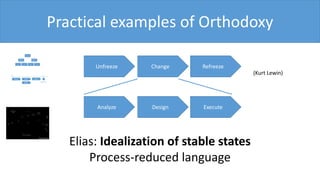
Practical examples of Orthodoxy
Elias: Idealization of stable states
Process-reduced language
Analyze Design Execute
Unfreeze Change Refreeze
(Kurt Lewin)
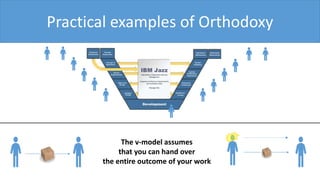
The v-model assumes
that you can hand over
the entire outcome of your work
Practical examples of Orthodoxy
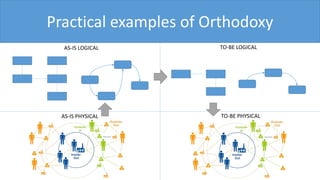
AS-IS LOGICAL
AS-IS PHYSICAL
TO-BE LOGICAL
TO-BE PHYSICAL
STRATEGY
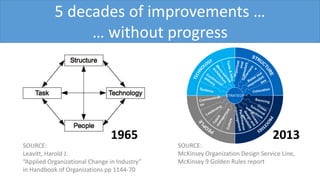
SOURCE:
McKinsey Organization Design Service Line,
McKinsey 9 Golden Rules report
2013
SOURCE:
Leavitt, Harold J.
“Applied Organizational Change in Industry”
in Handbook of Organizations pp 1144-70
1965
5 decades of improvements …
… without progress
Taking the attitude of the other is what allows us
to understand their perception of us – and allows us to “fit in”
Rather than pursuing an unattainable level of predictability,
why not improve instead our ability to observe and understand?
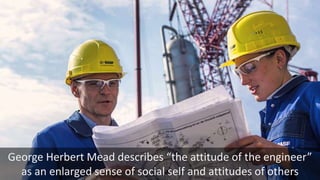
George Herbert Mead describes “the attitude of the engineer”
as an enlarged sense of social self and attitudes of others
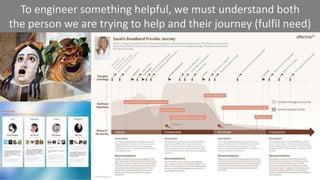
To engineer something helpful, we must understand both
the person we are trying to help and their journey (fulfil need)
Case: Agile@Nordea
How can we become “at our best” more of the time?
12
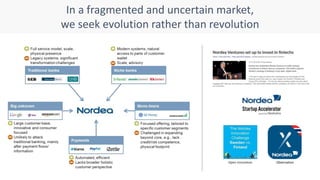
In a fragmented and uncertain market,
we seek evolution rather than revolution
Open innovation Observation
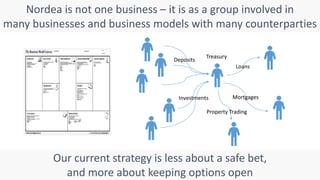
Deposits
Loans
Investments Mortgages
Property Trading
Treasury
Nordea is not one business – it is as a group involved in
many businesses and business models with many counterparties
Our current strategy is less about a safe bet,
and more about keeping options open
Collaboration is needed both between aspects of Architecture,
lines of Business, and between group, partitions & initiatives
Hub
Capability
Area
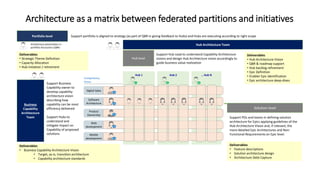
Architecture as a matrix between federated partitions and initiatives
Digital Sales
Software
Architecture
Product
Ownership
Mobile
development
Web
development
Competency
Areas
… Hub NHub 2Hub 1
CAL
CAL
CAL
CAL
CAL
HLHL
Hub Architecture Team
Business
Capability
Architecture
Team
Support Hub Lead to understand Capability Architecture
visions and design Hub Architecture vision accordingly to
guide business value realization
Support Business
Capability owner to
develop capability
architecture vision
describing how
capability can be most
efficiency delivered
Support Hubs to
understand and
mitigate impact on
Capability of proposed
solutions
HL
Deliverables
• Hub Architecture Vision
• QBR & roadmap support
• Hub backlog refinement
• Epic Definition
• Enabler Epic identification
• Epic architecture deep-dives
Deliverables
• Feature descriptions
• Solution architecture design
• Architecture Debt Capture
Deliverables
• Business Capability Architecture Vision
• Target, as-is, transition architecture
• Capability architecture standards
Solution level
Support POs and teams in defining solution
architecture for Epics applying guidelines of the
Hub Architecture Vision and, if relevant, the
more detailed Epic Architectures and Non-
Functional Requirements on Epic level.
Hub level
Portfolio level Support portfolio is aligned to strategy (as part of QBR in giving feedback to Hubs) and Hubs are executing according to right scope
Deliverables
• Strategic Theme Definition
• Capacity Allocation
• Hub initiation / retirement
Architecture presentation in
portfolio discussions (QBR)
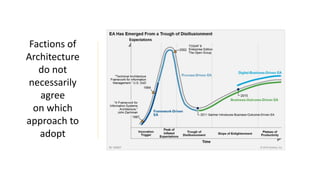
Factions of
Architecture
do not
necessarily
agree
on which
approach to
adopt
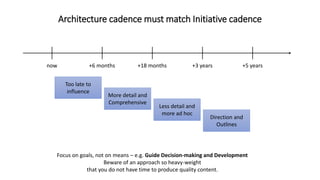
Architecture cadence must match Initiative cadence
now +6 months +18 months +3 years +5 years
Too late to
influence
More detail and
Comprehensive
Less detail and
more ad hoc
Direction and
Outlines
Focus on goals, not on means – e.g. Guide Decision-making and Development
Beware of an approach so heavy-weight
that you do not have time to produce quality content.
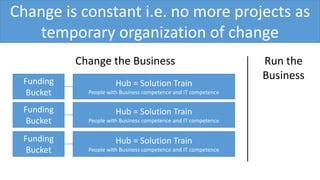
Change is constant i.e. no more projects as
temporary organization of change
Funding
Bucket
Run the
Business
Change the Business
Hub = Solution Train
People with Business competence and IT competence
Funding
Bucket
Hub = Solution Train
People with Business competence and IT competence
Funding
Bucket
Hub = Solution Train
People with Business competence and IT competence
App
BFF
Service
ESB
Service
Back
End
Supplier
Sector
Partner
App
Partner
Portal
end-to-endORG
end-to-end
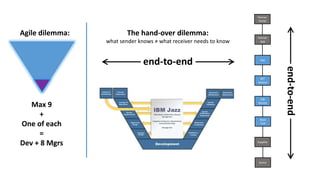
The hand-over dilemma:
what sender knows ≠ what receiver needs to know
Max 9
+
One of each
=
Dev + 8 Mgrs
Agile dilemma:
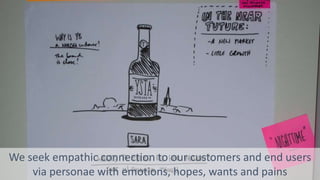
We seek empathic connection to our customers and end users
via personae with emotions, hopes, wants and pains
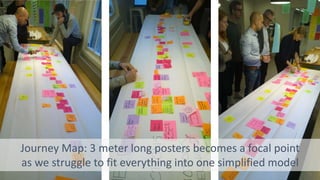
Journey Map: 3 meter long posters becomes a focal point
as we struggle to fit everything into one simplified model
Confidence vote: Teams express confidence
and commitment with 0-5 fingers raised
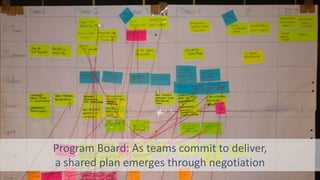
Program Board: As teams commit to deliver,
a shared plan emerges through negotiation
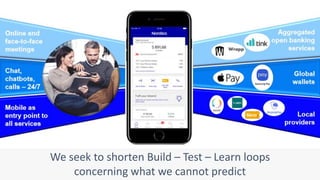
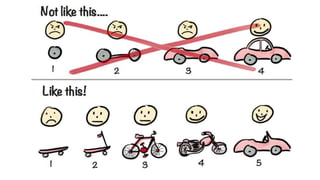
We seek to shorten Build – Test – Learn loops
concerning what we cannot predict
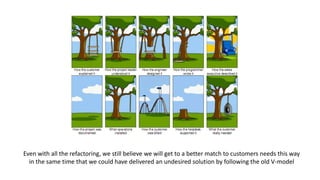
Even with all the refactoring, we still believe we will get to a better match to customers needs this way
in the same time that we could have delivered an undesired solution by following the old V-model
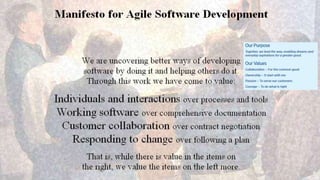
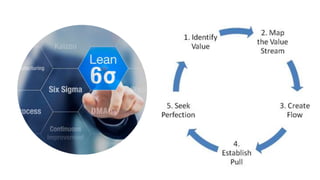
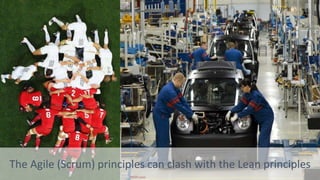
The Agile (Scrum) principles can clash with the Lean principles
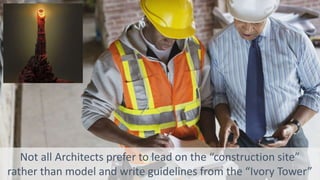
Not all Architects prefer to lead on the “construction site”
rather than model and write guidelines from the “Ivory Tower”
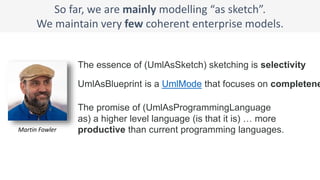
So far, we are mainly modelling “as sketch”.
We maintain very few coherent enterprise models.
UmlAsBlueprint is a UmlMode that focuses on completene
The essence of (UmlAsSketch) sketching is selectivity
The promise of (UmlAsProgrammingLanguage
as) a higher level language (is that it is) … more
productive than current programming languages.Martin Fowler
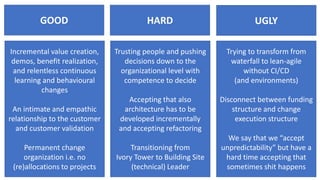
GOOD UGLYHARD
Incremental value creation,
demos, benefit realization,
and relentless continuous
learning and behavioural
changes
An intimate and empathic
relationship to the customer
and customer validation
Permanent change
organization i.e. no
(re)allocations to projects
Trusting people and pushing
decisions down to the
organizational level with
competence to decide
Accepting that also
architecture has to be
developed incrementally
and accepting refactoring
Transitioning from
Ivory Tower to Building Site
(technical) Leader
Trying to transform from
waterfall to lean-agile
without CI/CD
(and environments)
Disconnect between funding
structure and change
execution structure
We say that we “accept
unpredictability” but have a
hard time accepting that
sometimes shit happens
Summary
Different ways of thinking about change
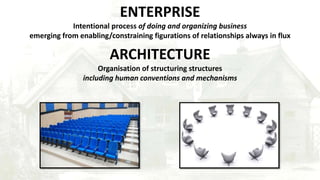
ENTERPRISE
Intentional process of doing and organizing business
emerging from enabling/constraining figurations of relationships always in flux
ARCHITECTURE
Organisation of structuring structures
including human conventions and mechanisms
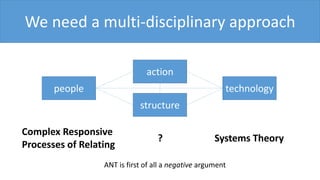
We need a multi-disciplinary approach
Complex Responsive
Processes of Relating
Systems Theory
people technology
action
structure
?
ANT is first of all a negative argument
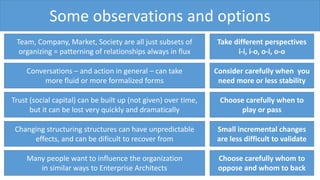
Take different perspectives
i-i, i-o, o-i, o-o
Team, Company, Market, Society are all just subsets of
organizing = patterning of relationships always in flux
Consider carefully when you
need more or less stability
Conversations – and action in general – can take
more fluid or more formalized forms
Choose carefully when to
play or pass
Trust (social capital) can be built up (not given) over time,
but it can be lost very quickly and dramatically
Small incremental changes
are less difficult to validate
Changing structuring structures can have unpredictable
effects, and can be dificult to recover from
Choose carefully whom to
oppose and whom to back
Many people want to influence the organization
in similar ways to Enterprise Architects
Some observations and options
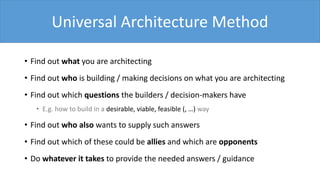
• Find out what you are architecting
• Find out who is building / making decisions on what you are architecting
• Find out which questions the builders / decision-makers have
• E.g. how to build in a desirable, viable, feasible (, …) way
• Find out who also wants to supply such answers
• Find out which of these could be allies and which are opponents
• Do whatever it takes to provide the needed answers / guidance
Universal Architecture Method
Stacey, Ralph D. and Mowles, Chris (2016).
Strategic management and Organisational Dynamics: The
Challenge of Complexity to Ways of Thinking About
Organisations. 7th ed. United Kingdom: Pearson Education.
Stacey, Ralph D (2012).
Tools & Techniques
of Leadership and Management.
Routledge.
Jackall, Robert (2010).
Moral Mazes –
The World of Corporate Managers.
Oxford University Press.
Scott, John C (1990).
Domination and the Arts of Resistance -
Hidden transcripts.
Yale University Press.
Elias, Norbert (1978).
What is Sociology?
Columbia University Press.
Elias, Norbert (1991).
The Society of Individuals.
Basil Blackwell.
Latour, Bruno (2005).
Reassembling the Social – An introduction
to Actor-Network-Theory.
Oxford University Press.
Mead, George Herbert (1934).
Mind, Self, & Society.
The University of Chicago Press.
Bourdieu, Pierre (1977)
Outline of a Theory of Practice.
Cambridge University Press
Scott, John C (1998).
Seeing like a State – How Certain Schemes to Improve
the Human Condition Have Failed.
Yale University Press.
Guenther, Milan (2013).
Intersection – How Enterprise Design bridges the gap
between Business, technology and People.
Elsevier.
Ries, Eric (2013).
The Lean Startup – How today’s Entrepreneurs use Continuous
Innovation to create radically successful Businesses.
Crown Business.

A complexity approach to managing technology enabled business transformation - part 2

  • 1.
    Practical implications of thinking andacting differently Doctor of Management (Ph.D) Mikkel H Brahm Head of Architecture, Nordea | Digital Banking
  • 2.
    Practical examples ofOrthodoxy Outcome Mean / Objective Mean / Objective Mean Mean MeanMean Linear Causality => Predictable
  • 3.
    Practical examples ofOrthodoxy Mean Mean Mean Mean Outcome Organisation / needs in t0 = organisation / needs in t1 i.e. we control when the organization does and does not change t0 t1
  • 4.
    Practical examples ofOrthodoxy Elias: Idealization of stable states Process-reduced language Analyze Design Execute Unfreeze Change Refreeze (Kurt Lewin)
  • 5.
    The v-model assumes thatyou can hand over the entire outcome of your work Practical examples of Orthodoxy
  • 6.
    Practical examples ofOrthodoxy AS-IS LOGICAL AS-IS PHYSICAL TO-BE LOGICAL TO-BE PHYSICAL
  • 7.
    STRATEGY SOURCE: McKinsey Organization DesignService Line, McKinsey 9 Golden Rules report 2013 SOURCE: Leavitt, Harold J. “Applied Organizational Change in Industry” in Handbook of Organizations pp 1144-70 1965 5 decades of improvements … … without progress
  • 8.
    Taking the attitudeof the other is what allows us to understand their perception of us – and allows us to “fit in” Rather than pursuing an unattainable level of predictability, why not improve instead our ability to observe and understand?
  • 9.
    George Herbert Meaddescribes “the attitude of the engineer” as an enlarged sense of social self and attitudes of others
  • 10.
    To engineer somethinghelpful, we must understand both the person we are trying to help and their journey (fulfil need)
  • 11.
    Case: Agile@Nordea How canwe become “at our best” more of the time?
  • 12.
  • 13.
    In a fragmentedand uncertain market, we seek evolution rather than revolution Open innovation Observation
  • 14.
    Deposits Loans Investments Mortgages Property Trading Treasury Nordeais not one business – it is as a group involved in many businesses and business models with many counterparties Our current strategy is less about a safe bet, and more about keeping options open
  • 17.
    Collaboration is neededboth between aspects of Architecture, lines of Business, and between group, partitions & initiatives Hub Capability Area
  • 18.
    Architecture as amatrix between federated partitions and initiatives Digital Sales Software Architecture Product Ownership Mobile development Web development Competency Areas … Hub NHub 2Hub 1 CAL CAL CAL CAL CAL HLHL Hub Architecture Team Business Capability Architecture Team Support Hub Lead to understand Capability Architecture visions and design Hub Architecture vision accordingly to guide business value realization Support Business Capability owner to develop capability architecture vision describing how capability can be most efficiency delivered Support Hubs to understand and mitigate impact on Capability of proposed solutions HL Deliverables • Hub Architecture Vision • QBR & roadmap support • Hub backlog refinement • Epic Definition • Enabler Epic identification • Epic architecture deep-dives Deliverables • Feature descriptions • Solution architecture design • Architecture Debt Capture Deliverables • Business Capability Architecture Vision • Target, as-is, transition architecture • Capability architecture standards Solution level Support POs and teams in defining solution architecture for Epics applying guidelines of the Hub Architecture Vision and, if relevant, the more detailed Epic Architectures and Non- Functional Requirements on Epic level. Hub level Portfolio level Support portfolio is aligned to strategy (as part of QBR in giving feedback to Hubs) and Hubs are executing according to right scope Deliverables • Strategic Theme Definition • Capacity Allocation • Hub initiation / retirement Architecture presentation in portfolio discussions (QBR)
  • 19.
  • 20.
    Architecture cadence mustmatch Initiative cadence now +6 months +18 months +3 years +5 years Too late to influence More detail and Comprehensive Less detail and more ad hoc Direction and Outlines Focus on goals, not on means – e.g. Guide Decision-making and Development Beware of an approach so heavy-weight that you do not have time to produce quality content.
  • 21.
    Change is constanti.e. no more projects as temporary organization of change Funding Bucket Run the Business Change the Business Hub = Solution Train People with Business competence and IT competence Funding Bucket Hub = Solution Train People with Business competence and IT competence Funding Bucket Hub = Solution Train People with Business competence and IT competence
  • 22.
    App BFF Service ESB Service Back End Supplier Sector Partner App Partner Portal end-to-endORG end-to-end The hand-over dilemma: whatsender knows ≠ what receiver needs to know Max 9 + One of each = Dev + 8 Mgrs Agile dilemma:
  • 23.
    We seek empathicconnection to our customers and end users via personae with emotions, hopes, wants and pains
  • 24.
    Journey Map: 3meter long posters becomes a focal point as we struggle to fit everything into one simplified model
  • 25.
    Confidence vote: Teamsexpress confidence and commitment with 0-5 fingers raised
  • 26.
    Program Board: Asteams commit to deliver, a shared plan emerges through negotiation
  • 27.
    We seek toshorten Build – Test – Learn loops concerning what we cannot predict
  • 29.
    Even with allthe refactoring, we still believe we will get to a better match to customers needs this way in the same time that we could have delivered an undesired solution by following the old V-model
  • 32.
    The Agile (Scrum)principles can clash with the Lean principles
  • 33.
    Not all Architectsprefer to lead on the “construction site” rather than model and write guidelines from the “Ivory Tower”
  • 34.
    So far, weare mainly modelling “as sketch”. We maintain very few coherent enterprise models. UmlAsBlueprint is a UmlMode that focuses on completene The essence of (UmlAsSketch) sketching is selectivity The promise of (UmlAsProgrammingLanguage as) a higher level language (is that it is) … more productive than current programming languages.Martin Fowler
  • 36.
    GOOD UGLYHARD Incremental valuecreation, demos, benefit realization, and relentless continuous learning and behavioural changes An intimate and empathic relationship to the customer and customer validation Permanent change organization i.e. no (re)allocations to projects Trusting people and pushing decisions down to the organizational level with competence to decide Accepting that also architecture has to be developed incrementally and accepting refactoring Transitioning from Ivory Tower to Building Site (technical) Leader Trying to transform from waterfall to lean-agile without CI/CD (and environments) Disconnect between funding structure and change execution structure We say that we “accept unpredictability” but have a hard time accepting that sometimes shit happens
  • 37.
    Summary Different ways ofthinking about change
  • 38.
    ENTERPRISE Intentional process ofdoing and organizing business emerging from enabling/constraining figurations of relationships always in flux ARCHITECTURE Organisation of structuring structures including human conventions and mechanisms
  • 39.
    We need amulti-disciplinary approach Complex Responsive Processes of Relating Systems Theory people technology action structure ? ANT is first of all a negative argument
  • 40.
    Take different perspectives i-i,i-o, o-i, o-o Team, Company, Market, Society are all just subsets of organizing = patterning of relationships always in flux Consider carefully when you need more or less stability Conversations – and action in general – can take more fluid or more formalized forms Choose carefully when to play or pass Trust (social capital) can be built up (not given) over time, but it can be lost very quickly and dramatically Small incremental changes are less difficult to validate Changing structuring structures can have unpredictable effects, and can be dificult to recover from Choose carefully whom to oppose and whom to back Many people want to influence the organization in similar ways to Enterprise Architects Some observations and options
  • 41.
    • Find outwhat you are architecting • Find out who is building / making decisions on what you are architecting • Find out which questions the builders / decision-makers have • E.g. how to build in a desirable, viable, feasible (, …) way • Find out who also wants to supply such answers • Find out which of these could be allies and which are opponents • Do whatever it takes to provide the needed answers / guidance Universal Architecture Method
  • 42.
    Stacey, Ralph D.and Mowles, Chris (2016). Strategic management and Organisational Dynamics: The Challenge of Complexity to Ways of Thinking About Organisations. 7th ed. United Kingdom: Pearson Education. Stacey, Ralph D (2012). Tools & Techniques of Leadership and Management. Routledge. Jackall, Robert (2010). Moral Mazes – The World of Corporate Managers. Oxford University Press. Scott, John C (1990). Domination and the Arts of Resistance - Hidden transcripts. Yale University Press. Elias, Norbert (1978). What is Sociology? Columbia University Press. Elias, Norbert (1991). The Society of Individuals. Basil Blackwell. Latour, Bruno (2005). Reassembling the Social – An introduction to Actor-Network-Theory. Oxford University Press. Mead, George Herbert (1934). Mind, Self, & Society. The University of Chicago Press. Bourdieu, Pierre (1977) Outline of a Theory of Practice. Cambridge University Press Scott, John C (1998). Seeing like a State – How Certain Schemes to Improve the Human Condition Have Failed. Yale University Press. Guenther, Milan (2013). Intersection – How Enterprise Design bridges the gap between Business, technology and People. Elsevier. Ries, Eric (2013). The Lean Startup – How today’s Entrepreneurs use Continuous Innovation to create radically successful Businesses. Crown Business.

Editor's Notes

  • #14 And the changing world is reflected in a more fragmented competitive picture. Whilst our competition was traditionally from other banks, technology has meant that other players are coming into the market, with this be online only banks or players adressing specific more transactional elements of our current business such as payments (mobile payments, peer to peer) and financing (for example crowd sourcing) What is interesting to note, is that players such as Facebook and telecompanies who are moving into the payments market, are leveraging established and loyal customer bases
  • #24 The role descriptions we ususally use as per TOGAF /ADM and BPMN only describes responsibility and accountability relative to action whereas we here try to understand emotions and needs and thus develop an empathic connection with our user/customer so that we might better anticipate how a user/customer might react to a given design in a given situation.
  • #25 The tangible artifact draws attention and shapes process. We quickly begin to resemble an ant trail picking up post-it’s from previous work artefacts and placing them on the emerging customer journey map. There seems to be a very low level of conflicts at this stage.
  • #26 The cleaned up artefact is brought to new meetings where we elaborate on the contents.
  • #27 The cleaned up artefact is brought to new meetings where we elaborate on the contents.