By: Rose Gordon
 DAWN OF A NEW ERA
◦ Purpose of Portfolio
◦ Taking the first step
 My learning Plan
◦ Goals
◦ Strategies to Accomplish Goals
◦ Self Correction
◦ My revised Learning Plan
◦ Strategies to accomplish my Goals
 Identifying Self in the Context of
Workplace (Unit 1)
◦ My Reflection
◦ My Profile as a Worker
◦ Preferred Perspective of Work
◦ Approach to Work
◦ Core Values
◦ Professional Goals Achieved
◦ Professional Goals to be achieved
◦ Characteristics
◦ Talents, Roles and responsibilities
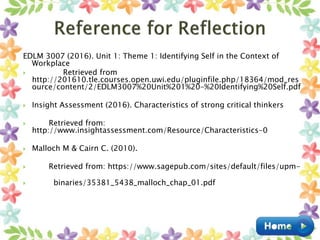
◦ Reference for Reflection
◦ Reflection Continued…
◦ Self Correction to Unit 1 Reflection
◦ Self correction on Unit One
 Change as the Challenge to Professional Stagnancy (Unit 2)
◦ Collaboration instead of individualism
◦ Meet My Team
◦ Our work space
◦ My contribution to team work
◦ Rational
◦ Areas to include in Proposal
◦ Dimensions for change that was left out
◦ Critique done by Rose & D’Nell to Andrea and Naidia
◦ My Reflection on completing Unit 2 activities
◦ References for Reflection
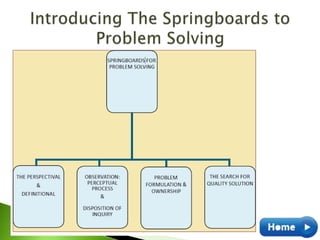
◦ Introducing The Springboards to Problem Solving
 Springboards for Problem Solving in Work Setting (Unit 3)
◦ Teams Make Things Happen
◦ Motto: Collaboration instead of individualism
◦ Unit 3 Reflection
◦ Reference
 Action Learning revealed (Unit 4)
◦ Action learning revealed
◦ My Reflection on Activity 4:1
◦ Activity 4:2
◦ Activity 4:3
◦ Action Learning Production
◦ My Reflection on Unit 4
◦ Reference
◦ A Glimpse at My Workplace
◦ Action Plan to Improve Workplace
◦ References
 My Development through Action Learning
◦ Introduction to My Story
◦ Conclusion
◦ Reference
The next phase to complete the transformation
process began in the work context EDLM 3007
located in the UWI open campus.
A set of objectives were given that would serve
as our measuring rod.
This aspect of the portfolio is to highlight the
experiences and insights that were gained
from being engaged in the course EDLM 3007.
It is also to serve as documentation of personal
and professional development.
This journey started in the work context EDLM
2008. It continued in the work context EDLM
3007. To get a glimpse of what the journey
was like at the beginning go to Part 1 here if
you so desire.
I was not sure were the road would lead but I
made every effort to complete my learning
plan. The developing of this plan was
important since it is an indication of my
planned approach towards learning. By
developing a learning plan, I will be able to
assess the areas in which I most want to
develop and the most effective methods to
acquire skills and improve performance even in
my workplace.
Continue Reading
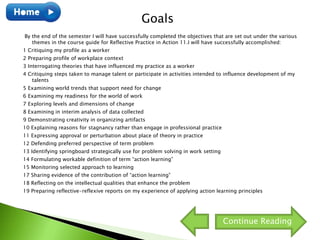
By the end of the semester I will have successfully completed the objectives that are set out under the various
themes in the course guide for Reflective Practice in Action 11.I will have successfully accomplished:
1 Critiquing my profile as a worker
2 Preparing profile of workplace context
3 Interrogating theories that have influenced my practice as a worker
4 Critiquing steps taken to manage talent or participate in activities intended to influence development of my
talents
5 Examining world trends that support need for change
6 Examining my readiness for the world of work
7 Exploring levels and dimensions of change
8 Examining in interim analysis of data collected
9 Demonstrating creativity in organizing artifacts
10 Explaining reasons for stagnancy rather than engage in professional practice
11 Expressing approval or perturbation about place of theory in practice
12 Defending preferred perspective of term problem
13 Identifying springboard strategically use for problem solving in work setting
14 Formulating workable definition of term “action learning”
15 Monitoring selected approach to learning
17 Sharing evidence of the contribution of “action learning”
18 Reflecting on the intellectual qualities that enhance the problem
19 Preparing reflective-reflexive reports on my experience of applying action learning principles
Goals
Continue Reading
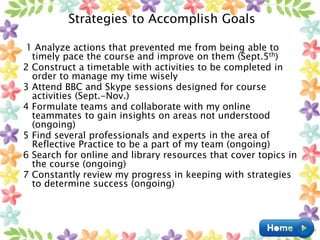
1 Analyze actions that prevented me from being able to
timely pace the course and improve on them (Sept.5th)
2 Construct a timetable with activities to be completed in
order to manage my time wisely
3 Attend BBC and Skype sessions designed for course
activities (Sept.-Nov.)
4 Formulate teams and collaborate with my online
teammates to gain insights on areas not understood
(ongoing)
5 Find several professionals and experts in the area of
Reflective Practice to be a part of my team (ongoing)
6 Search for online and library resources that cover topics in
the course (ongoing)
7 Constantly review my progress in keeping with strategies
to determine success (ongoing)
Strategies to Accomplish Goals
After feedback from the e-tutor I watched the
required videos and restructured my learning
plan.
As leaders/teachers it is important that we
guard against taking meaning of terms for
granted.
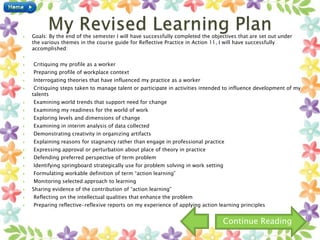
 Goals: By the end of the semester I will have successfully completed the objectives that are set out under
the various themes in the course guide for Reflective Practice in Action 11, I will have successfully
accomplished:

 Critiquing my profile as a worker
 Preparing profile of workplace context
 Interrogating theories that have influenced my practice as a worker
 Critiquing steps taken to manage talent or participate in activities intended to influence development of my
talents
 Examining world trends that support need for change
 Examining my readiness for the world of work
 Exploring levels and dimensions of change
 Examining in interim analysis of data collected
 Demonstrating creativity in organizing artifacts
 Explaining reasons for stagnancy rather than engage in professional practice
 Expressing approval or perturbation about place of theory in practice
 Defending preferred perspective of term problem
 Identifying springboard strategically use for problem solving in work setting
 Formulating workable definition of term “action learning”
 Monitoring selected approach to learning
 Sharing evidence of the contribution of “action learning”
 Reflecting on the intellectual qualities that enhance the problem
 Preparing reflective-reflexive reports on my experience of applying action learning principles
Continue Reading
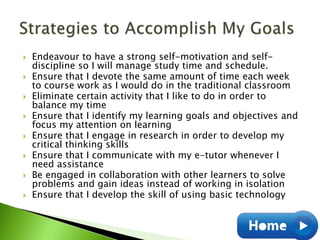
 Endeavour to have a strong self-motivation and self-
discipline so I will manage study time and schedule.
 Ensure that I devote the same amount of time each week
to course work as I would do in the traditional classroom
 Eliminate certain activity that I like to do in order to
balance my time
 Ensure that I identify my learning goals and objectives and
focus my attention on learning
 Ensure that I engage in research in order to develop my
critical thinking skills
 Ensure that I communicate with my e-tutor whenever I
need assistance
 Be engaged in collaboration with other learners to solve
problems and gain ideas instead of working in isolation
 Ensure that I develop the skill of using basic technology
Unit 1
Continue Reading
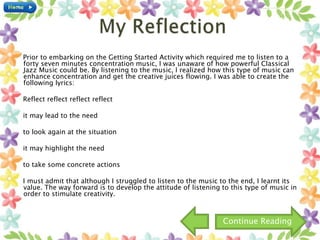
Prior to embarking on the Getting Started Activity which required me to listen to a
forty seven minutes concentration music, I was unaware of how powerful Classical
Jazz Music could be. By listening to the music, I realized how this type of music can
enhance concentration and get the creative juices flowing. I was able to create the
following lyrics:
Reflect reflect reflect reflect
it may lead to the need
to look again at the situation
it may highlight the need
to take some concrete actions
I must admit that although I struggled to listen to the music to the end, I learnt its
value. The way forward is to develop the attitude of listening to this type of music in
order to stimulate creativity.
Continue Reading
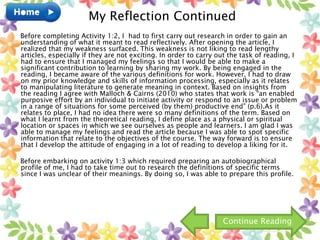
Before completing Activity 1:2, I had to first carry out research in order to gain an
understanding of what it meant to read reflectively. After opening the article, I
realized that my weakness surfaced. This weakness is not liking to read lengthy
articles, especially if they are not exciting. In order to carry out the task of reading, I
had to ensure that I managed my feelings so that I would be able to make a
significant contribution to learning by sharing my work. By being engaged in the
reading, I became aware of the various definitions for work. However, I had to draw
on my prior knowledge and skills of information processing, especially as it relates
to manipulating literature to generate meaning in context. Based on insights from
the reading I agree with Malloch & Cairns (2010) who states that work is “an enabled
purposive effort by an individual to initiate activity or respond to an issue or problem
in a range of situations for some perceived (by them) productive end” (p.6).As it
relates to place, I had no idea there were so many definitions of the term. Based on
what I learnt from the theoretical reading, I define place as a physical or spiritual
location or spaces in which we see ourselves as people and learners. I am glad I was
able to manage my feelings and read the article because I was able to spot specific
information that relate to the objectives of the course. The way forward is to ensure
that I develop the attitude of engaging in a lot of reading to develop a liking for it.
Before embarking on activity 1:3 which required preparing an autobiographical
profile of me, I had to take time out to research the definitions of specific terms
since I was unclear of their meanings. By doing so, I was able to prepare this profile.
My Reflection Continued
Continue Reading
 Preferred Perspective of Work
 Approach to Work
 Core Values
 Professional Goals Achieved
Continue Reading
Work is an enabled purposive effort by an
individual to initiate activity or respond to an
issue or problem in a range of situations for
some perceived (by them) productive end.
Continue Reading
 Display a positive attitude towards others and
work interdependently both towards personal
and professional goals.
 Collaborate with others and use my talent and
experience to contribute to the goals of my
school.
 Demonstrate willingness to take cues from others
(even students) as it relates to how my behaviour
impacts them and make the necessary changes
even if it means to up-end traditions.
 Demonstrate willingness to put values into
practice and welcomes unexpected detours.
Approach to Work
Continue Reading
 Perseverance, nurturing, objective, integrity,
honesty, gallant, equality, ethical, excellence,
diligence, discovery, challenge, action
oriented, collaboration, accountability,
commitment, balance, community.
Core Values
Continue Reading
 To work in the education sector, have an
important experience job in teaching and a
permanent job in this area.
 To participate actively in my school and to
work with others in the development of my
abilities, attitudes, leadership and initiative.
 To qualify for a prestigious school in order to
implement my experience of many years in
education
 To use my skills for doing best in the
organization that chooses me as its employee
Professional Goals Achieved
Continue Reading
 Looking for a challenging position that would
allow me to apply my educational knowledge in
different areas.
 To develop within my organization, apply
knowledge gained to develop professionally,
getting better every day and make the right
decisions to accomplish goals and succeed.
 To develop myself personally and professionally
in areas where I can apply my up-to-date
knowledge and experience.
 To take the opportunities presented, overcoming
the challenges imposed on me in order to
achieve personal growth and dedicate myself
professionally.
Professional Goals to be achieved
Continue Reading
 Open mindedness, honesty, concern to
become and remain well-informed,
willingness to reconsider and revise views
where honest reflections suggest that
change is wanted, teachable , love to learn,
believe investment in learning is worthwhile,
humble and self aware of limits and needs,
ambitious, action-oriented , hardworking,
display leadership autonomous.
Characteristics
Continue Reading
 Leadership, ability to handle change, writing,
creativity, self management, imaginative,
storytelling, communication skills, empathy,
humour.
 Supervisor, coach and educator, decision
maker, coordinator/chairperson.
Talents, Roles and Responsibilities
Continue Reading
 Activity 1.4 allowed me to apply what I learned in the previous courses
about meaning-making and operational definitions. Using this previous
knowledge I was able to come up with key words such as movement
towards a goal, advancement, growth, continuous improvement,
development, from a dictionary definition of the word progress. After
assessing other standpoints, I expanded the definition to mean, a
movement towards a goal through continuously keeping formal skills up
to date and accepting challenging assignments and taking responsibility
for educating oneself to acquire knowledge and skills along with
social/emotional development. By comparing my definition with that of
the specified chapter, I found that we differ because the writer sees
progress as not only benefiting you as the individual but a larger portion
of people. Therefore, I redefine progress to mean movement towards a
goal through modernization and expansion to continuously expand
knowledge, skills and accepting challenging assignment in order to
bring about improvement in the wellbeing of oneself and the population.
In light of this definition is to ensure that I assist those in my workplace
so that it can be a progressive one.
Reflection Continues…
EDLM 3007 (2016). Unit 1: Theme 1: Identifying Self in the Context of
Workplace
 Retrieved from
http://201610.tle.courses.open.uwi.edu/pluginfile.php/18364/mod_res
ource/content/2/EDLM3007%20Unit%201%20-%20Identifying%20Self.pdf
 Insight Assessment (2016). Characteristics of strong critical thinkers
 Retrieved from:
http://www.insightassessment.com/Resource/Characteristics-0
 Malloch M & Cairn C. (2010).
 Retrieved from: https://www.sagepub.com/sites/default/files/upm-
 binaries/35381_5438_malloch_chap_01.pdf
Based on feedback from e-tutor regarding our
approach to unit 1 activities, I self corrected
Continue Reading
 I ensured that I completed the remaining activities
before the designated time that the group decided to
meet. The team met and I was asked to critique activity
1:4.I read the activity and assessed it requirements. I
conducted research to gain different meanings on the
word progressive. I found that all the definitions
emphasized key words such as growth and development. I
proceeded to read the related course material to the
activity and made the necessary comments. Afterwards the
group met and we had discussions on all that was done. It
was at this point it dawned on me that I could have used
the approach of finding multiple meanings while I was
completing the activity on my own. To be progressive we
have to develop the attitude of researching multiple
perspectives on topics as a means of helping us to develop
working definitions.
Continue Reading
 During the discussions, I reflected on my
profile as a worker and realized the
importance of ensuring that I adopt
characteristics that depict the spaceship
culture to fit the changing society. I also
questioned myself as it relates to my
approach to work as to whether I
demonstrated willingness to put values into
practice and well known unexpected detours.
Continue Reading
 It dawned on me that there is more to be done in this
area. I now understand that work based experiences
can allow me critique my profile as a worker because
I can assess my behaviour against what I learned and
gain more understanding about myself. Through this
experience I will be able to assess myself to realize
how flexible and adaptable I am, than before, to keep
up with the rapid changes taking place in the world of
work. Also, I can use it as a medium to assess my
workplace to see if it is progressive based on
information gained about a progressive work
setting. In addition, it can be used as a medium to
question the theories I have been using to guide my
practice.
Continue Reading
 Listening to my group members share their insights from
doing activities 1:5 and 1:6 and comparing it to what I had
done, allowed me to fully realize that it is the action and
behaviours of those in the work setting that influence how
progressive it will be. My assessment of the workplace
depicted in activity 1:5 showed that it is the action of the
individuals that allows for the work setting to look
unproductive and non progressive. It dawned on me
that I should assess the steps that I have taken to
participate in activities that are intended to influence the
development of my work setting. An assessment revealed
my weaknesses, therefore, I must take the necessary
actions to improve these. I have to ensure that I help to
contribute to making my workplace one where there is a
level of trust and people feel valued and highly engaged.
Continue Reading
 As the discussion continued, it dawned on me how
important it was to complete all activities. If I had not
gone back to complete activity 1:7, I would lack knowledge
of the theories that we can as teachers / leaders apply to
situations in order to gain in depth knowledge. From the
discussion, I was made aware of the importance of
applying the relevant theories to assess a situation. As
teachers / leaders we have to ensure that we use the
correct theory that is applicable to the situation. As we
delve into these theories, I gave thought to the need for
me to engage in a lot more reading and exploring in order
to be informed about the various theories that exists. I
realize that that I need to take time out to engage in more
research in order to have a wide scope of knowledge.
Unit 2
Continue Reading
 As we move to complete unit 2 activities the
mystery began to unfold. A team approach
was required to complete the activities. Here
we had to change our approach and start
working as a team to achieve the objectives
set out in the unit.
Continue Reading
Continue Reading
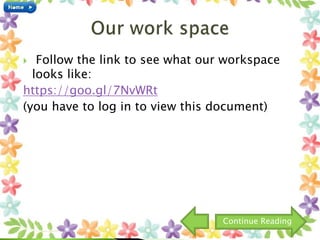
 Follow the link to see what our workspace
looks like:
https://goo.gl/7NvWRt
(you have to log in to view this document)
Continue Reading
 Activity 2.3 (Rose and D’nell)
Change management for technology
Justification of the need for change
In order to develop the proposal we had to
first create a rational which includes justification
for the need of change. Although we had prior
knowledge on dimensions for change from
previous courses, research had to be conducted to
gain information on Dimensions for change.
Continue Reading
In our rapidly changing society, we need to adapt to change and even take initiative
to seek ways to change which would improve the organization on a whole. Due to
globalization, our world has been transformed and has brought about changes in all
walks of life. Forces such as technology, globalization, education reform and
competition cannot be ignored. Thus, it is necessary to implement use of ICT in our
schools as a means of revolutionizing teaching and learning. According to a study
conducted by The National Science Foundation in California, it validates that teaching
people how to be competent users of ICT is important so that they can be successful
in their academic and work careers and effectively participate in the modern
technological society. It was also mentioned that in the 21st century the ability to
work with ICT is becoming essential to education, life and success. Also, the article
stated that 82% of the respondents agreed that ITC should be considered as a basic
skill in the educational system. In our schools over 45% of the students are learning
below average and the teachers are unwilling to change their teaching styles to
accommodate the students and ensure that the curriculum is being efficiently
delivered. In addition, the course of study educational leadership and management
has opened our awareness to the benefits of ICT mediated instruction and the
importance of using the constructivist approach to teaching. it has also allowed us to
realise that as professionals we should be ready to implement changes in this ever
changing society.
Continue Reading
Outline of strategic approaches to change - that will include strategies that
will be used- the most effective one being educative strategy
Should outline the responsibilities that as the leader will have in managing
the change example, communicating the change, leading the change,
creating the appropriate climate for change, conducting actions and
setting and agenda
Give an outline of the aspect of the organization that will be affected e.g.
teachers, students, Ministry of Education
Outline the impact of change on individuals; emotionally, intellectually,
socially, technologically and psychologically
Continue Reading
After using the instrument: Dimension for Change
provided it was noted that the dimension left out was
sociological which includes values, norms and cultural
practices that impact the change process.
Changes to be made
Sociological will now be included as a dimension for
change.
Continue Reading
 From the completed activity, it is clear that there was a misunderstanding in
meaning of what was required. Based on what was explained in the unit, a deeper
reflection for action to ascertain what should be done in activity is essential.
 The first part required individuals to consider the groups of stakeholders that
contribute to a profession, career or work situation. The word stakeholder was
misinterpreted. A stakeholders is a person with an interest or concern in
something. In the context it is used it focuses on an individual. And so, hospital
should not have been included as a group of stakeholders.
 The second part of the question required individuals to find out the conceptual
knowledge, disposition and skills that each group of stakeholder requires in order
to function effectively. Although the table gave some information in that regard,
separate columns could have been included to give a clearer understanding of how
each is required to function effectively. Is asked for knowledge that doctors
should have. What knowledge have to relate to work setting
 It is therefore important to identify the key terms and get and understanding as it
relates to how they were used in the context. According to the unit it is important
to self assess, which includes, identifying key terms, clarifying terms or concepts,
re-reading the task to ensure understanding in light of terms clarified and
engaging in task analysis. These will ensure that task is completed well. As
reflective practitioner, reflection before, during and after task is essential to for
successful completion.
My group indicated that I should work with Dnell to
complete activity 2:3.Dnell and I met via Skype and did a
task analysis to ensure we understood what was required of
us. We also did research in order to gain an understanding
of what a proposal was and the dimensions of change. While
brainstorming to see what area we could use as a means of
justification for change, we realized that teachers in our
respective schools needed to become users of technology in
order to keep with world trends. In the 21st century, the
ability to work with ICT is becoming essential to education,
life and workplace success. The areas highlighted by the
world trend clock cannot be ignored, thus we saw it
necessary to develop a proposal that seeks to implement
the use of ICT mediated instruction in our schools.
Continue Reading
After completing the task, we sent it to the Google Document that
was created, to be critiqued by the designated group member. Our
task was to critique activity 2:4 which was done by Andrea and
Naida. We met again via Skype, did an analysis of the activity to
ensure we understood what was required. We carried out research
in order to gain a full understanding of words such as stakeholder,
knowledge, skills and disposition. We also wanted to ensure that
we did not take the meaning of these words for granted.
Understanding the meaning of words is important especially if we
are required to formulate working definitions for them. By
critiquing this activity, I was able to become aware of the
knowledge, skills and dispositions that I need as a teacher to
function in an environment where the world of work is changing
rapidly. I am now cognizant of the fact that lifelong learning has to
be a choice and knowledge, skills and dispositions need to be a
habit that is maintained over time rather than a college
degree(Brooks,2014).We read the related course material for
activity 2:4,prepared the feedback, then rejoined the group.
Continue Reading
 At this point we had discussions on all the four activities that were done
and the feedback given based on the course material. I ensured that I
did some recording as a means of evidence that I participated . I took
time out to make the necessary adjustments to the activity I did based
on insights from course material. From the discussions, I learnt the
importance of guarding against professional stagnancy. I also learnt the
importance of giving serious attention to each area that the global trend
clock highlights. My awareness was opened to the fact that I can use
these areas as a basis for ensuring that I become a life wide learner who
is open to change (EDLM Unit 2, p.36).I was made to realize that by
integrating principles from theories about change, research,
professionalism and critical thinking will allow me to provide high
quality work. In addition, I learnt that my beliefs, customary practices
and attitude towards research are indicators of the kind of research
culture I am likely to influence as a leader/worker/learner (EDLM 3007,
unit 2, p.47).The way forward is to ensure that I make every effort to
adopt the correct dispositions, skills and knowledge that will enable me
to become an effective worker within my work context.
Continue Reading
Brooks, B. (2014).15 career trends every young
professional should understand
Retrieved from www.barretbrooks.com/top-
trends-world-work-every-youngprofesssional-
should-understand/
EDLM 3007 Unit 2-Change as the challenge to
professional stagnancy
Retrieved from
2016.tle.course.open.uwi.edu/pluginfile-
php/18374/mod_resource/content/2EDLM3007%2
0units%202%20%20change%20as%20the%20challen
ge.pdf
Unit 3
As I move into this unit the mystery unfolded. It was
evident that there had to be a change in the way I
approach problem solving in my workplace. There should
be a structured approach to problem solving than a
haphazard one. Hence, the springboards highlighted
above allow for a structured approach.
 As I worked with my online team members I
realize the values of using a team approach
to problem solving. Although there were
some bumps at this point I did not give up. I
hang in there with my team and used my
talent of being able to motivate others to
keep members going. As a result we were
able to complete our task that required using
the springboards for for problem solving.
Continue Reading
 Our group New
Dimension
Reflective
Practitioner, which
emerged out of the
wider EDLM 3007
work context
presented Phase
three of the
Collaborative Task
Great things can be
achieved from team
work
I agree that learners are aware of the
springboards they use to influence their
choice of solution for problems and whether
or not these are appropriate. The course
EDLM 3007 has raised this consciousness as
far as I am concern.
Continue Reading
As a learner in the EDLM 3007 work context, my interaction
with the various activities in unit three done by my team has
opened my awareness to these springboards that I can use
to influence my choice of solution for problems and whether
or not they are appropriate. I have been made cognizant of
these through having to engage in research while reading
the unit. From the discussions and validating of work done
by each team member on these activities, I have been made
cognizant of the fact that observation along with conversing
with others and reflection are essential to arrive at a
conclusion that a problem exists. The insights gained from
activity 3: 1 allowed me to fully realize that observation is an
essential method of data collection. My knowledge as it
relates to the different methods of observation has been
increased as such that my personal agenda is to make use of
these when embarking on action research.
Continue Reading
In addition, these activities have increased my capability as such that I will
now ensure that I examine the role that my perception plays in my decision
as I endeavour to identify a problem in order to move to solution. They
also suggest to me that these springboards are appropriate because they
allow for a systematic approach to problem solving and are more effective
than using a haphazard approach. Good problem solving is skills are
fundamentally important if I am going to be successful in my career. To be
an effective problem-solver I need to be systematic and logical in my
approach (Mind tools, 2016).Moreover, I fully understand that each stage
of the springboard is relevant as they allow for a more structured approach
to problem solving. By spending some time defining the problem will not
only allow for understanding it more clearly but also allows for
communicating its nature to others. The structuring period allows for the
gaining of more information about the problem and increase
understanding of it. This stage allows for fact finding and analysis,
building a more complete picture of both the goals and barriers. This stage
is essential for problems of more intricate nature. The stage of looking for
possible solutions allows for brainstorming to create a range of possible
course of action (Skills you need, 2011).
Continue Reading
Activity 3:4 stands out in my mind because it has increased
my alertness. This is so because I have been enlightened
about the techniques that can influence my choice of a
solution to a problem that I have formulated. The three that
stand out most in my mind are brainstorming, drilldown and
the fishbone diagram. I will endeavour to use the drill down
especially during my practice, since it will allow me to
understand the root causes of problems that hold up my
organization (GeekPRENUER, 2016). By being engaged in the
process of reading through the unit in order to understand
the springboards for problem solving allowed for me to
become even more aware of these springboards that we can
use to influence our choice of solving problems and whether
or not they are appropriate. This course has certainly helped
in opening my awareness and debunked certain perceptions
I had.
EDLM 3007, Unit 3 Springboards for Problem Solving in the Work
Setting
Retrieved from
http://201610.tle.courses.open.uwi.edu/pluginfile.php/18380/
mod_resource/content/2/EDLM3007%20Unit%203%20-
%20Springboards%20for%20Problem%20Solving%20%281%29.pdf
Mind tools, (2016). How good is your problem solving?
Retrieved from
https://www.mindtools.com/pages/article/newTMC_72htm
Skills you need (2011). Problem solving
Retrieved from
http://www.skillsyouneed.com/ips/problem-solving.htm/
Unit 4
Development through Action Learning
 According to Mc Gill and Brockbank(n.d), “Action
learning is a continuous process of learning and
reflection with the support of group colleagues,
working on real issues” (para.1).
 It was at this time I realize what was at the end of
this journey. The mystery unfolded and action
learning was revealed. As I move towards this
milestone, I had to test myself to see if I was
developing or stagnant. As I embarked upon
completing the activities the answer came to me.
Action learning is the way to go to keep with
world trends and to guard against stagnancy.
Continue Reading
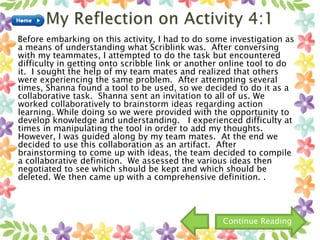
Before embarking on this activity, I had to do some investigation as
a means of understanding what Scriblink was. After conversing
with my teammates, I attempted to do the task but encountered
difficulty in getting onto scribble link or another online tool to do
it. I sought the help of my team mates and realized that others
were experiencing the same problem. After attempting several
times, Shanna found a tool to be used, so we decided to do it as a
collaborative task. Shanna sent an invitation to all of us. We
worked collaboratively to brainstorm ideas regarding action
learning. While doing so we were provided with the opportunity to
develop knowledge and understanding. I experienced difficulty at
times in manipulating the tool in order to add my thoughts.
However, I was guided along by my team mates. At the end we
decided to use this collaboration as an artifact. After
brainstorming to come up with ideas, the team decided to compile
a collaborative definition. We assessed the various ideas then
negotiated to see which should be kept and which should be
deleted. We then came up with a comprehensive definition. .
Continue Reading
Continue Reading
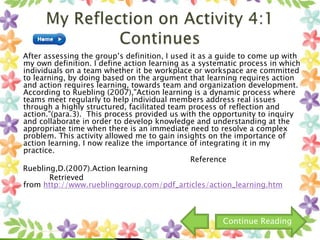
After assessing the group’s definition, I used it as a guide to come up with
my own definition. I define action learning as a systematic process in which
individuals on a team whether it be workplace or workspace are committed
to learning, by doing based on the argument that learning requires action
and action requires learning, towards team and organization development.
According to Ruebling (2007),"Action learning is a dynamic process where
teams meet regularly to help individual members address real issues
through a highly structured, facilitated team process of reflection and
action."(para.3). This process provided us with the opportunity to inquiry
and collaborate in order to develop knowledge and understanding at the
appropriate time when there is an immediate need to resolve a complex
problem. This activity allowed me to gain insights on the importance of
action learning. I now realize the importance of integrating it in my
practice.
Reference
Ruebling,D.(2007).Action learning
Retrieved
from http://www.rueblinggroup.com/pdf_articles/action_learning.htm
Continue Reading
 Before embarking on this activity, I had to delve deeply into the readings on
action research as action learning in order to identify the action learning principles
that are made use of during my approach to problem solving using action
research. The approach of conversing with members of staff, after careful
observation, to identify the problem that would be my action research topic and to
decide what the intervention should be like, demonstrates the use of action
learning principles.
 By taking on the task to implement a programme of parent education, using
teach the parent sessions, to bring about change in parents attitude and
behaviours, as it relates to their involvement in the activities of the school,
demonstrates a process where learning will be drawn from experience. The
learning from experience will also take place for the members of staff as they will
learn that teachers and parents have a shared responsibility in the education
process. This learning from experience shows the use of action learning principles
during my approach to problem solving using action research. Both action
research and action learning are about learning from experience (Dick, 2000).
 By deciding to become a participatory researcher and implement an
intervention programme, as a means of helping parents to change themselves, as
it relates to their participation in the school life of their children, also shows that I
have deliberately integrated action learning principles as part of my approach to
problem solving using action research.
Continue Reading
 The approach where a ‘Parent Place” stocked with resources will be established, for parents to work
collaboratively on activities and have access to information and support from facilitators of workshops, to
enhance their skills (Krogh, n.d), also shows the integrating of action learning principles. The fact that the
workshops will allow for the parents and the researcher to be one and same, as they engage in participative
problem solving school based activities, also demonstrates that action learning principles are made use of. The
incorporating of sessions, where parents will practice what they learnt, through role-play and scenarios, also
show the integrating of action learning principles. Action learning is more than a dialogue or discussion
group. It allows for members to actually apply their learning between groups and meetings (Authenticity
consulting, n.d.). Furthermore, by providing a framework for the practice of learning, teaching and professional
development through the designed workshops and practice sessions, shows the integrating of the action
learning principles. Overall the idea of establishing this parent place as a means of continuous training and
development beyond the period of intervention, in order to create a culture of lifelong learning, demonstrates
the integrating of action learning principles.
 In addition, the inclusion of an evaluation to assess the outcome of the programme, using interviews with the
parents, after the intervention, shows that I have strategically integrated action research principles as part of the
process.
Reference
Authencity Consulting, LLC, (n.d).Action Learning (peer Coaching Groups): Some Related Theories
Retrieved from www.authencityconsulting.com/act-lrn/a-l/theory.htm
Dick, B. (2000). Action learning and action research
Retrieved from www.ard.com.au/resorces/actlearn.html
Krogh, C. (n.d). Action research as action learning as action research as action Learning…at multiple levels in adult
education
Retrieved from http://www.avetra.org.au/abstracts_and_papers_2001/Krogh_full.pdf
Continue Reading
 Action research and action learning can be compared to experiential learning because
all are cyclic and involve action and reflection and reflection on that action (Alara, 2012).In
assessing my approach to problem solving using action research, I realized that there are some
gaps in my proposed plan of action that is developed for my action research for EDLM 3004.
 Although I have ensured that roles and responsibilities are assigned, the principle of
action learning that requires a review of the action that will be taken was ignored. I have also
ignored the planning that should occur after the review. Additionally, I have not considered
the action that should follow after the review and planning. As a result of not taking these into
consideration, I have ignored the principle of action learning that speaks to critical reflection,
that should be informed by conscious theories and assumptions, which should be used to plan
the next experience (ALARA, 2012).It is said that action research helps members solve
problems and learn primarily by their ongoing dialogue in their groups, that is all members
pose probing questions and supportive challenges to each member (Authencity Consulting,
LLC, n.d). Again I realize that my approach does not allow for members, which are a part of the
action research team, to pose probing questions and supporting challenges to each member of
the group.
 In addition, I found that I did not pay attention to the principle of action learning which
highlights that participants should be allowed to learn from insights rather from just collecting
knowledge and advice. This realization came about after assessing the way the workshops are
structured. Therefore, there has to be a restructuring of these, so that they allow for
participants to ask probing questions, as this will help them to reflect on their experience. By
engaging in this reflection they will be able to take apart and put back together again how they
perceive their challenges, goals and issues (Authencity Consulting, LLC, n.d).
Continue Reading
 By being made aware that the evaluation process is a mixture of “process and outcome”, I
realize that I have not given any attention to the aspect of the evaluation that deals with the
process. This is so because the evaluation of the programme is centered on the outcome. As it
relates to the evaluation methodology, some principles of action learning are ignored. Despite
the fact that there will be qualitative interview with the parents, there should be the inclusion
of an interview with the management involved in the workplace before, during and after the
planned programme (Krogh, n.d).I also realized that I have not paid attention to the principle
that requires respondents to write their reflection on their learning experience.
 By being made aware of these gaps, I have to ensure that I make the necessary
adjustments in order to ensure that action learning is incorporated in my approach to problem
solving using action research.
Reference
ALARA (n.d).Action Learning
Retrieved from http://www.alara.net.au/aral/actionlearning
Authencity Consulting, LLC, (n.d).Action Learning (peer Coaching Groups): Some Related Theories
Retrieved from www.authencityconsulting.com/act-lrn/a-l/theory.htm
Krogh, L. (n.d).Action research
Retrieved
from www.appstate.edu/%ESanderSr/rcoe/ActionLearningTools/Action%20Learning.pdf
Continue Reading
Using the objectives as though they are questions, reflect on
your development or stagnancy. Your reflection should be
supported with examples from the learning activities you
have done.
By being engaged in the activities in unit 4, session 1,
allowed me to realize that I show a lot of vitality as it relates
to my learning. In assessing myself against the objectives of
the session, I see myself as progressive rather than being
stagnant. I say progressive because I found that I took the
approach of searching for information; reading, analyzing
and evaluating this information and collaborating with
others in order to complete the activities of the session. In
addition, I demonstrated confidence that I would figure out
what to do after realizing from the tutor’s feedback that my
team had not approached the activities in the correct
manner.
Continue Reading
By being engaged in the activity where I had to construct a
mind map demonstrates the high level of vitality that I show
towards my learning. After realizing that I was experiencing
difficulty in accessing the online tool to do the mind map, I
did not endorse the thought that it is totally out of my
control. Instead, I resorted to finding my other teammates
who were experiencing the same difficulty and who had the
expertise and adopted a team approach to solving the
problem. By doing so, we were able to create mind map.
Was I able to formulate a working definition for the term
action learning? The answer is yes. This definition can be
found in activity 4:1. This experience allowed me to give
considerable thought to what I was learning and as a result, I
classified it as one of the best learning experience. From
experiences like these we can learn the importance of asking
probing questions whenever we do not know a great deal
about a specific area.
Continue Reading
In addition, we can learn the importance of team members learning
about each other early in the action learning experience. From
these moments we can learn that as an action working learners we
should ensure that within the set, there is a facilitator who
monitors to find out the background and skills of the set and how
these can be used to potentially contribute to the problem
resolution. Most importantly, we will gain insights into the value of
determining norms that will determine how the set approaches the
problem. Furthermore, this experience can allow individuals to
develop competences because of being able to invent their own
process. As in the case of our team we had to invent our own
process in order to complete the mind map. By drawing on the
intellectual resources of other members will also help individuals
to develop competency. I was able to develop more competency as
it relates to the use of the computer by drawing on the intellectual
knowledge of other team members.
Continue Reading
Through these activities, I was able to critique my
personal approach to learning. They allowed me
to assess whether my approach was that of a
traditional or transformational one. Reflecting on
my approach while engaging Activity 4:1 allowed
me to realize insights that I am developing
because I am moving away from the traditional
approach to learning to a more transformational
approach. I say developing because I have been
able to collaborate with others, to be an active
participant, problem solver and planner during the
process of creating the mind map and constructing
a definition for the term action learning.
Continue Reading
As I moved towards a sophisticated technological aspect, I
was willing to adapt to the new forms of knowledge and
skills that were required to become an effective member of
the team. This allowed me to realize that as an adult
learner, it is essential to acquire new forms of skills and
knowledge, in order to become an effective member of the
workforce of the future (Mezirow, n.d.). Additionally, I have
been made aware that my aim for participating in an action
learning environment should be to gain access to
information that I will be able to adjust myself in the world
(Mezirow, n.d.). My openness to others perspective and
willingness to listen and search for common ground as we
worked towards a comprehensive definition for action
learning shows that I am that I am more progressive than
stagnant.
Continue Reading
Reflecting on my action research plan, while completing activity 4:2 and
4:3, also demonstrates to me that I am moving towards a transformational
approach. This is so because I endeavour to incorporate parents into the
action research process primarily because I perceive them as the key
teachers, goal setters, planners and a means of resource. Despite the
move to transformational learning, I realize that there are gaps to be
filled. There is need to become more involved in the school community as
it relates to using coaching as a means of enhancing performance, building
relationships and promoting learning and development. Therefore, the way
forward is to be more proactive and be ready to give feedback as a means
of enhancing performance in my school. As I reflect on how we used team
approach to address the unfamiliar problem of compiling the table for the
orientation activity, allowed me to realize the importance of not only
coaching but also pooling intellectual capital. By being given these
moments in the field as action-working learners can help us to realize that
by pooling intellectual capital has a superior worth strategically for an
organization and allows it to be better able to deal with change dynamics
(Dilworth, n.d).
Continue Reading
By being engaged in activity 4:2, which allowed me to critically
examine my approach to problem solving using action research allowed
me to reexamine my approach .I have started taken note of the gaps and is
constantly assessing myself to ensure I adhere to what is learnt.I will
therefore say yes I was able to monitor a selected approach to problem
solving using the principles of action learning. From this I also realize that
I am progressive because I have made the commitment to make necessary
changes in the design because of being made aware that there are some
principles of action learning that have been ignored.
My overall engagement in the activities has allowed me to realize that
I am progressive because I have been able to share evidence of my
contribution to learning through the posting of artifacts in the discussion
forum. Additionally, I have given access to my peers to view my previous
portfolio as a means of using the feedback to enhance my professional
development as it relates to aspects of action learning that can be
incorporated. It is my intention to add my action research plan, evidence
of implemented progresses and reports to my portfolio. Was I able to share
evidence of the contribution to action learning to professional and
organization development? The answer is yes.
Continue Reading
Dilworth, R. (n.d).Action learning in a nutshell
Retrieved from www.itapinti.com/index.php/about-
us/articles/action-learning-in-a-nutshell
Mezirow, J. (n.d.).Transformative learning: Theory to practice
Retrieved from:
http://www.dickriversideinnovationcentre.co.uk/wp-
content/uploads/2012/10/Transformative-Learning-
mezirow.pdf
Based on feedback from the e-tutor this self correction was done.
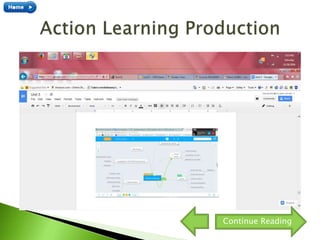
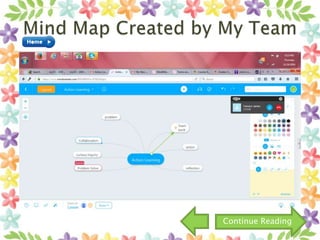
The mind map that was constructed by all members of the team during my
engagement in activity 4:1 is shown below.
Assessing me as it relates to my approach to learning, I must add that I
continue to move towards the transformational approach. I say transformational
because I have been engaged in the online learning medium as a means of
developing myself professionally. My interaction with the various courses during my
studies has led to a deep shift in my attitude. Prior to embarking on my course of
study, I would say traditional because my custom was to ignore any perspective that
is odd to mine. However, there has been a shift in my attitude especially as it relates
to my workplace. I am now open to use the perspective of my colleagues to question
my held beliefs, values and assumptions and even use it to make the necessary
changes. Mezirow as cited in (Koth & Cranton, n.d), articulates that when the
perspective lead to an examination of previously held beliefs, values and
assumptions, the potential for transformative learning exists. This learning occurs
when the individual changes in noticeable ways. At my workplace, I have made the
necessary changes to my teaching methods based on insights gained from being
engaged in my course of study, staff development sessions and workshops
conducted by the Ministry of education.
Continue Reading
Reflecting on the objectives and the question as to whether I was able to monitor a
selected approach to problem using the principles of action learning, I must say
there is a move towards transformational learning. This is so because I have used a
team approach in my workplace to discuss the problem that is identified for my
action research and to develop a programme as a means of solving it .Additionally, I
have incorporated persons outside of the school community with the skills and
knowledge in specific areas to be a part of the intervention programme. As it relates
to the gaps, I must I say I erred where team members should be allowed to ask
piercing questions to other members of the team because this is a principle of action
research. The approach used was that where team members posed questions directly
to me. It is said that action research help members to solve problems and learn by
their ongoing dialogue in groups, that is all members pose probing and supportive
challenges to each other (Authencity, LLD.n.d).Therefore, the way forward is to
ensure that this approach is used at all times during our meetings. Also, there is a
gap where I omitted the principle of action learning that speaks to reflection
informed by conscious theories and assumptions which should be used to plan the
next experience (ALARA, 2012).The way forward is to ensure that I make the
necessary changes.
As it relates to showing evidence of contribution to action learning for my
organizational development, I must say my action research proposal is evidence of
such.
Continue Reading
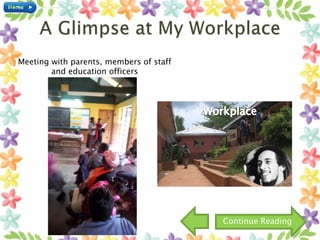
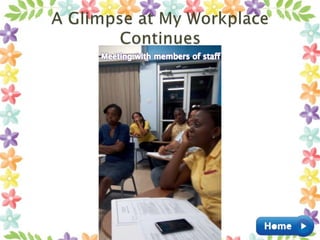
Meeting with parents, members of staff
and education officers
Continue Reading
In order for me to show my development it is
important that I give insights of what I have
being doing in my workplace.
Click here to view my action action research proposal
google doc
(You need to login to view the document)
 BusinessDictionary.com (2016). Definition of the word problem.
Retrieved from:
http://www.businessdictionary.com/definition/problem.html
 Convergence training (diagram 1). Retrieved from
https://www.convergencetraining.com/problem-solving-
strategies.html
 EDLM 3007. Springboards for Problem Solving in Work Setting. Unit 3.
Retrieved from:
http://201610.tle.courses.open.uwi.edu/pluginfile.php/18380/mod_r
esource/content/2/EDLM3007%20Unit%203%20-
%20Springboards%20for%20Problem%20Solving%20%281%29.pdf
 Rebour,M.(n.d). Effective Problem solving techniques for groups
 Mayer, R and Whitlock, M. (2009). Problem Solving. Retrieved from
www.education.com/reference/article/problem-solving/
 Sigsigma.net (diagram 2). Pugh Matrix. Retrieved from
http://www.whatissixsigma.net/pugh-matrix/
 All animated pictures adapted from Google Images
Sharing my story
Continue Reading
Mc Gill and Brockbank (n.d), define action learning as “a continuous
process of learning and reflection with the support of group colleagues,
working on real issues” (para.1). “Practicum is a professional field
experience program designed to provide the student with the opportunity
to work in a professional environment under the supervision of an
experienced informative professional with the guidance of a faculty
member” (School of information sciences, 2016). The purpose of this paper
is to demonstrate how my efforts to use action learning to solve a problem
while on my practicum field work at my school helped me to achieve the
stated goals of the course EDLM 3007.
My course EDLM 3004 has afforded me the opportunity to undertake an
action research within my school as a means of fulfilling the requirements
for my practicum. For this research, I had to identify a real problem within
my organization that would be the topic for my action research. “Action
research is disciplined process of inquiry conducted by and for those
taking the action” (Sagor, 2016). Based on observation over a period of
time and conversing with members of staff, I realized that the lack of
parental involvement in the activities at the school was a major issue. To
begin dealing with the issue,
Continue Reading
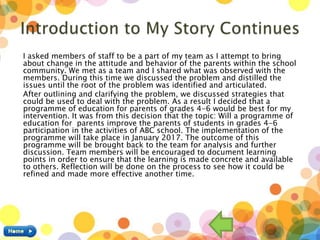
I asked members of staff to be a part of my team as I attempt to bring
about change in the attitude and behavior of the parents within the school
community. We met as a team and I shared what was observed with the
members. During this time we discussed the problem and distilled the
issues until the root of the problem was identified and articulated.
After outlining and clarifying the problem, we discussed strategies that
could be used to deal with the problem. As a result I decided that a
programme of education for parents of grades 4-6 would be best for my
intervention. It was from this decision that the topic: Will a programme of
education for parents improve the parents of students in grades 4-6
participation in the activities of ABC school. The implementation of the
programme will take place in January 2017. The outcome of this
programme will be brought back to the team for analysis and further
discussion. Team members will be encouraged to document learning
points in order to ensure that the learning is made concrete and available
to others. Reflection will be done on the process to see how it could be
refined and made more effective another time.
GOALS OF
COURSE
DESCRIPTION OF
ARTEFACTS IN
PORTFOLIO & LINK TO
UNITS
DIMENSION/S
OF THE
WORKPLACE &
PROBLEM
ADDRESSED
REFLECTIVE STORY ON ACTION LEARNING
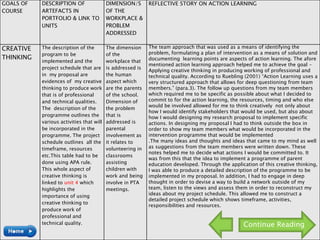
CREATIVE
THINKING
The description of the
program to be
implemented and the
project schedule that are
in my proposal are
evidences of my creative
thinking to produce work
that is of professional
and technical qualities.
The description of the
programme outlines the
various activities that will
be incorporated in the
programme. The project
schedule outlines all the
timeframe, resources
etc.This table had to be
done using APA rule.
This whole aspect of
creative thinking is
linked to unit 4 which
highlights the
importance of using
creative thinking to
produce work of
professional and
technical quality.
The dimension
of the
workplace that
is addressed is
the human
aspect which
are the parents
of the school.
Dimension of
the problem
that is
addressed is
parental
involvement as
it relates to
volunteering in
classrooms
assisting
children with
work and being
involve in PTA
meetings.
The team approach that was used as a means of identifying the
problem, formulating a plan of intervention as a means of solution and
documenting learning points are aspects of action learning. The afore
mentioned action learning approach helped me to achieve the goal -
Applying creative thinking in producing working of professional and
technical quality. According to Ruebling (2001) “Action Learning uses a
very structured approach that allows for deep questioning from team
members.” (para.3). The follow up questions from my team members
which required me to be specific as possible about what I decided to
commit to for the action learning, the resources, timing and who else
would be involved allowed for me to think creatively not only about
how I would identify stakeholders that would be used, but also about
how I would designing my research proposal to implement specific
actions. In designing my proposal I had to think outside the box in
order to show my team members what would be incorporated in the
intervention programme that would be implemented
.The many ideas and thoughts and ideas that came to my mind as well
as suggestions from the team members were written down. These
notes helped me to decide what actions I would be committed to. It
was from this that the idea to implement a programme of parent
education developed. Through the application of this creative thinking,
I was able to produce a detailed description of the programme to be
implemented in my proposal. In addition, I had to engage in deep
thought in order to devise a way to build a network outside of my
team, listen to the views and assess them in order to reconstruct my
ideas about my project schedule. This allowed me to construct a
detailed project schedule which shows timeframe, activities,
responsibilities and resources.
Continue Reading
GOALS OF
COURSE
DESCRIPTION OF
ARTEFACTS IN
PORTFOLIO & LINK TO
UNITS
DIMENSION/S OF
THE WORKPLACE
& PROBLEM
ADDRESSED
REFLECTIVE STORY ON ACTION LEARNING
TALENTS/
GIFTS
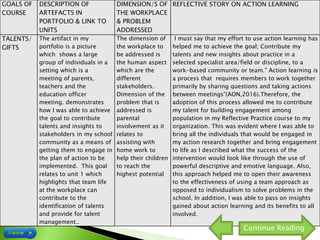
The artifact in my
portfolio is a picture
which shows a large
group of individuals in a
setting which is a
meeting of parents,
teachers and the
education officer
meeting. demonstrates
how I was able to achieve
the goal to contribute
talents and insights to
stakeholders in my school
community as a means of
getting them to engage in
the plan of action to be
implemented. This goal
relates to unit 1 which
highlights that team life
at the workplace can
contribute to the
identification of talents
and provide for talent
management..
The dimension of
the workplace to
be addressed is
the human aspect
which are the
different
stakeholders.
Dimension of the
problem that is
addressed is
parental
involvement as it
relates to
assisting with
home work to
help their children
to reach the
highest potential
I must say that my effort to use action learning has
helped me to achieve the goal; Contribute my
talents and new insights about practice in a
selected specialist area/field or discipline, to a
work-based community or team.” Action learning is
a process that requires members to work together
primarily by sharing questions and taking actions
between meetings”(AON,2016).Therefore, the
adoption of this process allowed me to contribute
my talent for building engagement among
population in my Reflective Practice course to my
organization. This was evident where I was able to
bring all the individuals that would be engaged in
my action research together and bring engagement
to life as I described what the success of the
intervention would look like through the use of
powerful descriptive and emotive language. Also,
this approach helped me to open their awareness
to the effectiveness of using a team approach as
opposed to individualism to solve problems in the
school. In addition, I was able to pass on insights
gained about action learning and its benefits to all
involved.
Continue Reading
GOALS OF
COURSE
DESCRIPTION OF
ARTEFACTS IN
PORTFOLIO & LINK
TO UNITS
DIMENSION/S
OF THE
WORKPLACE &
PROBLEM
ADDRESSED
REFLECTIVE STORY ON ACTION LEARNING
DYNAMICS OF
CHANGE
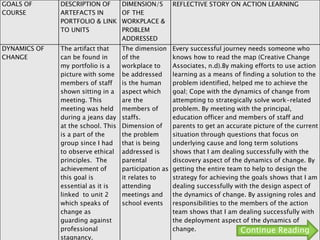
The artifact that
can be found in
my portfolio is a
picture with some
members of staff
shown sitting in a
meeting. This
meeting was held
during a jeans day
at the school. This
is a part of the
group since I had
to observe ethical
principles. The
achievement of
this goal is
essential as it is
linked to unit 2
which speaks of
change as
guarding against
professional
stagnancy.
The dimension
of the
workplace to
be addressed
is the human
aspect which
are the
members of
staffs.
Dimension of
the problem
that is being
addressed is
parental
participation as
it relates to
attending
meetings and
school events
Every successful journey needs someone who
knows how to read the map (Creative Change
Associates, n.d).By making efforts to use action
learning as a means of finding a solution to the
problem identified, helped me to achieve the
goal; Cope with the dynamics of change from
attempting to strategically solve work-related
problem. By meeting with the principal,
education officer and members of staff and
parents to get an accurate picture of the current
situation through questions that focus on
underlying cause and long term solutions
shows that I am dealing successfully with the
discovery aspect of the dynamics of change. By
getting the entire team to help to design the
strategy for achieving the goals shows that I am
dealing successfully with the design aspect of
the dynamics of change. By assigning roles and
responsibilities to the members of the action
team shows that I am dealing successfully with
the deployment aspect of the dynamics of
change. Continue Reading
GOALS OF
COURSE
DESCRIPTION OF
ARTEFACTS IN
PORTFOLIO & LINK
TO UNITS
DIMENSION/S
OF THE
WORKPLACE &
PROBLEM
ADDRESSED
REFLECTIVE STORY ON ACTION LEARNING
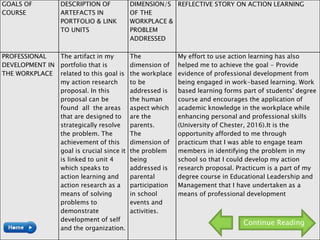
PROFESSIONAL
DEVELOPMENT IN
THE WORKPLACE
The artifact in my
portfolio that is
related to this goal is
my action research
proposal. In this
proposal can be
found all the areas
that are designed to
strategically resolve
the problem. The
achievement of this
goal is crucial since it
is linked to unit 4
which speaks to
action learning and
action research as a
means of solving
problems to
demonstrate
development of self
and the organization.
The
dimension of
the workplace
to be
addressed is
the human
aspect which
are the
parents.
The
dimension of
the problem
being
addressed is
parental
participation
in school
events and
activities.
My effort to use action learning has also
helped me to achieve the goal - Provide
evidence of professional development from
being engaged in work-based learning. Work
based learning forms part of students' degree
course and encourages the application of
academic knowledge in the workplace while
enhancing personal and professional skills
(University of Chester, 2016).It is the
opportunity afforded to me through
practicum that I was able to engage team
members in identifying the problem in my
school so that I could develop my action
research proposal. Practicum is a part of my
degree course in Educational Leadership and
Management that I have undertaken as a
means of professional development
Continue Reading
GOALS OF
COURSE
DESCRIPTION OF
ARTEFACTS IN
PORTFOLIO & LINK TO
UNITS
DIMENSION/S
OF THE
WORKPLACE &
PROBLEM
ADDRESSED
REFLECTIVE STORY ON ACTION LEARNING
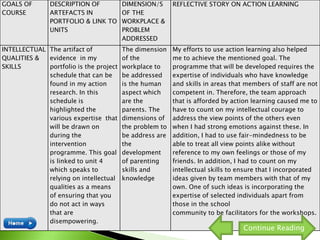
INTELLECTUAL
QUALITIES &
SKILLS
The artifact of
evidence in my
portfolio is the project
schedule that can be
found in my action
research. In this
schedule is
highlighted the
various expertise that
will be drawn on
during the
intervention
programme. This goal
is linked to unit 4
which speaks to
relying on intellectual
qualities as a means
of ensuring that you
do not act in ways
that are
disempowering.
The dimension
of the
workplace to
be addressed
is the human
aspect which
are the
parents. The
dimensions of
the problem to
be address are
the
development
of parenting
skills and
knowledge
My efforts to use action learning also helped
me to achieve the mentioned goal. The
programme that will be developed requires the
expertise of individuals who have knowledge
and skills in areas that members of staff are not
competent in. Therefore, the team approach
that is afforded by action learning caused me to
have to count on my intellectual courage to
address the view points of the others even
when I had strong emotions against these. In
addition, I had to use fair-mindedness to be
able to treat all view points alike without
reference to my own feelings or those of my
friends. In addition, I had to count on my
intellectual skills to ensure that I incorporated
ideas given by team members with that of my
own. One of such ideas is incorporating the
expertise of selected individuals apart from
those in the school
community to be facilitators for the workshops.
Continue Reading
GOALS OF
COURSE
DESCRIPTION OF
ARTEFACTS IN
PORTFOLIO & LINK TO
UNITS
DIMENSION/S
OF THE
WORKPLACE &
PROBLEM
ADDRESSED
REFLECTIVE STORY ON ACTION LEARNING
VALUE OF
THEORY IN
PRACTICE
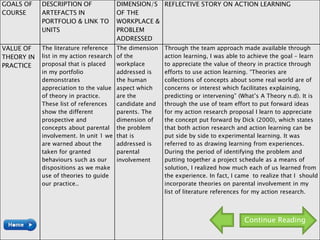
The literature reference
list in my action research
proposal that is placed
in my portfolio
demonstrates
appreciation to the value
of theory in practice.
These list of references
show the different
prospective and
concepts about parental
involvement. In unit 1 we
are warned about the
taken for granted
behaviours such as our
dispositions as we make
use of theories to guide
our practice..
The dimension
of the
workplace
addressed is
the human
aspect which
are the
candidate and
parents. The
dimension of
the problem
that is
addressed is
parental
involvement
Through the team approach made available through
action learning, I was able to achieve the goal – learn
to appreciate the value of theory in practice through
efforts to use action learning. “Theories are
collections of concepts about some real world are of
concerns or interest which facilitates explaining,
predicting or intervening” (What’s A Theory n.d). It is
through the use of team effort to put forward ideas
for my action research proposal I learn to appreciate
the concept put forward by Dick (2000), which states
that both action research and action learning can be
put side by side to experimental learning. It was
referred to as drawing learning from experiences.
During the period of identifying the problem and
putting together a project schedule as a means of
solution, I realized how much each of us learned from
the experience. In fact, I came to realize that I should
incorporate theories on parental involvement in my
list of literature references for my action research.
Continue Reading
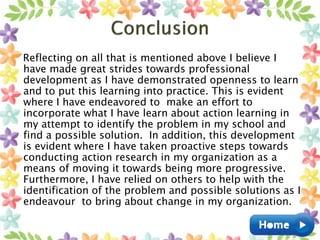
Reflecting on all that is mentioned above I believe I
have made great strides towards professional
development as I have demonstrated openness to learn
and to put this learning into practice. This is evident
where I have endeavored to make an effort to
incorporate what I have learn about action learning in
my attempt to identify the problem in my school and
find a possible solution. In addition, this development
is evident where I have taken proactive steps towards
conducting action research in my organization as a
means of moving it towards being more progressive.
Furthermore, I have relied on others to help with the
identification of the problem and possible solutions as I
endeavour to bring about change in my organization.
 Creative Change Association (N.D) Dynamics of Change
Retrieved from http://www.creativechange.org/dynamics-of-change
 Dick, R. (2000) Action Learning and action research
Retrieved from www.aral.com.au/resources/actlearn.html
 McGill, I & Brockbank, A.C. The Action Learning Handbook: Powerful Techniques for Education,
Professional development training.
Retrieved from https://www.questia.com/library/108763483/the-action-learning-
 handbookpowerfultechniques
 School of Information Science 2016. Practicum
Retrieved from https://school,Illinois.edu/current-student/practicum
 Saqor, R. (2016). Chapter 1. What Is Action Research?
Retrieved from
http://www.ascd.org/publications/books/100047/chapters/What-Is-Action-
Research%C2%A2.aspx
 What’s A Theory (N.D)
Retrieved from https://zcomm.org/wp-
content/uploads/zinstructionals/www/RTInstruc/id6.htm

Road to Transformation Part 2: Reflective Practice E Portfolio

  • 1.
  • 2.
     DAWN OFA NEW ERA ◦ Purpose of Portfolio ◦ Taking the first step  My learning Plan ◦ Goals ◦ Strategies to Accomplish Goals ◦ Self Correction ◦ My revised Learning Plan ◦ Strategies to accomplish my Goals  Identifying Self in the Context of Workplace (Unit 1) ◦ My Reflection ◦ My Profile as a Worker ◦ Preferred Perspective of Work ◦ Approach to Work ◦ Core Values ◦ Professional Goals Achieved ◦ Professional Goals to be achieved ◦ Characteristics ◦ Talents, Roles and responsibilities ◦ Reference for Reflection ◦ Reflection Continued… ◦ Self Correction to Unit 1 Reflection ◦ Self correction on Unit One  Change as the Challenge to Professional Stagnancy (Unit 2) ◦ Collaboration instead of individualism ◦ Meet My Team ◦ Our work space ◦ My contribution to team work ◦ Rational ◦ Areas to include in Proposal ◦ Dimensions for change that was left out ◦ Critique done by Rose & D’Nell to Andrea and Naidia ◦ My Reflection on completing Unit 2 activities ◦ References for Reflection ◦ Introducing The Springboards to Problem Solving  Springboards for Problem Solving in Work Setting (Unit 3) ◦ Teams Make Things Happen ◦ Motto: Collaboration instead of individualism ◦ Unit 3 Reflection ◦ Reference  Action Learning revealed (Unit 4) ◦ Action learning revealed ◦ My Reflection on Activity 4:1 ◦ Activity 4:2 ◦ Activity 4:3 ◦ Action Learning Production ◦ My Reflection on Unit 4 ◦ Reference ◦ A Glimpse at My Workplace ◦ Action Plan to Improve Workplace ◦ References  My Development through Action Learning ◦ Introduction to My Story ◦ Conclusion ◦ Reference
  • 3.
    The next phaseto complete the transformation process began in the work context EDLM 3007 located in the UWI open campus. A set of objectives were given that would serve as our measuring rod.
  • 4.
    This aspect ofthe portfolio is to highlight the experiences and insights that were gained from being engaged in the course EDLM 3007. It is also to serve as documentation of personal and professional development. This journey started in the work context EDLM 2008. It continued in the work context EDLM 3007. To get a glimpse of what the journey was like at the beginning go to Part 1 here if you so desire.
  • 5.
    I was notsure were the road would lead but I made every effort to complete my learning plan. The developing of this plan was important since it is an indication of my planned approach towards learning. By developing a learning plan, I will be able to assess the areas in which I most want to develop and the most effective methods to acquire skills and improve performance even in my workplace.
  • 6.
  • 7.
    By the endof the semester I will have successfully completed the objectives that are set out under the various themes in the course guide for Reflective Practice in Action 11.I will have successfully accomplished: 1 Critiquing my profile as a worker 2 Preparing profile of workplace context 3 Interrogating theories that have influenced my practice as a worker 4 Critiquing steps taken to manage talent or participate in activities intended to influence development of my talents 5 Examining world trends that support need for change 6 Examining my readiness for the world of work 7 Exploring levels and dimensions of change 8 Examining in interim analysis of data collected 9 Demonstrating creativity in organizing artifacts 10 Explaining reasons for stagnancy rather than engage in professional practice 11 Expressing approval or perturbation about place of theory in practice 12 Defending preferred perspective of term problem 13 Identifying springboard strategically use for problem solving in work setting 14 Formulating workable definition of term “action learning” 15 Monitoring selected approach to learning 17 Sharing evidence of the contribution of “action learning” 18 Reflecting on the intellectual qualities that enhance the problem 19 Preparing reflective-reflexive reports on my experience of applying action learning principles Goals Continue Reading
  • 8.
    1 Analyze actionsthat prevented me from being able to timely pace the course and improve on them (Sept.5th) 2 Construct a timetable with activities to be completed in order to manage my time wisely 3 Attend BBC and Skype sessions designed for course activities (Sept.-Nov.) 4 Formulate teams and collaborate with my online teammates to gain insights on areas not understood (ongoing) 5 Find several professionals and experts in the area of Reflective Practice to be a part of my team (ongoing) 6 Search for online and library resources that cover topics in the course (ongoing) 7 Constantly review my progress in keeping with strategies to determine success (ongoing) Strategies to Accomplish Goals
  • 9.
    After feedback fromthe e-tutor I watched the required videos and restructured my learning plan. As leaders/teachers it is important that we guard against taking meaning of terms for granted.
  • 10.
     Goals: Bythe end of the semester I will have successfully completed the objectives that are set out under the various themes in the course guide for Reflective Practice in Action 11, I will have successfully accomplished:   Critiquing my profile as a worker  Preparing profile of workplace context  Interrogating theories that have influenced my practice as a worker  Critiquing steps taken to manage talent or participate in activities intended to influence development of my talents  Examining world trends that support need for change  Examining my readiness for the world of work  Exploring levels and dimensions of change  Examining in interim analysis of data collected  Demonstrating creativity in organizing artifacts  Explaining reasons for stagnancy rather than engage in professional practice  Expressing approval or perturbation about place of theory in practice  Defending preferred perspective of term problem  Identifying springboard strategically use for problem solving in work setting  Formulating workable definition of term “action learning”  Monitoring selected approach to learning  Sharing evidence of the contribution of “action learning”  Reflecting on the intellectual qualities that enhance the problem  Preparing reflective-reflexive reports on my experience of applying action learning principles Continue Reading
  • 11.
     Endeavour tohave a strong self-motivation and self- discipline so I will manage study time and schedule.  Ensure that I devote the same amount of time each week to course work as I would do in the traditional classroom  Eliminate certain activity that I like to do in order to balance my time  Ensure that I identify my learning goals and objectives and focus my attention on learning  Ensure that I engage in research in order to develop my critical thinking skills  Ensure that I communicate with my e-tutor whenever I need assistance  Be engaged in collaboration with other learners to solve problems and gain ideas instead of working in isolation  Ensure that I develop the skill of using basic technology
  • 12.
  • 13.
    Prior to embarkingon the Getting Started Activity which required me to listen to a forty seven minutes concentration music, I was unaware of how powerful Classical Jazz Music could be. By listening to the music, I realized how this type of music can enhance concentration and get the creative juices flowing. I was able to create the following lyrics: Reflect reflect reflect reflect it may lead to the need to look again at the situation it may highlight the need to take some concrete actions I must admit that although I struggled to listen to the music to the end, I learnt its value. The way forward is to develop the attitude of listening to this type of music in order to stimulate creativity. Continue Reading
  • 14.
    Before completing Activity1:2, I had to first carry out research in order to gain an understanding of what it meant to read reflectively. After opening the article, I realized that my weakness surfaced. This weakness is not liking to read lengthy articles, especially if they are not exciting. In order to carry out the task of reading, I had to ensure that I managed my feelings so that I would be able to make a significant contribution to learning by sharing my work. By being engaged in the reading, I became aware of the various definitions for work. However, I had to draw on my prior knowledge and skills of information processing, especially as it relates to manipulating literature to generate meaning in context. Based on insights from the reading I agree with Malloch & Cairns (2010) who states that work is “an enabled purposive effort by an individual to initiate activity or respond to an issue or problem in a range of situations for some perceived (by them) productive end” (p.6).As it relates to place, I had no idea there were so many definitions of the term. Based on what I learnt from the theoretical reading, I define place as a physical or spiritual location or spaces in which we see ourselves as people and learners. I am glad I was able to manage my feelings and read the article because I was able to spot specific information that relate to the objectives of the course. The way forward is to ensure that I develop the attitude of engaging in a lot of reading to develop a liking for it. Before embarking on activity 1:3 which required preparing an autobiographical profile of me, I had to take time out to research the definitions of specific terms since I was unclear of their meanings. By doing so, I was able to prepare this profile. My Reflection Continued Continue Reading
  • 15.
     Preferred Perspectiveof Work  Approach to Work  Core Values  Professional Goals Achieved Continue Reading
  • 16.
    Work is anenabled purposive effort by an individual to initiate activity or respond to an issue or problem in a range of situations for some perceived (by them) productive end. Continue Reading
  • 17.
     Display apositive attitude towards others and work interdependently both towards personal and professional goals.  Collaborate with others and use my talent and experience to contribute to the goals of my school.  Demonstrate willingness to take cues from others (even students) as it relates to how my behaviour impacts them and make the necessary changes even if it means to up-end traditions.  Demonstrate willingness to put values into practice and welcomes unexpected detours. Approach to Work Continue Reading
  • 18.
     Perseverance, nurturing,objective, integrity, honesty, gallant, equality, ethical, excellence, diligence, discovery, challenge, action oriented, collaboration, accountability, commitment, balance, community. Core Values Continue Reading
  • 19.
     To workin the education sector, have an important experience job in teaching and a permanent job in this area.  To participate actively in my school and to work with others in the development of my abilities, attitudes, leadership and initiative.  To qualify for a prestigious school in order to implement my experience of many years in education  To use my skills for doing best in the organization that chooses me as its employee Professional Goals Achieved Continue Reading
  • 20.
     Looking fora challenging position that would allow me to apply my educational knowledge in different areas.  To develop within my organization, apply knowledge gained to develop professionally, getting better every day and make the right decisions to accomplish goals and succeed.  To develop myself personally and professionally in areas where I can apply my up-to-date knowledge and experience.  To take the opportunities presented, overcoming the challenges imposed on me in order to achieve personal growth and dedicate myself professionally. Professional Goals to be achieved Continue Reading
  • 21.
     Open mindedness,honesty, concern to become and remain well-informed, willingness to reconsider and revise views where honest reflections suggest that change is wanted, teachable , love to learn, believe investment in learning is worthwhile, humble and self aware of limits and needs, ambitious, action-oriented , hardworking, display leadership autonomous. Characteristics Continue Reading
  • 22.
     Leadership, abilityto handle change, writing, creativity, self management, imaginative, storytelling, communication skills, empathy, humour.  Supervisor, coach and educator, decision maker, coordinator/chairperson. Talents, Roles and Responsibilities Continue Reading
  • 23.
     Activity 1.4allowed me to apply what I learned in the previous courses about meaning-making and operational definitions. Using this previous knowledge I was able to come up with key words such as movement towards a goal, advancement, growth, continuous improvement, development, from a dictionary definition of the word progress. After assessing other standpoints, I expanded the definition to mean, a movement towards a goal through continuously keeping formal skills up to date and accepting challenging assignments and taking responsibility for educating oneself to acquire knowledge and skills along with social/emotional development. By comparing my definition with that of the specified chapter, I found that we differ because the writer sees progress as not only benefiting you as the individual but a larger portion of people. Therefore, I redefine progress to mean movement towards a goal through modernization and expansion to continuously expand knowledge, skills and accepting challenging assignment in order to bring about improvement in the wellbeing of oneself and the population. In light of this definition is to ensure that I assist those in my workplace so that it can be a progressive one. Reflection Continues…
  • 24.
    EDLM 3007 (2016).Unit 1: Theme 1: Identifying Self in the Context of Workplace  Retrieved from http://201610.tle.courses.open.uwi.edu/pluginfile.php/18364/mod_res ource/content/2/EDLM3007%20Unit%201%20-%20Identifying%20Self.pdf  Insight Assessment (2016). Characteristics of strong critical thinkers  Retrieved from: http://www.insightassessment.com/Resource/Characteristics-0  Malloch M & Cairn C. (2010).  Retrieved from: https://www.sagepub.com/sites/default/files/upm-  binaries/35381_5438_malloch_chap_01.pdf
  • 25.
    Based on feedbackfrom e-tutor regarding our approach to unit 1 activities, I self corrected Continue Reading
  • 26.
     I ensuredthat I completed the remaining activities before the designated time that the group decided to meet. The team met and I was asked to critique activity 1:4.I read the activity and assessed it requirements. I conducted research to gain different meanings on the word progressive. I found that all the definitions emphasized key words such as growth and development. I proceeded to read the related course material to the activity and made the necessary comments. Afterwards the group met and we had discussions on all that was done. It was at this point it dawned on me that I could have used the approach of finding multiple meanings while I was completing the activity on my own. To be progressive we have to develop the attitude of researching multiple perspectives on topics as a means of helping us to develop working definitions. Continue Reading
  • 27.
     During thediscussions, I reflected on my profile as a worker and realized the importance of ensuring that I adopt characteristics that depict the spaceship culture to fit the changing society. I also questioned myself as it relates to my approach to work as to whether I demonstrated willingness to put values into practice and well known unexpected detours. Continue Reading
  • 28.
     It dawnedon me that there is more to be done in this area. I now understand that work based experiences can allow me critique my profile as a worker because I can assess my behaviour against what I learned and gain more understanding about myself. Through this experience I will be able to assess myself to realize how flexible and adaptable I am, than before, to keep up with the rapid changes taking place in the world of work. Also, I can use it as a medium to assess my workplace to see if it is progressive based on information gained about a progressive work setting. In addition, it can be used as a medium to question the theories I have been using to guide my practice. Continue Reading
  • 29.
     Listening tomy group members share their insights from doing activities 1:5 and 1:6 and comparing it to what I had done, allowed me to fully realize that it is the action and behaviours of those in the work setting that influence how progressive it will be. My assessment of the workplace depicted in activity 1:5 showed that it is the action of the individuals that allows for the work setting to look unproductive and non progressive. It dawned on me that I should assess the steps that I have taken to participate in activities that are intended to influence the development of my work setting. An assessment revealed my weaknesses, therefore, I must take the necessary actions to improve these. I have to ensure that I help to contribute to making my workplace one where there is a level of trust and people feel valued and highly engaged. Continue Reading
  • 30.
     As thediscussion continued, it dawned on me how important it was to complete all activities. If I had not gone back to complete activity 1:7, I would lack knowledge of the theories that we can as teachers / leaders apply to situations in order to gain in depth knowledge. From the discussion, I was made aware of the importance of applying the relevant theories to assess a situation. As teachers / leaders we have to ensure that we use the correct theory that is applicable to the situation. As we delve into these theories, I gave thought to the need for me to engage in a lot more reading and exploring in order to be informed about the various theories that exists. I realize that that I need to take time out to engage in more research in order to have a wide scope of knowledge.
  • 31.
  • 32.
     As wemove to complete unit 2 activities the mystery began to unfold. A team approach was required to complete the activities. Here we had to change our approach and start working as a team to achieve the objectives set out in the unit. Continue Reading
  • 33.
  • 34.
     Follow thelink to see what our workspace looks like: https://goo.gl/7NvWRt (you have to log in to view this document) Continue Reading
  • 35.
     Activity 2.3(Rose and D’nell) Change management for technology Justification of the need for change In order to develop the proposal we had to first create a rational which includes justification for the need of change. Although we had prior knowledge on dimensions for change from previous courses, research had to be conducted to gain information on Dimensions for change. Continue Reading
  • 36.
    In our rapidlychanging society, we need to adapt to change and even take initiative to seek ways to change which would improve the organization on a whole. Due to globalization, our world has been transformed and has brought about changes in all walks of life. Forces such as technology, globalization, education reform and competition cannot be ignored. Thus, it is necessary to implement use of ICT in our schools as a means of revolutionizing teaching and learning. According to a study conducted by The National Science Foundation in California, it validates that teaching people how to be competent users of ICT is important so that they can be successful in their academic and work careers and effectively participate in the modern technological society. It was also mentioned that in the 21st century the ability to work with ICT is becoming essential to education, life and success. Also, the article stated that 82% of the respondents agreed that ITC should be considered as a basic skill in the educational system. In our schools over 45% of the students are learning below average and the teachers are unwilling to change their teaching styles to accommodate the students and ensure that the curriculum is being efficiently delivered. In addition, the course of study educational leadership and management has opened our awareness to the benefits of ICT mediated instruction and the importance of using the constructivist approach to teaching. it has also allowed us to realise that as professionals we should be ready to implement changes in this ever changing society. Continue Reading
  • 37.
    Outline of strategicapproaches to change - that will include strategies that will be used- the most effective one being educative strategy Should outline the responsibilities that as the leader will have in managing the change example, communicating the change, leading the change, creating the appropriate climate for change, conducting actions and setting and agenda Give an outline of the aspect of the organization that will be affected e.g. teachers, students, Ministry of Education Outline the impact of change on individuals; emotionally, intellectually, socially, technologically and psychologically Continue Reading
  • 38.
    After using theinstrument: Dimension for Change provided it was noted that the dimension left out was sociological which includes values, norms and cultural practices that impact the change process. Changes to be made Sociological will now be included as a dimension for change. Continue Reading
  • 39.
     From thecompleted activity, it is clear that there was a misunderstanding in meaning of what was required. Based on what was explained in the unit, a deeper reflection for action to ascertain what should be done in activity is essential.  The first part required individuals to consider the groups of stakeholders that contribute to a profession, career or work situation. The word stakeholder was misinterpreted. A stakeholders is a person with an interest or concern in something. In the context it is used it focuses on an individual. And so, hospital should not have been included as a group of stakeholders.  The second part of the question required individuals to find out the conceptual knowledge, disposition and skills that each group of stakeholder requires in order to function effectively. Although the table gave some information in that regard, separate columns could have been included to give a clearer understanding of how each is required to function effectively. Is asked for knowledge that doctors should have. What knowledge have to relate to work setting  It is therefore important to identify the key terms and get and understanding as it relates to how they were used in the context. According to the unit it is important to self assess, which includes, identifying key terms, clarifying terms or concepts, re-reading the task to ensure understanding in light of terms clarified and engaging in task analysis. These will ensure that task is completed well. As reflective practitioner, reflection before, during and after task is essential to for successful completion.
  • 40.
    My group indicatedthat I should work with Dnell to complete activity 2:3.Dnell and I met via Skype and did a task analysis to ensure we understood what was required of us. We also did research in order to gain an understanding of what a proposal was and the dimensions of change. While brainstorming to see what area we could use as a means of justification for change, we realized that teachers in our respective schools needed to become users of technology in order to keep with world trends. In the 21st century, the ability to work with ICT is becoming essential to education, life and workplace success. The areas highlighted by the world trend clock cannot be ignored, thus we saw it necessary to develop a proposal that seeks to implement the use of ICT mediated instruction in our schools. Continue Reading
  • 41.
    After completing thetask, we sent it to the Google Document that was created, to be critiqued by the designated group member. Our task was to critique activity 2:4 which was done by Andrea and Naida. We met again via Skype, did an analysis of the activity to ensure we understood what was required. We carried out research in order to gain a full understanding of words such as stakeholder, knowledge, skills and disposition. We also wanted to ensure that we did not take the meaning of these words for granted. Understanding the meaning of words is important especially if we are required to formulate working definitions for them. By critiquing this activity, I was able to become aware of the knowledge, skills and dispositions that I need as a teacher to function in an environment where the world of work is changing rapidly. I am now cognizant of the fact that lifelong learning has to be a choice and knowledge, skills and dispositions need to be a habit that is maintained over time rather than a college degree(Brooks,2014).We read the related course material for activity 2:4,prepared the feedback, then rejoined the group. Continue Reading
  • 42.
     At thispoint we had discussions on all the four activities that were done and the feedback given based on the course material. I ensured that I did some recording as a means of evidence that I participated . I took time out to make the necessary adjustments to the activity I did based on insights from course material. From the discussions, I learnt the importance of guarding against professional stagnancy. I also learnt the importance of giving serious attention to each area that the global trend clock highlights. My awareness was opened to the fact that I can use these areas as a basis for ensuring that I become a life wide learner who is open to change (EDLM Unit 2, p.36).I was made to realize that by integrating principles from theories about change, research, professionalism and critical thinking will allow me to provide high quality work. In addition, I learnt that my beliefs, customary practices and attitude towards research are indicators of the kind of research culture I am likely to influence as a leader/worker/learner (EDLM 3007, unit 2, p.47).The way forward is to ensure that I make every effort to adopt the correct dispositions, skills and knowledge that will enable me to become an effective worker within my work context. Continue Reading
  • 43.
    Brooks, B. (2014).15career trends every young professional should understand Retrieved from www.barretbrooks.com/top- trends-world-work-every-youngprofesssional- should-understand/ EDLM 3007 Unit 2-Change as the challenge to professional stagnancy Retrieved from 2016.tle.course.open.uwi.edu/pluginfile- php/18374/mod_resource/content/2EDLM3007%2 0units%202%20%20change%20as%20the%20challen ge.pdf
  • 45.
    Unit 3 As Imove into this unit the mystery unfolded. It was evident that there had to be a change in the way I approach problem solving in my workplace. There should be a structured approach to problem solving than a haphazard one. Hence, the springboards highlighted above allow for a structured approach.
  • 46.
     As Iworked with my online team members I realize the values of using a team approach to problem solving. Although there were some bumps at this point I did not give up. I hang in there with my team and used my talent of being able to motivate others to keep members going. As a result we were able to complete our task that required using the springboards for for problem solving. Continue Reading
  • 47.
     Our groupNew Dimension Reflective Practitioner, which emerged out of the wider EDLM 3007 work context presented Phase three of the Collaborative Task Great things can be achieved from team work
  • 48.
    I agree thatlearners are aware of the springboards they use to influence their choice of solution for problems and whether or not these are appropriate. The course EDLM 3007 has raised this consciousness as far as I am concern. Continue Reading
  • 49.
    As a learnerin the EDLM 3007 work context, my interaction with the various activities in unit three done by my team has opened my awareness to these springboards that I can use to influence my choice of solution for problems and whether or not they are appropriate. I have been made cognizant of these through having to engage in research while reading the unit. From the discussions and validating of work done by each team member on these activities, I have been made cognizant of the fact that observation along with conversing with others and reflection are essential to arrive at a conclusion that a problem exists. The insights gained from activity 3: 1 allowed me to fully realize that observation is an essential method of data collection. My knowledge as it relates to the different methods of observation has been increased as such that my personal agenda is to make use of these when embarking on action research. Continue Reading
  • 50.
    In addition, theseactivities have increased my capability as such that I will now ensure that I examine the role that my perception plays in my decision as I endeavour to identify a problem in order to move to solution. They also suggest to me that these springboards are appropriate because they allow for a systematic approach to problem solving and are more effective than using a haphazard approach. Good problem solving is skills are fundamentally important if I am going to be successful in my career. To be an effective problem-solver I need to be systematic and logical in my approach (Mind tools, 2016).Moreover, I fully understand that each stage of the springboard is relevant as they allow for a more structured approach to problem solving. By spending some time defining the problem will not only allow for understanding it more clearly but also allows for communicating its nature to others. The structuring period allows for the gaining of more information about the problem and increase understanding of it. This stage allows for fact finding and analysis, building a more complete picture of both the goals and barriers. This stage is essential for problems of more intricate nature. The stage of looking for possible solutions allows for brainstorming to create a range of possible course of action (Skills you need, 2011). Continue Reading
  • 51.
    Activity 3:4 standsout in my mind because it has increased my alertness. This is so because I have been enlightened about the techniques that can influence my choice of a solution to a problem that I have formulated. The three that stand out most in my mind are brainstorming, drilldown and the fishbone diagram. I will endeavour to use the drill down especially during my practice, since it will allow me to understand the root causes of problems that hold up my organization (GeekPRENUER, 2016). By being engaged in the process of reading through the unit in order to understand the springboards for problem solving allowed for me to become even more aware of these springboards that we can use to influence our choice of solving problems and whether or not they are appropriate. This course has certainly helped in opening my awareness and debunked certain perceptions I had.
  • 52.
    EDLM 3007, Unit3 Springboards for Problem Solving in the Work Setting Retrieved from http://201610.tle.courses.open.uwi.edu/pluginfile.php/18380/ mod_resource/content/2/EDLM3007%20Unit%203%20- %20Springboards%20for%20Problem%20Solving%20%281%29.pdf Mind tools, (2016). How good is your problem solving? Retrieved from https://www.mindtools.com/pages/article/newTMC_72htm Skills you need (2011). Problem solving Retrieved from http://www.skillsyouneed.com/ips/problem-solving.htm/
  • 53.
  • 54.
     According toMc Gill and Brockbank(n.d), “Action learning is a continuous process of learning and reflection with the support of group colleagues, working on real issues” (para.1).  It was at this time I realize what was at the end of this journey. The mystery unfolded and action learning was revealed. As I move towards this milestone, I had to test myself to see if I was developing or stagnant. As I embarked upon completing the activities the answer came to me. Action learning is the way to go to keep with world trends and to guard against stagnancy. Continue Reading
  • 55.
    Before embarking onthis activity, I had to do some investigation as a means of understanding what Scriblink was. After conversing with my teammates, I attempted to do the task but encountered difficulty in getting onto scribble link or another online tool to do it. I sought the help of my team mates and realized that others were experiencing the same problem. After attempting several times, Shanna found a tool to be used, so we decided to do it as a collaborative task. Shanna sent an invitation to all of us. We worked collaboratively to brainstorm ideas regarding action learning. While doing so we were provided with the opportunity to develop knowledge and understanding. I experienced difficulty at times in manipulating the tool in order to add my thoughts. However, I was guided along by my team mates. At the end we decided to use this collaboration as an artifact. After brainstorming to come up with ideas, the team decided to compile a collaborative definition. We assessed the various ideas then negotiated to see which should be kept and which should be deleted. We then came up with a comprehensive definition. . Continue Reading
  • 56.
  • 57.
    After assessing thegroup’s definition, I used it as a guide to come up with my own definition. I define action learning as a systematic process in which individuals on a team whether it be workplace or workspace are committed to learning, by doing based on the argument that learning requires action and action requires learning, towards team and organization development. According to Ruebling (2007),"Action learning is a dynamic process where teams meet regularly to help individual members address real issues through a highly structured, facilitated team process of reflection and action."(para.3). This process provided us with the opportunity to inquiry and collaborate in order to develop knowledge and understanding at the appropriate time when there is an immediate need to resolve a complex problem. This activity allowed me to gain insights on the importance of action learning. I now realize the importance of integrating it in my practice. Reference Ruebling,D.(2007).Action learning Retrieved from http://www.rueblinggroup.com/pdf_articles/action_learning.htm Continue Reading
  • 58.
     Before embarkingon this activity, I had to delve deeply into the readings on action research as action learning in order to identify the action learning principles that are made use of during my approach to problem solving using action research. The approach of conversing with members of staff, after careful observation, to identify the problem that would be my action research topic and to decide what the intervention should be like, demonstrates the use of action learning principles.  By taking on the task to implement a programme of parent education, using teach the parent sessions, to bring about change in parents attitude and behaviours, as it relates to their involvement in the activities of the school, demonstrates a process where learning will be drawn from experience. The learning from experience will also take place for the members of staff as they will learn that teachers and parents have a shared responsibility in the education process. This learning from experience shows the use of action learning principles during my approach to problem solving using action research. Both action research and action learning are about learning from experience (Dick, 2000).  By deciding to become a participatory researcher and implement an intervention programme, as a means of helping parents to change themselves, as it relates to their participation in the school life of their children, also shows that I have deliberately integrated action learning principles as part of my approach to problem solving using action research. Continue Reading
  • 59.
     The approachwhere a ‘Parent Place” stocked with resources will be established, for parents to work collaboratively on activities and have access to information and support from facilitators of workshops, to enhance their skills (Krogh, n.d), also shows the integrating of action learning principles. The fact that the workshops will allow for the parents and the researcher to be one and same, as they engage in participative problem solving school based activities, also demonstrates that action learning principles are made use of. The incorporating of sessions, where parents will practice what they learnt, through role-play and scenarios, also show the integrating of action learning principles. Action learning is more than a dialogue or discussion group. It allows for members to actually apply their learning between groups and meetings (Authenticity consulting, n.d.). Furthermore, by providing a framework for the practice of learning, teaching and professional development through the designed workshops and practice sessions, shows the integrating of the action learning principles. Overall the idea of establishing this parent place as a means of continuous training and development beyond the period of intervention, in order to create a culture of lifelong learning, demonstrates the integrating of action learning principles.  In addition, the inclusion of an evaluation to assess the outcome of the programme, using interviews with the parents, after the intervention, shows that I have strategically integrated action research principles as part of the process. Reference Authencity Consulting, LLC, (n.d).Action Learning (peer Coaching Groups): Some Related Theories Retrieved from www.authencityconsulting.com/act-lrn/a-l/theory.htm Dick, B. (2000). Action learning and action research Retrieved from www.ard.com.au/resorces/actlearn.html Krogh, C. (n.d). Action research as action learning as action research as action Learning…at multiple levels in adult education Retrieved from http://www.avetra.org.au/abstracts_and_papers_2001/Krogh_full.pdf Continue Reading
  • 60.
     Action researchand action learning can be compared to experiential learning because all are cyclic and involve action and reflection and reflection on that action (Alara, 2012).In assessing my approach to problem solving using action research, I realized that there are some gaps in my proposed plan of action that is developed for my action research for EDLM 3004.  Although I have ensured that roles and responsibilities are assigned, the principle of action learning that requires a review of the action that will be taken was ignored. I have also ignored the planning that should occur after the review. Additionally, I have not considered the action that should follow after the review and planning. As a result of not taking these into consideration, I have ignored the principle of action learning that speaks to critical reflection, that should be informed by conscious theories and assumptions, which should be used to plan the next experience (ALARA, 2012).It is said that action research helps members solve problems and learn primarily by their ongoing dialogue in their groups, that is all members pose probing questions and supportive challenges to each member (Authencity Consulting, LLC, n.d). Again I realize that my approach does not allow for members, which are a part of the action research team, to pose probing questions and supporting challenges to each member of the group.  In addition, I found that I did not pay attention to the principle of action learning which highlights that participants should be allowed to learn from insights rather from just collecting knowledge and advice. This realization came about after assessing the way the workshops are structured. Therefore, there has to be a restructuring of these, so that they allow for participants to ask probing questions, as this will help them to reflect on their experience. By engaging in this reflection they will be able to take apart and put back together again how they perceive their challenges, goals and issues (Authencity Consulting, LLC, n.d). Continue Reading
  • 61.
     By beingmade aware that the evaluation process is a mixture of “process and outcome”, I realize that I have not given any attention to the aspect of the evaluation that deals with the process. This is so because the evaluation of the programme is centered on the outcome. As it relates to the evaluation methodology, some principles of action learning are ignored. Despite the fact that there will be qualitative interview with the parents, there should be the inclusion of an interview with the management involved in the workplace before, during and after the planned programme (Krogh, n.d).I also realized that I have not paid attention to the principle that requires respondents to write their reflection on their learning experience.  By being made aware of these gaps, I have to ensure that I make the necessary adjustments in order to ensure that action learning is incorporated in my approach to problem solving using action research. Reference ALARA (n.d).Action Learning Retrieved from http://www.alara.net.au/aral/actionlearning Authencity Consulting, LLC, (n.d).Action Learning (peer Coaching Groups): Some Related Theories Retrieved from www.authencityconsulting.com/act-lrn/a-l/theory.htm Krogh, L. (n.d).Action research Retrieved from www.appstate.edu/%ESanderSr/rcoe/ActionLearningTools/Action%20Learning.pdf Continue Reading
  • 62.
    Using the objectivesas though they are questions, reflect on your development or stagnancy. Your reflection should be supported with examples from the learning activities you have done. By being engaged in the activities in unit 4, session 1, allowed me to realize that I show a lot of vitality as it relates to my learning. In assessing myself against the objectives of the session, I see myself as progressive rather than being stagnant. I say progressive because I found that I took the approach of searching for information; reading, analyzing and evaluating this information and collaborating with others in order to complete the activities of the session. In addition, I demonstrated confidence that I would figure out what to do after realizing from the tutor’s feedback that my team had not approached the activities in the correct manner. Continue Reading
  • 63.
    By being engagedin the activity where I had to construct a mind map demonstrates the high level of vitality that I show towards my learning. After realizing that I was experiencing difficulty in accessing the online tool to do the mind map, I did not endorse the thought that it is totally out of my control. Instead, I resorted to finding my other teammates who were experiencing the same difficulty and who had the expertise and adopted a team approach to solving the problem. By doing so, we were able to create mind map. Was I able to formulate a working definition for the term action learning? The answer is yes. This definition can be found in activity 4:1. This experience allowed me to give considerable thought to what I was learning and as a result, I classified it as one of the best learning experience. From experiences like these we can learn the importance of asking probing questions whenever we do not know a great deal about a specific area. Continue Reading
  • 64.
    In addition, wecan learn the importance of team members learning about each other early in the action learning experience. From these moments we can learn that as an action working learners we should ensure that within the set, there is a facilitator who monitors to find out the background and skills of the set and how these can be used to potentially contribute to the problem resolution. Most importantly, we will gain insights into the value of determining norms that will determine how the set approaches the problem. Furthermore, this experience can allow individuals to develop competences because of being able to invent their own process. As in the case of our team we had to invent our own process in order to complete the mind map. By drawing on the intellectual resources of other members will also help individuals to develop competency. I was able to develop more competency as it relates to the use of the computer by drawing on the intellectual knowledge of other team members. Continue Reading
  • 65.
    Through these activities,I was able to critique my personal approach to learning. They allowed me to assess whether my approach was that of a traditional or transformational one. Reflecting on my approach while engaging Activity 4:1 allowed me to realize insights that I am developing because I am moving away from the traditional approach to learning to a more transformational approach. I say developing because I have been able to collaborate with others, to be an active participant, problem solver and planner during the process of creating the mind map and constructing a definition for the term action learning. Continue Reading
  • 66.
    As I movedtowards a sophisticated technological aspect, I was willing to adapt to the new forms of knowledge and skills that were required to become an effective member of the team. This allowed me to realize that as an adult learner, it is essential to acquire new forms of skills and knowledge, in order to become an effective member of the workforce of the future (Mezirow, n.d.). Additionally, I have been made aware that my aim for participating in an action learning environment should be to gain access to information that I will be able to adjust myself in the world (Mezirow, n.d.). My openness to others perspective and willingness to listen and search for common ground as we worked towards a comprehensive definition for action learning shows that I am that I am more progressive than stagnant. Continue Reading
  • 67.
    Reflecting on myaction research plan, while completing activity 4:2 and 4:3, also demonstrates to me that I am moving towards a transformational approach. This is so because I endeavour to incorporate parents into the action research process primarily because I perceive them as the key teachers, goal setters, planners and a means of resource. Despite the move to transformational learning, I realize that there are gaps to be filled. There is need to become more involved in the school community as it relates to using coaching as a means of enhancing performance, building relationships and promoting learning and development. Therefore, the way forward is to be more proactive and be ready to give feedback as a means of enhancing performance in my school. As I reflect on how we used team approach to address the unfamiliar problem of compiling the table for the orientation activity, allowed me to realize the importance of not only coaching but also pooling intellectual capital. By being given these moments in the field as action-working learners can help us to realize that by pooling intellectual capital has a superior worth strategically for an organization and allows it to be better able to deal with change dynamics (Dilworth, n.d). Continue Reading
  • 68.
    By being engagedin activity 4:2, which allowed me to critically examine my approach to problem solving using action research allowed me to reexamine my approach .I have started taken note of the gaps and is constantly assessing myself to ensure I adhere to what is learnt.I will therefore say yes I was able to monitor a selected approach to problem solving using the principles of action learning. From this I also realize that I am progressive because I have made the commitment to make necessary changes in the design because of being made aware that there are some principles of action learning that have been ignored. My overall engagement in the activities has allowed me to realize that I am progressive because I have been able to share evidence of my contribution to learning through the posting of artifacts in the discussion forum. Additionally, I have given access to my peers to view my previous portfolio as a means of using the feedback to enhance my professional development as it relates to aspects of action learning that can be incorporated. It is my intention to add my action research plan, evidence of implemented progresses and reports to my portfolio. Was I able to share evidence of the contribution to action learning to professional and organization development? The answer is yes. Continue Reading
  • 69.
    Dilworth, R. (n.d).Actionlearning in a nutshell Retrieved from www.itapinti.com/index.php/about- us/articles/action-learning-in-a-nutshell Mezirow, J. (n.d.).Transformative learning: Theory to practice Retrieved from: http://www.dickriversideinnovationcentre.co.uk/wp- content/uploads/2012/10/Transformative-Learning- mezirow.pdf
  • 70.
    Based on feedbackfrom the e-tutor this self correction was done. The mind map that was constructed by all members of the team during my engagement in activity 4:1 is shown below. Assessing me as it relates to my approach to learning, I must add that I continue to move towards the transformational approach. I say transformational because I have been engaged in the online learning medium as a means of developing myself professionally. My interaction with the various courses during my studies has led to a deep shift in my attitude. Prior to embarking on my course of study, I would say traditional because my custom was to ignore any perspective that is odd to mine. However, there has been a shift in my attitude especially as it relates to my workplace. I am now open to use the perspective of my colleagues to question my held beliefs, values and assumptions and even use it to make the necessary changes. Mezirow as cited in (Koth & Cranton, n.d), articulates that when the perspective lead to an examination of previously held beliefs, values and assumptions, the potential for transformative learning exists. This learning occurs when the individual changes in noticeable ways. At my workplace, I have made the necessary changes to my teaching methods based on insights gained from being engaged in my course of study, staff development sessions and workshops conducted by the Ministry of education. Continue Reading
  • 71.
    Reflecting on theobjectives and the question as to whether I was able to monitor a selected approach to problem using the principles of action learning, I must say there is a move towards transformational learning. This is so because I have used a team approach in my workplace to discuss the problem that is identified for my action research and to develop a programme as a means of solving it .Additionally, I have incorporated persons outside of the school community with the skills and knowledge in specific areas to be a part of the intervention programme. As it relates to the gaps, I must I say I erred where team members should be allowed to ask piercing questions to other members of the team because this is a principle of action research. The approach used was that where team members posed questions directly to me. It is said that action research help members to solve problems and learn by their ongoing dialogue in groups, that is all members pose probing and supportive challenges to each other (Authencity, LLD.n.d).Therefore, the way forward is to ensure that this approach is used at all times during our meetings. Also, there is a gap where I omitted the principle of action learning that speaks to reflection informed by conscious theories and assumptions which should be used to plan the next experience (ALARA, 2012).The way forward is to ensure that I make the necessary changes. As it relates to showing evidence of contribution to action learning for my organizational development, I must say my action research proposal is evidence of such.
  • 72.
  • 73.
    Meeting with parents,members of staff and education officers Continue Reading
  • 75.
    In order forme to show my development it is important that I give insights of what I have being doing in my workplace. Click here to view my action action research proposal google doc (You need to login to view the document)
  • 76.
     BusinessDictionary.com (2016).Definition of the word problem. Retrieved from: http://www.businessdictionary.com/definition/problem.html  Convergence training (diagram 1). Retrieved from https://www.convergencetraining.com/problem-solving- strategies.html  EDLM 3007. Springboards for Problem Solving in Work Setting. Unit 3. Retrieved from: http://201610.tle.courses.open.uwi.edu/pluginfile.php/18380/mod_r esource/content/2/EDLM3007%20Unit%203%20- %20Springboards%20for%20Problem%20Solving%20%281%29.pdf  Rebour,M.(n.d). Effective Problem solving techniques for groups  Mayer, R and Whitlock, M. (2009). Problem Solving. Retrieved from www.education.com/reference/article/problem-solving/  Sigsigma.net (diagram 2). Pugh Matrix. Retrieved from http://www.whatissixsigma.net/pugh-matrix/  All animated pictures adapted from Google Images
  • 77.
  • 78.
    Mc Gill andBrockbank (n.d), define action learning as “a continuous process of learning and reflection with the support of group colleagues, working on real issues” (para.1). “Practicum is a professional field experience program designed to provide the student with the opportunity to work in a professional environment under the supervision of an experienced informative professional with the guidance of a faculty member” (School of information sciences, 2016). The purpose of this paper is to demonstrate how my efforts to use action learning to solve a problem while on my practicum field work at my school helped me to achieve the stated goals of the course EDLM 3007. My course EDLM 3004 has afforded me the opportunity to undertake an action research within my school as a means of fulfilling the requirements for my practicum. For this research, I had to identify a real problem within my organization that would be the topic for my action research. “Action research is disciplined process of inquiry conducted by and for those taking the action” (Sagor, 2016). Based on observation over a period of time and conversing with members of staff, I realized that the lack of parental involvement in the activities at the school was a major issue. To begin dealing with the issue, Continue Reading
  • 79.
    I asked membersof staff to be a part of my team as I attempt to bring about change in the attitude and behavior of the parents within the school community. We met as a team and I shared what was observed with the members. During this time we discussed the problem and distilled the issues until the root of the problem was identified and articulated. After outlining and clarifying the problem, we discussed strategies that could be used to deal with the problem. As a result I decided that a programme of education for parents of grades 4-6 would be best for my intervention. It was from this decision that the topic: Will a programme of education for parents improve the parents of students in grades 4-6 participation in the activities of ABC school. The implementation of the programme will take place in January 2017. The outcome of this programme will be brought back to the team for analysis and further discussion. Team members will be encouraged to document learning points in order to ensure that the learning is made concrete and available to others. Reflection will be done on the process to see how it could be refined and made more effective another time.
  • 80.
    GOALS OF COURSE DESCRIPTION OF ARTEFACTSIN PORTFOLIO & LINK TO UNITS DIMENSION/S OF THE WORKPLACE & PROBLEM ADDRESSED REFLECTIVE STORY ON ACTION LEARNING CREATIVE THINKING The description of the program to be implemented and the project schedule that are in my proposal are evidences of my creative thinking to produce work that is of professional and technical qualities. The description of the programme outlines the various activities that will be incorporated in the programme. The project schedule outlines all the timeframe, resources etc.This table had to be done using APA rule. This whole aspect of creative thinking is linked to unit 4 which highlights the importance of using creative thinking to produce work of professional and technical quality. The dimension of the workplace that is addressed is the human aspect which are the parents of the school. Dimension of the problem that is addressed is parental involvement as it relates to volunteering in classrooms assisting children with work and being involve in PTA meetings. The team approach that was used as a means of identifying the problem, formulating a plan of intervention as a means of solution and documenting learning points are aspects of action learning. The afore mentioned action learning approach helped me to achieve the goal - Applying creative thinking in producing working of professional and technical quality. According to Ruebling (2001) “Action Learning uses a very structured approach that allows for deep questioning from team members.” (para.3). The follow up questions from my team members which required me to be specific as possible about what I decided to commit to for the action learning, the resources, timing and who else would be involved allowed for me to think creatively not only about how I would identify stakeholders that would be used, but also about how I would designing my research proposal to implement specific actions. In designing my proposal I had to think outside the box in order to show my team members what would be incorporated in the intervention programme that would be implemented .The many ideas and thoughts and ideas that came to my mind as well as suggestions from the team members were written down. These notes helped me to decide what actions I would be committed to. It was from this that the idea to implement a programme of parent education developed. Through the application of this creative thinking, I was able to produce a detailed description of the programme to be implemented in my proposal. In addition, I had to engage in deep thought in order to devise a way to build a network outside of my team, listen to the views and assess them in order to reconstruct my ideas about my project schedule. This allowed me to construct a detailed project schedule which shows timeframe, activities, responsibilities and resources. Continue Reading
  • 81.
    GOALS OF COURSE DESCRIPTION OF ARTEFACTSIN PORTFOLIO & LINK TO UNITS DIMENSION/S OF THE WORKPLACE & PROBLEM ADDRESSED REFLECTIVE STORY ON ACTION LEARNING TALENTS/ GIFTS The artifact in my portfolio is a picture which shows a large group of individuals in a setting which is a meeting of parents, teachers and the education officer meeting. demonstrates how I was able to achieve the goal to contribute talents and insights to stakeholders in my school community as a means of getting them to engage in the plan of action to be implemented. This goal relates to unit 1 which highlights that team life at the workplace can contribute to the identification of talents and provide for talent management.. The dimension of the workplace to be addressed is the human aspect which are the different stakeholders. Dimension of the problem that is addressed is parental involvement as it relates to assisting with home work to help their children to reach the highest potential I must say that my effort to use action learning has helped me to achieve the goal; Contribute my talents and new insights about practice in a selected specialist area/field or discipline, to a work-based community or team.” Action learning is a process that requires members to work together primarily by sharing questions and taking actions between meetings”(AON,2016).Therefore, the adoption of this process allowed me to contribute my talent for building engagement among population in my Reflective Practice course to my organization. This was evident where I was able to bring all the individuals that would be engaged in my action research together and bring engagement to life as I described what the success of the intervention would look like through the use of powerful descriptive and emotive language. Also, this approach helped me to open their awareness to the effectiveness of using a team approach as opposed to individualism to solve problems in the school. In addition, I was able to pass on insights gained about action learning and its benefits to all involved. Continue Reading
  • 82.
    GOALS OF COURSE DESCRIPTION OF ARTEFACTSIN PORTFOLIO & LINK TO UNITS DIMENSION/S OF THE WORKPLACE & PROBLEM ADDRESSED REFLECTIVE STORY ON ACTION LEARNING DYNAMICS OF CHANGE The artifact that can be found in my portfolio is a picture with some members of staff shown sitting in a meeting. This meeting was held during a jeans day at the school. This is a part of the group since I had to observe ethical principles. The achievement of this goal is essential as it is linked to unit 2 which speaks of change as guarding against professional stagnancy. The dimension of the workplace to be addressed is the human aspect which are the members of staffs. Dimension of the problem that is being addressed is parental participation as it relates to attending meetings and school events Every successful journey needs someone who knows how to read the map (Creative Change Associates, n.d).By making efforts to use action learning as a means of finding a solution to the problem identified, helped me to achieve the goal; Cope with the dynamics of change from attempting to strategically solve work-related problem. By meeting with the principal, education officer and members of staff and parents to get an accurate picture of the current situation through questions that focus on underlying cause and long term solutions shows that I am dealing successfully with the discovery aspect of the dynamics of change. By getting the entire team to help to design the strategy for achieving the goals shows that I am dealing successfully with the design aspect of the dynamics of change. By assigning roles and responsibilities to the members of the action team shows that I am dealing successfully with the deployment aspect of the dynamics of change. Continue Reading
  • 83.
    GOALS OF COURSE DESCRIPTION OF ARTEFACTSIN PORTFOLIO & LINK TO UNITS DIMENSION/S OF THE WORKPLACE & PROBLEM ADDRESSED REFLECTIVE STORY ON ACTION LEARNING PROFESSIONAL DEVELOPMENT IN THE WORKPLACE The artifact in my portfolio that is related to this goal is my action research proposal. In this proposal can be found all the areas that are designed to strategically resolve the problem. The achievement of this goal is crucial since it is linked to unit 4 which speaks to action learning and action research as a means of solving problems to demonstrate development of self and the organization. The dimension of the workplace to be addressed is the human aspect which are the parents. The dimension of the problem being addressed is parental participation in school events and activities. My effort to use action learning has also helped me to achieve the goal - Provide evidence of professional development from being engaged in work-based learning. Work based learning forms part of students' degree course and encourages the application of academic knowledge in the workplace while enhancing personal and professional skills (University of Chester, 2016).It is the opportunity afforded to me through practicum that I was able to engage team members in identifying the problem in my school so that I could develop my action research proposal. Practicum is a part of my degree course in Educational Leadership and Management that I have undertaken as a means of professional development Continue Reading
  • 84.
    GOALS OF COURSE DESCRIPTION OF ARTEFACTSIN PORTFOLIO & LINK TO UNITS DIMENSION/S OF THE WORKPLACE & PROBLEM ADDRESSED REFLECTIVE STORY ON ACTION LEARNING INTELLECTUAL QUALITIES & SKILLS The artifact of evidence in my portfolio is the project schedule that can be found in my action research. In this schedule is highlighted the various expertise that will be drawn on during the intervention programme. This goal is linked to unit 4 which speaks to relying on intellectual qualities as a means of ensuring that you do not act in ways that are disempowering. The dimension of the workplace to be addressed is the human aspect which are the parents. The dimensions of the problem to be address are the development of parenting skills and knowledge My efforts to use action learning also helped me to achieve the mentioned goal. The programme that will be developed requires the expertise of individuals who have knowledge and skills in areas that members of staff are not competent in. Therefore, the team approach that is afforded by action learning caused me to have to count on my intellectual courage to address the view points of the others even when I had strong emotions against these. In addition, I had to use fair-mindedness to be able to treat all view points alike without reference to my own feelings or those of my friends. In addition, I had to count on my intellectual skills to ensure that I incorporated ideas given by team members with that of my own. One of such ideas is incorporating the expertise of selected individuals apart from those in the school community to be facilitators for the workshops. Continue Reading
  • 85.
    GOALS OF COURSE DESCRIPTION OF ARTEFACTSIN PORTFOLIO & LINK TO UNITS DIMENSION/S OF THE WORKPLACE & PROBLEM ADDRESSED REFLECTIVE STORY ON ACTION LEARNING VALUE OF THEORY IN PRACTICE The literature reference list in my action research proposal that is placed in my portfolio demonstrates appreciation to the value of theory in practice. These list of references show the different prospective and concepts about parental involvement. In unit 1 we are warned about the taken for granted behaviours such as our dispositions as we make use of theories to guide our practice.. The dimension of the workplace addressed is the human aspect which are the candidate and parents. The dimension of the problem that is addressed is parental involvement Through the team approach made available through action learning, I was able to achieve the goal – learn to appreciate the value of theory in practice through efforts to use action learning. “Theories are collections of concepts about some real world are of concerns or interest which facilitates explaining, predicting or intervening” (What’s A Theory n.d). It is through the use of team effort to put forward ideas for my action research proposal I learn to appreciate the concept put forward by Dick (2000), which states that both action research and action learning can be put side by side to experimental learning. It was referred to as drawing learning from experiences. During the period of identifying the problem and putting together a project schedule as a means of solution, I realized how much each of us learned from the experience. In fact, I came to realize that I should incorporate theories on parental involvement in my list of literature references for my action research. Continue Reading
  • 86.
    Reflecting on allthat is mentioned above I believe I have made great strides towards professional development as I have demonstrated openness to learn and to put this learning into practice. This is evident where I have endeavored to make an effort to incorporate what I have learn about action learning in my attempt to identify the problem in my school and find a possible solution. In addition, this development is evident where I have taken proactive steps towards conducting action research in my organization as a means of moving it towards being more progressive. Furthermore, I have relied on others to help with the identification of the problem and possible solutions as I endeavour to bring about change in my organization.
  • 87.
     Creative ChangeAssociation (N.D) Dynamics of Change Retrieved from http://www.creativechange.org/dynamics-of-change  Dick, R. (2000) Action Learning and action research Retrieved from www.aral.com.au/resources/actlearn.html  McGill, I & Brockbank, A.C. The Action Learning Handbook: Powerful Techniques for Education, Professional development training. Retrieved from https://www.questia.com/library/108763483/the-action-learning-  handbookpowerfultechniques  School of Information Science 2016. Practicum Retrieved from https://school,Illinois.edu/current-student/practicum  Saqor, R. (2016). Chapter 1. What Is Action Research? Retrieved from http://www.ascd.org/publications/books/100047/chapters/What-Is-Action- Research%C2%A2.aspx  What’s A Theory (N.D) Retrieved from https://zcomm.org/wp- content/uploads/zinstructionals/www/RTInstruc/id6.htm