Noline Skeet  branching-out consultancy
Agenda Professional Inquiry  Tough Conversations Cluster sharing of resources  Milestone reporting Further planning
Purpose for the Day To build your leadership skills to sustain the  ICTPD contract What is the research saying How can you get depth in your leadership? How can you get quality professional dialogue going in your school to improve learning? Having those tough conversations
Sustainable School Leadership “ Sustainable educational leadership and improvement preserves and develops deep learning for all that spreads and lasts, in ways that do no harm to and indeed creates positive benefits for others around us, now and in the future.”  Andy Hargeaves & Dean Fink
Seven principles of Sustainability Depth Length Breadth Justice Diversity  Resourcefulness Conservation
Depth Sustainable leadership matters. It preserves, protects, and promotes deep and broad understanding for all in relationships of care for others.
Sustainable leadership “ Sustainable leadership fully understands the nature and process of student learning, engages directly and regularly with learning and teaching in the classroom, and promotes learning among other adults in order to find continuing ways to improve abd expend the learning of students.” Andy Hargeaves & Dean Fink
Learning = Excellent meal Wholesome ingredients Rich and varied menu Caring preparation Pleasing presentation
Reflecting on your practice What have you done since the workshop to  increased your leadership skills?
4 Step Method Issue identification Issue analysis Issue change strategy option (priority setting) Issue action programming
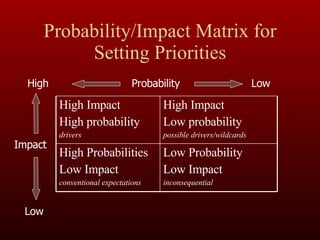
Probability/Impact Matrix for Setting Priorities Probability Impact High Low Low Low Probability Low Impact inconsequential High Probabilities Low Impact conventional expectations High Impact Low probability possible drivers/wildcards High Impact High probability drivers
Issue Identification As a lead teacher what do you find hard to implement in terms of pedagogy How do you know the ICTPD contract is lifting learning in your school? Making a difference to learning?
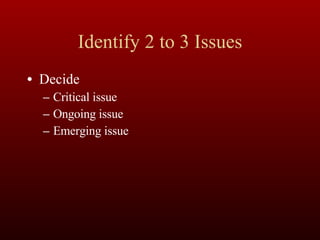
Identify 2 to 3 Issues Decide Critical issue Ongoing issue Emerging issue
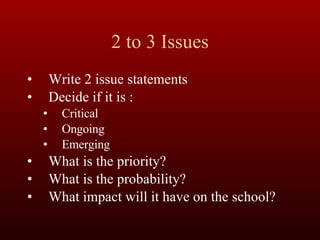
2 to 3 Issues Write 2 issue statements Decide if it is : Critical Ongoing Emerging What is the priority? What is the probability? What impact will it have on the school?
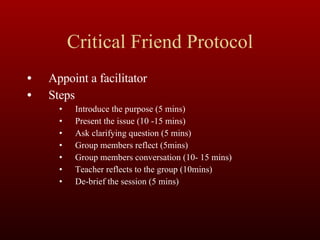
Critical Friend Protocol Appoint a facilitator Steps Introduce the purpose (5 mins) Present the issue (10 -15 mins) Ask clarifying question (5 mins) Group members reflect (5mins) Group members conversation (10- 15 mins) Teacher reflects to the group (10mins) De-brief the session (5 mins)
Tough Conversation We can have the conversations needed to create the results we say we want in our lives, or we can have all of our reasons why we can't have those conversations. But we can't have both. Reasons or results. We get to choose.'(Susan Scott, 2004)
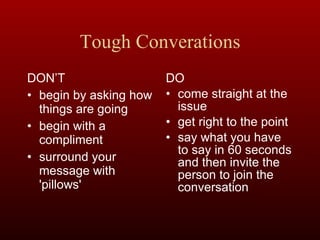
Tough Converations DON’T begin by asking how things are going begin with a compliment surround your message with 'pillows' DO come straight at the issue get right to the point say what you have to say in 60 seconds and then invite the person to join the conversation
A Three Step Process 1.Opening statement 2.Interaction 3.Resolution
Substantive Dialogue
A Hypothetical Issue ICT equipment is continually been broken in a particular classroom. Equipment is going missing. The teacher doesn’t set down any guidelines for students and there seems very little organisation. A teacher is undermining, a new strategy the school is planning to undertake with classroom coaching to improve inquiry practices in the classroom.
What are you going to do as a leader? What would you do?
Pedagogy Coaching Model  Turning Theory into Practice Julia Atkin - Beliefs/Values “ Educational design is a complex process .  The cornerstones for its integrity are our values and beliefs.  The key to its coherence is ongoing review of the various processes.  These key processes include: revisiting and clarifying our values and beliefs; stating our mission – our educative purpose; developing our understandings about how people learn; and being responsive to the context in determining what students should learn in their school learning years.”
We believe: Enjoyment enhances learning Motivation is essential for effective learning  We value: Communication with other cultures Equal opportunity       Values & Beliefs about Learning Underpinning the Use of  Information and Communication Technologies Julia Atkin
We believe: Enjoyment enhances learning Motivation is essential for effective learning  Engagement is critical for effective learning Ownership heightens intrinsic motivation Learning is amplified and deepened through processing and reprocessing  - through "making it your own" and through multiple ways of knowing A sense of achievement enhances learning and stimulates further learning Rapid feedback enhances motivation Learning is enhanced by celebration We value: Communication with other cultures Equal opportunity Empowering learners The development of critical evaluation skills Developing the confidence and skill to use available technologies effectively Learning for a full life - learning for leisure as well as learning for productive   contribution  Learning to learn The development of thinking skills       Values & Beliefs about Learning Underpinning the Use of  Information and Communication Technologies Julia Atkin
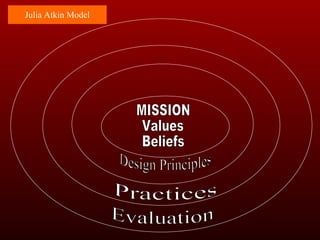
MISSION Values Beliefs Design Principles Practices Julia Atkin Model Evaluation
Quality Learning Circle Model Models of teachers engaged in professional dialogue
QLC Structured opportunities to narrate real instances of teaching and learning Critically reflect on own professional practice and that of their colleagues 3 phases Talk on a selected theme based on classroom teaching Observe practice in action as a learner Reflect on each others work. Beliefs and value statements
The Process Plan the visit Visit the classroom Provide feedback Take to the QLC Key values and beliefs Check against schools key values and beliefs
Plan the visit Organise the time Organise the Classroom release Decide on the purpose of the visit Discuss any necessary background information that will be relevant to the observation Decide on the data gathering process Decide how this will be recorded Decide on the time to give feedback
In the Classroom Arrive at correct time Place yourself where you are unobtrusive Concentrate on the data gathering for the teacher Quantative data Qualitative data  Keep to the agreed time May be used as a time to gather data for own personal learning
Feedback and Feed-forward Chose the time carefully - no interruptions Make time close to the observation Have the data documented - concept mapping Give feedback based on objective data collected What does this mean to the teacher Make notes on suggested form Decide how to feedback to the group
Beliefs/Value What are your beliefs about teaching and learning using ICT? What do you value about teaching and learning using ICT?
Formulate Key Values and Beliefs Teacher asked to summarise what their key beliefs and values are based on this observation Other group members are asked to contribute to this Check back with school’s key values and beliefs
Do you know where you are going? Leading others Capable of creating the future Having a clear vision that is in-line with the school’s direction
 
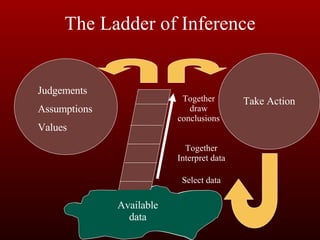
Available data The Ladder of Inference Available data Available data Together draw conclusions Together Interpret data Select data Available data Judgements Assumptions Values Take Action
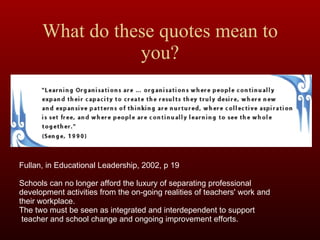
What do these quotes mean to you? Fullan, in Educational Leadership, 2002, p 19 Schools can no longer afford the luxury of separating professional development activities from the on-going realities of teachers' work and their workplace. The two must be seen as integrated and interdependent to support teacher and school change and ongoing improvement efforts.
What are our Norms for Working How do we like to be treated in a group? How do we like others to treat us? What are our shared norms and values that we are going to adhere to when discussing issues in the group situation?
Difference to Learning What are trying to achieve? How do we know we are making a difference to learning? How can we measure the difference to the learning?
Leading Learning Inquiry Learning Process How do we keep the momentum going?
Explicit teaching to get depth As researchers and investigators we know how to ・ use the table of contents in books ・ use indexes ・ locate information on the Internet ・ read statistical information ・ read abstracts ・ take notes ・ skim read ・ find main ideas ・ use interview techniques ・ undertake experimental research
Locate Information on the Internet What do you expect the students to know by end of year 2, 4, 6 Level 1 Level 2 Level 3
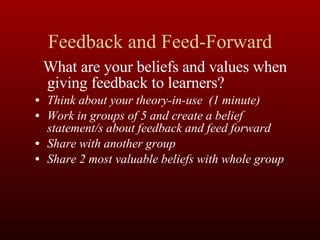
Feedback and Feed-Forward What are your beliefs and values when giving feedback to learners? Think about your theory-in-use  (1 minute) Work in groups of 5 and create a belief statement/s about feedback and feed forward Share with another group Share 2 most valuable beliefs with whole group
One Model Quality Learning Circle
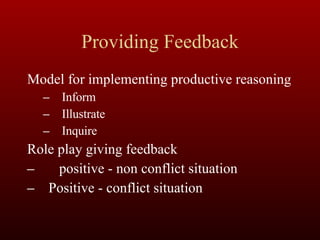
Providing Feedback Model for implementing productive reasoning Inform Illustrate Inquire Role play giving feedback positive - non conflict situation Positive - conflict situation
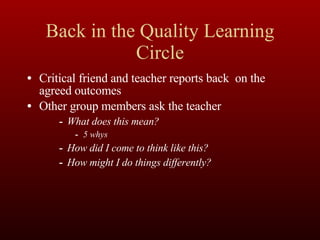
Back in the Quality Learning Circle Critical friend and teacher reports back  on the agreed outcomes Other group members ask the teacher  What does this mean?  5 whys How did I come to think like this?  How might I do things differently?
B. Pedagogy Coaching Model Turning Theory into Practice Quality Learning Circles  David Stewart Digital portfolio  - Learning Journey WJ Smyth - reflective practices/questioning What do I do? (describe) What does this mean? (inform) How did I come to be like this? (confront) How might I do things differently? (reconstruct)
Coaching - Skills The easy part………….
Expertise in ICT Skill  Software List different software e.g. word, powerpoint kidpix etc Data Bases Student files/profiles Planning Assessment Trouble shooting Sharing information Internet Intranet Extranet Email
Practical Ideas - Skill Coaching  Buddies across the school Basic trouble shooters Develop those with the passion/identified skills Additional professional development  Identifying ICT coaches with specific skills - Teachers, support staff, students, community Using experts inside and outside the school Tekkie Brekkies  Staff meetings/team meetings Modelling in the classrooms Co-operative planning One on one support Similar group needs support
Technical Advise Basic trouble shooters More technical trouble shooters Outside technical support for the school
Coaching Plan Beliefs/values Aims/objectives Actions - who/when Cost Expected outcomes
Advisory Team – Dream Team Mixed skills Mixed abilities Mixed roles/responsibilities Students Community member

Cluster workshop

  • 1.
    Noline Skeet branching-out consultancy
  • 2.
    Agenda Professional Inquiry Tough Conversations Cluster sharing of resources Milestone reporting Further planning
  • 3.
    Purpose for theDay To build your leadership skills to sustain the ICTPD contract What is the research saying How can you get depth in your leadership? How can you get quality professional dialogue going in your school to improve learning? Having those tough conversations
  • 4.
    Sustainable School Leadership“ Sustainable educational leadership and improvement preserves and develops deep learning for all that spreads and lasts, in ways that do no harm to and indeed creates positive benefits for others around us, now and in the future.” Andy Hargeaves & Dean Fink
  • 5.
    Seven principles ofSustainability Depth Length Breadth Justice Diversity Resourcefulness Conservation
  • 6.
    Depth Sustainable leadershipmatters. It preserves, protects, and promotes deep and broad understanding for all in relationships of care for others.
  • 7.
    Sustainable leadership “Sustainable leadership fully understands the nature and process of student learning, engages directly and regularly with learning and teaching in the classroom, and promotes learning among other adults in order to find continuing ways to improve abd expend the learning of students.” Andy Hargeaves & Dean Fink
  • 8.
    Learning = Excellentmeal Wholesome ingredients Rich and varied menu Caring preparation Pleasing presentation
  • 9.
    Reflecting on yourpractice What have you done since the workshop to increased your leadership skills?
  • 10.
    4 Step MethodIssue identification Issue analysis Issue change strategy option (priority setting) Issue action programming
  • 11.
    Probability/Impact Matrix forSetting Priorities Probability Impact High Low Low Low Probability Low Impact inconsequential High Probabilities Low Impact conventional expectations High Impact Low probability possible drivers/wildcards High Impact High probability drivers
  • 12.
    Issue Identification Asa lead teacher what do you find hard to implement in terms of pedagogy How do you know the ICTPD contract is lifting learning in your school? Making a difference to learning?
  • 13.
    Identify 2 to3 Issues Decide Critical issue Ongoing issue Emerging issue
  • 14.
    2 to 3Issues Write 2 issue statements Decide if it is : Critical Ongoing Emerging What is the priority? What is the probability? What impact will it have on the school?
  • 15.
    Critical Friend ProtocolAppoint a facilitator Steps Introduce the purpose (5 mins) Present the issue (10 -15 mins) Ask clarifying question (5 mins) Group members reflect (5mins) Group members conversation (10- 15 mins) Teacher reflects to the group (10mins) De-brief the session (5 mins)
  • 16.
    Tough Conversation Wecan have the conversations needed to create the results we say we want in our lives, or we can have all of our reasons why we can't have those conversations. But we can't have both. Reasons or results. We get to choose.'(Susan Scott, 2004)
  • 17.
    Tough Converations DON’Tbegin by asking how things are going begin with a compliment surround your message with 'pillows' DO come straight at the issue get right to the point say what you have to say in 60 seconds and then invite the person to join the conversation
  • 18.
    A Three StepProcess 1.Opening statement 2.Interaction 3.Resolution
  • 19.
  • 20.
    A Hypothetical IssueICT equipment is continually been broken in a particular classroom. Equipment is going missing. The teacher doesn’t set down any guidelines for students and there seems very little organisation. A teacher is undermining, a new strategy the school is planning to undertake with classroom coaching to improve inquiry practices in the classroom.
  • 21.
    What are yougoing to do as a leader? What would you do?
  • 22.
    Pedagogy Coaching Model Turning Theory into Practice Julia Atkin - Beliefs/Values “ Educational design is a complex process . The cornerstones for its integrity are our values and beliefs. The key to its coherence is ongoing review of the various processes. These key processes include: revisiting and clarifying our values and beliefs; stating our mission – our educative purpose; developing our understandings about how people learn; and being responsive to the context in determining what students should learn in their school learning years.”
  • 23.
    We believe: Enjoymentenhances learning Motivation is essential for effective learning We value: Communication with other cultures Equal opportunity       Values & Beliefs about Learning Underpinning the Use of Information and Communication Technologies Julia Atkin
  • 24.
    We believe: Enjoymentenhances learning Motivation is essential for effective learning Engagement is critical for effective learning Ownership heightens intrinsic motivation Learning is amplified and deepened through processing and reprocessing - through "making it your own" and through multiple ways of knowing A sense of achievement enhances learning and stimulates further learning Rapid feedback enhances motivation Learning is enhanced by celebration We value: Communication with other cultures Equal opportunity Empowering learners The development of critical evaluation skills Developing the confidence and skill to use available technologies effectively Learning for a full life - learning for leisure as well as learning for productive  contribution Learning to learn The development of thinking skills       Values & Beliefs about Learning Underpinning the Use of Information and Communication Technologies Julia Atkin
  • 25.
    MISSION Values BeliefsDesign Principles Practices Julia Atkin Model Evaluation
  • 26.
    Quality Learning CircleModel Models of teachers engaged in professional dialogue
  • 27.
    QLC Structured opportunitiesto narrate real instances of teaching and learning Critically reflect on own professional practice and that of their colleagues 3 phases Talk on a selected theme based on classroom teaching Observe practice in action as a learner Reflect on each others work. Beliefs and value statements
  • 28.
    The Process Planthe visit Visit the classroom Provide feedback Take to the QLC Key values and beliefs Check against schools key values and beliefs
  • 29.
    Plan the visitOrganise the time Organise the Classroom release Decide on the purpose of the visit Discuss any necessary background information that will be relevant to the observation Decide on the data gathering process Decide how this will be recorded Decide on the time to give feedback
  • 30.
    In the ClassroomArrive at correct time Place yourself where you are unobtrusive Concentrate on the data gathering for the teacher Quantative data Qualitative data Keep to the agreed time May be used as a time to gather data for own personal learning
  • 31.
    Feedback and Feed-forwardChose the time carefully - no interruptions Make time close to the observation Have the data documented - concept mapping Give feedback based on objective data collected What does this mean to the teacher Make notes on suggested form Decide how to feedback to the group
  • 32.
    Beliefs/Value What areyour beliefs about teaching and learning using ICT? What do you value about teaching and learning using ICT?
  • 33.
    Formulate Key Valuesand Beliefs Teacher asked to summarise what their key beliefs and values are based on this observation Other group members are asked to contribute to this Check back with school’s key values and beliefs
  • 34.
    Do you knowwhere you are going? Leading others Capable of creating the future Having a clear vision that is in-line with the school’s direction
  • 35.
  • 36.
    Available data TheLadder of Inference Available data Available data Together draw conclusions Together Interpret data Select data Available data Judgements Assumptions Values Take Action
  • 37.
    What do thesequotes mean to you? Fullan, in Educational Leadership, 2002, p 19 Schools can no longer afford the luxury of separating professional development activities from the on-going realities of teachers' work and their workplace. The two must be seen as integrated and interdependent to support teacher and school change and ongoing improvement efforts.
  • 38.
    What are ourNorms for Working How do we like to be treated in a group? How do we like others to treat us? What are our shared norms and values that we are going to adhere to when discussing issues in the group situation?
  • 39.
    Difference to LearningWhat are trying to achieve? How do we know we are making a difference to learning? How can we measure the difference to the learning?
  • 40.
    Leading Learning InquiryLearning Process How do we keep the momentum going?
  • 41.
    Explicit teaching toget depth As researchers and investigators we know how to ・ use the table of contents in books ・ use indexes ・ locate information on the Internet ・ read statistical information ・ read abstracts ・ take notes ・ skim read ・ find main ideas ・ use interview techniques ・ undertake experimental research
  • 42.
    Locate Information onthe Internet What do you expect the students to know by end of year 2, 4, 6 Level 1 Level 2 Level 3
  • 43.
    Feedback and Feed-ForwardWhat are your beliefs and values when giving feedback to learners? Think about your theory-in-use (1 minute) Work in groups of 5 and create a belief statement/s about feedback and feed forward Share with another group Share 2 most valuable beliefs with whole group
  • 44.
    One Model QualityLearning Circle
  • 45.
    Providing Feedback Modelfor implementing productive reasoning Inform Illustrate Inquire Role play giving feedback positive - non conflict situation Positive - conflict situation
  • 46.
    Back in theQuality Learning Circle Critical friend and teacher reports back on the agreed outcomes Other group members ask the teacher What does this mean? 5 whys How did I come to think like this? How might I do things differently?
  • 47.
    B. Pedagogy CoachingModel Turning Theory into Practice Quality Learning Circles David Stewart Digital portfolio - Learning Journey WJ Smyth - reflective practices/questioning What do I do? (describe) What does this mean? (inform) How did I come to be like this? (confront) How might I do things differently? (reconstruct)
  • 48.
    Coaching - SkillsThe easy part………….
  • 49.
    Expertise in ICTSkill Software List different software e.g. word, powerpoint kidpix etc Data Bases Student files/profiles Planning Assessment Trouble shooting Sharing information Internet Intranet Extranet Email
  • 50.
    Practical Ideas -Skill Coaching Buddies across the school Basic trouble shooters Develop those with the passion/identified skills Additional professional development Identifying ICT coaches with specific skills - Teachers, support staff, students, community Using experts inside and outside the school Tekkie Brekkies Staff meetings/team meetings Modelling in the classrooms Co-operative planning One on one support Similar group needs support
  • 51.
    Technical Advise Basictrouble shooters More technical trouble shooters Outside technical support for the school
  • 52.
    Coaching Plan Beliefs/valuesAims/objectives Actions - who/when Cost Expected outcomes
  • 53.
    Advisory Team –Dream Team Mixed skills Mixed abilities Mixed roles/responsibilities Students Community member