NZPF Conference 3 July 2008 Dr Cheryl Doig Powerful Professional  Learning Communities
 
WHAT IS A PLC? When members of your school collaborate in an intentional and consistent manner to support student learning.
Adapted from Joan Dalton and David Anderson  www.plotpd.com Relationships occurs in the context of your school environment   Learning Support Working together, sharing ideas and being supported to update knowledge and skills Challenge To raise student achievement through evidence based learning conversations A Professional Community
decreased teacher isolation increased commitment to mission shared responsibility more powerful learning higher likelihood of fundamental system change Why bother? DuFour, DuFour & Eaker (2002)
COLLABORATIVE CULTURE Support Working together, sharing ideas and being supported to update knowledge and skills Diversity Systems SUPPORT
Develop the key competencies in your adults Staff feedback - induction, satisfaction, and exit  This is an easy way to initiate a PLC Yeah RIGHT!
What are we currently doing in our school? What connections have you made?
FOCUS ON RESULTS CHALLENGE Challenge To raise student achievement through evidence based learning conversations Building capacity Professional Inquiry Implementing a PLC - beyond support
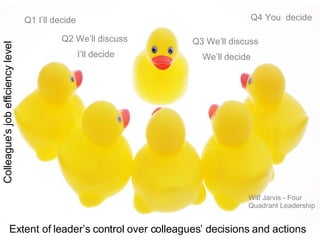
Q1 I’ll decide Colleague’s job efficiency level Extent of leader’s control over colleagues’ decisions and actions Q2 We’ll discuss I’ll decide Q3 We’ll discuss We’ll decide Q4 You  decide Wilf Jarvis - Four Quadrant Leadership
School Talk Non-learning Talk Learning Talk Teacher practice, student learning and so what? Non-teaching Talk Eg organisation, resourcing Teacher Practices Talk Describes practice without attached analysis or learning Professional Inquiry Adapted from Annan, Lai & Robinson 2003 With recognition to Roween Higgie,  Principal of Remuera School
Human systems move in the direction of what they most frequently and persistently ask questions about.  What you study G R O W S Yeah RIGHT! Firebox - Auger - Tuyere
What are the things you persistently ask questions about in your school?  Are these the most important things?  What one area do you want to work on next in order to bring about the next step of your challenge? If you’re not moving forward you’re going backward.
RELATIONSHIPS CULTURE BUILDING Sustaining the change Sustaining a PLC - beyond support and challenge
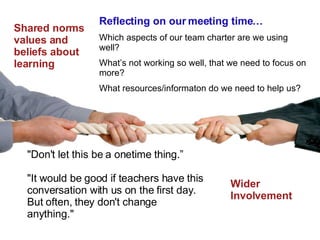
Shared norms  values and beliefs about learning Reflecting on our meeting time… Which aspects of our team charter are we using well? What’s not working so well, that we need to focus on more? What resources/informaton do we need to help us? Wider Involvement "Don't let this be a onetime thing.”  "It would be good if teachers have this conversation with us on the first day. But often, they don't change anything."
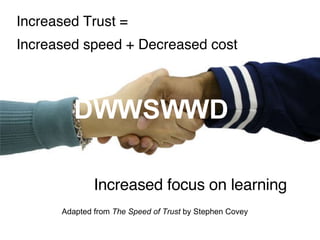
Increased Trust =  Increased speed + Decreased cost Increased focus on learning Adapted from  The Speed of Trust  by Stephen Covey DWWSWWD
Decreased Trust results in…  decreased speed + increased cost Decreased focus on learning Adapted from  The Speed of Trust  by Stephen Covey When the safety and well being of students is compromised challenge comes before support.
Yeah RIGHT! Embed feedback systems for students, staff and parents into your ‘way of doing things’ - never assume! Find safe ways of getting feedback about yourself and take action You can’t do it alone. It’s messy. It’s moral. It’s everyone’s responsibility!
Trust….credibility…   … .Shared norms….   … whose voices…. What would your staff say about the relationships you have?
FOCUS ON LEARNING What do we want  each child to learn? WHY? How will we know when  each child has learnt it? How will we respond when students experience difficulties in learning? DuFour et al, 2004
http://twentyfivedays.wordpress.com/ Sheryl Nussbaum-Beach http://www.21stcenturycollaborative.com/
INTO  THEIR  FUTURE… Role of other voices - all staff, students and parents Google -Docs, Groups, Alerts  www.google.com/ Blogs  http://www.blogger.com/ Wikis  www.wetpaint.com FaceBook  www.facebook.com Skype  www.Skype.com Online Surveys                             www.freeonlinesurveys.com   www.surveymonkey.com http://thinkbeyondltd.blogspot.com/ Knowledge Cafes  www.gurteen.com/ http://communityengagement.wetpaint.com/
Focus on LEARNING Support Challenge A Professional Working together: -within your schools -between schools --with external agencies  Learning Community Focus on teachers, students and the interaction between them  - get into the  learning  environment Relationships
www.thinkbeyond.co.nz What’s the smallest change that could make the biggest impact?
Identify where you are at now - what  you  can change or influence. Once you know this aim to close the gap between what you know and what you do. Build shared knowledge and understanding to gain commitment. Eliminate practices that don’t align. Make small, powerful changes that translate the vision into action… “ It’s what you do that matters, not what you call it.” How do we get started? Eaker, DuFour & DuFour (2004)
Reference List Boyd, S. (2005).  Teachers as lifelong learners.  A paper presented at NZARE, Dunedin, 2005. NZCER: New Zealand.  Downloaded from  http://www.nzcer.org.nz/pdfs/14717.pdf Eaker, DuFour and DuFour, 2002). Getting Started: Reculturing Schools to Become Professional Learning Communities. Bloomington, Indiana: National Education Service.  DuFour, R., DuFour, R., Eaker, R. & Many, T. ().  Learning by doing: A handbook for professional learning communities at work.  Bloomington: Solution Tree. Robinson, V. & Lai, M.K. (2006).  Practitioner research for educators: A guide to improving classrooms and schools.  Australia: Hawker Brownlow. National College of School Leadership and Louise Stoll - pdfs can be downloaded from  http://www.ncsl.org.uk/networked/networked-o-z.cfm Timperley, H., & Parr, J. (2004).  Using evidence in teaching practice: Implications for professional learning . Auckland: Hodder Moa Beckett. Timpereley, H., Wilson, A., Barrar, H., & Fung, I. (2207).  Teacher  professional learning and development: Best evidence synthesis iteration (BES).  Wellington: Ministry of Education. Can be downloaded from   http://www.educationcounts.govt.nz/publications/series/2515/15341 McKinsey Report (2007). How the world’s best performing school systems come out on top. Can be downloaded from  www.mckinsey.com/clientservice/socialsector/resources/pdf/Worlds_School_Systems_Final.pdf Other researchers/writers to explore include - Lorna Earl. Andy Hargreaves, Karen Seashore Loiuse, Bill Mulford and Jan Robertson.
It’s not just about what students are taught… it’s about ensuring that they learn  - no matter who their teacher is.
Learning uncomfortable enough to keep you on your toes Learning comfortable enough to engage with it -  Wenger

Professional Learning Communities

  • 1.
    NZPF Conference 3July 2008 Dr Cheryl Doig Powerful Professional Learning Communities
  • 2.
  • 3.
    WHAT IS APLC? When members of your school collaborate in an intentional and consistent manner to support student learning.
  • 4.
    Adapted from JoanDalton and David Anderson www.plotpd.com Relationships occurs in the context of your school environment Learning Support Working together, sharing ideas and being supported to update knowledge and skills Challenge To raise student achievement through evidence based learning conversations A Professional Community
  • 5.
    decreased teacher isolationincreased commitment to mission shared responsibility more powerful learning higher likelihood of fundamental system change Why bother? DuFour, DuFour & Eaker (2002)
  • 6.
    COLLABORATIVE CULTURE SupportWorking together, sharing ideas and being supported to update knowledge and skills Diversity Systems SUPPORT
  • 7.
    Develop the keycompetencies in your adults Staff feedback - induction, satisfaction, and exit This is an easy way to initiate a PLC Yeah RIGHT!
  • 8.
    What are wecurrently doing in our school? What connections have you made?
  • 9.
    FOCUS ON RESULTSCHALLENGE Challenge To raise student achievement through evidence based learning conversations Building capacity Professional Inquiry Implementing a PLC - beyond support
  • 10.
    Q1 I’ll decideColleague’s job efficiency level Extent of leader’s control over colleagues’ decisions and actions Q2 We’ll discuss I’ll decide Q3 We’ll discuss We’ll decide Q4 You decide Wilf Jarvis - Four Quadrant Leadership
  • 11.
    School Talk Non-learningTalk Learning Talk Teacher practice, student learning and so what? Non-teaching Talk Eg organisation, resourcing Teacher Practices Talk Describes practice without attached analysis or learning Professional Inquiry Adapted from Annan, Lai & Robinson 2003 With recognition to Roween Higgie, Principal of Remuera School
  • 12.
    Human systems movein the direction of what they most frequently and persistently ask questions about. What you study G R O W S Yeah RIGHT! Firebox - Auger - Tuyere
  • 13.
    What are thethings you persistently ask questions about in your school? Are these the most important things? What one area do you want to work on next in order to bring about the next step of your challenge? If you’re not moving forward you’re going backward.
  • 14.
    RELATIONSHIPS CULTURE BUILDINGSustaining the change Sustaining a PLC - beyond support and challenge
  • 15.
    Shared norms values and beliefs about learning Reflecting on our meeting time… Which aspects of our team charter are we using well? What’s not working so well, that we need to focus on more? What resources/informaton do we need to help us? Wider Involvement "Don't let this be a onetime thing.” "It would be good if teachers have this conversation with us on the first day. But often, they don't change anything."
  • 16.
    Increased Trust = Increased speed + Decreased cost Increased focus on learning Adapted from The Speed of Trust by Stephen Covey DWWSWWD
  • 17.
    Decreased Trust resultsin… decreased speed + increased cost Decreased focus on learning Adapted from The Speed of Trust by Stephen Covey When the safety and well being of students is compromised challenge comes before support.
  • 18.
    Yeah RIGHT! Embedfeedback systems for students, staff and parents into your ‘way of doing things’ - never assume! Find safe ways of getting feedback about yourself and take action You can’t do it alone. It’s messy. It’s moral. It’s everyone’s responsibility!
  • 19.
    Trust….credibility… … .Shared norms…. … whose voices…. What would your staff say about the relationships you have?
  • 20.
    FOCUS ON LEARNINGWhat do we want each child to learn? WHY? How will we know when each child has learnt it? How will we respond when students experience difficulties in learning? DuFour et al, 2004
  • 21.
    http://twentyfivedays.wordpress.com/ Sheryl Nussbaum-Beachhttp://www.21stcenturycollaborative.com/
  • 22.
    INTO THEIR FUTURE… Role of other voices - all staff, students and parents Google -Docs, Groups, Alerts www.google.com/ Blogs http://www.blogger.com/ Wikis www.wetpaint.com FaceBook www.facebook.com Skype www.Skype.com Online Surveys www.freeonlinesurveys.com www.surveymonkey.com http://thinkbeyondltd.blogspot.com/ Knowledge Cafes www.gurteen.com/ http://communityengagement.wetpaint.com/
  • 23.
    Focus on LEARNINGSupport Challenge A Professional Working together: -within your schools -between schools --with external agencies Learning Community Focus on teachers, students and the interaction between them - get into the learning environment Relationships
  • 24.
    www.thinkbeyond.co.nz What’s thesmallest change that could make the biggest impact?
  • 25.
    Identify where youare at now - what you can change or influence. Once you know this aim to close the gap between what you know and what you do. Build shared knowledge and understanding to gain commitment. Eliminate practices that don’t align. Make small, powerful changes that translate the vision into action… “ It’s what you do that matters, not what you call it.” How do we get started? Eaker, DuFour & DuFour (2004)
  • 26.
    Reference List Boyd,S. (2005). Teachers as lifelong learners. A paper presented at NZARE, Dunedin, 2005. NZCER: New Zealand. Downloaded from http://www.nzcer.org.nz/pdfs/14717.pdf Eaker, DuFour and DuFour, 2002). Getting Started: Reculturing Schools to Become Professional Learning Communities. Bloomington, Indiana: National Education Service. DuFour, R., DuFour, R., Eaker, R. & Many, T. (). Learning by doing: A handbook for professional learning communities at work. Bloomington: Solution Tree. Robinson, V. & Lai, M.K. (2006). Practitioner research for educators: A guide to improving classrooms and schools. Australia: Hawker Brownlow. National College of School Leadership and Louise Stoll - pdfs can be downloaded from http://www.ncsl.org.uk/networked/networked-o-z.cfm Timperley, H., & Parr, J. (2004). Using evidence in teaching practice: Implications for professional learning . Auckland: Hodder Moa Beckett. Timpereley, H., Wilson, A., Barrar, H., & Fung, I. (2207). Teacher professional learning and development: Best evidence synthesis iteration (BES). Wellington: Ministry of Education. Can be downloaded from http://www.educationcounts.govt.nz/publications/series/2515/15341 McKinsey Report (2007). How the world’s best performing school systems come out on top. Can be downloaded from www.mckinsey.com/clientservice/socialsector/resources/pdf/Worlds_School_Systems_Final.pdf Other researchers/writers to explore include - Lorna Earl. Andy Hargreaves, Karen Seashore Loiuse, Bill Mulford and Jan Robertson.
  • 27.
    It’s not justabout what students are taught… it’s about ensuring that they learn - no matter who their teacher is.
  • 28.
    Learning uncomfortable enoughto keep you on your toes Learning comfortable enough to engage with it - Wenger

Editor's Notes

  • #2 There is no handout for this presentation - the more we keep in digital format the more trees will be saved. However the slides from this presentation can be downloaded from her website, which will be shown at the end of the presentation. Cards with contact details are also available from the front of the stage at the end of the presentation.