Developing Educational PracticeDay 2
Overview of day 2Recap of yesterdayObservations and reflectionsReflectionWhy is reflection so central to teaching and learning?PracticeTeaching 1:1, small groups, lectures, critsDesigning the curriculum What are we trying to achieve? How do we support student-centred learning?
What do we know about how people learn?
What does our understanding of how people learn mean for teaching?
BrainstormImagine you have been asked to deliver a guest lecture on the theory and use of colour.What would you need to know in order to plan the session? Where would you go to find the answers?
ReflectionWhat is it?What is it for?
Group workGet into groups of three or four – work with new peopleIn your groups, work quickly and come up with as many ideas as you can about why reflection is considered to be so important for learning and teachingAccept every idea, don’t debate or discuss, just write everything downFeedback to the big group
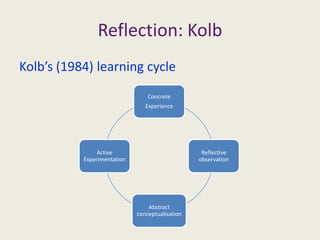
Ideas about reflection: KolbLearning is grounded in experience and reflection on experienceThere is a cycle made up of four stagesWe can enter the cycle at any point but must complete all four stages for successful learning to happen
Reflection: KolbKolb’s (1984) learning cycle
Ideas about reflection: SchönDonald Schön (1983) – idea of the reflective practitioner testing out theoriesReflection-in-actionThinking on your feetBuilding new understandings as you go, based on existing theories and experienceReflection-on-actionDone after the eventTime taken to explore how and why we acted as we did, what was going onDevelop questions and ideas
Ideas about reflection: BrookfieldBrookfield asks how possible it is for us to see ourselves in reality.He offers four lenses to enable self-reflection:Our autobiographies as learners and teachersOur students’ eyesOur colleagues’ experiencesTheoretical literature
Ideas about reflection: AmulyaNotion of purposeful learning – a way to prevent doing from overtaking learningConsciously trying to learn from struggles, dilemmas, uncertainty, conflicts, breakthroughsBringing our experience to language through writing and/or dialogue with others means that we that we have to analyse more carefully and more consciouslyReflection on your learning (Day 3)At the end of this course we ask you to undertake purposeful learning about your practice through reflection
You will identify an aspect of your teaching that you want to reflect on intentionally and purposefully in order to understand your experience better
You will need to write a 500 word reflection which will form the basis of a short presentation to the group on Day 3
You can revise your reflection after the presentation and then submit it to CLTAD, in order to complete the courseb r e a k
Practiceteacher-centred OR student-centred?filling empty vessels OR meeting individual needs?
PracticeOne to one teachingTutorialsSmall groupsLecturesCrits
What opportunities and challenges do these formats bring?When might you use each format?
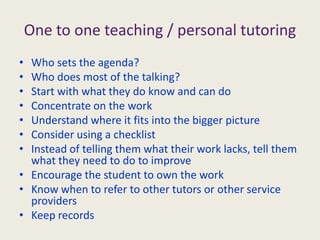
One to one teaching / personal tutoringWho sets the agenda?Who does most of the talking?Start with what they do know and can doConcentrate on the workUnderstand where it fits into the bigger pictureConsider using a checklistInstead of telling them what their work lacks, tell them what they need to do to improveEncourage the student to own the workKnow when to refer to other tutors or other service providersKeep records
Small groups Learning from each otherGroup dynamicsCan take time to build trust
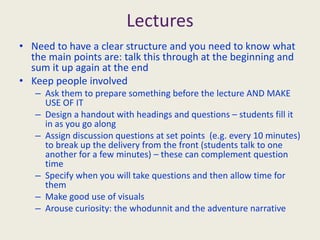
LecturesNeed to have a clear structure and you need to know what the main points are: talk this through at the beginning and sum it up again at the endKeep people involvedAsk them to prepare something before the lecture AND MAKE USE OF ITDesign a handout with headings and questions – students fill it in as you go alongAssign discussion questions at set points  (e.g. every 10 minutes) to break up the delivery from the front (students talk to one another for a few minutes) – these can complement question timeSpecify when you will take questions and then allow time for themMake good use of visualsArouse curiosity: the whodunnit and the adventure narrative
Managing critsYour experiences…
Designing for learningGet into groups of threeYou are going to be the teaching team of a first year BA-level unit in some aspect of Art and DesignDiscuss among yourselves and decide what your specific subject area is – try to be as specific as possible
 Step 1: AimsWhat are the aims of the course?These are your broad, general aspirationsWhat is your general purpose in running the courseWhat sort of aspirations do you have for students who take the course?
Step 2: Learning OutcomesWhat are the intended learning outcomes of your course?These are the assessable changes to the students’ behaviourWhat should they be able to do at the end of your course?Have a go at writing 3-4 Learning Outcomes
Step 3: AssessmentWhat forms of assessment might allow the students to demonstrate that they had achieved the outcomes you have written?Be as specific as possible – imagine this is a real course involving real students
Step 4: ActivitiesWhich teaching and learning activities will help people to prepare for the assessment tasks you have in mind?What will your teaching sessions involve?What will you be requiring students to do when they are not with you?
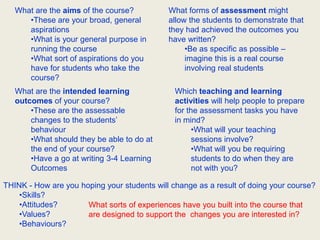
What are the aims of the course?These are your broad, general aspirations
What is your general purpose in running the course
What sort of aspirations do you have for students who take the course?What forms of assessment might allow the students to demonstrate that they had achieved the outcomes you have written?Be as specific as possible – imagine this is a real course involving real studentsWhat are the intended learning outcomes of your course?These are the assessable changes to the students’ behaviour
What should they be able to do at the end of your course?
Have a go at writing 3-4 Learning OutcomesWhich teaching and learning activities will help people to prepare for the assessment tasks you have in mind?What will your teaching sessions involve?

Developing Educational Practice #2

  • 1.
  • 3.
    Overview of day2Recap of yesterdayObservations and reflectionsReflectionWhy is reflection so central to teaching and learning?PracticeTeaching 1:1, small groups, lectures, critsDesigning the curriculum What are we trying to achieve? How do we support student-centred learning?
  • 4.
    What do weknow about how people learn?
  • 5.
    What does ourunderstanding of how people learn mean for teaching?
  • 6.
    BrainstormImagine you havebeen asked to deliver a guest lecture on the theory and use of colour.What would you need to know in order to plan the session? Where would you go to find the answers?
  • 7.
  • 8.
    Group workGet intogroups of three or four – work with new peopleIn your groups, work quickly and come up with as many ideas as you can about why reflection is considered to be so important for learning and teachingAccept every idea, don’t debate or discuss, just write everything downFeedback to the big group
  • 9.
    Ideas about reflection:KolbLearning is grounded in experience and reflection on experienceThere is a cycle made up of four stagesWe can enter the cycle at any point but must complete all four stages for successful learning to happen
  • 10.
  • 11.
    Ideas about reflection:SchönDonald Schön (1983) – idea of the reflective practitioner testing out theoriesReflection-in-actionThinking on your feetBuilding new understandings as you go, based on existing theories and experienceReflection-on-actionDone after the eventTime taken to explore how and why we acted as we did, what was going onDevelop questions and ideas
  • 12.
    Ideas about reflection:BrookfieldBrookfield asks how possible it is for us to see ourselves in reality.He offers four lenses to enable self-reflection:Our autobiographies as learners and teachersOur students’ eyesOur colleagues’ experiencesTheoretical literature
  • 13.
    Ideas about reflection:AmulyaNotion of purposeful learning – a way to prevent doing from overtaking learningConsciously trying to learn from struggles, dilemmas, uncertainty, conflicts, breakthroughsBringing our experience to language through writing and/or dialogue with others means that we that we have to analyse more carefully and more consciouslyReflection on your learning (Day 3)At the end of this course we ask you to undertake purposeful learning about your practice through reflection
  • 14.
    You will identifyan aspect of your teaching that you want to reflect on intentionally and purposefully in order to understand your experience better
  • 15.
    You will needto write a 500 word reflection which will form the basis of a short presentation to the group on Day 3
  • 16.
    You can reviseyour reflection after the presentation and then submit it to CLTAD, in order to complete the courseb r e a k
  • 17.
    Practiceteacher-centred OR student-centred?fillingempty vessels OR meeting individual needs?
  • 18.
    PracticeOne to oneteachingTutorialsSmall groupsLecturesCrits
  • 19.
    What opportunities andchallenges do these formats bring?When might you use each format?
  • 20.
    One to oneteaching / personal tutoringWho sets the agenda?Who does most of the talking?Start with what they do know and can doConcentrate on the workUnderstand where it fits into the bigger pictureConsider using a checklistInstead of telling them what their work lacks, tell them what they need to do to improveEncourage the student to own the workKnow when to refer to other tutors or other service providersKeep records
  • 21.
    Small groups Learningfrom each otherGroup dynamicsCan take time to build trust
  • 22.
    LecturesNeed to havea clear structure and you need to know what the main points are: talk this through at the beginning and sum it up again at the endKeep people involvedAsk them to prepare something before the lecture AND MAKE USE OF ITDesign a handout with headings and questions – students fill it in as you go alongAssign discussion questions at set points (e.g. every 10 minutes) to break up the delivery from the front (students talk to one another for a few minutes) – these can complement question timeSpecify when you will take questions and then allow time for themMake good use of visualsArouse curiosity: the whodunnit and the adventure narrative
  • 23.
  • 24.
    Designing for learningGetinto groups of threeYou are going to be the teaching team of a first year BA-level unit in some aspect of Art and DesignDiscuss among yourselves and decide what your specific subject area is – try to be as specific as possible
  • 25.
    Step 1:AimsWhat are the aims of the course?These are your broad, general aspirationsWhat is your general purpose in running the courseWhat sort of aspirations do you have for students who take the course?
  • 26.
    Step 2: LearningOutcomesWhat are the intended learning outcomes of your course?These are the assessable changes to the students’ behaviourWhat should they be able to do at the end of your course?Have a go at writing 3-4 Learning Outcomes
  • 27.
    Step 3: AssessmentWhatforms of assessment might allow the students to demonstrate that they had achieved the outcomes you have written?Be as specific as possible – imagine this is a real course involving real students
  • 28.
    Step 4: ActivitiesWhichteaching and learning activities will help people to prepare for the assessment tasks you have in mind?What will your teaching sessions involve?What will you be requiring students to do when they are not with you?
  • 29.
    What are theaims of the course?These are your broad, general aspirations
  • 30.
    What is yourgeneral purpose in running the course
  • 31.
    What sort ofaspirations do you have for students who take the course?What forms of assessment might allow the students to demonstrate that they had achieved the outcomes you have written?Be as specific as possible – imagine this is a real course involving real studentsWhat are the intended learning outcomes of your course?These are the assessable changes to the students’ behaviour
  • 32.
    What should theybe able to do at the end of your course?
  • 33.
    Have a goat writing 3-4 Learning OutcomesWhich teaching and learning activities will help people to prepare for the assessment tasks you have in mind?What will your teaching sessions involve?