
By
Dr. Aikyna Finch
Presentation for the Huntsville Verizon Wireless Campus
Management styles are characteristic ways of
making decisions and relating to subordinates
during the management process
The management process is
to plan, organize, lead and control.
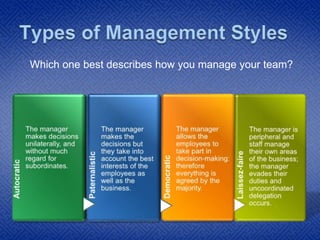
Which one best describes how you manage your team?
Which do you think is your Management Style?
 A leader who requires control over all organizational
decisions and requests little input from his or her
team members characterizes autocratic management,
also referred to as Authoritarian. In a positive sense,
autocratic leaders are good at making decisions,
although they may not always be the most informed.
 On the negative side, people who work for autocratic
managers often feel as though their contributions are no
t valued by the organization and decisions often don't
consider how it will affect employees other than the ma
nager.
 Paternalistic management is also very dictatorial,
but includes the best interests of the employees
as well as the business itself. In a very basic sens
e, the leader is often in a better situation to make
overall organizational decisions due to experience
 From a positive perspective, these managers care
about the social needs of their employees (for exa
mple, being happy), but it also slows down and clo
uds the decision-making process.
 This style gives everyone equal say in decisions, from
employees to management themselves.
The "leadership by committee" approach makes employees
feel really good about the overall product, and the
collaborative style of management often leads to more
thorough and thought-out solutions to problems.
 If the workforce doesn't have the experience necessary to
make informed decisions, they can sometimes be made
hastily while also being drawn out in the decision-making
process, but democratic leadership is popular and often
effective.
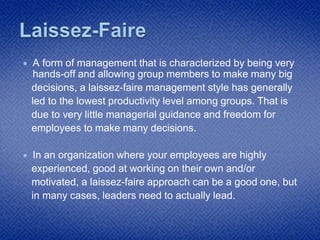
 A form of management that is characterized by being very
hands-off and allowing group members to make many big
decisions, a laissez-faire management style has generally
led to the lowest productivity level among groups. That is
due to very little managerial guidance and freedom for
employees to make many decisions.
 In an organization where your employees are highly
experienced, good at working on their own and/or
motivated, a laissez-faire approach can be a good one, but
in many cases, leaders need to actually lead.
How others see your Management Style?
Management Style Reflection
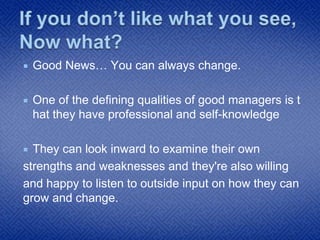
 Good News… You can always change.
 One of the defining qualities of good managers is t
hat they have professional and self-knowledge
 They can look inward to examine their own
strengths and weaknesses and they're also willing
and happy to listen to outside input on how they can
grow and change.
 • Are you prepared to adapt your style to become a m
ore effective leader?
• Is a change needed to drive business or can it functi
on as-is?
• Are you willing to ask your staff for more feedback o
n how to lead them more effectively and then listen to
their thoughts?
• What short-term changes can be made?
• What alterations in style will need a more long-term
approach?
• Who inside and outside your organization can you en
list for support in this change?
Identifying your Management Style

Identifying your Management Style

  • 1.
    By Dr. Aikyna Finch Presentationfor the Huntsville Verizon Wireless Campus
  • 2.
    Management styles arecharacteristic ways of making decisions and relating to subordinates during the management process The management process is to plan, organize, lead and control.
  • 3.
    Which one bestdescribes how you manage your team?
  • 4.
    Which do youthink is your Management Style?
  • 5.
     A leaderwho requires control over all organizational decisions and requests little input from his or her team members characterizes autocratic management, also referred to as Authoritarian. In a positive sense, autocratic leaders are good at making decisions, although they may not always be the most informed.  On the negative side, people who work for autocratic managers often feel as though their contributions are no t valued by the organization and decisions often don't consider how it will affect employees other than the ma nager.
  • 6.
     Paternalistic managementis also very dictatorial, but includes the best interests of the employees as well as the business itself. In a very basic sens e, the leader is often in a better situation to make overall organizational decisions due to experience  From a positive perspective, these managers care about the social needs of their employees (for exa mple, being happy), but it also slows down and clo uds the decision-making process.
  • 7.
     This stylegives everyone equal say in decisions, from employees to management themselves. The "leadership by committee" approach makes employees feel really good about the overall product, and the collaborative style of management often leads to more thorough and thought-out solutions to problems.  If the workforce doesn't have the experience necessary to make informed decisions, they can sometimes be made hastily while also being drawn out in the decision-making process, but democratic leadership is popular and often effective.
  • 8.
     A formof management that is characterized by being very hands-off and allowing group members to make many big decisions, a laissez-faire management style has generally led to the lowest productivity level among groups. That is due to very little managerial guidance and freedom for employees to make many decisions.  In an organization where your employees are highly experienced, good at working on their own and/or motivated, a laissez-faire approach can be a good one, but in many cases, leaders need to actually lead.
  • 9.
    How others seeyour Management Style?
  • 10.
  • 11.
     Good News…You can always change.  One of the defining qualities of good managers is t hat they have professional and self-knowledge  They can look inward to examine their own strengths and weaknesses and they're also willing and happy to listen to outside input on how they can grow and change.
  • 12.
     • Areyou prepared to adapt your style to become a m ore effective leader? • Is a change needed to drive business or can it functi on as-is? • Are you willing to ask your staff for more feedback o n how to lead them more effectively and then listen to their thoughts? • What short-term changes can be made? • What alterations in style will need a more long-term approach? • Who inside and outside your organization can you en list for support in this change?