Supervision Please turn off all cell phones
OR
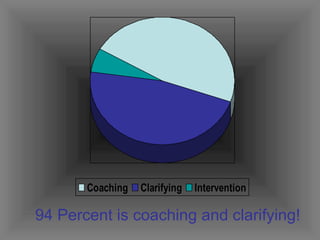
94 Percent is coaching and clarifying!
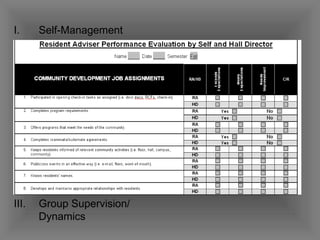
Self-Management Administration Communication Individual Supervision Group Supervision/ Dynamics
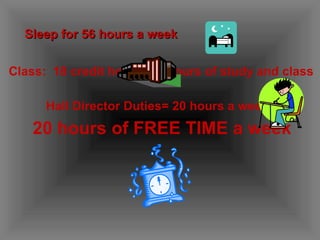
Sleep for 56 hours a week Class:  18 credit hours=72 hours of study and class Hall Director Duties= 20 hours a week 20 hours of FREE TIME a week
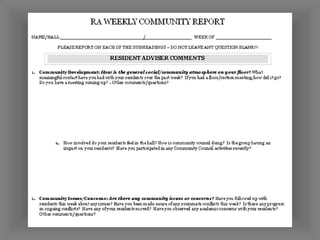
Self-Management Administration Communication Individual Supervision Group Supervision/ Dynamics Where am I keeping these things? Are they confidential? How do I want the staff to see this information? How do I want to receive this information?
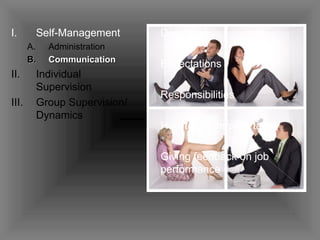
Self-Management Administration Communication Individual Supervision Group Supervision/ Dynamics Deadlines Expectations Responsibilities How to accomplish tasks Giving feedback on job performance
 
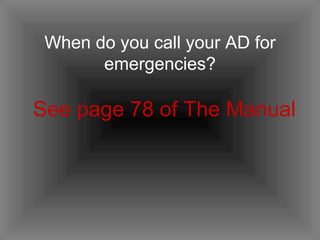
When do you call your AD for emergencies? See page 78 of The Manual
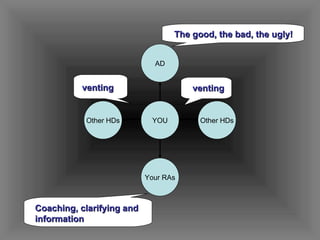
Other HDs Your RAs Other HDs AD YOU venting Coaching, clarifying and  information venting The good, the bad, the ugly!
Coaching Excerpted from the Paraprofessional Healthcare Institute ©
Coaching Organization
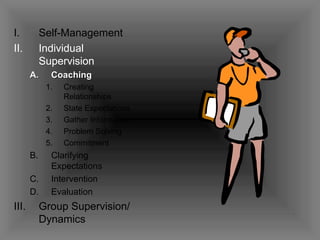
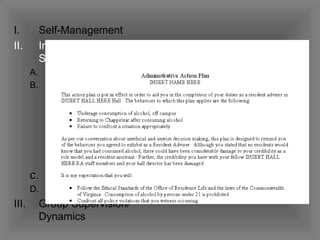
Self-Management Individual Supervision Coaching Creating Relationships State Expectations Gather Information Problem Solving Commitment Clarifying Expectations Intervention Evaluation Group Supervision/ Dynamics
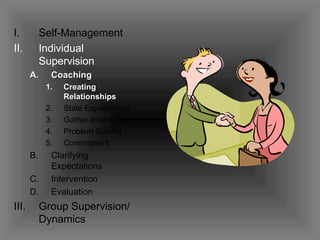
Self-Management Individual Supervision Coaching  Creating Relationships State Expectations Gather Information Problem Solving Commitment Clarifying Expectations Intervention Evaluation Group Supervision/ Dynamics
Self-Management Individual Supervision Coaching  Creating Relationships State Expectations Gather Information Problem Solving Commitment Clarifying Expectations Intervention Evaluation Group Supervision/ Dynamics Billie Jean
Self-Management Individual Supervision Coaching  Creating Relationships State Expectations Gather Information Problem Solving Commitment Clarifying Expectations Intervention Evaluation Group Supervision/ Dynamics
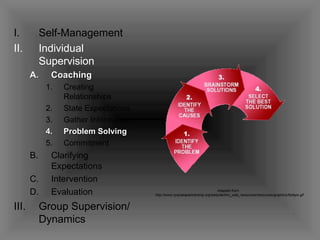
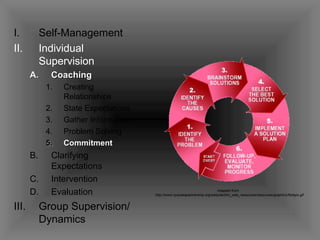
Self-Management Individual Supervision Coaching  Creating Relationships State Expectations Gather Information Problem Solving Commitment Clarifying Expectations Intervention Evaluation Group Supervision/ Dynamics Adapted from:  http://www.nyscseapartnership.org/website/lmc_web_resources/resources/graphics/6steps.gif
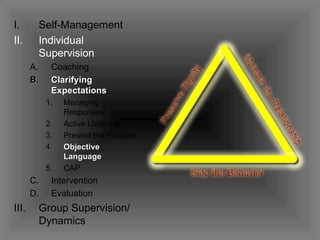
Self-Management Individual Supervision Coaching   Clarifying Expectations Managing Responses Active Listening Present the Problem Objective Language CAP Intervention Evaluation Group Supervision/ Dynamics
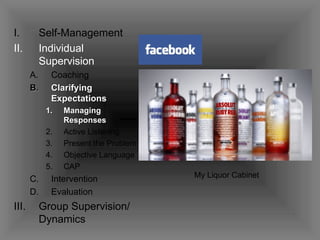
Self-Management Individual Supervision Coaching   Clarifying Expectations Managing Responses Active Listening Present the Problem Objective Language CAP Intervention Evaluation Group Supervision/ Dynamics My Liquor Cabinet
Self-Management Individual Supervision Coaching   Clarifying Expectations Managing Responses Active Listening Present the Problem Objective Language CAP Intervention Evaluation Group Supervision/ Dynamics
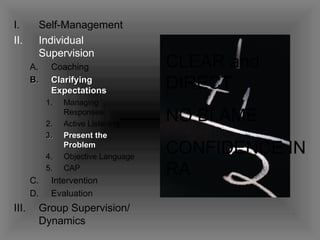
Self-Management Individual Supervision Coaching   Clarifying Expectations Managing Responses Active Listening Present the Problem Objective Language CAP Intervention Evaluation Group Supervision/ Dynamics CLEAR and DIRECT NO BLAME CONFIDENCE IN RA
Self-Management Individual Supervision Coaching   Clarifying Expectations Managing Responses Active Listening Present the Problem Objective Language CAP Intervention Evaluation Group Supervision/ Dynamics
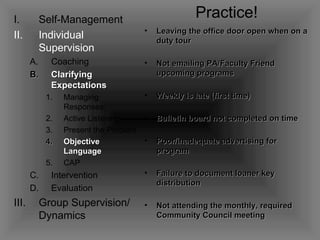
Self-Management Individual Supervision Coaching   Clarifying Expectations Managing Responses Active Listening Present the Problem Objective Language CAP Intervention Evaluation Group Supervision/ Dynamics Practice! Leaving the office door open when on a duty tour Not emailing PA/Faculty Friend upcoming programs Weekly is late (first time) Bulletin board not completed on time Poor/inadequate advertising for program Failure to document loaner key distribution Not attending the monthly, required Community Council meeting
Self-Management Individual Supervision Coaching   Clarifying Expectations Managing Responses Active Listening Present the Problem Objective Language CAP Intervention Evaluation Group Supervision/ Dynamics Without AD Consent
Self-Management Individual Supervision Coaching   Clarifying Expectations Managing Responses Active Listening Present the Problem Objective Language CAP Intervention Evaluation Group Supervision/ Dynamics
Self-Management Individual Supervision Group Supervision/ Dynamics Administration Staff Meetings Developmental Meetings Facilitation Managing Difference Differently
Self-Management Individual Supervision Group Supervision/ Dynamics Administration Facilitation Managing Difference Differently
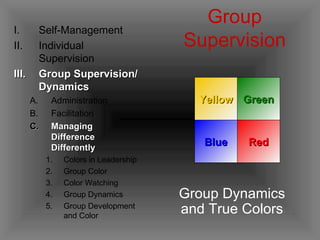
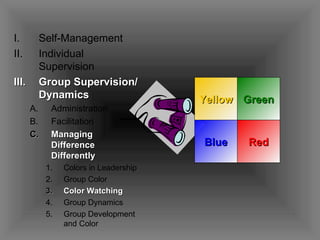
Group Supervision Group Dynamics and True Colors Yellow Green Blue Red Self-Management Individual Supervision Group Supervision/ Dynamics Administration Facilitation Managing Difference Differently Colors in Leadership Group Color Color Watching Group Dynamics Group Development and Color
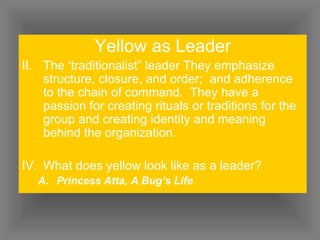
Yellow as Leader The ‘traditionalist” leader They emphasize structure, closure, and order;  and adherence to the chain of command.  They have a passion for creating rituals or traditions for the group and creating identity and meaning behind the organization. What does yellow look like as a leader? Princess Atta, A Bug’s Life
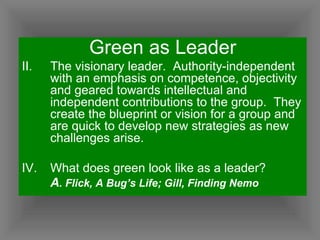
Green as Leader The visionary leader.  Authority-independent with an emphasis on competence, objectivity and geared towards intellectual and independent contributions to the group.  They create the blueprint or vision for a group and are quick to develop new strategies as new challenges arise. What does green look like as a leader? A . Flick, A Bug’s Life; Gill, Finding Nemo
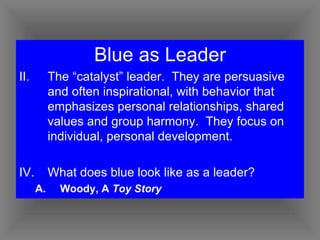
Blue as Leader The “catalyst” leader.  They are persuasive and often inspirational, with behavior that emphasizes personal relationships, shared values and group harmony.  They focus on individual, personal development.  What does blue look like as a leader? Woody, A  Toy Story
Red The “troubleshooter” type of leader, they have the highest sense of reality.  They are negotiators because of this ability. They are action-oriented and adaptable, focusing on practical and hands on behavior that avoids future focus in favor or the more immediate/present problems or options.  What does red look like as a leader? Crush, Finding Nemo; Dory, Finding Nemo
Some Questions Self-Management Individual Supervision Group Supervision/ Dynamics Administration Facilitation Managing Difference Differently Colors in Leadership Group Color Color Watching Group Dynamics Group Development and Color
Self-Management Individual Supervision Group Supervision/ Dynamics Administration Facilitation Managing Difference Differently Colors in Leadership Group Color Color Watching Group Dynamics Group Development and Color
Yellow Green Blue Red Self-Management Individual Supervision Group Supervision/ Dynamics Administration Facilitation Managing Difference Differently Colors in Leadership Group Color Color Watching Group Dynamics Group Development and Color
Watching for Type Yellows Chain of command Structure Order Decisive Practical Leading Yellows Give clear answers that focus on clarity and order.  Don’t be wishy-washy.  Strive for consistency and timeliness. Greens Problem first, people second Logic Competency Wordsmiths/Debaters Leading Greens Give constructive criticism, allow freedom for ideas, give harder assignments
Watching for Type Blues People centered Subjective Relationship first, task or problem second Want to like/be liked Leading Blues Be likeable, go out of your way to show you like the people you are working with, actively engage as a human. Reds Active (just do it) Don’t like lengthy explanations Love to laugh/have fun Leading Reds Don’t delay time on task.  Give the tasks and provide as much freedom as possible to get the task done.  Stop explaining and start doing and have fun!
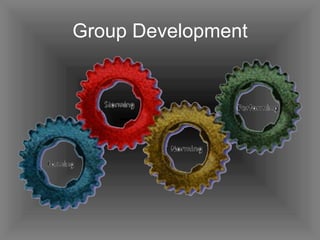
Group Development
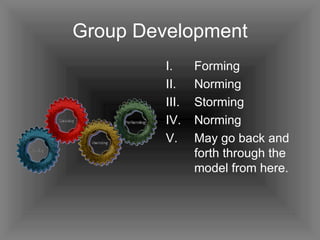
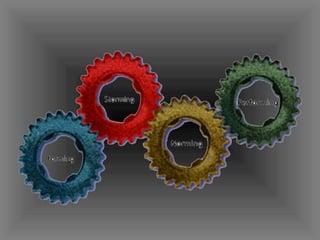
Group Development Forming Norming Storming Norming May go back and forth through the model from here.
Forming What does this look like in ORL? Lots of uncertainty as the staff comes together. What is it we do? Who are you?  This leads to differing levels of commitment Communication is low level (favorite movies, etc.) Need the HD for direction What do we do? Provide direction (tell them what to do, training) Expectations (help get to norming) Goal Setting (this leads to greater commitment by involving the staff) Icebreaking (move past the favorite color stage)
Forming Yellows :  “How will I be a good staff member?” Greens :  “Why are we doing this in this way?” Blues :  “Who are you?  Who are you?  Who am I?” Reds :   “What can I do…right now?!?”
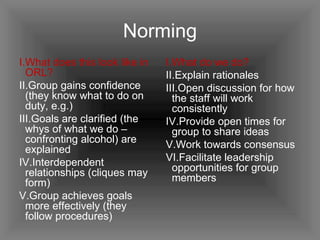
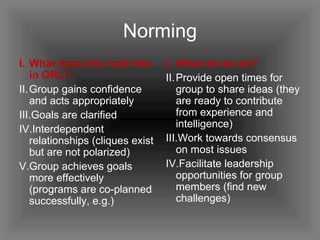
Norming What does this look like in ORL? Group gains confidence (they know what to do on duty, e.g.) Goals are clarified (the whys of what we do – confronting alcohol) are explained Interdependent relationships (cliques may form) Group achieves goals more effectively (they follow procedures) What do we do? Explain rationales Open discussion for how the staff will work consistently Provide open times for group to share ideas Work towards consensus Facilitate leadership opportunities for group members
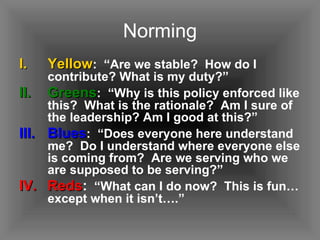
Norming Yellow :  “Are we stable?  How do I contribute? What is my duty?” Greens :  “Why is this policy enforced like this?  What is the rationale?  Am I sure of the leadership? Am I good at this?” Blues :  “Does everyone here understand me?  Do I understand where everyone else is coming from?  Are we serving who we are supposed to be serving?” Reds :   “What can I do now?  This is fun…except when it isn’t….”
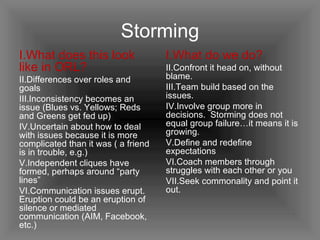
Storming What does this look like in ORL? Differences over roles and goals Inconsistency becomes an issue (Blues vs. Yellows; Reds and Greens get fed up) Uncertain about how to deal with issues because it is more complicated than it was ( a friend is in trouble, e.g.) Independent cliques have formed, perhaps around “party lines” Communication issues erupt.  Eruption could be an eruption of silence or mediated communication (AIM, Facebook, etc.) What do we do? Confront it head on, without blame. Team build based on the issues. Involve group more in decisions.  Storming does not equal group failure…it means it is growing. Define and redefine expectations Coach members through struggles with each other or you Seek commonality and point it out.
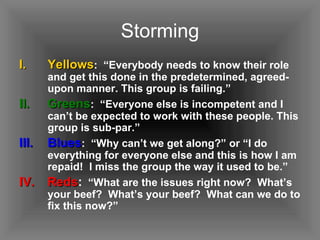
Storming Yellows :  “Everybody needs to know their role and get this done in the predetermined, agreed-upon manner. This group is failing.” Greens :  “Everyone else is incompetent and I can’t be expected to work with these people. This group is sub-par.” Blues :  “Why can’t we get along?” or “I do everything for everyone else and this is how I am repaid!  I miss the group the way it used to be.” Reds :   “What are the issues right now?  What’s your beef?  What’s your beef?  What can we do to fix this now?”
Norming What does this look like in ORL? Group gains confidence and acts appropriately Goals are clarified Interdependent relationships (cliques exist but are not polarized) Group achieves goals more effectively (programs are co-planned successfully, e.g.) What do we do? Provide open times for group to share ideas (they are ready to contribute from experience and intelligence) Work towards consensus on most issues Facilitate leadership opportunities for group members (find new challenges)
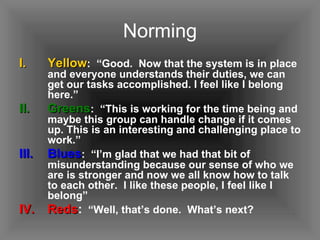
Norming Yellow :  “Good.  Now that the system is in place and everyone understands their duties, we can get our tasks accomplished. I feel like I belong here.” Greens :  “This is working for the time being and maybe this group can handle change if it comes up. This is an interesting and challenging place to work.” Blues :  “I’m glad that we had that bit of misunderstanding because our sense of who we are is stronger and now we all know how to talk to each other.  I like these people, I feel like I belong” Reds :   “Well, that’s done.  What’s next?
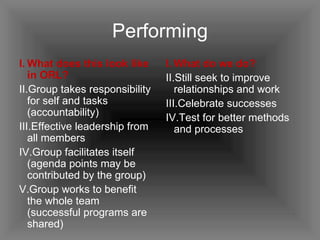
Performing What does this look like in ORL? Group takes responsibility for self and tasks (accountability) Effective leadership from all members  Group facilitates itself (agenda points may be contributed by the group) Group works to benefit the whole team (successful programs are shared) What do we do? Still seek to improve relationships and work Celebrate successes Test for better methods and processes
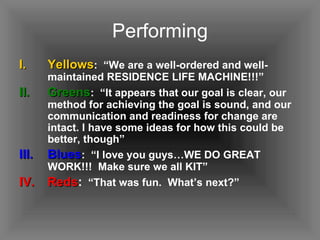
Performing Yellows :  “We are a well-ordered and well-maintained RESIDENCE LIFE MACHINE!!!” Greens :  “It appears that our goal is clear, our method for achieving the goal is sound, and our communication and readiness for change are intact. I have some ideas for how this could be better, though” Blues :  “I love you guys…WE DO GREAT WORK!!!  Make sure we all KIT” Reds :   “That was fun.  What’s next?”
STORMING?!?!?? Storming is feared for many reasons: Yellows :  Disrupts the chain or flow of the organization.  They are likely to avoid it because instability is bad and it is a reflection of not doing one’s duty. Greens :  It is non-productive and doesn’t seem like a logical or rational use of group time.  However, greens are the most likely to welcome storming and seek to replicate it frequently Blues :  People could get their feelings hurt and we may cease to be connected as a group.  They are likely to avoid it because conflict between people is destroying the reason for the group to exist. Reds :   It’s a lot of talk…no action…generally no fun.  However, Reds may seek to replicate to provide some action or something to do.
STORMING?!?!?? How to lead colors through it: Yellows :  Remind yellows of their duty to the group.  They will respond to this by being a good “second in command.” Greens :  Ask the greens for ideas on how to get through the conflict.  Also, explain the theory of development.  They may not believe it, but use of logical reasoning will help. Blues :  Explain to the blues that this will strengthen the bonds between people if they can get through it. Ask them to help “bridge the gaps” between people. Reds :  Do team-builders or active initiatives to illustrate the process.  Ask them for their perception of reality in the process and what they think needs to happen to “fix” the situation.
 

Supervision Skills

  • 1.
    Supervision Please turnoff all cell phones
  • 2.
  • 3.
    94 Percent iscoaching and clarifying!
  • 4.
    Self-Management Administration CommunicationIndividual Supervision Group Supervision/ Dynamics
  • 5.
    Self-Management Administration CommunicationIndividual Supervision Group Supervision/ Dynamics
  • 6.
    Sleep for 56hours a week Class: 18 credit hours=72 hours of study and class Hall Director Duties= 20 hours a week 20 hours of FREE TIME a week
  • 7.
    Self-Management Administration CommunicationIndividual Supervision Group Supervision/ Dynamics Where am I keeping these things? Are they confidential? How do I want the staff to see this information? How do I want to receive this information?
  • 8.
    Self-Management Administration CommunicationIndividual Supervision Group Supervision/ Dynamics Deadlines Expectations Responsibilities How to accomplish tasks Giving feedback on job performance
  • 9.
  • 10.
    When do youcall your AD for emergencies? See page 78 of The Manual
  • 11.
    Other HDs YourRAs Other HDs AD YOU venting Coaching, clarifying and information venting The good, the bad, the ugly!
  • 12.
    Coaching Excerpted fromthe Paraprofessional Healthcare Institute ©
  • 13.
  • 14.
    Self-Management Individual SupervisionCoaching Creating Relationships State Expectations Gather Information Problem Solving Commitment Clarifying Expectations Intervention Evaluation Group Supervision/ Dynamics
  • 15.
    Self-Management Individual SupervisionCoaching Creating Relationships State Expectations Gather Information Problem Solving Commitment Clarifying Expectations Intervention Evaluation Group Supervision/ Dynamics
  • 16.
    Self-Management Individual SupervisionCoaching Creating Relationships State Expectations Gather Information Problem Solving Commitment Clarifying Expectations Intervention Evaluation Group Supervision/ Dynamics Billie Jean
  • 17.
    Self-Management Individual SupervisionCoaching Creating Relationships State Expectations Gather Information Problem Solving Commitment Clarifying Expectations Intervention Evaluation Group Supervision/ Dynamics
  • 18.
    Self-Management Individual SupervisionCoaching Creating Relationships State Expectations Gather Information Problem Solving Commitment Clarifying Expectations Intervention Evaluation Group Supervision/ Dynamics Adapted from: http://www.nyscseapartnership.org/website/lmc_web_resources/resources/graphics/6steps.gif
  • 19.
    Self-Management Individual SupervisionCoaching Creating Relationships State Expectations Gather Information Problem Solving Commitment Clarifying Expectations Intervention Evaluation Group Supervision/ Dynamics Adapted from: http://www.nyscseapartnership.org/website/lmc_web_resources/resources/graphics/6steps.gif
  • 20.
    Self-Management Individual SupervisionCoaching Clarifying Expectations Managing Responses Active Listening Present the Problem Objective Language CAP Intervention Evaluation Group Supervision/ Dynamics
  • 21.
    Self-Management Individual SupervisionCoaching Clarifying Expectations Managing Responses Active Listening Present the Problem Objective Language CAP Intervention Evaluation Group Supervision/ Dynamics My Liquor Cabinet
  • 22.
    Self-Management Individual SupervisionCoaching Clarifying Expectations Managing Responses Active Listening Present the Problem Objective Language CAP Intervention Evaluation Group Supervision/ Dynamics
  • 23.
    Self-Management Individual SupervisionCoaching Clarifying Expectations Managing Responses Active Listening Present the Problem Objective Language CAP Intervention Evaluation Group Supervision/ Dynamics CLEAR and DIRECT NO BLAME CONFIDENCE IN RA
  • 24.
    Self-Management Individual SupervisionCoaching Clarifying Expectations Managing Responses Active Listening Present the Problem Objective Language CAP Intervention Evaluation Group Supervision/ Dynamics
  • 25.
    Self-Management Individual SupervisionCoaching Clarifying Expectations Managing Responses Active Listening Present the Problem Objective Language CAP Intervention Evaluation Group Supervision/ Dynamics Practice! Leaving the office door open when on a duty tour Not emailing PA/Faculty Friend upcoming programs Weekly is late (first time) Bulletin board not completed on time Poor/inadequate advertising for program Failure to document loaner key distribution Not attending the monthly, required Community Council meeting
  • 26.
    Self-Management Individual SupervisionCoaching Clarifying Expectations Managing Responses Active Listening Present the Problem Objective Language CAP Intervention Evaluation Group Supervision/ Dynamics Without AD Consent
  • 27.
    Self-Management Individual SupervisionCoaching Clarifying Expectations Managing Responses Active Listening Present the Problem Objective Language CAP Intervention Evaluation Group Supervision/ Dynamics
  • 28.
    Self-Management Individual SupervisionCoaching Clarifying Expectations Managing Responses Active Listening Present the Problem Objective Language CAP Intervention Evaluation Group Supervision/ Dynamics
  • 29.
    Self-Management Individual SupervisionGroup Supervision/ Dynamics Administration Staff Meetings Developmental Meetings Facilitation Managing Difference Differently
  • 30.
    Self-Management Individual SupervisionGroup Supervision/ Dynamics Administration Staff Meetings Developmental Meetings Facilitation Managing Difference Differently
  • 31.
    Self-Management Individual SupervisionGroup Supervision/ Dynamics Administration Facilitation Managing Difference Differently
  • 32.
    Group Supervision GroupDynamics and True Colors Yellow Green Blue Red Self-Management Individual Supervision Group Supervision/ Dynamics Administration Facilitation Managing Difference Differently Colors in Leadership Group Color Color Watching Group Dynamics Group Development and Color
  • 33.
    Yellow as LeaderThe ‘traditionalist” leader They emphasize structure, closure, and order; and adherence to the chain of command. They have a passion for creating rituals or traditions for the group and creating identity and meaning behind the organization. What does yellow look like as a leader? Princess Atta, A Bug’s Life
  • 34.
    Green as LeaderThe visionary leader. Authority-independent with an emphasis on competence, objectivity and geared towards intellectual and independent contributions to the group. They create the blueprint or vision for a group and are quick to develop new strategies as new challenges arise. What does green look like as a leader? A . Flick, A Bug’s Life; Gill, Finding Nemo
  • 35.
    Blue as LeaderThe “catalyst” leader. They are persuasive and often inspirational, with behavior that emphasizes personal relationships, shared values and group harmony. They focus on individual, personal development. What does blue look like as a leader? Woody, A Toy Story
  • 36.
    Red The “troubleshooter”type of leader, they have the highest sense of reality. They are negotiators because of this ability. They are action-oriented and adaptable, focusing on practical and hands on behavior that avoids future focus in favor or the more immediate/present problems or options. What does red look like as a leader? Crush, Finding Nemo; Dory, Finding Nemo
  • 37.
    Some Questions Self-ManagementIndividual Supervision Group Supervision/ Dynamics Administration Facilitation Managing Difference Differently Colors in Leadership Group Color Color Watching Group Dynamics Group Development and Color
  • 38.
    Self-Management Individual SupervisionGroup Supervision/ Dynamics Administration Facilitation Managing Difference Differently Colors in Leadership Group Color Color Watching Group Dynamics Group Development and Color
  • 39.
    Yellow Green BlueRed Self-Management Individual Supervision Group Supervision/ Dynamics Administration Facilitation Managing Difference Differently Colors in Leadership Group Color Color Watching Group Dynamics Group Development and Color
  • 40.
    Watching for TypeYellows Chain of command Structure Order Decisive Practical Leading Yellows Give clear answers that focus on clarity and order. Don’t be wishy-washy. Strive for consistency and timeliness. Greens Problem first, people second Logic Competency Wordsmiths/Debaters Leading Greens Give constructive criticism, allow freedom for ideas, give harder assignments
  • 41.
    Watching for TypeBlues People centered Subjective Relationship first, task or problem second Want to like/be liked Leading Blues Be likeable, go out of your way to show you like the people you are working with, actively engage as a human. Reds Active (just do it) Don’t like lengthy explanations Love to laugh/have fun Leading Reds Don’t delay time on task. Give the tasks and provide as much freedom as possible to get the task done. Stop explaining and start doing and have fun!
  • 42.
  • 43.
    Group Development FormingNorming Storming Norming May go back and forth through the model from here.
  • 44.
    Forming What doesthis look like in ORL? Lots of uncertainty as the staff comes together. What is it we do? Who are you? This leads to differing levels of commitment Communication is low level (favorite movies, etc.) Need the HD for direction What do we do? Provide direction (tell them what to do, training) Expectations (help get to norming) Goal Setting (this leads to greater commitment by involving the staff) Icebreaking (move past the favorite color stage)
  • 45.
    Forming Yellows : “How will I be a good staff member?” Greens : “Why are we doing this in this way?” Blues : “Who are you? Who are you? Who am I?” Reds : “What can I do…right now?!?”
  • 46.
    Norming What doesthis look like in ORL? Group gains confidence (they know what to do on duty, e.g.) Goals are clarified (the whys of what we do – confronting alcohol) are explained Interdependent relationships (cliques may form) Group achieves goals more effectively (they follow procedures) What do we do? Explain rationales Open discussion for how the staff will work consistently Provide open times for group to share ideas Work towards consensus Facilitate leadership opportunities for group members
  • 47.
    Norming Yellow : “Are we stable? How do I contribute? What is my duty?” Greens : “Why is this policy enforced like this? What is the rationale? Am I sure of the leadership? Am I good at this?” Blues : “Does everyone here understand me? Do I understand where everyone else is coming from? Are we serving who we are supposed to be serving?” Reds : “What can I do now? This is fun…except when it isn’t….”
  • 48.
    Storming What doesthis look like in ORL? Differences over roles and goals Inconsistency becomes an issue (Blues vs. Yellows; Reds and Greens get fed up) Uncertain about how to deal with issues because it is more complicated than it was ( a friend is in trouble, e.g.) Independent cliques have formed, perhaps around “party lines” Communication issues erupt. Eruption could be an eruption of silence or mediated communication (AIM, Facebook, etc.) What do we do? Confront it head on, without blame. Team build based on the issues. Involve group more in decisions. Storming does not equal group failure…it means it is growing. Define and redefine expectations Coach members through struggles with each other or you Seek commonality and point it out.
  • 49.
    Storming Yellows : “Everybody needs to know their role and get this done in the predetermined, agreed-upon manner. This group is failing.” Greens : “Everyone else is incompetent and I can’t be expected to work with these people. This group is sub-par.” Blues : “Why can’t we get along?” or “I do everything for everyone else and this is how I am repaid! I miss the group the way it used to be.” Reds : “What are the issues right now? What’s your beef? What’s your beef? What can we do to fix this now?”
  • 50.
    Norming What doesthis look like in ORL? Group gains confidence and acts appropriately Goals are clarified Interdependent relationships (cliques exist but are not polarized) Group achieves goals more effectively (programs are co-planned successfully, e.g.) What do we do? Provide open times for group to share ideas (they are ready to contribute from experience and intelligence) Work towards consensus on most issues Facilitate leadership opportunities for group members (find new challenges)
  • 51.
    Norming Yellow : “Good. Now that the system is in place and everyone understands their duties, we can get our tasks accomplished. I feel like I belong here.” Greens : “This is working for the time being and maybe this group can handle change if it comes up. This is an interesting and challenging place to work.” Blues : “I’m glad that we had that bit of misunderstanding because our sense of who we are is stronger and now we all know how to talk to each other. I like these people, I feel like I belong” Reds : “Well, that’s done. What’s next?
  • 52.
    Performing What doesthis look like in ORL? Group takes responsibility for self and tasks (accountability) Effective leadership from all members Group facilitates itself (agenda points may be contributed by the group) Group works to benefit the whole team (successful programs are shared) What do we do? Still seek to improve relationships and work Celebrate successes Test for better methods and processes
  • 53.
    Performing Yellows : “We are a well-ordered and well-maintained RESIDENCE LIFE MACHINE!!!” Greens : “It appears that our goal is clear, our method for achieving the goal is sound, and our communication and readiness for change are intact. I have some ideas for how this could be better, though” Blues : “I love you guys…WE DO GREAT WORK!!! Make sure we all KIT” Reds : “That was fun. What’s next?”
  • 54.
    STORMING?!?!?? Storming isfeared for many reasons: Yellows : Disrupts the chain or flow of the organization. They are likely to avoid it because instability is bad and it is a reflection of not doing one’s duty. Greens : It is non-productive and doesn’t seem like a logical or rational use of group time. However, greens are the most likely to welcome storming and seek to replicate it frequently Blues : People could get their feelings hurt and we may cease to be connected as a group. They are likely to avoid it because conflict between people is destroying the reason for the group to exist. Reds : It’s a lot of talk…no action…generally no fun. However, Reds may seek to replicate to provide some action or something to do.
  • 55.
    STORMING?!?!?? How tolead colors through it: Yellows : Remind yellows of their duty to the group. They will respond to this by being a good “second in command.” Greens : Ask the greens for ideas on how to get through the conflict. Also, explain the theory of development. They may not believe it, but use of logical reasoning will help. Blues : Explain to the blues that this will strengthen the bonds between people if they can get through it. Ask them to help “bridge the gaps” between people. Reds : Do team-builders or active initiatives to illustrate the process. Ask them for their perception of reality in the process and what they think needs to happen to “fix” the situation.
  • 56.