“How Do You Say ‘Cryptography’ in Romanian?”
Learning About Integers from Ciphers in Different
                  Languages


                                  Joshua Holden

                          Rose-Hulman Institute of Technology
                       http://www.rose-hulman.edu/~holden


Joshua Holden (RHIT)           “How Do You Say ‘Cryptography’?”   1 / 16
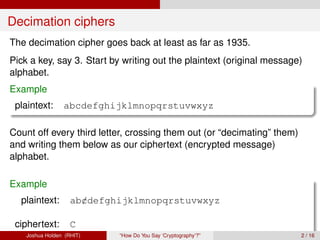
Decimation ciphers
The decimation cipher goes back at least as far as 1935.
Pick a key, say 3. Start by writing out the plaintext (original message)
alphabet.
Example
 plaintext:      abcdefghijklmnopqrstuvwxyz

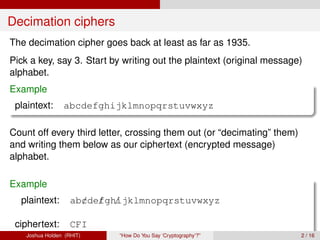
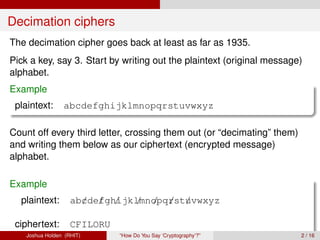
Count off every third letter, crossing them out (or “decimating” them)
and writing them below as our ciphertext (encrypted message)
alphabet.

Example
  plaintext:        ab/defghijklmnopqrstuvwxyz
                      c

 ciphertext:        C
    Joshua Holden (RHIT)    “How Do You Say ‘Cryptography’?”             2 / 16
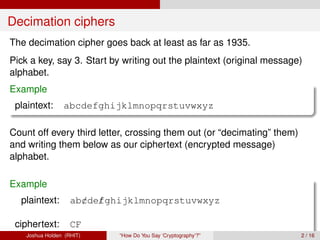
Decimation ciphers
The decimation cipher goes back at least as far as 1935.
Pick a key, say 3. Start by writing out the plaintext (original message)
alphabet.
Example
 plaintext:      abcdefghijklmnopqrstuvwxyz

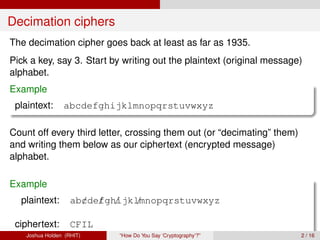
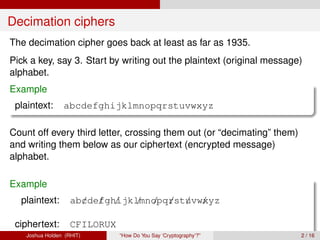
Count off every third letter, crossing them out (or “decimating” them)
and writing them below as our ciphertext (encrypted message)
alphabet.

Example
  plaintext:        ab/de/ ghijklmnopqrstuvwxyz
                      c f

 ciphertext:        CF
    Joshua Holden (RHIT)    “How Do You Say ‘Cryptography’?”             2 / 16
Decimation ciphers
The decimation cipher goes back at least as far as 1935.
Pick a key, say 3. Start by writing out the plaintext (original message)
alphabet.
Example
 plaintext:      abcdefghijklmnopqrstuvwxyz

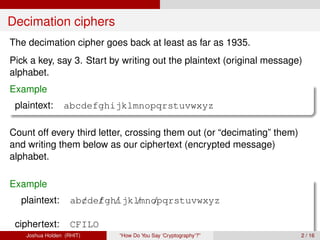
Count off every third letter, crossing them out (or “decimating” them)
and writing them below as our ciphertext (encrypted message)
alphabet.

Example
  plaintext:        ab/de/ gh/
                      c f ijklmnopqrstuvwxyz

 ciphertext:        CFI
    Joshua Holden (RHIT)   “How Do You Say ‘Cryptography’?”              2 / 16
Decimation ciphers
The decimation cipher goes back at least as far as 1935.
Pick a key, say 3. Start by writing out the plaintext (original message)
alphabet.
Example
 plaintext:      abcdefghijklmnopqrstuvwxyz

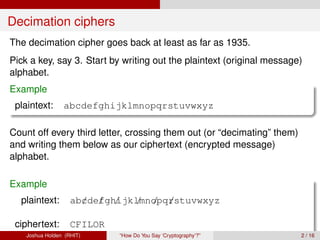
Count off every third letter, crossing them out (or “decimating” them)
and writing them below as our ciphertext (encrypted message)
alphabet.

Example
  plaintext:        ab/de/ gh/ lmnopqrstuvwxyz
                      c f ijk /

 ciphertext:        CFIL
    Joshua Holden (RHIT)    “How Do You Say ‘Cryptography’?”             2 / 16
Decimation ciphers
The decimation cipher goes back at least as far as 1935.
Pick a key, say 3. Start by writing out the plaintext (original message)
alphabet.
Example
 plaintext:      abcdefghijklmnopqrstuvwxyz

Count off every third letter, crossing them out (or “decimating” them)
and writing them below as our ciphertext (encrypted message)
alphabet.

Example
  plaintext:        ab/de/ gh/ lmnopqrstuvwxyz
                      c f ijk / /

 ciphertext:        CFILO
    Joshua Holden (RHIT)    “How Do You Say ‘Cryptography’?”             2 / 16
Decimation ciphers
The decimation cipher goes back at least as far as 1935.
Pick a key, say 3. Start by writing out the plaintext (original message)
alphabet.
Example
 plaintext:      abcdefghijklmnopqrstuvwxyz

Count off every third letter, crossing them out (or “decimating” them)
and writing them below as our ciphertext (encrypted message)
alphabet.

Example
  plaintext:        ab/de/ gh/ lmnopq/stuvwxyz
                      c f ijk / / r

 ciphertext:        CFILOR
    Joshua Holden (RHIT)     “How Do You Say ‘Cryptography’?”            2 / 16
Decimation ciphers
The decimation cipher goes back at least as far as 1935.
Pick a key, say 3. Start by writing out the plaintext (original message)
alphabet.
Example
 plaintext:      abcdefghijklmnopqrstuvwxyz

Count off every third letter, crossing them out (or “decimating” them)
and writing them below as our ciphertext (encrypted message)
alphabet.

Example
  plaintext:        ab/de/ gh/ lmnopq/st/vwxyz
                      c f ijk / / r u

 ciphertext:        CFILORU
    Joshua Holden (RHIT)      “How Do You Say ‘Cryptography’?”           2 / 16
Decimation ciphers
The decimation cipher goes back at least as far as 1935.
Pick a key, say 3. Start by writing out the plaintext (original message)
alphabet.
Example
 plaintext:      abcdefghijklmnopqrstuvwxyz

Count off every third letter, crossing them out (or “decimating” them)
and writing them below as our ciphertext (encrypted message)
alphabet.

Example
  plaintext:        ab/de/ gh/ lmnopq/st/vw/
                      c f ijk / / r u xyz

 ciphertext:        CFILORUX
    Joshua Holden (RHIT)       “How Do You Say ‘Cryptography’?”          2 / 16
Wrap around


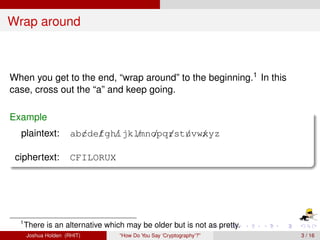
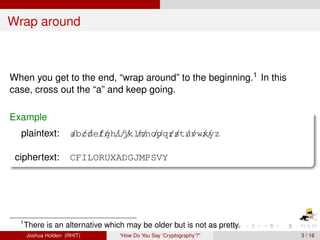
When you get to the end, “wrap around” to the beginning.1 In this
case, cross out the “a” and keep going.

Example
  plaintext:          ab/de/ gh/ lmnopq/st/vw/
                        c f ijk / / r u xyz

 ciphertext:          CFILORUX


  1
      There is an alternative which may be older but is not as pretty.
      Joshua Holden (RHIT)        “How Do You Say ‘Cryptography’?”       3 / 16
Wrap around


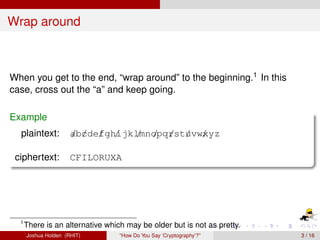
When you get to the end, “wrap around” to the beginning.1 In this
case, cross out the “a” and keep going.

Example
  plaintext:          ab/de/ gh/ lmnopq/st/vw/
                      / c f ijk / / r u xyz

 ciphertext:          CFILORUXA


  1
      There is an alternative which may be older but is not as pretty.
      Joshua Holden (RHIT)        “How Do You Say ‘Cryptography’?”       3 / 16
Wrap around


When you get to the end, “wrap around” to the beginning.1 In this
case, cross out the “a” and keep going.

Example
  plaintext:          ab//e// ijklmnopq/st// w/ yz
                      / cd fgh/// // // r / uv x/

 ciphertext:          CFILORUXADGJMPSVY


  1
      There is an alternative which may be older but is not as pretty.
      Joshua Holden (RHIT)        “How Do You Say ‘Cryptography’?”       3 / 16
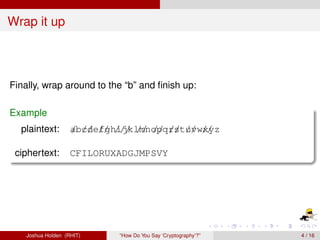
Wrap it up


Finally, wrap around to the “b” and finish up:

Example
  plaintext:        ab//e// ijklmnopq/st// w/ yz
                    / cd fgh/// // // r / uv x/

 ciphertext:        CFILORUXADGJMPSVY


    Joshua Holden (RHIT)     “How Do You Say ‘Cryptography’?”   4 / 16
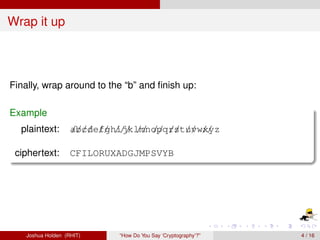
Wrap it up


Finally, wrap around to the “b” and finish up:

Example
  plaintext:        abc/e// ijklmnopq/st// w/ yz
                    ///d fgh/// // // r / uv x/

 ciphertext:        CFILORUXADGJMPSVYB


    Joshua Holden (RHIT)     “How Do You Say ‘Cryptography’?”   4 / 16
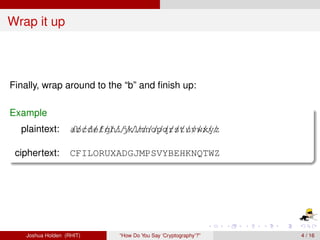
Wrap it up


Finally, wrap around to the “b” and finish up:

Example
  plaintext:        abc//// h////////pq/st//// y/
                    ///defg/ ijklmno //r //uvwx/ z

 ciphertext:        CFILORUXADGJMPSVYBEHKNQTWZ


    Joshua Holden (RHIT)     “How Do You Say ‘Cryptography’?”   4 / 16
Be fruitful


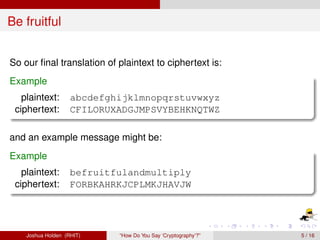
So our final translation of plaintext to ciphertext is:
Example
   plaintext:       abcdefghijklmnopqrstuvwxyz
 ciphertext:        CFILORUXADGJMPSVYBEHKNQTWZ

and an example message might be:
Example
   plaintext:       befruitfulandmultiply
 ciphertext:        FORBKAHRKJCPLMKJHAVJW


    Joshua Holden (RHIT)    “How Do You Say ‘Cryptography’?”   5 / 16
Letters to numbers


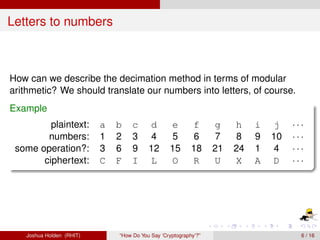
How can we describe the decimation method in terms of modular
arithmetic? We should translate our numbers into letters, of course.
Example
         plaintext:       a   b    c     d       e        f      g    h    i   j    ···
        numbers:          1   2    3     4       5        6      7    8    9   10   ···
 some operation?:         3   6    9     12      15       18     21   24   1    4   ···
       ciphertext:        C   F    I     L       O        R      U    X    A   D    ···


   Joshua Holden (RHIT)       “How Do You Say ‘Cryptography’?”                        6 / 16
Multiplicative cipher


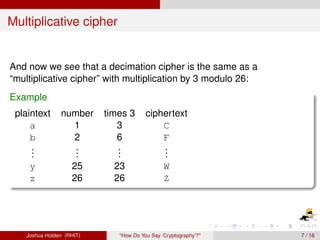
And now we see that a decimation cipher is the same as a
“multiplicative cipher” with multiplication by 3 modulo 26:
Example
 plaintext     number     times 3      ciphertext
     a           1           3             C
     b           2           6             F
     .
     .            .
                  .          .
                             .             .
                                           .
     .            .          .             .
    y              25       23                W
    z              26       26                Z


   Joshua Holden (RHIT)      “How Do You Say ‘Cryptography’?”   7 / 16
Bad Keys
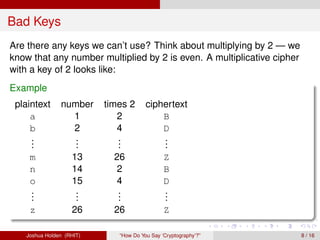
Are there any keys we can’t use? Think about multiplying by 2 — we
know that any number multiplied by 2 is even. A multiplicative cipher
with a key of 2 looks like:
Example
 plaintext     number     times 2      ciphertext
     a           1           2             B
     b           2           4             D
     .
     .            .
                  .          .
                             .             .
                                           .
     .            .          .             .
    m              13       26                Z
    n              14        2                B
    o              15        4                D
    .
    .               .
                    .        .
                             .                .
                                              .
    .               .        .                .
    z              26       26                Z

   Joshua Holden (RHIT)      “How Do You Say ‘Cryptography’?”           8 / 16
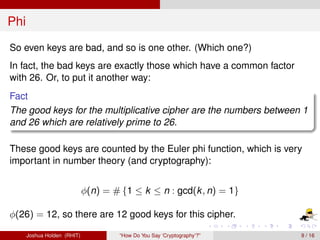
Phi
So even keys are bad, and so is one other. (Which one?)
In fact, the bad keys are exactly those which have a common factor
with 26. Or, to put it another way:
Fact
The good keys for the multiplicative cipher are the numbers between 1
and 26 which are relatively prime to 26.

These good keys are counted by the Euler phi function, which is very
important in number theory (and cryptography):


                             φ(n) = # {1 ≤ k ≤ n : gcd(k , n) = 1}

φ(26) = 12, so there are 12 good keys for this cipher.

      Joshua Holden (RHIT)            “How Do You Say ‘Cryptography’?”   9 / 16
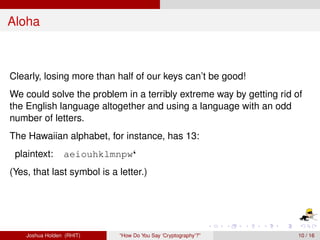
Aloha


Clearly, losing more than half of our keys can’t be good!
We could solve the problem in a terribly extreme way by getting rid of
the English language altogether and using a language with an odd
number of letters.
The Hawaiian alphabet, for instance, has 13:
 plaintext:      aeiouhklmnpw‘
(Yes, that last symbol is a letter.)


    Joshua Holden (RHIT)    “How Do You Say ‘Cryptography’?”         10 / 16
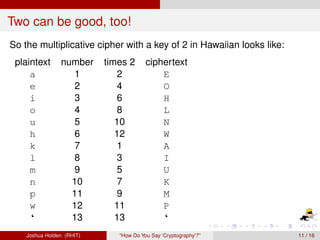
Two can be good, too!
So the multiplicative cipher with a key of 2 in Hawaiian looks like:
 plaintext      number     times 2      ciphertext
     a             1           2            E
     e             2           4            O
     i             3           6            H
     o             4           8            L
     u             5          10            N
     h             6          12            W
     k             7           1            A
     l             8           3            I
     m             9           5            U
     n            10          7             K
     p            11          9             M
     w            12          11            P
     ‘            13          13            ‘
    Joshua Holden (RHIT)      “How Do You Say ‘Cryptography’?”         11 / 16
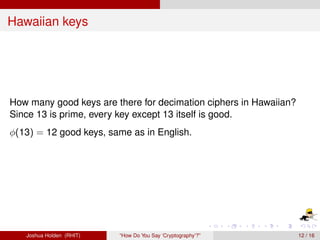
Hawaiian keys


How many good keys are there for decimation ciphers in Hawaiian?
Since 13 is prime, every key except 13 itself is good.
φ(13) = 12 good keys, same as in English.


   Joshua Holden (RHIT)   “How Do You Say ‘Cryptography’?”         12 / 16
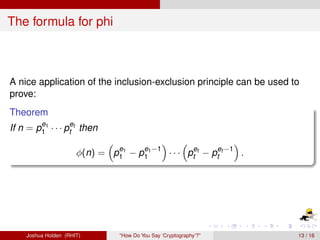
The formula for phi


A nice application of the inclusion-exclusion principle can be used to
prove:
Theorem
        e
If n = p11 · · · ptet then

                      φ(n) = p11 − p11 −1 · · · ptet − ptet −1 .
                              e     e


    Joshua Holden (RHIT)        “How Do You Say ‘Cryptography’?”     13 / 16
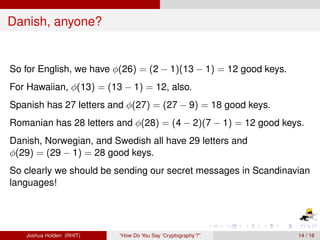
Danish, anyone?


So for English, we have φ(26) = (2 − 1)(13 − 1) = 12 good keys.
For Hawaiian, φ(13) = (13 − 1) = 12, also.
Spanish has 27 letters and φ(27) = (27 − 9) = 18 good keys.
Romanian has 28 letters and φ(28) = (4 − 2)(7 − 1) = 12 good keys.
Danish, Norwegian, and Swedish all have 29 letters and
φ(29) = (29 − 1) = 28 good keys.
So clearly we should be sending our secret messages in Scandinavian
languages!


   Joshua Holden (RHIT)   “How Do You Say ‘Cryptography’?”        14 / 16
Further developments


There is lots of other modular arithmetic that can be motivated in this
way.
You may see some of it (fixed points) in the next talk.
But if you only look at it in English, you only get to see one modulus!


    Joshua Holden (RHIT)   “How Do You Say ‘Cryptography’?”           15 / 16
EILWE ‘LO
                       and thanks for listening!


Joshua Holden (RHIT)     “How Do You Say ‘Cryptography’?”   16 / 16

How Do You Say 'Cryptography' in Romanian?

  • 1.
    “How Do YouSay ‘Cryptography’ in Romanian?” Learning About Integers from Ciphers in Different Languages Joshua Holden Rose-Hulman Institute of Technology http://www.rose-hulman.edu/~holden Joshua Holden (RHIT) “How Do You Say ‘Cryptography’?” 1 / 16
  • 2.
    Decimation ciphers The decimationcipher goes back at least as far as 1935. Pick a key, say 3. Start by writing out the plaintext (original message) alphabet. Example plaintext: abcdefghijklmnopqrstuvwxyz Count off every third letter, crossing them out (or “decimating” them) and writing them below as our ciphertext (encrypted message) alphabet. Example plaintext: ab/defghijklmnopqrstuvwxyz c ciphertext: C Joshua Holden (RHIT) “How Do You Say ‘Cryptography’?” 2 / 16
  • 3.
    Decimation ciphers The decimationcipher goes back at least as far as 1935. Pick a key, say 3. Start by writing out the plaintext (original message) alphabet. Example plaintext: abcdefghijklmnopqrstuvwxyz Count off every third letter, crossing them out (or “decimating” them) and writing them below as our ciphertext (encrypted message) alphabet. Example plaintext: ab/de/ ghijklmnopqrstuvwxyz c f ciphertext: CF Joshua Holden (RHIT) “How Do You Say ‘Cryptography’?” 2 / 16
  • 4.
    Decimation ciphers The decimationcipher goes back at least as far as 1935. Pick a key, say 3. Start by writing out the plaintext (original message) alphabet. Example plaintext: abcdefghijklmnopqrstuvwxyz Count off every third letter, crossing them out (or “decimating” them) and writing them below as our ciphertext (encrypted message) alphabet. Example plaintext: ab/de/ gh/ c f ijklmnopqrstuvwxyz ciphertext: CFI Joshua Holden (RHIT) “How Do You Say ‘Cryptography’?” 2 / 16
  • 5.
    Decimation ciphers The decimationcipher goes back at least as far as 1935. Pick a key, say 3. Start by writing out the plaintext (original message) alphabet. Example plaintext: abcdefghijklmnopqrstuvwxyz Count off every third letter, crossing them out (or “decimating” them) and writing them below as our ciphertext (encrypted message) alphabet. Example plaintext: ab/de/ gh/ lmnopqrstuvwxyz c f ijk / ciphertext: CFIL Joshua Holden (RHIT) “How Do You Say ‘Cryptography’?” 2 / 16
  • 6.
    Decimation ciphers The decimationcipher goes back at least as far as 1935. Pick a key, say 3. Start by writing out the plaintext (original message) alphabet. Example plaintext: abcdefghijklmnopqrstuvwxyz Count off every third letter, crossing them out (or “decimating” them) and writing them below as our ciphertext (encrypted message) alphabet. Example plaintext: ab/de/ gh/ lmnopqrstuvwxyz c f ijk / / ciphertext: CFILO Joshua Holden (RHIT) “How Do You Say ‘Cryptography’?” 2 / 16
  • 7.
    Decimation ciphers The decimationcipher goes back at least as far as 1935. Pick a key, say 3. Start by writing out the plaintext (original message) alphabet. Example plaintext: abcdefghijklmnopqrstuvwxyz Count off every third letter, crossing them out (or “decimating” them) and writing them below as our ciphertext (encrypted message) alphabet. Example plaintext: ab/de/ gh/ lmnopq/stuvwxyz c f ijk / / r ciphertext: CFILOR Joshua Holden (RHIT) “How Do You Say ‘Cryptography’?” 2 / 16
  • 8.
    Decimation ciphers The decimationcipher goes back at least as far as 1935. Pick a key, say 3. Start by writing out the plaintext (original message) alphabet. Example plaintext: abcdefghijklmnopqrstuvwxyz Count off every third letter, crossing them out (or “decimating” them) and writing them below as our ciphertext (encrypted message) alphabet. Example plaintext: ab/de/ gh/ lmnopq/st/vwxyz c f ijk / / r u ciphertext: CFILORU Joshua Holden (RHIT) “How Do You Say ‘Cryptography’?” 2 / 16
  • 9.
    Decimation ciphers The decimationcipher goes back at least as far as 1935. Pick a key, say 3. Start by writing out the plaintext (original message) alphabet. Example plaintext: abcdefghijklmnopqrstuvwxyz Count off every third letter, crossing them out (or “decimating” them) and writing them below as our ciphertext (encrypted message) alphabet. Example plaintext: ab/de/ gh/ lmnopq/st/vw/ c f ijk / / r u xyz ciphertext: CFILORUX Joshua Holden (RHIT) “How Do You Say ‘Cryptography’?” 2 / 16
  • 10.
    Wrap around When youget to the end, “wrap around” to the beginning.1 In this case, cross out the “a” and keep going. Example plaintext: ab/de/ gh/ lmnopq/st/vw/ c f ijk / / r u xyz ciphertext: CFILORUX 1 There is an alternative which may be older but is not as pretty. Joshua Holden (RHIT) “How Do You Say ‘Cryptography’?” 3 / 16
  • 11.
    Wrap around When youget to the end, “wrap around” to the beginning.1 In this case, cross out the “a” and keep going. Example plaintext: ab/de/ gh/ lmnopq/st/vw/ / c f ijk / / r u xyz ciphertext: CFILORUXA 1 There is an alternative which may be older but is not as pretty. Joshua Holden (RHIT) “How Do You Say ‘Cryptography’?” 3 / 16
  • 12.
    Wrap around When youget to the end, “wrap around” to the beginning.1 In this case, cross out the “a” and keep going. Example plaintext: ab//e// ijklmnopq/st// w/ yz / cd fgh/// // // r / uv x/ ciphertext: CFILORUXADGJMPSVY 1 There is an alternative which may be older but is not as pretty. Joshua Holden (RHIT) “How Do You Say ‘Cryptography’?” 3 / 16
  • 13.
    Wrap it up Finally,wrap around to the “b” and finish up: Example plaintext: ab//e// ijklmnopq/st// w/ yz / cd fgh/// // // r / uv x/ ciphertext: CFILORUXADGJMPSVY Joshua Holden (RHIT) “How Do You Say ‘Cryptography’?” 4 / 16
  • 14.
    Wrap it up Finally,wrap around to the “b” and finish up: Example plaintext: abc/e// ijklmnopq/st// w/ yz ///d fgh/// // // r / uv x/ ciphertext: CFILORUXADGJMPSVYB Joshua Holden (RHIT) “How Do You Say ‘Cryptography’?” 4 / 16
  • 15.
    Wrap it up Finally,wrap around to the “b” and finish up: Example plaintext: abc//// h////////pq/st//// y/ ///defg/ ijklmno //r //uvwx/ z ciphertext: CFILORUXADGJMPSVYBEHKNQTWZ Joshua Holden (RHIT) “How Do You Say ‘Cryptography’?” 4 / 16
  • 16.
    Be fruitful So ourfinal translation of plaintext to ciphertext is: Example plaintext: abcdefghijklmnopqrstuvwxyz ciphertext: CFILORUXADGJMPSVYBEHKNQTWZ and an example message might be: Example plaintext: befruitfulandmultiply ciphertext: FORBKAHRKJCPLMKJHAVJW Joshua Holden (RHIT) “How Do You Say ‘Cryptography’?” 5 / 16
  • 17.
    Letters to numbers Howcan we describe the decimation method in terms of modular arithmetic? We should translate our numbers into letters, of course. Example plaintext: a b c d e f g h i j ··· numbers: 1 2 3 4 5 6 7 8 9 10 ··· some operation?: 3 6 9 12 15 18 21 24 1 4 ··· ciphertext: C F I L O R U X A D ··· Joshua Holden (RHIT) “How Do You Say ‘Cryptography’?” 6 / 16
  • 18.
    Multiplicative cipher And nowwe see that a decimation cipher is the same as a “multiplicative cipher” with multiplication by 3 modulo 26: Example plaintext number times 3 ciphertext a 1 3 C b 2 6 F . . . . . . . . . . . . y 25 23 W z 26 26 Z Joshua Holden (RHIT) “How Do You Say ‘Cryptography’?” 7 / 16
  • 19.
    Bad Keys Are thereany keys we can’t use? Think about multiplying by 2 — we know that any number multiplied by 2 is even. A multiplicative cipher with a key of 2 looks like: Example plaintext number times 2 ciphertext a 1 2 B b 2 4 D . . . . . . . . . . . . m 13 26 Z n 14 2 B o 15 4 D . . . . . . . . . . . . z 26 26 Z Joshua Holden (RHIT) “How Do You Say ‘Cryptography’?” 8 / 16
  • 20.
    Phi So even keysare bad, and so is one other. (Which one?) In fact, the bad keys are exactly those which have a common factor with 26. Or, to put it another way: Fact The good keys for the multiplicative cipher are the numbers between 1 and 26 which are relatively prime to 26. These good keys are counted by the Euler phi function, which is very important in number theory (and cryptography): φ(n) = # {1 ≤ k ≤ n : gcd(k , n) = 1} φ(26) = 12, so there are 12 good keys for this cipher. Joshua Holden (RHIT) “How Do You Say ‘Cryptography’?” 9 / 16
  • 21.
    Aloha Clearly, losing morethan half of our keys can’t be good! We could solve the problem in a terribly extreme way by getting rid of the English language altogether and using a language with an odd number of letters. The Hawaiian alphabet, for instance, has 13: plaintext: aeiouhklmnpw‘ (Yes, that last symbol is a letter.) Joshua Holden (RHIT) “How Do You Say ‘Cryptography’?” 10 / 16
  • 22.
    Two can begood, too! So the multiplicative cipher with a key of 2 in Hawaiian looks like: plaintext number times 2 ciphertext a 1 2 E e 2 4 O i 3 6 H o 4 8 L u 5 10 N h 6 12 W k 7 1 A l 8 3 I m 9 5 U n 10 7 K p 11 9 M w 12 11 P ‘ 13 13 ‘ Joshua Holden (RHIT) “How Do You Say ‘Cryptography’?” 11 / 16
  • 23.
    Hawaiian keys How manygood keys are there for decimation ciphers in Hawaiian? Since 13 is prime, every key except 13 itself is good. φ(13) = 12 good keys, same as in English. Joshua Holden (RHIT) “How Do You Say ‘Cryptography’?” 12 / 16
  • 24.
    The formula forphi A nice application of the inclusion-exclusion principle can be used to prove: Theorem e If n = p11 · · · ptet then φ(n) = p11 − p11 −1 · · · ptet − ptet −1 . e e Joshua Holden (RHIT) “How Do You Say ‘Cryptography’?” 13 / 16
  • 25.
    Danish, anyone? So forEnglish, we have φ(26) = (2 − 1)(13 − 1) = 12 good keys. For Hawaiian, φ(13) = (13 − 1) = 12, also. Spanish has 27 letters and φ(27) = (27 − 9) = 18 good keys. Romanian has 28 letters and φ(28) = (4 − 2)(7 − 1) = 12 good keys. Danish, Norwegian, and Swedish all have 29 letters and φ(29) = (29 − 1) = 28 good keys. So clearly we should be sending our secret messages in Scandinavian languages! Joshua Holden (RHIT) “How Do You Say ‘Cryptography’?” 14 / 16
  • 26.
    Further developments There islots of other modular arithmetic that can be motivated in this way. You may see some of it (fixed points) in the next talk. But if you only look at it in English, you only get to see one modulus! Joshua Holden (RHIT) “How Do You Say ‘Cryptography’?” 15 / 16
  • 27.
    EILWE ‘LO and thanks for listening! Joshua Holden (RHIT) “How Do You Say ‘Cryptography’?” 16 / 16