Cryptography: Basics
Outline Classical Cryptography Caesar cipher Vigenère cipher DES Public Key Cryptography Diffie-Hellman RSA Cryptographic Checksums HMAC
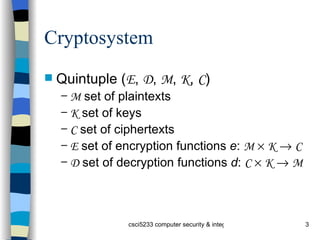
Cryptosystem Quintuple ( E ,  D ,  M ,  K ,  C ) M  set of plaintexts K  set of keys C  set of ciphertexts E  set of encryption functions  e :  M      K      C D  set of decryption functions  d :  C      K      M
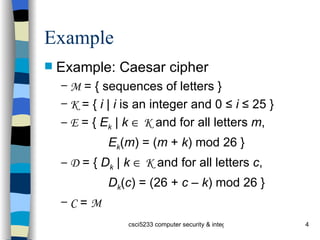
Example Example: Caesar cipher M  = { sequences of letters } K  = {  i  |  i  is an integer and 0 ≤  i  ≤ 25 } E  = {  E k  |  k      K  and for all letters  m , E k ( m ) = ( m  +  k ) mod 26 } D  = {  D k  |  k      K  and for all letters  c , D k ( c ) = (26 +  c  –  k ) mod 26 } C  =  M
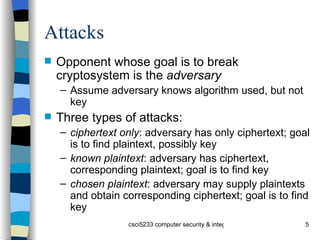
Attacks Opponent whose goal is to break cryptosystem is the  adversary Assume adversary knows algorithm used, but not key Three types of attacks: ciphertext only : adversary has only ciphertext; goal is to find plaintext, possibly key known plaintext : adversary has ciphertext, corresponding plaintext; goal is to find key chosen plaintext : adversary may supply plaintexts and obtain corresponding ciphertext; goal is to find key
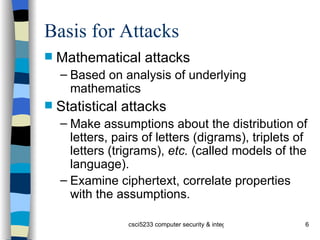
Basis for Attacks Mathematical attacks Based on analysis of underlying mathematics Statistical attacks Make assumptions about the distribution of letters, pairs of letters (digrams), triplets of letters (trigrams),  etc.  (called models of the language).  Examine ciphertext, correlate properties with the assumptions.
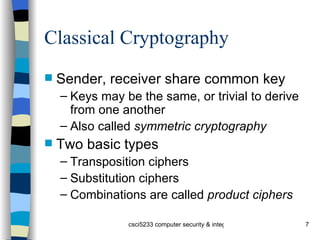
Classical Cryptography Sender, receiver share common key Keys may be the same, or trivial to derive from one another Also called  symmetric cryptography Two basic types Transposition ciphers Substitution ciphers Combinations are called  product ciphers
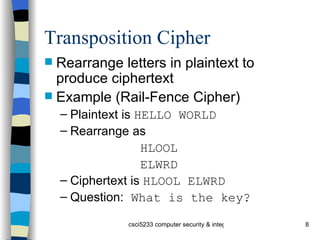
Transposition Cipher Rearrange letters in plaintext to produce ciphertext Example (Rail-Fence Cipher) Plaintext is  HELLO WORLD Rearrange as HLOOL ELWRD Ciphertext is  HLOOL ELWRD Question:  What is the key?
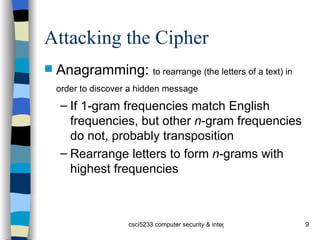
Attacking the Cipher Anagramming:  to rearrange (the letters of a text) in order to discover a hidden message   If 1-gram frequencies match English frequencies, but other  n -gram frequencies do not, probably transposition Rearrange letters to form  n -grams with highest frequencies
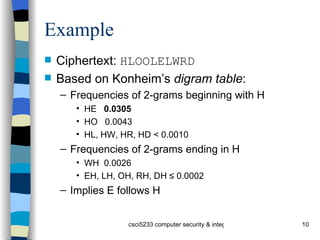
Example Ciphertext:  HLOOLELWRD Based on Konheim’s  digram table : Frequencies of 2-grams beginning with H HE  0.0305 HO  0.0043 HL, HW, HR, HD < 0.0010 Frequencies of 2-grams ending in H WH  0.0026 EH, LH, OH, RH, DH ≤ 0.0002 Implies E follows H
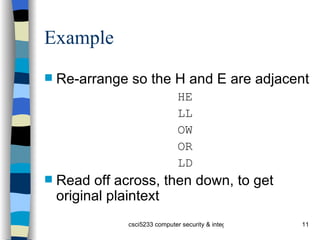
Example Re-arrange so the H and E are adjacent HE LL OW OR LD Read off across, then down, to get original plaintext
Substitution Ciphers Change characters in plaintext to produce ciphertext Example (Cæsar cipher) Plaintext is  HELLO WORLD Change each letter to the third letter following it (X goes to A, Y to B, Z to C) Key  is 3, usually written as letter ‘D’ Ciphertext is  KHOOR ZRUOG
Attacking the Cipher Exhaustive search If the key space is small enough, try all possible keys until you find the right one Cæsar cipher has 26 possible keys Statistical analysis Compare to 1-gram model of English
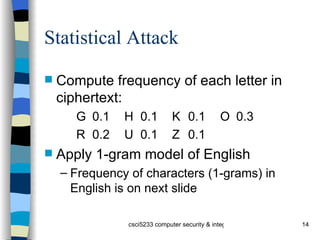
Statistical Attack Compute frequency of each letter in ciphertext: G 0.1 H 0.1 K 0.1 O 0.3 R 0.2 U 0.1 Z 0.1 Apply 1-gram model of English Frequency of characters (1-grams) in English is on next slide
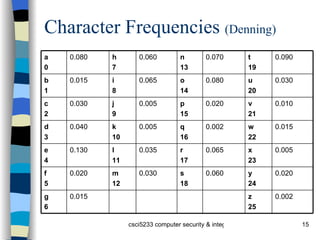
Character Frequencies  (Denning) 0.002 z 25 0.015 g 6 0.020 y 24 0.060 s 18 0.030 m 12 0.020 f 5 0.005 x 23 0.065 r 17 0.035 l 11 0.130 e 4 0.015 w 22 0.002 q 16 0.005 k 10 0.040 d 3 0.010 v 21 0.020 p 15 0.005 j 9 0.030 c 2 0.030 u 20 0.080 o 14 0.065 i 8 0.015 b 1 0.090 t 19 0.070 n 13 0.060 h 7 0.080 a  0
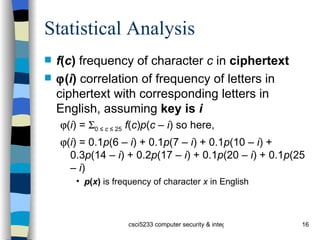
Statistical Analysis f ( c )  frequency of character  c  in  ciphertext  ( i )  correlation of frequency of letters in ciphertext with corresponding letters in English, assuming  key is  i  ( i ) =   0 ≤  c  ≤ 25   f ( c ) p ( c  –  i ) so here,  ( i ) = 0.1 p (6 –  i ) + 0.1 p (7 –  i ) + 0.1 p (10 –  i ) + 0.3 p (14 –  i ) + 0.2 p (17 –  i ) + 0.1 p (20 –  i ) + 0.1 p (25 –  i ) p ( x )  is frequency of character  x  in English
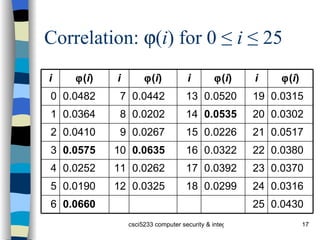
Correlation:   ( i ) for 0 ≤  i  ≤ 25 0.0430 25 0.0660 6 0.0316 24 0.0299 18 0.0325 12 0.0190 5 0.0370 23 0.0392 17 0.0262 11 0.0252 4 0.0380 22 0.0322 16 0.0635 10 0.0575 3 0.0517 21 0.0226 15 0.0267 9 0.0410 2 0.0302 20 0.0535 14 0.0202 8 0.0364 1 0.0315 19 0.0520 13 0.0442 7 0.0482 0  ( i ) i  ( i ) i  ( i ) i  ( i ) i
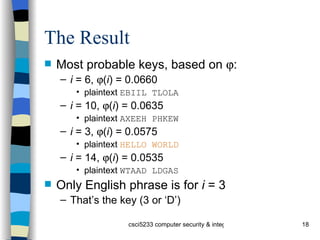
The Result Most probable keys, based on   : i  = 6,   ( i ) = 0.0660 plaintext  EBIIL TLOLA i  = 10,   ( i ) = 0.0635 plaintext  AXEEH PHKEW i  = 3,   ( i ) = 0.0575 plaintext  HELLO WORLD i  = 14,   ( i ) = 0.0535 plaintext  WTAAD LDGAS Only English phrase is for  i  = 3 That’s the key (3 or ‘D’)
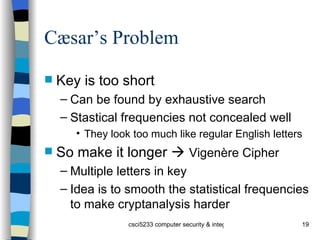
Cæsar’s Problem Key is too short Can be found by exhaustive search Stastical frequencies not concealed well They look too much like regular English letters So make it longer     Vigenère Cipher Multiple letters in key Idea is to smooth the statistical frequencies to make cryptanalysis harder
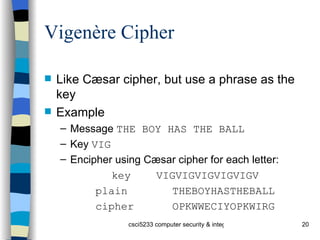
Vigenère Cipher Like Cæsar cipher, but use a phrase as the key Example Message  THE BOY HAS THE BALL Key  VIG Encipher using Cæsar cipher for each letter: key  VIGVIGVIGVIGVIGV plain  THEBOYHASTHEBALL cipher  OPKWWECIYOPKWIRG
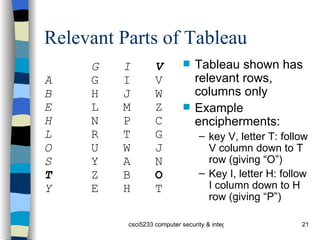
Relevant Parts of Tableau   G   I   V A   G   I   V B   H   J   W E   L   M   Z H   N   P   C L   R   T   G O   U   W   J S   Y   A   N T   Z   B   O Y   E   H   T Tableau shown has relevant rows, columns only Example encipherments: key V, letter T: follow V column down to T row (giving “O”) Key I, letter H: follow I column down to H row (giving “P”)
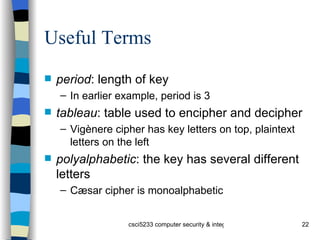
Useful Terms period : length of key In earlier example, period is 3 tableau : table used to encipher and decipher Vigènere cipher has key letters on top, plaintext letters on the left polyalphabetic : the key has several different letters Cæsar cipher is monoalphabetic
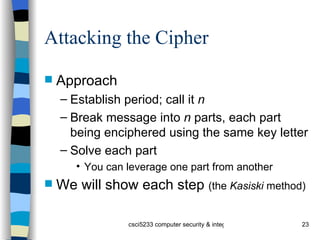
Attacking the Cipher  Approach Establish period; call it  n Break message into  n  parts, each part being enciphered using the same key letter Solve each part You can leverage one part from another We will show each step  (the  Kasiski  method)
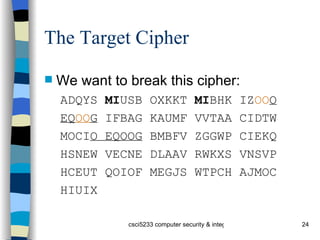
The Target Cipher We want to break this cipher: ADQYS  MI USB OXKKT  MI BHK IZ OO O EQ OO G  IFBAG KAUMF VVTAA CIDTW MOCI O EQOOG  BMBFV ZGGWP CIEKQ HSNEW VECNE DLAAV RWKXS VNSVP HCEUT QOIOF MEGJS WTPCH AJMOC HIUIX
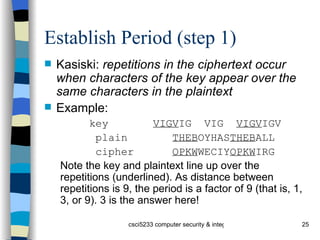
Establish Period (step 1) Kasiski:  repetitions in the ciphertext occur when characters of the key appear over the same characters in the plaintext Example: key  VIGV IG  VIG  VIGV IGV plain  THEB OYHAS THEB ALL cipher  OPKW WECIY OPKW IRG Note the key and plaintext line up over the repetitions (underlined). As distance between repetitions is 9, the period is a factor of 9 (that is, 1, 3, or 9). 3 is the answer here!
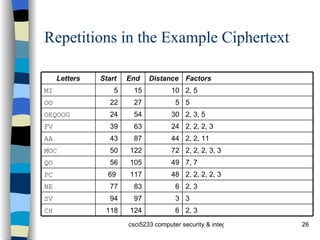
Repetitions in the Example Ciphertext 2, 3 6 124 118 CH 3 3 97 94 SV 2, 3 6 83 77 NE 2, 2, 2, 2, 3 48 117 69  PC 7, 7 49 105 56 QO 2, 2, 2, 3, 3 72 122 50 MOC 2, 2, 11 44 87 43 AA 2, 2, 2, 3 24 63 39 FV 2, 3, 5 30 54 24 OEQOOG 5 5 27 22 OO 2, 5 10 15 5 MI Factors Distance End Start Letters
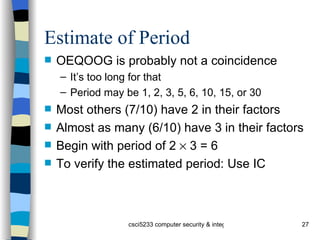
Estimate of Period OEQOOG is probably not a coincidence It’s too long for that Period may be 1, 2, 3, 5, 6, 10, 15, or 30 Most others (7/10) have 2 in their factors Almost as many (6/10) have 3 in their factors Begin with period of 2    3 = 6 To verify the estimated period: Use IC
Check on Period using IC Index of coincidence  (IC) is probability that two randomly chosen letters from ciphertext will be the same Tabulated for different periods  [Denning] : 1 0.066 3 0.047 5 0.044 2 0.052 4 0.045 10 0.041 Large 0.038
Compute IC IC = [ n  ( n  – 1)] –1   0≤ i ≤25  [ F i  ( F i  – 1)] where  n  is length of ciphertext and  F i  the number of times character  i  occurs in ciphertext Here, IC = 0.043 Indicates a key of slightly more than 5 A statistical measure, so it can be in error, but it agrees with the previous estimate (which was 6)
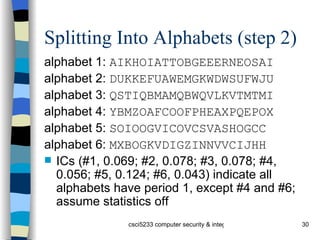
Splitting Into Alphabets (step 2) alphabet 1:  AIKHOIATTOBGEEERNEOSAI alphabet 2:  DUKKEFUAWEMGKWDWSUFWJU alphabet 3:  QSTIQBMAMQBWQVLKVTMTMI alphabet 4:  YBMZOAFCOOFPHEAXPQEPOX alphabet 5:  SOIOOGVICOVCSVASHOGCC alphabet 6:  MXBOGKVDIGZINNVVCIJHH ICs (#1, 0.069; #2, 0.078; #3, 0.078; #4, 0.056; #5, 0.124; #6, 0.043) indicate all alphabets have period 1, except #4 and #6; assume statistics off
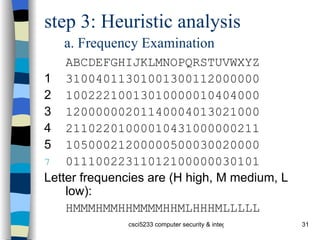
step 3: Heuristic analysis   a. Frequency Examination ABCDEFGHIJKLMNOPQRSTUVWXYZ 1 31004011301001300112000000 2 10022210013010000010404000 3 12000000201140004013021000 4 21102201000010431000000211 5 10500021200000500030020000 01110022311012100000030101 Letter frequencies are (H high, M medium, L low): HMMMHMMHHMMMMHHMLHHHMLLLLL
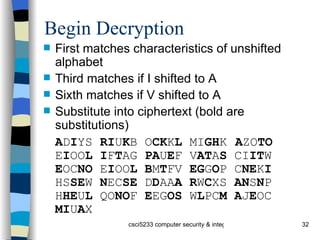
Begin Decryption First matches characteristics of unshifted alphabet Third matches if I shifted to A Sixth matches if V shifted to A Substitute into ciphertext (bold are substitutions) A D I YS  RI U K B O CK K L  MI GH K A ZO TO  E I OO L I F T AG  PA U E F V AT A S  CI IT W  E OC NO  E I OO L B M T FV  EG G O P C NE K I HS SE W  N EC SE  D D AA A R W C XS  AN S N P H HE U L  QO NO F  E EG OS  W L PC M A J E OC  MI U A X
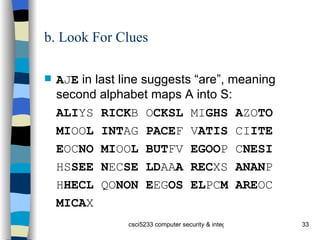
b. Look For Clues A J E  in last line suggests “are”, meaning second alphabet maps A into S: ALI YS  RICK B O CKSL  MI GHS A ZO TO MI OO L INT AG  PACE F V ATIS  CI ITE E OC NO MI OO L BUT FV  EGOO P C NESI HS SEE N EC SE LD AA A REC XS  ANAN P H HECL  QO NON E EG OS EL PC M ARE OC MICA X
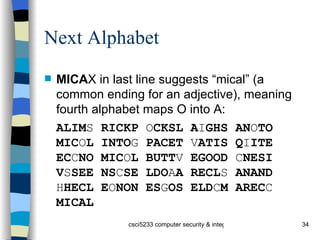
Next Alphabet MICA X in last line suggests “mical” (a common ending for an adjective), meaning fourth alphabet maps O into A: ALIM S  RICKP  O CKSL A I GHS AN O TO MIC O L INTO G  PACET  V ATIS Q I ITE EC C NO MIC O L BUTT V  EGOOD  C NESI V S SEE NS C SE LDO A A RECL S  ANAND  H HECL E O NON ES G OS ELD C M AREC C  MICAL
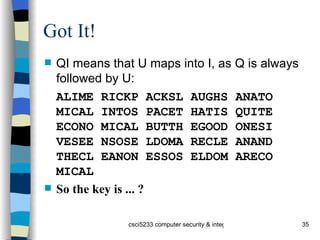
Got It! QI means that U maps into I, as Q is always followed by U: ALIME RICKP ACKSL AUGHS ANATO MICAL INTOS PACET HATIS QUITE ECONO MICAL BUTTH EGOOD ONESI VESEE NSOSE LDOMA RECLE ANAND THECL EANON ESSOS ELDOM ARECO MICAL So the key is ... ?
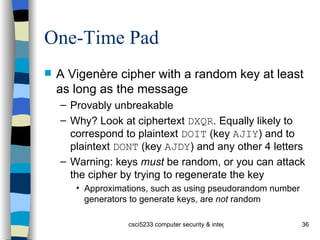
One-Time Pad A Vigenère cipher with a random key at least as long as the message Provably unbreakable Why? Look at ciphertext  DXQR . Equally likely to correspond to plaintext  DOIT  (key  AJIY ) and to plaintext  DONT  (key  AJDY ) and any other 4 letters Warning: keys  must  be random, or you can attack the cipher by trying to regenerate the key Approximations, such as using pseudorandom number generators to generate keys, are  not  random
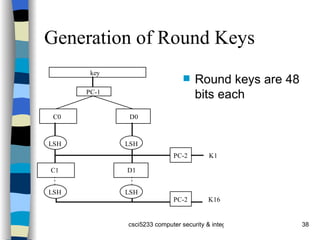
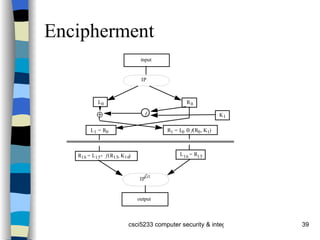
Overview of the DES A block cipher: encrypts blocks of 64 bits using a 64 bit key outputs 64 bits of ciphertext A product cipher basic unit is the bit performs both substitution and transposition (permutation) on the bits Cipher consists of 16 rounds (iterations) each with a round key generated from the user-supplied key
Generation of Round Keys Round keys are 48 bits each
Encipherment
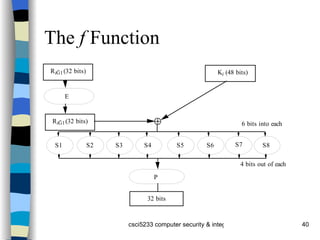
The  f  Function
Controversy Considered too weak Diffie, Hellman said in a few years technology would allow DES to be broken in days Design using 1999 technology published Design decisions not public S-boxes may have backdoors
Undesirable Properties 4 weak keys They are their own inverses 12 semi-weak keys Each has another semi-weak key as inverse Complementation property DES k ( m ) =  c     DES k´ ( m´ ) =  c´ S-boxes exhibit irregular properties Distribution of odd, even numbers non-random Outputs of fourth box depends on input to third box
Differential Cryptanalysis A chosen ciphertext attack Requires 2 47  plaintext, ciphertext pairs Revealed several properties Small changes in S-boxes reduce the number of pairs needed Making every bit of the round keys independent does not impede attack Linear cryptanalysis improves result Requires 2 43  plaintext, ciphertext pairs
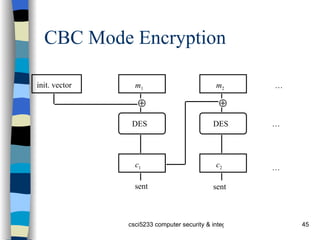
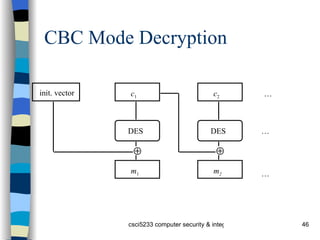
DES Modes Electronic Code Book Mode (ECB) Encipher each block independently Cipher Block Chaining Mode (CBC) Xor each block with previous ciphertext block Requires an initialization vector for the first one Encrypt-Decrypt-Encrypt Mode (2 keys:  k ,  k´ ) c  = DES k (DES k´ –1 (DES k ( m ))) Encrypt-Encrypt-Encrypt Mode (3 keys:  k ,  k´ ,  k´´ ) c  = DES k (DES k´ (DES k´´ ( m )))
CBC Mode Encryption  init. vector m 1 DES c 1  m 2 DES c 2 sent sent … … …
CBC Mode Decryption  init. vector c 1 DES m 1 … … …  c 2 DES m 2
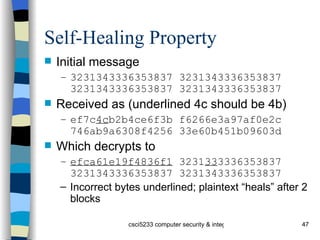
Self-Healing Property Initial message 3231343336353837 3231343336353837 3231343336353837 3231343336353837   Received as (underlined 4c should be 4b) ef7c 4c b2b4ce6f3b f6266e3a97af0e2c 746ab9a6308f4256 33e60b451b09603d Which decrypts to efca61e19f4836f1  3231 33 3336353837 3231343336353837 3231343336353837 Incorrect bytes underlined; plaintext “heals” after 2 blocks
Current Status of DES Design for computer system, associated software that could break any DES-enciphered message in a few days published in 1998 Several challenges to break DES messages solved using distributed computing NIST selected Rijndael as Advanced Encryption Standard, successor to DES Designed to withstand attacks that were successful on DES

Crypto

  • 1.
  • 2.
    Outline Classical CryptographyCaesar cipher Vigenère cipher DES Public Key Cryptography Diffie-Hellman RSA Cryptographic Checksums HMAC
  • 3.
    Cryptosystem Quintuple (E , D , M , K , C ) M set of plaintexts K set of keys C set of ciphertexts E set of encryption functions e : M  K  C D set of decryption functions d : C  K  M
  • 4.
    Example Example: Caesarcipher M = { sequences of letters } K = { i | i is an integer and 0 ≤ i ≤ 25 } E = { E k | k  K and for all letters m , E k ( m ) = ( m + k ) mod 26 } D = { D k | k  K and for all letters c , D k ( c ) = (26 + c – k ) mod 26 } C = M
  • 5.
    Attacks Opponent whosegoal is to break cryptosystem is the adversary Assume adversary knows algorithm used, but not key Three types of attacks: ciphertext only : adversary has only ciphertext; goal is to find plaintext, possibly key known plaintext : adversary has ciphertext, corresponding plaintext; goal is to find key chosen plaintext : adversary may supply plaintexts and obtain corresponding ciphertext; goal is to find key
  • 6.
    Basis for AttacksMathematical attacks Based on analysis of underlying mathematics Statistical attacks Make assumptions about the distribution of letters, pairs of letters (digrams), triplets of letters (trigrams), etc. (called models of the language). Examine ciphertext, correlate properties with the assumptions.
  • 7.
    Classical Cryptography Sender,receiver share common key Keys may be the same, or trivial to derive from one another Also called symmetric cryptography Two basic types Transposition ciphers Substitution ciphers Combinations are called product ciphers
  • 8.
    Transposition Cipher Rearrangeletters in plaintext to produce ciphertext Example (Rail-Fence Cipher) Plaintext is HELLO WORLD Rearrange as HLOOL ELWRD Ciphertext is HLOOL ELWRD Question: What is the key?
  • 9.
    Attacking the CipherAnagramming: to rearrange (the letters of a text) in order to discover a hidden message If 1-gram frequencies match English frequencies, but other n -gram frequencies do not, probably transposition Rearrange letters to form n -grams with highest frequencies
  • 10.
    Example Ciphertext: HLOOLELWRD Based on Konheim’s digram table : Frequencies of 2-grams beginning with H HE 0.0305 HO 0.0043 HL, HW, HR, HD < 0.0010 Frequencies of 2-grams ending in H WH 0.0026 EH, LH, OH, RH, DH ≤ 0.0002 Implies E follows H
  • 11.
    Example Re-arrange sothe H and E are adjacent HE LL OW OR LD Read off across, then down, to get original plaintext
  • 12.
    Substitution Ciphers Changecharacters in plaintext to produce ciphertext Example (Cæsar cipher) Plaintext is HELLO WORLD Change each letter to the third letter following it (X goes to A, Y to B, Z to C) Key is 3, usually written as letter ‘D’ Ciphertext is KHOOR ZRUOG
  • 13.
    Attacking the CipherExhaustive search If the key space is small enough, try all possible keys until you find the right one Cæsar cipher has 26 possible keys Statistical analysis Compare to 1-gram model of English
  • 14.
    Statistical Attack Computefrequency of each letter in ciphertext: G 0.1 H 0.1 K 0.1 O 0.3 R 0.2 U 0.1 Z 0.1 Apply 1-gram model of English Frequency of characters (1-grams) in English is on next slide
  • 15.
    Character Frequencies (Denning) 0.002 z 25 0.015 g 6 0.020 y 24 0.060 s 18 0.030 m 12 0.020 f 5 0.005 x 23 0.065 r 17 0.035 l 11 0.130 e 4 0.015 w 22 0.002 q 16 0.005 k 10 0.040 d 3 0.010 v 21 0.020 p 15 0.005 j 9 0.030 c 2 0.030 u 20 0.080 o 14 0.065 i 8 0.015 b 1 0.090 t 19 0.070 n 13 0.060 h 7 0.080 a 0
  • 16.
    Statistical Analysis f( c ) frequency of character c in ciphertext  ( i ) correlation of frequency of letters in ciphertext with corresponding letters in English, assuming key is i  ( i ) =  0 ≤ c ≤ 25 f ( c ) p ( c – i ) so here,  ( i ) = 0.1 p (6 – i ) + 0.1 p (7 – i ) + 0.1 p (10 – i ) + 0.3 p (14 – i ) + 0.2 p (17 – i ) + 0.1 p (20 – i ) + 0.1 p (25 – i ) p ( x ) is frequency of character x in English
  • 17.
    Correlation: ( i ) for 0 ≤ i ≤ 25 0.0430 25 0.0660 6 0.0316 24 0.0299 18 0.0325 12 0.0190 5 0.0370 23 0.0392 17 0.0262 11 0.0252 4 0.0380 22 0.0322 16 0.0635 10 0.0575 3 0.0517 21 0.0226 15 0.0267 9 0.0410 2 0.0302 20 0.0535 14 0.0202 8 0.0364 1 0.0315 19 0.0520 13 0.0442 7 0.0482 0  ( i ) i  ( i ) i  ( i ) i  ( i ) i
  • 18.
    The Result Mostprobable keys, based on  : i = 6,  ( i ) = 0.0660 plaintext EBIIL TLOLA i = 10,  ( i ) = 0.0635 plaintext AXEEH PHKEW i = 3,  ( i ) = 0.0575 plaintext HELLO WORLD i = 14,  ( i ) = 0.0535 plaintext WTAAD LDGAS Only English phrase is for i = 3 That’s the key (3 or ‘D’)
  • 19.
    Cæsar’s Problem Keyis too short Can be found by exhaustive search Stastical frequencies not concealed well They look too much like regular English letters So make it longer  Vigenère Cipher Multiple letters in key Idea is to smooth the statistical frequencies to make cryptanalysis harder
  • 20.
    Vigenère Cipher LikeCæsar cipher, but use a phrase as the key Example Message THE BOY HAS THE BALL Key VIG Encipher using Cæsar cipher for each letter: key VIGVIGVIGVIGVIGV plain THEBOYHASTHEBALL cipher OPKWWECIYOPKWIRG
  • 21.
    Relevant Parts ofTableau G I V A G I V B H J W E L M Z H N P C L R T G O U W J S Y A N T Z B O Y E H T Tableau shown has relevant rows, columns only Example encipherments: key V, letter T: follow V column down to T row (giving “O”) Key I, letter H: follow I column down to H row (giving “P”)
  • 22.
    Useful Terms period: length of key In earlier example, period is 3 tableau : table used to encipher and decipher Vigènere cipher has key letters on top, plaintext letters on the left polyalphabetic : the key has several different letters Cæsar cipher is monoalphabetic
  • 23.
    Attacking the Cipher Approach Establish period; call it n Break message into n parts, each part being enciphered using the same key letter Solve each part You can leverage one part from another We will show each step (the Kasiski method)
  • 24.
    The Target CipherWe want to break this cipher: ADQYS MI USB OXKKT MI BHK IZ OO O EQ OO G IFBAG KAUMF VVTAA CIDTW MOCI O EQOOG BMBFV ZGGWP CIEKQ HSNEW VECNE DLAAV RWKXS VNSVP HCEUT QOIOF MEGJS WTPCH AJMOC HIUIX
  • 25.
    Establish Period (step1) Kasiski: repetitions in the ciphertext occur when characters of the key appear over the same characters in the plaintext Example: key VIGV IG VIG VIGV IGV plain THEB OYHAS THEB ALL cipher OPKW WECIY OPKW IRG Note the key and plaintext line up over the repetitions (underlined). As distance between repetitions is 9, the period is a factor of 9 (that is, 1, 3, or 9). 3 is the answer here!
  • 26.
    Repetitions in theExample Ciphertext 2, 3 6 124 118 CH 3 3 97 94 SV 2, 3 6 83 77 NE 2, 2, 2, 2, 3 48 117 69 PC 7, 7 49 105 56 QO 2, 2, 2, 3, 3 72 122 50 MOC 2, 2, 11 44 87 43 AA 2, 2, 2, 3 24 63 39 FV 2, 3, 5 30 54 24 OEQOOG 5 5 27 22 OO 2, 5 10 15 5 MI Factors Distance End Start Letters
  • 27.
    Estimate of PeriodOEQOOG is probably not a coincidence It’s too long for that Period may be 1, 2, 3, 5, 6, 10, 15, or 30 Most others (7/10) have 2 in their factors Almost as many (6/10) have 3 in their factors Begin with period of 2  3 = 6 To verify the estimated period: Use IC
  • 28.
    Check on Periodusing IC Index of coincidence (IC) is probability that two randomly chosen letters from ciphertext will be the same Tabulated for different periods [Denning] : 1 0.066 3 0.047 5 0.044 2 0.052 4 0.045 10 0.041 Large 0.038
  • 29.
    Compute IC IC= [ n ( n – 1)] –1  0≤ i ≤25 [ F i ( F i – 1)] where n is length of ciphertext and F i the number of times character i occurs in ciphertext Here, IC = 0.043 Indicates a key of slightly more than 5 A statistical measure, so it can be in error, but it agrees with the previous estimate (which was 6)
  • 30.
    Splitting Into Alphabets(step 2) alphabet 1: AIKHOIATTOBGEEERNEOSAI alphabet 2: DUKKEFUAWEMGKWDWSUFWJU alphabet 3: QSTIQBMAMQBWQVLKVTMTMI alphabet 4: YBMZOAFCOOFPHEAXPQEPOX alphabet 5: SOIOOGVICOVCSVASHOGCC alphabet 6: MXBOGKVDIGZINNVVCIJHH ICs (#1, 0.069; #2, 0.078; #3, 0.078; #4, 0.056; #5, 0.124; #6, 0.043) indicate all alphabets have period 1, except #4 and #6; assume statistics off
  • 31.
    step 3: Heuristicanalysis a. Frequency Examination ABCDEFGHIJKLMNOPQRSTUVWXYZ 1 31004011301001300112000000 2 10022210013010000010404000 3 12000000201140004013021000 4 21102201000010431000000211 5 10500021200000500030020000 01110022311012100000030101 Letter frequencies are (H high, M medium, L low): HMMMHMMHHMMMMHHMLHHHMLLLLL
  • 32.
    Begin Decryption Firstmatches characteristics of unshifted alphabet Third matches if I shifted to A Sixth matches if V shifted to A Substitute into ciphertext (bold are substitutions) A D I YS RI U K B O CK K L MI GH K A ZO TO E I OO L I F T AG PA U E F V AT A S CI IT W E OC NO E I OO L B M T FV EG G O P C NE K I HS SE W N EC SE D D AA A R W C XS AN S N P H HE U L QO NO F E EG OS W L PC M A J E OC MI U A X
  • 33.
    b. Look ForClues A J E in last line suggests “are”, meaning second alphabet maps A into S: ALI YS RICK B O CKSL MI GHS A ZO TO MI OO L INT AG PACE F V ATIS CI ITE E OC NO MI OO L BUT FV EGOO P C NESI HS SEE N EC SE LD AA A REC XS ANAN P H HECL QO NON E EG OS EL PC M ARE OC MICA X
  • 34.
    Next Alphabet MICAX in last line suggests “mical” (a common ending for an adjective), meaning fourth alphabet maps O into A: ALIM S RICKP O CKSL A I GHS AN O TO MIC O L INTO G PACET V ATIS Q I ITE EC C NO MIC O L BUTT V EGOOD C NESI V S SEE NS C SE LDO A A RECL S ANAND H HECL E O NON ES G OS ELD C M AREC C MICAL
  • 35.
    Got It! QImeans that U maps into I, as Q is always followed by U: ALIME RICKP ACKSL AUGHS ANATO MICAL INTOS PACET HATIS QUITE ECONO MICAL BUTTH EGOOD ONESI VESEE NSOSE LDOMA RECLE ANAND THECL EANON ESSOS ELDOM ARECO MICAL So the key is ... ?
  • 36.
    One-Time Pad AVigenère cipher with a random key at least as long as the message Provably unbreakable Why? Look at ciphertext DXQR . Equally likely to correspond to plaintext DOIT (key AJIY ) and to plaintext DONT (key AJDY ) and any other 4 letters Warning: keys must be random, or you can attack the cipher by trying to regenerate the key Approximations, such as using pseudorandom number generators to generate keys, are not random
  • 37.
    Overview of theDES A block cipher: encrypts blocks of 64 bits using a 64 bit key outputs 64 bits of ciphertext A product cipher basic unit is the bit performs both substitution and transposition (permutation) on the bits Cipher consists of 16 rounds (iterations) each with a round key generated from the user-supplied key
  • 38.
    Generation of RoundKeys Round keys are 48 bits each
  • 39.
  • 40.
    The f Function
  • 41.
    Controversy Considered tooweak Diffie, Hellman said in a few years technology would allow DES to be broken in days Design using 1999 technology published Design decisions not public S-boxes may have backdoors
  • 42.
    Undesirable Properties 4weak keys They are their own inverses 12 semi-weak keys Each has another semi-weak key as inverse Complementation property DES k ( m ) = c  DES k´ ( m´ ) = c´ S-boxes exhibit irregular properties Distribution of odd, even numbers non-random Outputs of fourth box depends on input to third box
  • 43.
    Differential Cryptanalysis Achosen ciphertext attack Requires 2 47 plaintext, ciphertext pairs Revealed several properties Small changes in S-boxes reduce the number of pairs needed Making every bit of the round keys independent does not impede attack Linear cryptanalysis improves result Requires 2 43 plaintext, ciphertext pairs
  • 44.
    DES Modes ElectronicCode Book Mode (ECB) Encipher each block independently Cipher Block Chaining Mode (CBC) Xor each block with previous ciphertext block Requires an initialization vector for the first one Encrypt-Decrypt-Encrypt Mode (2 keys: k , k´ ) c = DES k (DES k´ –1 (DES k ( m ))) Encrypt-Encrypt-Encrypt Mode (3 keys: k , k´ , k´´ ) c = DES k (DES k´ (DES k´´ ( m )))
  • 45.
    CBC Mode Encryption init. vector m 1 DES c 1  m 2 DES c 2 sent sent … … …
  • 46.
    CBC Mode Decryption init. vector c 1 DES m 1 … … …  c 2 DES m 2
  • 47.
    Self-Healing Property Initialmessage 3231343336353837 3231343336353837 3231343336353837 3231343336353837 Received as (underlined 4c should be 4b) ef7c 4c b2b4ce6f3b f6266e3a97af0e2c 746ab9a6308f4256 33e60b451b09603d Which decrypts to efca61e19f4836f1 3231 33 3336353837 3231343336353837 3231343336353837 Incorrect bytes underlined; plaintext “heals” after 2 blocks
  • 48.
    Current Status ofDES Design for computer system, associated software that could break any DES-enciphered message in a few days published in 1998 Several challenges to break DES messages solved using distributed computing NIST selected Rijndael as Advanced Encryption Standard, successor to DES Designed to withstand attacks that were successful on DES