CLIMATE CHANGE CHALLENGES
IN TRANSBOUNDARY RIVER WATER
    RESOURCES MANAGEMENT


               Dr Mohamed AIT KADI
               GWP/Technical Committee Chair
               MRC International Conference
               2-3 April 2010, Hua Hin, Thailand
Outline


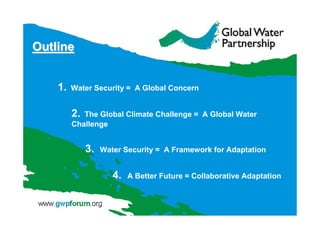
    1.   Water Security = A Global Concern


         2. The Global Climate Challenge = A Global Water
         Challenge


              3.   Water Security = A Framework for Adaptation


                      4.   A Better Future = Collaborative Adaptation
15 YEARS TOWARDS HYDROSOLIDARITY
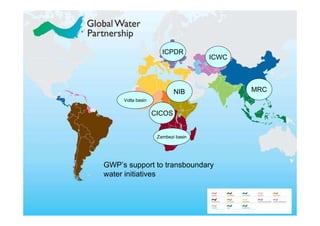
ICPDR
                                    ICWC


                           NIB             MRC
     Volta basin


                   CICOS


                    Zambezi basin


GWP’s support to transboundary
water initiatives
1.   Water Security = A Global Concern

                        The challenge of securing safe and plentiful
                        water for all of us is one of the most daunting
                        challenges faced by the world today… Our
                        experiences tell us that environmental stress
                        due to lack of water may lead to conflict and
                        would be greater in poor countries

                                                         UN secretary-General Ban Ki-moon
                                                                    WEF, 24 Jannuary 2008


Humanity is facing « water bankrupcy » as a
result of a crisis even greater than the financial
meldown now destabilizing the global economy
… it is already beginning to take effect, and
there will be no way of bailing the earth out of
water scarcity …

                         G. Lean, The Independent, 15 March 2009
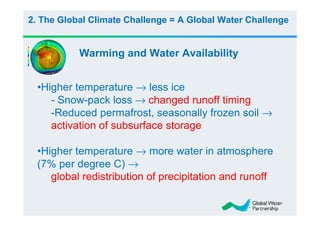
2. The Global Climate Challenge = A Global Water Challenge


           Warming and Water Availability


  •Higher temperature → less ice
     - Snow-pack loss → changed runoff timing
     -Reduced permafrost, seasonally frozen soil →
     activation of subsurface storage

  •Higher temperature → more water in atmosphere
  (7% per degree C) →
     global redistribution of precipitation and runoff
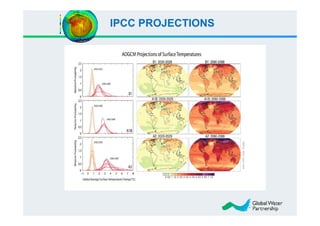
IPCC PROJECTIONS
IPCC PROJECTIONS
Model-Projected Runoff Change (%)
                       [(2041-2060)-(1900-1970)]


(Milly et al., 2005)
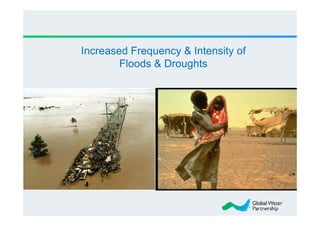
Increased Frequency & Intensity of
        Floods & Droughts
Cascading effects on the Economy , Society & Ecosystems
                                            •SEA LEVEL RISE
                                            •COASTAL FLOODS


               •POOR WATER QUALITY
               •MORE SEDIMENTS                  •SALT INTRUSION
                                                •URBAN FLOODS


      •INCREASED FLOODS
      •REDUCED LOW FLOWS                              •SHORT GROWING SEASON
                                                      •LONGER DROUGHTS


•SNOWMELT CHANGE
•INCREASED EROSION
•LAND SLIDES
Need to Understand the Complex
Relations Between Climate, Land/Water
Use, Surface/Subsurface Flows + Feed               Complex Climate
back SUPPLY & DEMAND                               Relations

                                                      Multiple-Aquifer
                                                      Stresses
                                                                                       GW/SW
                                                                                       Relations


                                                                         Multiple-Aquifer
                                                                         Flow Systems &
                                                                         Flow Directions


                                      Regional Flow Systems


  Modified from Puri & Arnold, 2002
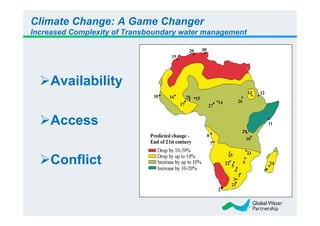
Climate Change: A Game Changer
Increased Complexity of Transboundary water management


     Availability

     Access

     Conflict
3.   Water Security = A Framework for Adaptation

 Water Security = { Reliable Availability + Acceptable level of Risks}


      A focus on water security provides a framework for
      developing appropriate response strategies
      Much of the challenge focuses on managing
      hydrological variability -- economic impacts of variability
      today are far-reaching, and climate change will
      increase such variability
      The scale of the water security challenge depends on a
      basin’s natural hydrology, and countries’ mix of
      institutions and infrastructure for water management
3.   Water Security = A Framework for Adaptation

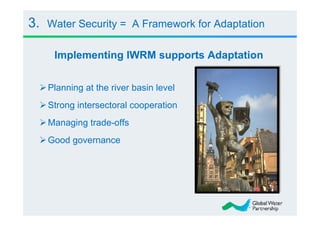
      Implementing IWRM supports Adaptation


     Planning at the river basin level
     Strong intersectoral cooperation
     Managing trade-offs
     Good governance
4.      A Better Future = Collaborative Adaptation

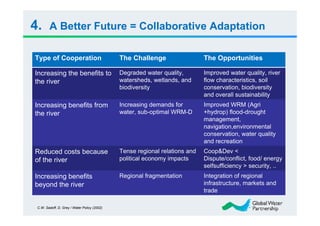
Type of Cooperation                           The Challenge                  The Opportunities

Increasing the benefits to                    Degraded water quality,        Improved water quality, river
the river                                     watersheds, wetlands, and      flow characteristics, soil
                                              biodiversity                   conservation, biodiversity
                                                                             and overall sustainability
Increasing benefits from                      Increasing demands for         Improved WRM (Agri
the river                                     water, sub-optimal WRM-D       +hydrop) flood-drought
                                                                             management,
                                                                             navigation,environmental
                                                                             conservation, water quality
                                                                             and recreation
Reduced costs because                         Tense regional relations and   Coop&Dev <
of the river                                  political economy impacts      Dispute/conflict, food/ energy
                                                                             selfsufficiency > security, ..
Increasing benefits                           Regional fragmentation         Integration of regional
beyond the river                                                             infrastructure, markets and
                                                                             trade

 C.W. Sadoff, D. Grey / Water Policy (2002)
4.   A Better Future = Collaborative Adaptation


     Transboundary cooperation is both necessary and
     beneficial in adapting to climate change

     Barriers to collaborative adaptation in the legal,
     institutional and policy spheres should be removed

     When planning for adaptation across boundaries, riparian
     countries should focus on transboundary impacts, sharing
     benefits and risks in an equitable and reasonable manner

     Sharing information, including that from early warning
     systems, between riparian countries is essential for
     effective and efficient climate change adaptation
Conclusions

The international rivers of the world are coming under growing
pressure from climate change

Water security as a framework of adaptation can be achieved on the
basis of « hydrosolidarity » which embraces collective action,
interdependence, and shared responsibility

The approach to collaborative adaptation is IWRM supported by
strong management institutions, a high level of cooperation among
all interests and continuous adaptation to new conditions

If the focus from competing national interests can be shifted to
attaining common benefits, genuine transboundary water
security can be achieved and sustained
Thank You


            Sources: UN Water/internet

Climate Change Challenges in Transboundary River Water Resources Management presented by Dr .Mohamed AIT KADI ,GWP/Technical Committee Chair MRC at International Conference 2-3 April 2010, Hua Hin, Thailand

  • 1.
    CLIMATE CHANGE CHALLENGES INTRANSBOUNDARY RIVER WATER RESOURCES MANAGEMENT Dr Mohamed AIT KADI GWP/Technical Committee Chair MRC International Conference 2-3 April 2010, Hua Hin, Thailand
  • 2.
    Outline 1. Water Security = A Global Concern 2. The Global Climate Challenge = A Global Water Challenge 3. Water Security = A Framework for Adaptation 4. A Better Future = Collaborative Adaptation
  • 3.
    15 YEARS TOWARDSHYDROSOLIDARITY
  • 4.
    ICPDR ICWC NIB MRC Volta basin CICOS Zambezi basin GWP’s support to transboundary water initiatives
  • 5.
    1. Water Security = A Global Concern The challenge of securing safe and plentiful water for all of us is one of the most daunting challenges faced by the world today… Our experiences tell us that environmental stress due to lack of water may lead to conflict and would be greater in poor countries UN secretary-General Ban Ki-moon WEF, 24 Jannuary 2008 Humanity is facing « water bankrupcy » as a result of a crisis even greater than the financial meldown now destabilizing the global economy … it is already beginning to take effect, and there will be no way of bailing the earth out of water scarcity … G. Lean, The Independent, 15 March 2009
  • 6.
    2. The GlobalClimate Challenge = A Global Water Challenge Warming and Water Availability •Higher temperature → less ice - Snow-pack loss → changed runoff timing -Reduced permafrost, seasonally frozen soil → activation of subsurface storage •Higher temperature → more water in atmosphere (7% per degree C) → global redistribution of precipitation and runoff
  • 7.
  • 8.
  • 9.
    Model-Projected Runoff Change(%) [(2041-2060)-(1900-1970)] (Milly et al., 2005)
  • 10.
    Increased Frequency &Intensity of Floods & Droughts
  • 11.
    Cascading effects onthe Economy , Society & Ecosystems •SEA LEVEL RISE •COASTAL FLOODS •POOR WATER QUALITY •MORE SEDIMENTS •SALT INTRUSION •URBAN FLOODS •INCREASED FLOODS •REDUCED LOW FLOWS •SHORT GROWING SEASON •LONGER DROUGHTS •SNOWMELT CHANGE •INCREASED EROSION •LAND SLIDES
  • 12.
    Need to Understandthe Complex Relations Between Climate, Land/Water Use, Surface/Subsurface Flows + Feed Complex Climate back SUPPLY & DEMAND Relations Multiple-Aquifer Stresses GW/SW Relations Multiple-Aquifer Flow Systems & Flow Directions Regional Flow Systems Modified from Puri & Arnold, 2002
  • 13.
    Climate Change: AGame Changer Increased Complexity of Transboundary water management Availability Access Conflict
  • 14.
    3. Water Security = A Framework for Adaptation Water Security = { Reliable Availability + Acceptable level of Risks} A focus on water security provides a framework for developing appropriate response strategies Much of the challenge focuses on managing hydrological variability -- economic impacts of variability today are far-reaching, and climate change will increase such variability The scale of the water security challenge depends on a basin’s natural hydrology, and countries’ mix of institutions and infrastructure for water management
  • 15.
    3. Water Security = A Framework for Adaptation Implementing IWRM supports Adaptation Planning at the river basin level Strong intersectoral cooperation Managing trade-offs Good governance
  • 16.
    4. A Better Future = Collaborative Adaptation Type of Cooperation The Challenge The Opportunities Increasing the benefits to Degraded water quality, Improved water quality, river the river watersheds, wetlands, and flow characteristics, soil biodiversity conservation, biodiversity and overall sustainability Increasing benefits from Increasing demands for Improved WRM (Agri the river water, sub-optimal WRM-D +hydrop) flood-drought management, navigation,environmental conservation, water quality and recreation Reduced costs because Tense regional relations and Coop&Dev < of the river political economy impacts Dispute/conflict, food/ energy selfsufficiency > security, .. Increasing benefits Regional fragmentation Integration of regional beyond the river infrastructure, markets and trade C.W. Sadoff, D. Grey / Water Policy (2002)
  • 17.
    4. A Better Future = Collaborative Adaptation Transboundary cooperation is both necessary and beneficial in adapting to climate change Barriers to collaborative adaptation in the legal, institutional and policy spheres should be removed When planning for adaptation across boundaries, riparian countries should focus on transboundary impacts, sharing benefits and risks in an equitable and reasonable manner Sharing information, including that from early warning systems, between riparian countries is essential for effective and efficient climate change adaptation
  • 18.
    Conclusions The international riversof the world are coming under growing pressure from climate change Water security as a framework of adaptation can be achieved on the basis of « hydrosolidarity » which embraces collective action, interdependence, and shared responsibility The approach to collaborative adaptation is IWRM supported by strong management institutions, a high level of cooperation among all interests and continuous adaptation to new conditions If the focus from competing national interests can be shifted to attaining common benefits, genuine transboundary water security can be achieved and sustained
  • 19.
    Thank You Sources: UN Water/internet