BFP‐ANDES
– Leader: Mark Mulligan, KCL
– Coordinator: Jorge Rubiano, UNAL
    •   WP1(POV): G. Hyman, A. Farrow, G. Lema (CIAT)
        WP1(POV): G Hyman A Farrow G Lema (CIAT)
    •   WP2(AVAIL): M. Mulligan (KCL), J..G. Leon (UNAL)
    •   WP3(PROD): M. Kirby (CSIRO), J. Selvaraj (UNAL)
    •   WP4(INST): D. White (CIAT), V. Vargas (UNAL)
    •   WP5(INTERV) M S
                     M. Saravia (CONDESAN,BC), incl. prev. CP projects
                              i (CONDESAN BC) i l          CP    j
    •   WP6(KNOW): N. Niederhauser (CIAT) 
    •   + tied PhD, MSc and UG students


AIM: To have the best available science used in the 
  formulation and testing of land and water policy for 
  better livelihoods, in cases where currently it is not
  better livelihoods in cases where currently it is not
Brief for presentation:
– What Andes BFP is intended to achieve? And for whom?
– Expected Research products 
– How you intend to get outputs?
Team Experience 
• Extensive knowledge of the region
• Poverty mapping and analysis
• Water accounting and productivity
  Water accounting and productivity
• Institutions and interventions
• L l t k h ld
  Local stakeholders and networks
                        d t      k
• Spatial hydrological modelling and GIS
• Global datasets
• Policy support systems and knowledge
  Policy support systems and knowledge 
  systems
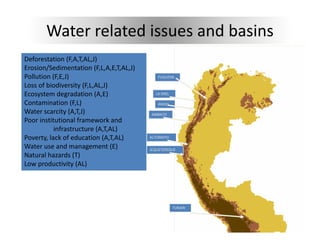
Water related issues and basins
Deforestation (F,A,T,AL,J)
Erosion/Sedimentation (F,L,A,E,T,AL,J)
Pollution (F,E,J)
Pollution (F E J)                           FUQUENE

Loss of biodiversity (F,L,AL,J)
Ecosystem degradation (A,E)                LA MIEL

Contamination (F,L)                         ANGEL

Water scarcity (A,T,J)                   AMBATO
Poor institutional framework and 
           infrastructure (A,T,AL)                            SG505
Poverty, lack of education (A,T,AL)
Poverty lack of education (A T AL)       ALTOMAYO             SG510
Water use and management (E)             JEQUETEPEQUE
Natural hazards (T)
Low productivity (AL)


                                                     TUNARI
Basin(s) Context
• High but variable rainfall steep slopes spatial
  High but variable rainfall, steep slopes, spatial 
  heterogeneity, climate change
• Poverty sometimes related to lack of water, sometimes of 
        y                                      ,
  excess water:
   – Hazards to productivity : (landslides, soil erosion/degradation, 
       nutrient losses)
       nutrient losses)
   – Downstream impacts : (sedimentation, water quality losses, 
       flooding, supply to major cities)
   .... with impacts on health and poverty sometimes through food.
• Competing land‐use demands on steep‐lands 
• E i ti
  Existing and proposed major dam projects, inter‐basin 
             d         d j d          j t i t b i
  transfers, mining...
• Payments for environmental services and other non ag.
  Payments for environmental services and other non ag. 
  livelihood options
‘Clients’

• Farmers, (basin) communities, interested citizens
   a e s, (bas ) co       u t es, te ested c t e s
• Local government (policy advisors)
• National government (policy advisors)
  National government (policy advisors)
• Universities, research orgs (e.g. IDEAM)
• Commercial : Water/HEP companies
  Commercial : Water/HEP companies
• International Conservation NGOs (CI, WWF, TNC)
• International organisations (CP/CGIAR,CARE, 
  International organisations (CP/CGIAR CARE
  Oxfam)
• International donors (WB, IADB,DfID,GTZ..)
  International donors (WB, IADB,DfID,GTZ..)
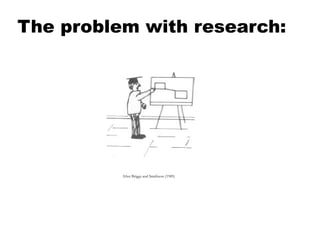
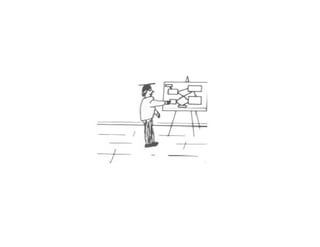
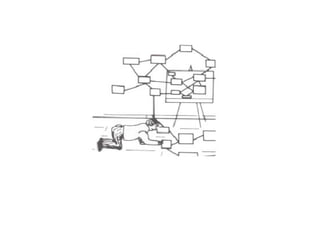
The problem with research:


          After Briggs and Smithson (1985)
“The
“Th researchers … h
               h        have already th
                              l d thrown
much darkness on this subject, and it is
probable that if they continue [their
investigations] we shall soon know nothing
at all about it. “ (Mark Twain)
Unintended 

                   ‘Client’ Needs                      consequences


• Simplification of a complex problem
• Accessible baseline data and information
              baseline data and information
• Accessible tools for testing effects of alternative policy 
  options (interventions) and their intended and 
  unintended consequences
• Accessible  knowledge on impacts of climate change 
• Accessible knowledge of (seasonal) downstream 
          ibl k    l d     f(         l) d
  impacts of land use change on water supply to 
  cities/dams
        /
• Accessible spatial planning tools for optimisation in a 
  highly heterogeneous and connected environment
• An Institutional framework for evidence‐based policy 
  implementation
Products
• Capacity built in local institutions/stakeholders (and
  Capacity built in local institutions/stakeholders (and 
  networks e.g. CONDESAN)
• Students engaged and trained
             engaged and trained
• Report diagnosing current status of water poverty, 
  water productivity, environmental security and 
  water productivity environmental security and
  social and institutional context incl. gender
• Maps of long term average water availability and
         of long term average water availability and 
  trends
• Maps of resource sensitivity to land use and
  Maps of resource sensitivity to land use and 
  climate change 
• Maps of the poverty outcomes of changing access
  Maps of the poverty outcomes of changing access 
  to water
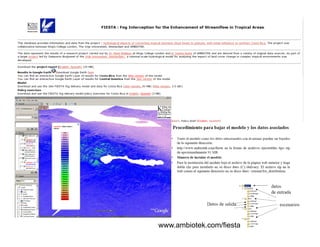
www.ambiotek.com/fiesta
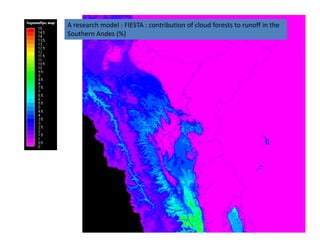
A research model : FIESTA : contribution of cloud forests to runoff in the 
Southern Andes (%)
Products
• Maps of the sensitivity of food production to climate 
  (variability and change) and land use change
• D b
  Database of institutions and intervention projects
               fi i i         di         i       j
  and likely outcomes of a range of these in the basin
• S
  Summary of points of contact and types of 
               f i t f       t t dt          f
  data/information required by institutions
• Andes BFP portal on IDIS
  Andes BFP portal on IDIS

Much of the above integrated into:
M h f th b           i t    t di t
• CPWF‐ANDES PSS (Web‐based Policy Support 
  System) for impact assessment of policy 
  System) for impact assessment of policy
  interventions (bilingual)
Why a PSS?
Premise is that policies are better when based on the science (natural 
Premise is that policies are better when based on the science (natural
and social), so how do we get the analysts to look at the science?  ‐
make it easy.

What is a PSS (Policy Support System) : 
•combines best available data and knowledge of process (models),
•integrated spatial database and test‐bed for user policies or 
interventions
•leaving the simplest possible messages without losing the important 
•leaving the simplest possible messages without losing the important
complexity of the data and the science,
• flexible and dynamic project legacy in addition to static data and 
publications,
   bli ti
•Visual and informative to a wide range of audiences, a learning and 
thinking tool
•Clearly defined output requiring specific inputs (sub‐models) from 
each WP in the BFP,
CPWF ANDES BFP PSS : Approach
Like science in general, most classic PSS are poorly used in the policy 
Like science in general most classic PSS are poorly used in the policy
framework
Why?
         ‐ th
           they may not address the end users concerns
                        t dd       th     d
         ‐ they are technically difficult to work with
         ‐ they are insufficiently visual
         ‐ they have few or poor means of dealing with uncertainty
            h h       f                      f d li    ih      i
         ‐ they require a lot of data

The CPWF‐ANDES PSS APPROACH
      ‐ link tightly with institutions and interventions at design stage
      ‐ Web and geobrowser‐based, simple scenarios (models may be 
                complex but outputs are simple)
      ‐ Using visual power of Google Earth etc.
      ‐ Uncertainty analyses inbuilt – results grey out as uncertainty 
                                                          increases
      ‐ Self‐parameterising for any basin by connection to KCL geodata portal
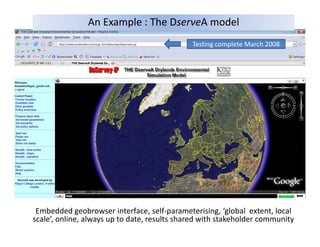
An Example : The DserveA model
                                              Testing complete March 2008
                                              Testing complete March 2008


 Embedded geobrowser interface, self‐parameterising, ‘global  extent, local 
scale’, online, always up to date, results shared with stakeholder community
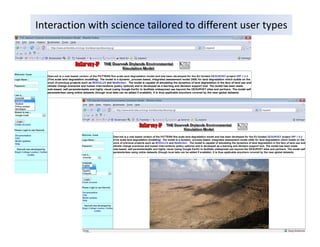
Interaction with science tailored to different user types
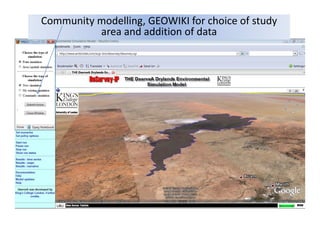
Community modelling, GEOWIKI for choice of study 
          area and addition of data
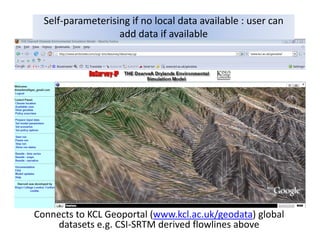
Self‐parameterising if no local data available : user can 
                   add data if available


Connects to KCL Geoportal (www.kcl.ac.uk/geodata) global 
     datasets e.g. CSI‐SRTM derived flowlines above
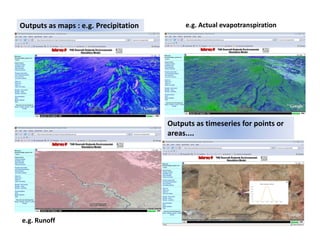
Outputs as maps : e.g. Precipitation         e.g. Actual evapotranspiration


                                        Outputs as timeseries for points or 
                                        areas.... 


e.g. Runoff
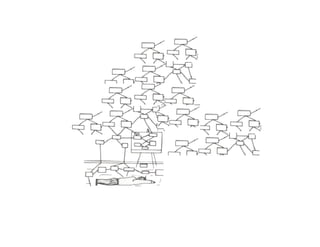
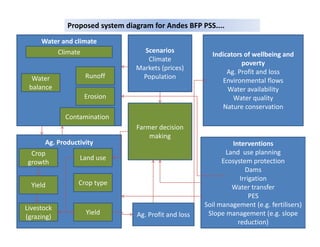
Proposed system diagram for Andes BFP PSS....
     Water and climate
         Climate                   Scenarios
                                                         Indicators of wellbeing and 
                                    Climate
                                                                   poverty
                                 Markets (prices)
                                                              Ag. Profit and loss
  Water 
  W t               Runoff        Population
                                                            Environmental flows
 balance                                                      Water availability
                    Erosion                                     Water quality
                                                            Nature conservation
                                                            Nature conservation
             Contamination
                                 Farmer decision 
                                     making
                                          g
       Ag. Productivity                                         Interventions
  Crop                                                        Land  use planning
                  Land use                                   Ecosystem protection
 growth
                                                                     Dams
                                                                   Irrigation
  Yield           Crop type
                                                                Water transfer
                                                                       PES
Livestock                                              Soil management (e.g. fertilisers)
                    Yield        Ag. Profit and loss    Slope management (e.g. slope 
(grazing)
                                                                  reduction)
Thank you
Th k

BFP Andes-Project Plans

  • 1.
    BFP‐ANDES – Leader: Mark Mulligan, KCL – Coordinator: Jorge Rubiano, UNAL • WP1(POV): G. Hyman, A. Farrow, G. Lema (CIAT) WP1(POV): G Hyman A Farrow G Lema (CIAT) • WP2(AVAIL): M. Mulligan (KCL), J..G. Leon (UNAL) • WP3(PROD): M. Kirby (CSIRO), J. Selvaraj (UNAL) • WP4(INST): D. White (CIAT), V. Vargas (UNAL) • WP5(INTERV) M S M. Saravia (CONDESAN,BC), incl. prev. CP projects i (CONDESAN BC) i l CP j • WP6(KNOW): N. Niederhauser (CIAT)  • + tied PhD, MSc and UG students AIM: To have the best available science used in the  formulation and testing of land and water policy for  better livelihoods, in cases where currently it is not better livelihoods in cases where currently it is not Brief for presentation: – What Andes BFP is intended to achieve? And for whom? – Expected Research products  – How you intend to get outputs?
  • 2.
    Team Experience  • Extensive knowledge of the region • Poverty mapping and analysis •Water accounting and productivity Water accounting and productivity • Institutions and interventions • L l t k h ld Local stakeholders and networks d t k • Spatial hydrological modelling and GIS • Global datasets • Policy support systems and knowledge Policy support systems and knowledge  systems
  • 3.
    Water related issues and basins Deforestation (F,A,T,AL,J) Erosion/Sedimentation (F,L,A,E,T,AL,J) Pollution (F,E,J) Pollution (F EJ) FUQUENE Loss of biodiversity (F,L,AL,J) Ecosystem degradation (A,E)  LA MIEL Contamination (F,L) ANGEL Water scarcity (A,T,J) AMBATO Poor institutional framework and  infrastructure (A,T,AL) SG505 Poverty, lack of education (A,T,AL) Poverty lack of education (A T AL) ALTOMAYO SG510 Water use and management (E) JEQUETEPEQUE Natural hazards (T) Low productivity (AL) TUNARI
  • 4.
    Basin(s) Context • High butvariable rainfall steep slopes spatial High but variable rainfall, steep slopes, spatial  heterogeneity, climate change • Poverty sometimes related to lack of water, sometimes of  y , excess water: – Hazards to productivity : (landslides, soil erosion/degradation,  nutrient losses) nutrient losses) – Downstream impacts : (sedimentation, water quality losses,  flooding, supply to major cities) .... with impacts on health and poverty sometimes through food. • Competing land‐use demands on steep‐lands  • E i ti Existing and proposed major dam projects, inter‐basin  d d j d j t i t b i transfers, mining... • Payments for environmental services and other non ag. Payments for environmental services and other non ag.  livelihood options
  • 5.
    ‘Clients’ • Farmers, (basin) communities, interested citizens a e s, (bas ) co u t es, te ested c t e s • Local government (policy advisors) • National government (policy advisors) National government (policy advisors) • Universities, research orgs (e.g. IDEAM) • Commercial : Water/HEP companies Commercial : Water/HEP companies • International Conservation NGOs (CI, WWF, TNC) • International organisations (CP/CGIAR,CARE,  International organisations (CP/CGIAR CARE Oxfam) • International donors (WB, IADB,DfID,GTZ..) International donors (WB, IADB,DfID,GTZ..)
  • 6.
    The problem withresearch: After Briggs and Smithson (1985)
  • 10.
    “The “Th researchers …h h have already th l d thrown much darkness on this subject, and it is probable that if they continue [their investigations] we shall soon know nothing at all about it. “ (Mark Twain)
  • 11.
    Unintended  ‘Client’ Needs consequences • Simplification of a complex problem • Accessible baseline data and information baseline data and information • Accessible tools for testing effects of alternative policy  options (interventions) and their intended and  unintended consequences • Accessible  knowledge on impacts of climate change  • Accessible knowledge of (seasonal) downstream  ibl k l d f( l) d impacts of land use change on water supply to  cities/dams / • Accessible spatial planning tools for optimisation in a  highly heterogeneous and connected environment • An Institutional framework for evidence‐based policy  implementation
  • 12.
    Products • Capacity builtin local institutions/stakeholders (and Capacity built in local institutions/stakeholders (and  networks e.g. CONDESAN) • Students engaged and trained engaged and trained • Report diagnosing current status of water poverty,  water productivity, environmental security and  water productivity environmental security and social and institutional context incl. gender • Maps of long term average water availability and of long term average water availability and  trends • Maps of resource sensitivity to land use and Maps of resource sensitivity to land use and  climate change  • Maps of the poverty outcomes of changing access Maps of the poverty outcomes of changing access  to water
  • 13.
  • 14.
  • 15.
    Products • Maps of the sensitivity of food production to climate  (variability and change) and land use change • D b Database of institutions and intervention projects fi i i di i j and likely outcomes of a range of these in the basin • S Summary of points of contact and types of  f i t f t t dt f data/information required by institutions • Andes BFP portal on IDIS Andes BFP portal on IDIS Much of the above integrated into: M h f th b i t t di t • CPWF‐ANDES PSS (Web‐based Policy Support  System) for impact assessment of policy  System) for impact assessment of policy interventions (bilingual)
  • 16.
    Why a PSS? Premise is that policies are better when based on the science (natural  Premise is thatpolicies are better when based on the science (natural and social), so how do we get the analysts to look at the science?  ‐ make it easy. What is a PSS (Policy Support System) :  •combines best available data and knowledge of process (models), •integrated spatial database and test‐bed for user policies or  interventions •leaving the simplest possible messages without losing the important  •leaving the simplest possible messages without losing the important complexity of the data and the science, • flexible and dynamic project legacy in addition to static data and  publications, bli ti •Visual and informative to a wide range of audiences, a learning and  thinking tool •Clearly defined output requiring specific inputs (sub‐models) from  each WP in the BFP,
  • 17.
    CPWF ANDES BFP PSS : Approach Like science in general, most classic PSS are poorly used in the policy  Like science ingeneral most classic PSS are poorly used in the policy framework Why? ‐ th they may not address the end users concerns t dd th d ‐ they are technically difficult to work with ‐ they are insufficiently visual ‐ they have few or poor means of dealing with uncertainty h h f f d li ih i ‐ they require a lot of data The CPWF‐ANDES PSS APPROACH ‐ link tightly with institutions and interventions at design stage ‐ Web and geobrowser‐based, simple scenarios (models may be  complex but outputs are simple) ‐ Using visual power of Google Earth etc. ‐ Uncertainty analyses inbuilt – results grey out as uncertainty  increases ‐ Self‐parameterising for any basin by connection to KCL geodata portal
  • 18.
    An Example : The DserveA model Testing complete March 2008 Testing complete March 2008 Embedded geobrowser interface, self‐parameterising, ‘global  extent, local  scale’, online, always up to date, results shared with stakeholder community
  • 19.
  • 20.
  • 21.
    Self‐parameterising if no local data available : user can  add data if available Connects to KCL Geoportal (www.kcl.ac.uk/geodata) global  datasets e.g. CSI‐SRTM derived flowlines above
  • 22.
    Outputs as maps : e.g. Precipitation  e.g. Actual evapotranspiration Outputs as timeseries for points or  areas....  e.g. Runoff
  • 23.
    Proposed system diagram for Andes BFP PSS.... Water and climate Climate Scenarios Indicators of wellbeing and  Climate poverty Markets (prices) Ag. Profit and loss Water  W t Runoff Population Environmental flows balance Water availability Erosion Water quality Nature conservation Nature conservation Contamination Farmer decision  making g Ag. Productivity Interventions Crop  Land  use planning Land use Ecosystem protection growth Dams Irrigation Yield Crop type Water transfer PES Livestock  Soil management (e.g. fertilisers) Yield Ag. Profit and loss Slope management (e.g. slope  (grazing) reduction)
  • 24.