Unifying principles for terrestrial
ecosystem carbon, water and land-
surface modelling
Presentation by Brad Evans
The problem: CO2 is rising
The Ecosystem Modeller seeks to:
Generally, understand the effects of CO2
increases on ecosystems
Quantify negative feedbacks – the impact of
rising CO2, land surface warming and extreme
events on ecosystems
6CO2 + 6H20 C6H12O6 + 6O2
light energy
chlorophyll +
nutrients
IPCC Consensus: CO2 Fertilization
WUE
NPP
WUE =
GPP
ET
NPP = GPP - R
N & P
Residential land sink
Complexity of global models
What models don’t currently do well (mostly)…
• Ecosystem dynamics generally
• Migration
• Fire
• Logging
• Harvesting
• Insect outbreaks
• Decomposition
• Phosphorus cycle
• Veg-soil-atmosphere continuum
• Land use, land use change and forestry generally
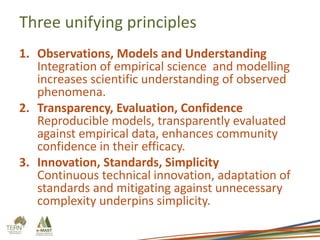
Three unifying principles
1. Observations, Models and Understanding
Integration of empirical science and modelling
increases scientific understanding of observed
phenomena.
2. Transparency, Evaluation, Confidence
Reproducible models, transparently evaluated
against empirical data, enhances community
confidence in their efficacy.
3. Innovation, Standards, Simplicity
Continuous technical innovation, adaptation of
standards and mitigating against unnecessary
complexity underpins simplicity.
The viscous observation – model – policy cycle
(1) MORE
Observations
(2) BETTER
models are
developed
(3) Models
evaluated
against
observations
(4) EVEN
BETTER
Models
(5) BETTER
Policy
This project is supported by the Australian National Data Service (ANDS). ANDS is supported by the Australian Government through the National Collaborative Research Infrastructure Strategy
Program and the Education Investment Fund (EIF) Super Science Initiative. For more information visit the ANDS website ands.org.au and Research Data Australia services.ands.org.au.

Unifying principles for modelling, Brad Evans, ACEAS Grand 2014

  • 1.
    Unifying principles forterrestrial ecosystem carbon, water and land- surface modelling Presentation by Brad Evans
  • 3.
    The problem: CO2is rising The Ecosystem Modeller seeks to: Generally, understand the effects of CO2 increases on ecosystems Quantify negative feedbacks – the impact of rising CO2, land surface warming and extreme events on ecosystems 6CO2 + 6H20 C6H12O6 + 6O2 light energy chlorophyll + nutrients
  • 4.
    IPCC Consensus: CO2Fertilization WUE NPP WUE = GPP ET NPP = GPP - R N & P
  • 5.
  • 6.
    Complexity of globalmodels What models don’t currently do well (mostly)… • Ecosystem dynamics generally • Migration • Fire • Logging • Harvesting • Insect outbreaks • Decomposition • Phosphorus cycle • Veg-soil-atmosphere continuum • Land use, land use change and forestry generally
  • 7.
    Three unifying principles 1.Observations, Models and Understanding Integration of empirical science and modelling increases scientific understanding of observed phenomena. 2. Transparency, Evaluation, Confidence Reproducible models, transparently evaluated against empirical data, enhances community confidence in their efficacy. 3. Innovation, Standards, Simplicity Continuous technical innovation, adaptation of standards and mitigating against unnecessary complexity underpins simplicity.
  • 8.
    The viscous observation– model – policy cycle (1) MORE Observations (2) BETTER models are developed (3) Models evaluated against observations (4) EVEN BETTER Models (5) BETTER Policy
  • 9.
    This project issupported by the Australian National Data Service (ANDS). ANDS is supported by the Australian Government through the National Collaborative Research Infrastructure Strategy Program and the Education Investment Fund (EIF) Super Science Initiative. For more information visit the ANDS website ands.org.au and Research Data Australia services.ands.org.au.