EC6801
WIRELESS COMMUNICATION
R.Ramalakshmi
Assistant Professor
Ramco Institute of Technology
Rajapalayam
Introduction
• Communication is defined as the process of
transferring or exchanging the information from
one place to other place.
• Communication channel is a connection between
transmitter and receiver through which Data can
be transmitted.
• Communication channel also called as
communication media or transmission media
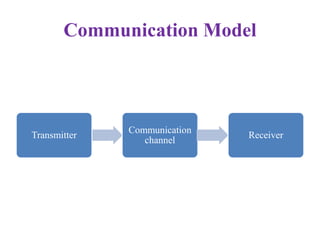
Communication Model
Transmitter
Communication
channel
Receiver
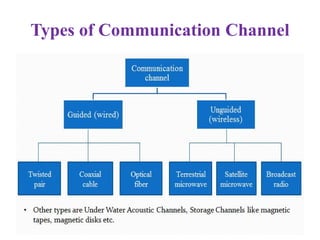
Types of Communication Channel
• Communication channel is essential for
communication systems.
• The transmission characteristics are important
in selecting channel because they directly
affect the communication quality.
• Different types of communication channels
have different transmission characteristics and
costs, they are used in different applications.
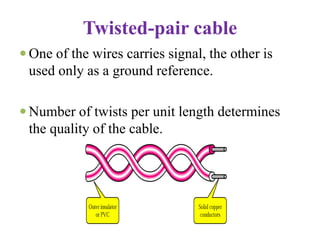
Twisted-pair cable
 One of the wires carries signal, the other is
used only as a ground reference.
 Number of twists per unit length determines
the quality of the cable.
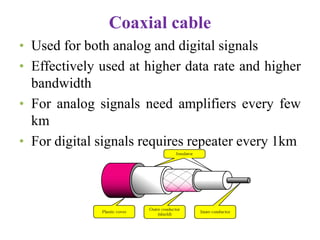
Coaxial cable
• Used for both analog and digital signals
• Effectively used at higher data rate and higher
bandwidth
• For analog signals need amplifiers every few
km
• For digital signals requires repeater every 1km
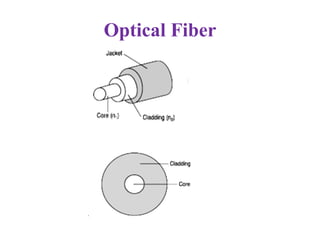
Optical Fiber
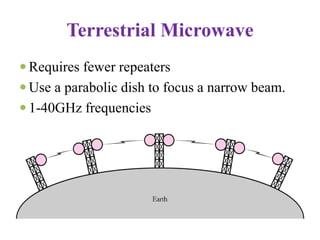
Terrestrial Microwave
 Requires fewer repeaters
 Use a parabolic dish to focus a narrow beam.
 1-40GHz frequencies
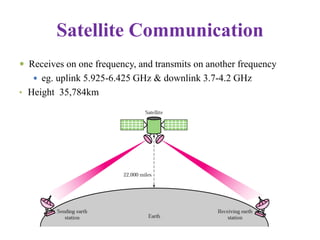
Satellite Communication
 Receives on one frequency, and transmits on another frequency
 eg. uplink 5.925-6.425 GHz & downlink 3.7-4.2 GHz
• Height 35,784km
Broadcast Radio
• Radio frequency range is 3kHz to 300GHz
• Use broadcast radio of 30MHz - 1GHz, for:
– FM radio
– UHF and VHF television
• Is unidirectional
• Suffers from multipath interference
• Reflections from land, water, other objects
• Are used for multicasts communications, such as radio and
television, and paging system.
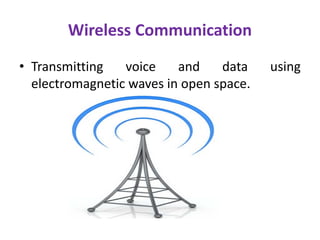
Wireless Communication
• Transmitting voice and data using
electromagnetic waves in open space.
Need for Wireless Communication
Freedom from wires
• No cost of installing the wires, No bunches of
wires.
• Running around e.g. Bluetooth , Wi-Fi
Global coverage
where wired communication is not feasible or
costly.
e.g. rural areas, battle field and outer space.
Stay Connected
Any where any time
Flexibility
Connect to multiple devices simultaneously
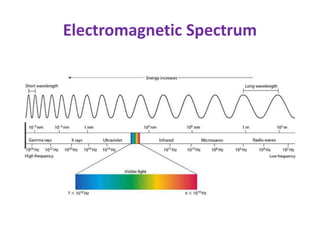
Electromagnetic Spectrum
CELLULAR SYSTEMS-BASIC CONCEPTS
• Cellular system solves the problem of spectral congestion.
• Offers high capacity in limited spectrum.
• High capacity is achieved by limiting the coverage area of
each BS to a small geographical area called cell.
• Replaces high powered transmitter with several low power
transmitters.
• Additional radio capacity is achieved.
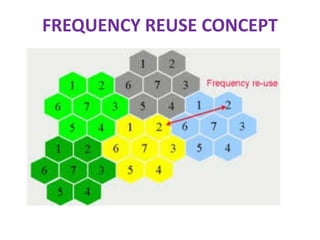
FREQUENCY REUSE
• Used by service providers to improve the efficiency of a
cellular network and to serve millions of subscribers using a
limited radio spectrum
• After covering a certain distance a radio wave gets
attenuated and the signal falls below a point where it can no
longer be used or cause any interference
• A transmitter transmitting in a specific frequency range will
have only a limited coverage area
• Beyond this coverage area, that frequency can
be reused by another transmitter.
• The entire network coverage area is divided
into cells based on the principle of frequency
reuse
• A cell is the basic geographical unit of a
cellular network; is the area around an antenna
where a specific frequency range is used.
• When a subscriber moves to another cell, the antenna
of the new cell takes over the signal transmission
• A cluster is a group of adjacent cells, usually 7 cells; no
frequency reuse is done within a cluster
• The frequency spectrum is divided into sub-bands and
each sub-band is used within one cell of the cluster
• In heavy traffic zones cells are smaller, while in isolated
zones cells are larger
• The design process of selecting and allocating channel
groups for all of the cellular base stations within a
system is called frequency reuse or frequency planning.
• Cell labelled with same letter use the same set
of frequencies.
• Cell Shapes: Circle, Square, Triangle and
Hexagon.
FREQUENCY REUSE CONCEPT
REFERENCES
• 1. Rappaport,T.S., “Wireless communications”,
Second Edition, Pearson Education, 2010.
• 2. Andreas.F. Molisch, “Wireless
Communications”, John Wiley – India, 2006.
Thank You

Introduction to wireless communication

  • 1.
  • 2.
    Introduction • Communication isdefined as the process of transferring or exchanging the information from one place to other place. • Communication channel is a connection between transmitter and receiver through which Data can be transmitted. • Communication channel also called as communication media or transmission media
  • 3.
  • 4.
  • 5.
    • Communication channelis essential for communication systems. • The transmission characteristics are important in selecting channel because they directly affect the communication quality. • Different types of communication channels have different transmission characteristics and costs, they are used in different applications.
  • 6.
    Twisted-pair cable  Oneof the wires carries signal, the other is used only as a ground reference.  Number of twists per unit length determines the quality of the cable.
  • 7.
    Coaxial cable • Usedfor both analog and digital signals • Effectively used at higher data rate and higher bandwidth • For analog signals need amplifiers every few km • For digital signals requires repeater every 1km
  • 8.
  • 9.
    Terrestrial Microwave  Requiresfewer repeaters  Use a parabolic dish to focus a narrow beam.  1-40GHz frequencies
  • 10.
    Satellite Communication  Receiveson one frequency, and transmits on another frequency  eg. uplink 5.925-6.425 GHz & downlink 3.7-4.2 GHz • Height 35,784km
  • 11.
    Broadcast Radio • Radiofrequency range is 3kHz to 300GHz • Use broadcast radio of 30MHz - 1GHz, for: – FM radio – UHF and VHF television • Is unidirectional • Suffers from multipath interference • Reflections from land, water, other objects • Are used for multicasts communications, such as radio and television, and paging system.
  • 12.
    Wireless Communication • Transmittingvoice and data using electromagnetic waves in open space.
  • 13.
    Need for WirelessCommunication Freedom from wires • No cost of installing the wires, No bunches of wires. • Running around e.g. Bluetooth , Wi-Fi
  • 14.
    Global coverage where wiredcommunication is not feasible or costly. e.g. rural areas, battle field and outer space. Stay Connected Any where any time Flexibility Connect to multiple devices simultaneously
  • 15.
  • 16.
    CELLULAR SYSTEMS-BASIC CONCEPTS •Cellular system solves the problem of spectral congestion. • Offers high capacity in limited spectrum. • High capacity is achieved by limiting the coverage area of each BS to a small geographical area called cell. • Replaces high powered transmitter with several low power transmitters. • Additional radio capacity is achieved.
  • 17.
    FREQUENCY REUSE • Usedby service providers to improve the efficiency of a cellular network and to serve millions of subscribers using a limited radio spectrum • After covering a certain distance a radio wave gets attenuated and the signal falls below a point where it can no longer be used or cause any interference • A transmitter transmitting in a specific frequency range will have only a limited coverage area
  • 18.
    • Beyond thiscoverage area, that frequency can be reused by another transmitter. • The entire network coverage area is divided into cells based on the principle of frequency reuse • A cell is the basic geographical unit of a cellular network; is the area around an antenna where a specific frequency range is used.
  • 19.
    • When asubscriber moves to another cell, the antenna of the new cell takes over the signal transmission • A cluster is a group of adjacent cells, usually 7 cells; no frequency reuse is done within a cluster • The frequency spectrum is divided into sub-bands and each sub-band is used within one cell of the cluster • In heavy traffic zones cells are smaller, while in isolated zones cells are larger • The design process of selecting and allocating channel groups for all of the cellular base stations within a system is called frequency reuse or frequency planning.
  • 20.
    • Cell labelledwith same letter use the same set of frequencies. • Cell Shapes: Circle, Square, Triangle and Hexagon.
  • 21.
  • 22.
    REFERENCES • 1. Rappaport,T.S.,“Wireless communications”, Second Edition, Pearson Education, 2010. • 2. Andreas.F. Molisch, “Wireless Communications”, John Wiley – India, 2006.
  • 23.