CHAPTER 11
MOTION
SECTION 11.1 DISTANCE AND
DISPLACEMENT
11.1 DISTANCE AND
DISPLACEMENT

All of science is concerned with motion.

The motion of objects change when forces act
upon them.
All objects have motion they just appear to be
motionless. All of matter contains atoms that are
continuously in motion (vibrate and collide).
In order to describe motion you must state the
direction in which the object is moving and how
fast the object is moving.
*
You have to choose a frame of reference. ( To
describe motion accurately)
It is a system of objects that are not moving with
respect to one another.
EX. People on the bus are not a good frame of
reference because they are moving with the bus.
You need to choose and object not moving outside
the bus.
You have to choose an appropriate frame of
reference to describe motion in a clear and
relevant manner.

Relevant Motion is movement in relation to a
frame of reference.
MEASURING DISTANCE

Distance is the length of a path between
two points.

SI unit for distance is the meter (m)
However, for larger distances it is better
to use kilometers (km)
MEASURING DISPLACEMENTS

Displacement is the direction from the starting
point and the length of a straight line from the
starting point to the ending point.
Displacement use vectors
A vector is a quantity that has magnitude and
direction.

Magnitude can be the size, length, or amount of
something.
Arrows on maps represent vectors.

Symbol for vector →
COMBINING DISPLACEMENTS

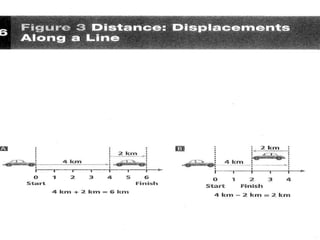
Distance: Displacements along a straight line
Use vector addition or subtraction.
Going 10 km east and 3 km west = 10-3 = 7
Page 330 demo
Use vector addition if in a straight line 4km +
2km = 6km
DISPLACEMENT THAT ISN’T ALONG A
STRAIGHT PATH

Resultant vector- is the vector sum of
two or more vectors.
The vector goes directly from the
starting point to the end point.

P. 331 Figure 4
SECTION 11.2 SPEED
AND VELOCITY
Speed- is the ratio of the distance an object moves
to the amount of time the object moves.
SI unit = m/s *use the units that make the most
sense.
cars = miles/hr or km/hr
2 Ways to express the speed of an object
1. Average speed- (v) is the total distance traveled,
(d) divided by the time, (t) it takes to travel that
distance.
CALCULATING SPEED
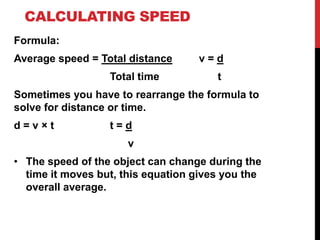
Formula:
Average speed = Total distance
Total time

v=d
t

Sometimes you have to rearrange the formula to
solve for distance or time.
d=v×t

t=d

v
• The speed of the object can change during the
time it moves but, this equation gives you the
overall average.
11.2 SPEED AND VELOCITY

Instantaneous Speed (v) is the rate at
which an object is moving at a given
moment in time.

Ex driving car look at a speedometer.
• Average speed is computed for the
duration of a trip. And it does not have
to be the speed that you are driving
throughout the whole trip.
Instantaneous is JUST the speed at a
particular moment
11.2 SPEED AND VELOCITY
Velocity is the speed and direction in which an object is moving
(has to be measured relative to a reference point)
• calculated the same as speed

• It is a vector (use an arrow.)
Combining Velocities
Use vector addition when the motion involves more than one
velocity ( direction).
Example:
Boat Velocity with respect to river bank is the same directions with
the water at 12 km/hr.
River is moving 5km/h
How fast is the boat moving? Answer: 5km/h + 12 km/h = 17 km/h
11.2 SPEED AND VELOCITY

In vector addition you add the speed of water
and the speed of the boat.
5km/h + 12 km/h = 17 km/h
Example 2:
When the boat is moving opposite of the flow of
the water.
Velocity with respect to river bank is the same
directions against the water at 12 km/hr.
Answer: 5km/h - 12 km/h = 7 km/h
You subtract the movement of the boat from the movement of
the water.
11.3 ACCELERATION
Acceleration - the rate at which velocity
changes.

• Unit m/s2 Meters per second squared.
• Velocity changes all the time.
• You can have positive or negative
acceleration.
Negative is slowing down and decreases
acceleration

Positive is speeding up and increases
acceleration.
11.3 ACCELERATION

Acceleration can be described as changes in speed,
changes in direction, or changes in both speed and
direction.
• It is a vector.
1. Change in speed = free fall
Ex: parachuting before you engage the chute.
Movement of an object towards the Earth solely
because of gravity.
Value of acceleration due to gravity = 9.8 m/s2
Speed is m/s

Acceleration is m/s2
*

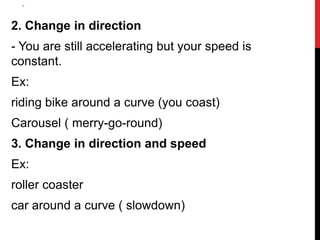
2. Change in direction
- You are still accelerating but your speed is
constant.

Ex:
riding bike around a curve (you coast)
Carousel ( merry-go-round)

3. Change in direction and speed
Ex:
roller coaster
car around a curve ( slowdown)
11.3 ACCELERATION

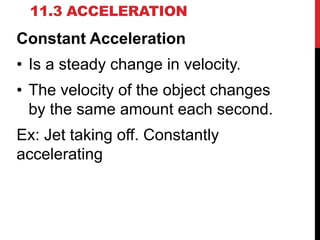
Constant Acceleration
• Is a steady change in velocity.

• The velocity of the object changes
by the same amount each second.
Ex: Jet taking off. Constantly
accelerating
*

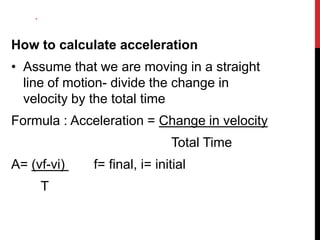
How to calculate acceleration
• Assume that we are moving in a straight
line of motion- divide the change in
velocity by the total time
Formula : Acceleration = Change in velocity

Total Time
A= (vf-vi)
T

f= final, i= initial

Chapter 11 motion_power_point

  • 1.
    CHAPTER 11 MOTION SECTION 11.1DISTANCE AND DISPLACEMENT
  • 2.
    11.1 DISTANCE AND DISPLACEMENT Allof science is concerned with motion. The motion of objects change when forces act upon them. All objects have motion they just appear to be motionless. All of matter contains atoms that are continuously in motion (vibrate and collide). In order to describe motion you must state the direction in which the object is moving and how fast the object is moving.
  • 3.
    * You have tochoose a frame of reference. ( To describe motion accurately) It is a system of objects that are not moving with respect to one another. EX. People on the bus are not a good frame of reference because they are moving with the bus. You need to choose and object not moving outside the bus. You have to choose an appropriate frame of reference to describe motion in a clear and relevant manner. Relevant Motion is movement in relation to a frame of reference.
  • 4.
    MEASURING DISTANCE Distance isthe length of a path between two points. SI unit for distance is the meter (m) However, for larger distances it is better to use kilometers (km)
  • 5.
    MEASURING DISPLACEMENTS Displacement isthe direction from the starting point and the length of a straight line from the starting point to the ending point. Displacement use vectors A vector is a quantity that has magnitude and direction. Magnitude can be the size, length, or amount of something. Arrows on maps represent vectors. Symbol for vector →
  • 6.
    COMBINING DISPLACEMENTS Distance: Displacementsalong a straight line Use vector addition or subtraction. Going 10 km east and 3 km west = 10-3 = 7 Page 330 demo Use vector addition if in a straight line 4km + 2km = 6km
  • 8.
    DISPLACEMENT THAT ISN’TALONG A STRAIGHT PATH Resultant vector- is the vector sum of two or more vectors. The vector goes directly from the starting point to the end point. P. 331 Figure 4
  • 9.
    SECTION 11.2 SPEED ANDVELOCITY Speed- is the ratio of the distance an object moves to the amount of time the object moves. SI unit = m/s *use the units that make the most sense. cars = miles/hr or km/hr 2 Ways to express the speed of an object 1. Average speed- (v) is the total distance traveled, (d) divided by the time, (t) it takes to travel that distance.
  • 10.
    CALCULATING SPEED Formula: Average speed= Total distance Total time v=d t Sometimes you have to rearrange the formula to solve for distance or time. d=v×t t=d v • The speed of the object can change during the time it moves but, this equation gives you the overall average.
  • 11.
    11.2 SPEED ANDVELOCITY Instantaneous Speed (v) is the rate at which an object is moving at a given moment in time. Ex driving car look at a speedometer. • Average speed is computed for the duration of a trip. And it does not have to be the speed that you are driving throughout the whole trip. Instantaneous is JUST the speed at a particular moment
  • 12.
    11.2 SPEED ANDVELOCITY Velocity is the speed and direction in which an object is moving (has to be measured relative to a reference point) • calculated the same as speed • It is a vector (use an arrow.) Combining Velocities Use vector addition when the motion involves more than one velocity ( direction). Example: Boat Velocity with respect to river bank is the same directions with the water at 12 km/hr. River is moving 5km/h How fast is the boat moving? Answer: 5km/h + 12 km/h = 17 km/h
  • 13.
    11.2 SPEED ANDVELOCITY In vector addition you add the speed of water and the speed of the boat. 5km/h + 12 km/h = 17 km/h Example 2: When the boat is moving opposite of the flow of the water. Velocity with respect to river bank is the same directions against the water at 12 km/hr. Answer: 5km/h - 12 km/h = 7 km/h You subtract the movement of the boat from the movement of the water.
  • 14.
    11.3 ACCELERATION Acceleration -the rate at which velocity changes. • Unit m/s2 Meters per second squared. • Velocity changes all the time. • You can have positive or negative acceleration. Negative is slowing down and decreases acceleration Positive is speeding up and increases acceleration.
  • 15.
    11.3 ACCELERATION Acceleration canbe described as changes in speed, changes in direction, or changes in both speed and direction. • It is a vector. 1. Change in speed = free fall Ex: parachuting before you engage the chute. Movement of an object towards the Earth solely because of gravity. Value of acceleration due to gravity = 9.8 m/s2 Speed is m/s Acceleration is m/s2
  • 16.
    * 2. Change indirection - You are still accelerating but your speed is constant. Ex: riding bike around a curve (you coast) Carousel ( merry-go-round) 3. Change in direction and speed Ex: roller coaster car around a curve ( slowdown)
  • 17.
    11.3 ACCELERATION Constant Acceleration •Is a steady change in velocity. • The velocity of the object changes by the same amount each second. Ex: Jet taking off. Constantly accelerating
  • 18.
    * How to calculateacceleration • Assume that we are moving in a straight line of motion- divide the change in velocity by the total time Formula : Acceleration = Change in velocity Total Time A= (vf-vi) T f= final, i= initial

Editor's Notes

  • #4 Tennis ball demo.
  • #9 p. 330 Quick lab