


Normandy
Landings
              Clarissa Nitihardjo
                    IB History HL
                       002171-012
     Bandung International School
PREPARATION FOR D-DAY
• Grand Alliance (Britain & America) started to
  prepare since 1942
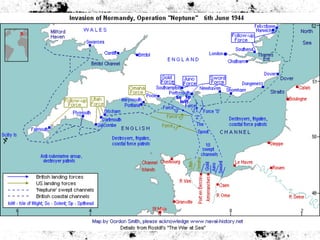
• Allies chose June 1944 and beaches of Normandy
• Germans thought Allies would choose Calais and
  Boulogne
• General D. Eisenhower was in charge
   – Supreme Commander over all Allied soldiers
   – Because majority of equipment and forces would
     come from USA
PREPARATION FOR D-DAY
• Equipments
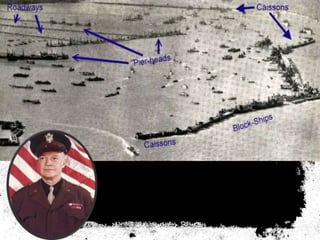
  – 2 ―Mulberry‖ harbors
  – ―Gooseberry‖ shelter piers
  – Waterproof tanks and lorries
  – Specially design tanks for beaches
  – 7000 SHIPS!
    • 4000 would land soldiers and their weapons
    • 3000 bombard from sea or carry supplies
    • > ¾ were British
PREPARATION FOR D-DAY
• Men had to be specially trained
  – On English south coast  cleared from
    inhabitants
  – Could not be hidden from Germans
    • However Germans still didn’t know where
      the landings would take place
    • Decoy from Allies  Calais was regularly
      bombed
D-DAY
• OPERATION OVERLOAD
  – Weeks before: Allies bombed bridges, roads
    and railways  German difficult to reinforce
• Beginning of June 1944 everything was
  ready
  – Eisenhower: 6 June
    • Troops were already on landing craft
    • They could suffer from seasickness
  – Germans: impossible due to heavy seas
D-DAY
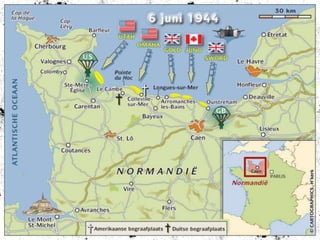
• Airborne troops were dropped in advance to seize
  bridges and protect landing
• Warships bombarded coastline
• 6:30 a.m. the landings began
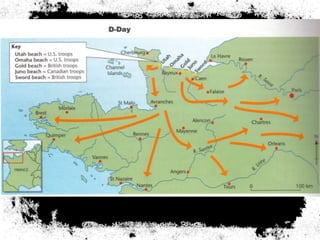
• Five beaches
   – Utah, Omaha, Gold, Juno, Sword
   – Four landings went well
   – Omaha: against top division of German army
   – Omaha: 3000 American casualties in first few
     hours
D-DAY
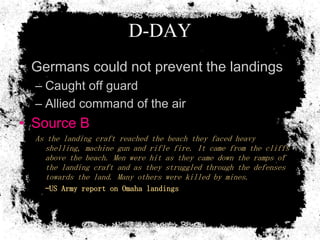
• Germans could not prevent the landings
  – Caught off guard
  – Allied command of the air
• Source B
  As the landing craft reached the beach they faced heavy
     shelling, machine gun and rifle fire. It came from the cliffs
     above the beach. Men were hit as they came down the ramps of
     the landing craft and as they struggled through the defenses
     towards the land. Many others were killed by mines.
    –US Army report on Omaha landings
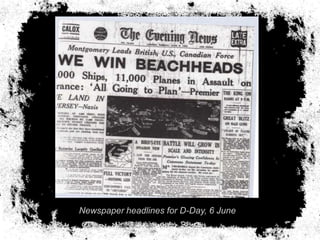
Newspaper headlines for D-Day, 6 June
Timeline
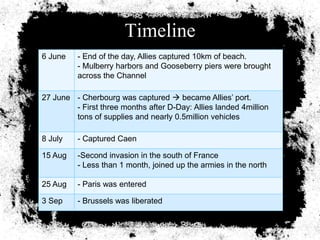
6 June    - End of the day, Allies captured 10km of beach.
          - Mulberry harbors and Gooseberry piers were brought
          across the Channel

27 June - Cherbourg was captured  became Allies’ port.
        - First three months after D-Day: Allies landed 4million
        tons of supplies and nearly 0.5million vehicles

8 July    - Captured Caen

15 Aug    -Second invasion in the south of France
          - Less than 1 month, joined up the armies in the north

25 Aug    - Paris was entered

3 Sep     - Brussels was liberated
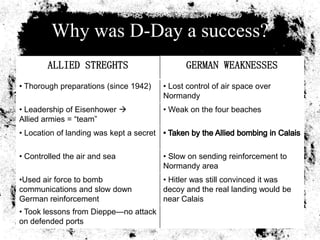
Why was D-Day a success?
        ALLIED STREGHTS                         GERMAN WEAKNESSES
• Thorough preparations (since 1942)      • Lost control of air space over
                                          Normandy
• Leadership of Eisenhower               • Weak on the four beaches
Allied armies = ―team‖
• Location of landing was kept a secret

• Controlled the air and sea              • Slow on sending reinforcement to
                                          Normandy area
•Used air force to bomb                   • Hitler was still convinced it was
communications and slow down              decoy and the real landing would be
German reinforcement                      near Calais
• Took lessons from Dieppe—no attack
on defended ports
European War Ends
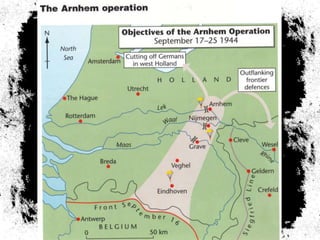
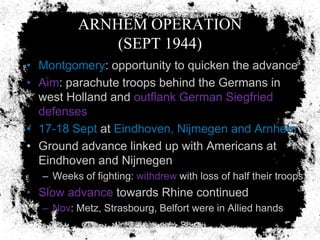
ARNHEM OPERATION
              (SEPT 1944)
• Montgomery: opportunity to quicken the advance
• Aim: parachute troops behind the Germans in
  west Holland and outflank German Siegfried
  defenses
• 17-18 Sept at Eindhoven, Nijmegen and Arnhem
• Ground advance linked up with Americans at
  Eindhoven and Nijmegen
  – Weeks of fighting: withdrew with loss of half their troops
• Slow advance towards Rhine continued
  – Nov: Metz, Strasbourg, Belfort were in Allied hands
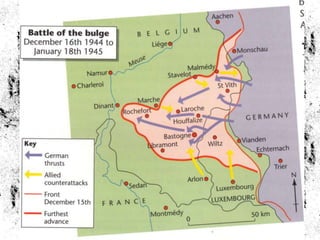
BATTLE OF THE BULGE
            (DEC 1944)
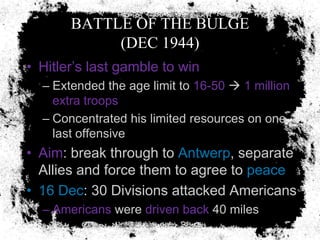
• Hitler’s last gamble to win
  – Extended the age limit to 16-50  1 million
    extra troops
  – Concentrated his limited resources on one
    last offensive
• Aim: break through to Antwerp, separate
  Allies and force them to agree to peace
• 16 Dec: 30 Divisions attacked Americans
  – Americans were driven back 40 miles
BATTLE OF THE BULGE
             (DEC 1944)
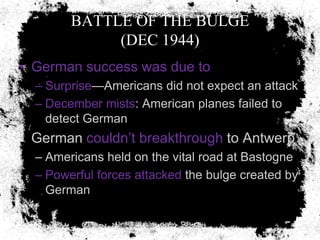
• German success was due to
  – Surprise—Americans did not expect an attack
  – December mists: American planes failed to
    detect German
• German couldn’t breakthrough to Antwerp
  – Americans held on the vital road at Bastogne
  – Powerful forces attacked the bulge created by
    German
BATTLE OF THE BULGE
             (DEC 1944)
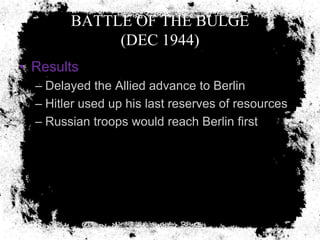
• Results
  – Delayed the Allied advance to Berlin
  – Hitler used up his last reserves of resources
  – Russian troops would reach Berlin first
CROSSING THE RHINE
• General Patton (America)
  – forced a crossing near Mainz on 22 March
• General B. Montgomery (Britain)
  – near Wessel 23 March
• German
  – disintegrate
RUSSIAN FRONT
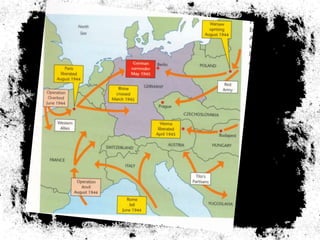
• Germans had retreated since Stalingrad in
  January 1943
• End 1944: Russians cleared Germans out
  – Liberated Poland, Romania, Bulgaria, and
    Yugoslavia
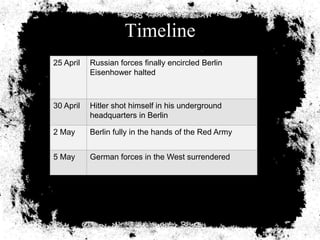
Timeline
25 April   Russian forces finally encircled Berlin
           Eisenhower halted


30 April   Hitler shot himself in his underground
           headquarters in Berlin

2 May      Berlin fully in the hands of the Red Army


5 May      German forces in the West surrendered
REASONS FOR GERMAN DEFEAT
• STRENGTH OF THE GRAND ALLIANCE
  – Britain: base for the invasion of France and
    bombing of Germany
  – USSR: vast reserves of manpower
  – USA: wealth, resources, forces
• HITLER’S MISTAKES
  – Failure at Dunkirk and Battle of Britain
  – Fateful decision to attack Russia
  – Slow reinforcements to Normandy
REASONS FOR GERMAN DEFEAT
• SURVIVAL OF BRITAIN 1940-1
  – Due to Churchill’s leadership
• FAILURE OF OPERATION BARBAROSSA
  – Germany had to fight a war on two fronts
  – Defeat at Stalingrad
• ALLIED AIRPOWER
  – Total air control in Normandy  full advantage
• D-DAY LANDINGS
  – Diverted German forces from Eastern Front
THANK YOU 

Normandy Landings (D-Day)

  • 1.
    Normandy Landings Clarissa Nitihardjo IB History HL 002171-012 Bandung International School
  • 2.
    PREPARATION FOR D-DAY •Grand Alliance (Britain & America) started to prepare since 1942 • Allies chose June 1944 and beaches of Normandy • Germans thought Allies would choose Calais and Boulogne • General D. Eisenhower was in charge – Supreme Commander over all Allied soldiers – Because majority of equipment and forces would come from USA
  • 4.
    PREPARATION FOR D-DAY •Equipments – 2 ―Mulberry‖ harbors – ―Gooseberry‖ shelter piers – Waterproof tanks and lorries – Specially design tanks for beaches – 7000 SHIPS! • 4000 would land soldiers and their weapons • 3000 bombard from sea or carry supplies • > ¾ were British
  • 6.
    PREPARATION FOR D-DAY •Men had to be specially trained – On English south coast  cleared from inhabitants – Could not be hidden from Germans • However Germans still didn’t know where the landings would take place • Decoy from Allies  Calais was regularly bombed
  • 7.
    D-DAY • OPERATION OVERLOAD – Weeks before: Allies bombed bridges, roads and railways  German difficult to reinforce • Beginning of June 1944 everything was ready – Eisenhower: 6 June • Troops were already on landing craft • They could suffer from seasickness – Germans: impossible due to heavy seas
  • 8.
    D-DAY • Airborne troopswere dropped in advance to seize bridges and protect landing • Warships bombarded coastline • 6:30 a.m. the landings began • Five beaches – Utah, Omaha, Gold, Juno, Sword – Four landings went well – Omaha: against top division of German army – Omaha: 3000 American casualties in first few hours
  • 10.
    D-DAY • Germans couldnot prevent the landings – Caught off guard – Allied command of the air • Source B As the landing craft reached the beach they faced heavy shelling, machine gun and rifle fire. It came from the cliffs above the beach. Men were hit as they came down the ramps of the landing craft and as they struggled through the defenses towards the land. Many others were killed by mines. –US Army report on Omaha landings
  • 11.
  • 12.
    Timeline 6 June - End of the day, Allies captured 10km of beach. - Mulberry harbors and Gooseberry piers were brought across the Channel 27 June - Cherbourg was captured  became Allies’ port. - First three months after D-Day: Allies landed 4million tons of supplies and nearly 0.5million vehicles 8 July - Captured Caen 15 Aug -Second invasion in the south of France - Less than 1 month, joined up the armies in the north 25 Aug - Paris was entered 3 Sep - Brussels was liberated
  • 14.
    Why was D-Daya success? ALLIED STREGHTS GERMAN WEAKNESSES • Thorough preparations (since 1942) • Lost control of air space over Normandy • Leadership of Eisenhower  • Weak on the four beaches Allied armies = ―team‖ • Location of landing was kept a secret • Controlled the air and sea • Slow on sending reinforcement to Normandy area •Used air force to bomb • Hitler was still convinced it was communications and slow down decoy and the real landing would be German reinforcement near Calais • Took lessons from Dieppe—no attack on defended ports
  • 15.
  • 17.
    ARNHEM OPERATION (SEPT 1944) • Montgomery: opportunity to quicken the advance • Aim: parachute troops behind the Germans in west Holland and outflank German Siegfried defenses • 17-18 Sept at Eindhoven, Nijmegen and Arnhem • Ground advance linked up with Americans at Eindhoven and Nijmegen – Weeks of fighting: withdrew with loss of half their troops • Slow advance towards Rhine continued – Nov: Metz, Strasbourg, Belfort were in Allied hands
  • 19.
    BATTLE OF THEBULGE (DEC 1944) • Hitler’s last gamble to win – Extended the age limit to 16-50  1 million extra troops – Concentrated his limited resources on one last offensive • Aim: break through to Antwerp, separate Allies and force them to agree to peace • 16 Dec: 30 Divisions attacked Americans – Americans were driven back 40 miles
  • 20.
    BATTLE OF THEBULGE (DEC 1944) • German success was due to – Surprise—Americans did not expect an attack – December mists: American planes failed to detect German • German couldn’t breakthrough to Antwerp – Americans held on the vital road at Bastogne – Powerful forces attacked the bulge created by German
  • 22.
    BATTLE OF THEBULGE (DEC 1944) • Results – Delayed the Allied advance to Berlin – Hitler used up his last reserves of resources – Russian troops would reach Berlin first
  • 23.
    CROSSING THE RHINE •General Patton (America) – forced a crossing near Mainz on 22 March • General B. Montgomery (Britain) – near Wessel 23 March • German – disintegrate
  • 24.
    RUSSIAN FRONT • Germanshad retreated since Stalingrad in January 1943 • End 1944: Russians cleared Germans out – Liberated Poland, Romania, Bulgaria, and Yugoslavia
  • 25.
    Timeline 25 April Russian forces finally encircled Berlin Eisenhower halted 30 April Hitler shot himself in his underground headquarters in Berlin 2 May Berlin fully in the hands of the Red Army 5 May German forces in the West surrendered
  • 26.
    REASONS FOR GERMANDEFEAT • STRENGTH OF THE GRAND ALLIANCE – Britain: base for the invasion of France and bombing of Germany – USSR: vast reserves of manpower – USA: wealth, resources, forces • HITLER’S MISTAKES – Failure at Dunkirk and Battle of Britain – Fateful decision to attack Russia – Slow reinforcements to Normandy
  • 27.
    REASONS FOR GERMANDEFEAT • SURVIVAL OF BRITAIN 1940-1 – Due to Churchill’s leadership • FAILURE OF OPERATION BARBAROSSA – Germany had to fight a war on two fronts – Defeat at Stalingrad • ALLIED AIRPOWER – Total air control in Normandy  full advantage • D-DAY LANDINGS – Diverted German forces from Eastern Front
  • 28.