03/18/1603/18/16 15:5415:54 cottinghamcottingham
HomeostasisHomeostasis
03/18/1603/18/16 15:5415:54 cottinghamcottingham
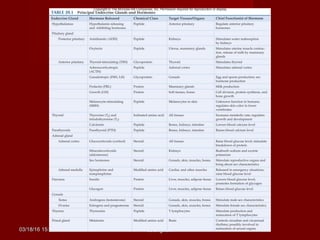
Table 20.1Table 20.1
03/18/1603/18/16 15:5415:54 cottinghamcottingham
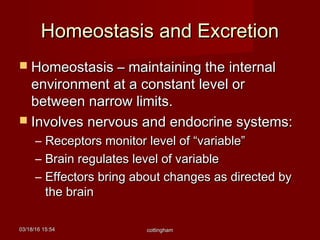
Homeostasis and ExcretionHomeostasis and Excretion
 Homeostasis – maintaining the internalHomeostasis – maintaining the internal
environment at a constant level orenvironment at a constant level or
between narrow limits.between narrow limits.
 Involves nervous and endocrine systems:Involves nervous and endocrine systems:
– Receptors monitor level of “variable”Receptors monitor level of “variable”
– Brain regulates level of variableBrain regulates level of variable
– Effectors bring about changes as directed byEffectors bring about changes as directed by
the brainthe brain
03/18/1603/18/16 15:5415:54 cottinghamcottingham
HomeostasisHomeostasis
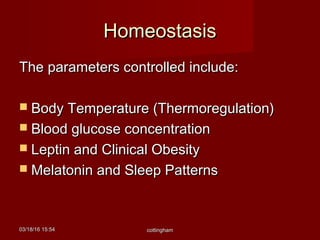
The parameters controlled include:The parameters controlled include:
 Body Temperature (Thermoregulation)Body Temperature (Thermoregulation)
 Blood glucose concentrationBlood glucose concentration
 Leptin and Clinical ObesityLeptin and Clinical Obesity
 Melatonin and Sleep PatternsMelatonin and Sleep Patterns
03/18/1603/18/16 15:5415:54 cottinghamcottingham
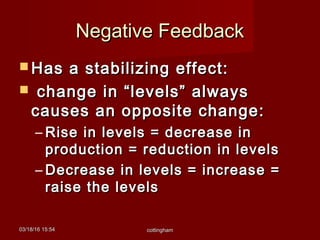
Negative FeedbackNegative Feedback
 Has a stabilizing effect:Has a stabilizing effect:
 change in “levels” alwayschange in “levels” always
causes an opposite change:causes an opposite change:
– Rise in levels = decrease inRise in levels = decrease in
production = reduction in levelsproduction = reduction in levels
– Decrease in levels = increase =Decrease in levels = increase =
raise the levelsraise the levels
03/18/1603/18/16 15:5415:54 cottinghamcottingham
ThermoregulationThermoregulation
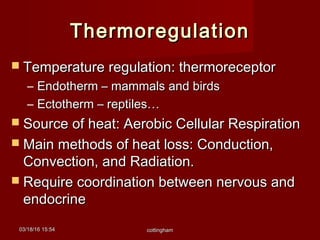
 Temperature regulation: thermoreceptorTemperature regulation: thermoreceptor
– Endotherm – mammals and birdsEndotherm – mammals and birds
– Ectotherm – reptiles…Ectotherm – reptiles…
 Source of heat: Aerobic Cellular RespirationSource of heat: Aerobic Cellular Respiration
 Main methods of heat loss: Conduction,Main methods of heat loss: Conduction,
Convection, and Radiation.Convection, and Radiation.
 Require coordination between nervous andRequire coordination between nervous and
endocrineendocrine
03/18/1603/18/16 15:5415:54 cottinghamcottingham
ThermoregulationThermoregulation
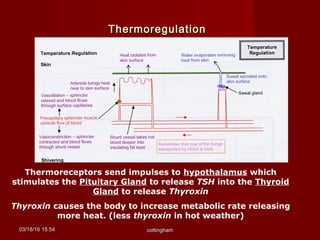
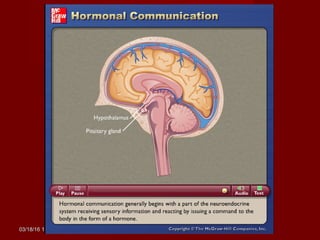
Thermoreceptors send impulses to hypothalamus which
stimulates the Pituitary Gland to release TSH into the Thyroid
Gland to release Thyroxin
Thyroxin causes the body to increase metabolic rate releasing
more heat. (less thyroxin in hot weather)
03/18/1603/18/16 15:5415:54 cottinghamcottingham
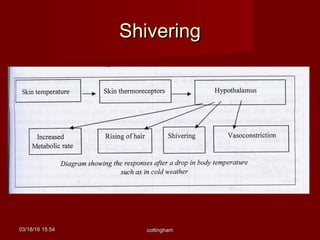
ShiveringShivering
03/18/1603/18/16 15:5415:54 cottinghamcottingham
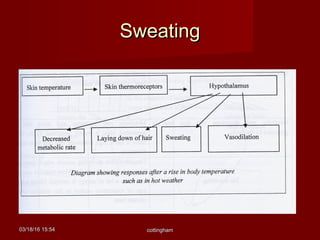
SweatingSweating
03/18/1603/18/16 15:5415:54 cottinghamcottingham
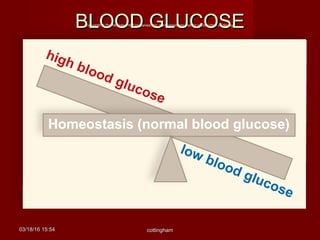
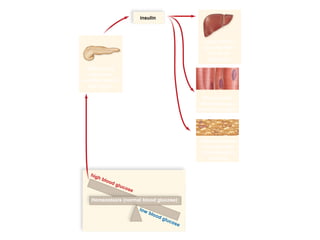
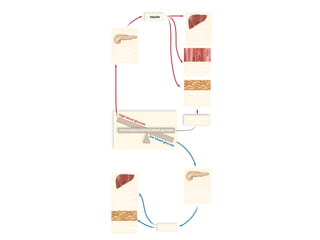
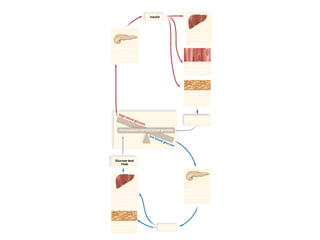
BLOOD GLUCOSEBLOOD GLUCOSECopyright © The McGraw-Hill Companies, Inc. Permission required for reproduction or display.
high blood glucose
low blood glucose
Homeostasis (normal blood glucose)
03/18/16 15:54 cottingham
Copyright © The McGraw-Hill Companies, Inc. Permission required for reproduction or display.
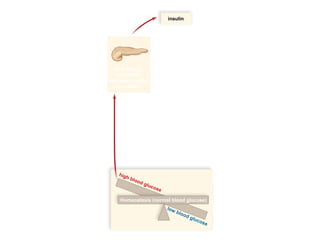
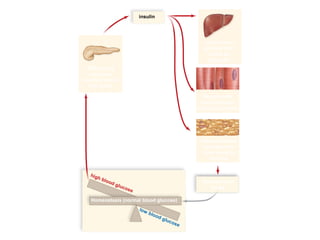
insulin
high blood glucose
low blood glucose
After eating,
pancreas
secretes insulin
into blood.
Homeostasis (normal blood glucose)
03/18/16 15:54 cottingham
Copyright © The McGraw-Hill Companies, Inc. Permission required for reproduction or display.
insuli
n
high blood glucose
low blood glucose
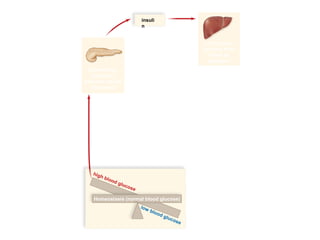
After eating,
pancreas
secretes insulin
into blood.
Homeostasis (normal blood glucose)
Liver stores
glucose from
blood as
glycogen.
03/18/16 15:54 cottingham
Copyright © The McGraw-Hill Companies, Inc. Permission required for reproduction or display.
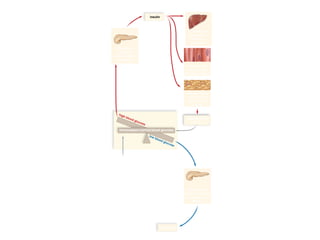
insulin
high blood glucose
low blood glucose
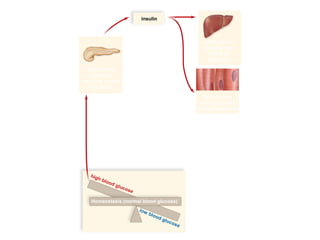
After eating,
pancreas
secretes insulin
into blood.
Muscle cells
store glycogen
and build protein.
Homeostasis (normal blood glucose)
Liver stores
glucose from
blood as
glycogen.
03/18/16 15:54 cottingham
Copyright © The McGraw-Hill Companies, Inc. Permission required for reproduction or display.
insulin
high blood glucose
low blood glucose
After eating,
pancreas
secretes insulin
into blood.
Muscle cells
store glycogen
and build protein.
Adipose tissue
uses glucose
from blood to
form fat.
Homeostasis (normal blood glucose)
Liver stores
glucose from
blood as
glycogen.
03/18/16 15:54 cottingham
Copyright © The McGraw-Hill Companies, Inc. Permission required for reproduction or display.
insulin
high blood glucose
low blood glucose
After eating,
pancreas
secretes insulin
into blood.
Muscle cells
store glycogen
and build protein.
Adipose tissue
uses glucose
from blood to
form fat.
Homeostasis (normal blood glucose)
Glucose level
drops.
Liver stores
glucose from
blood as
glycogen.
03/18/16 15:54 cottingham
Copyright © The McGraw-Hill Companies, Inc. Permission required for reproduction or display.
insulin
high blood glucose
low blood glucose
After eating,
pancreas
secretes insulin
into blood.
Muscle cells
store glycogen
and build protein.
Adipose tissue
uses glucose
from blood to
form fat.
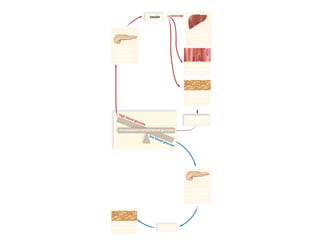
Before eating,
pancreas secretes
glucagon into
blood.
glucagon
Homeostasis (normal blood glucose)
Glucose level
drops.
Liver stores
glucose from
blood as
glycogen.
03/18/16 15:54 cottingham
Copyright © The McGraw-Hill Companies, Inc. Permission required for reproduction or display.
insulin
high blood glucose
low blood glucose
After eating,
pancreas
secretes insulin
into blood.
Before eating,
pancreas secretes
glucagon into
blood.
glucagon
Adipose tissue
breaks downfat.
Homeostasis (normal blood glucose)
Glucose level
drops.
Muscle cells
store glycogen
and build protein.
Adipose tissue
uses glucose
from blood to
form fat.
Liver stores
glucose from
blood as
glycogen.
03/18/16 15:54 cottingham
Copyright © The McGraw-Hill Companies, Inc. Permission required for reproduction or display.
insulin
high blood glucose
low blood glucose
After eating,
pancreas
secretes insulin
into blood.
Before eating,
pancreas secretes
glucagon into
blood.
glucagon
Liver breaks
Down glycogen
to glucose.
Glucose enters
blood.
Adipose tissue
breaks downfat.
Homeostasis (normal blood glucose)
Glucose level
drops.
Muscle cells
store glycogen
and build protein.
Adipose tissue
uses glucose
from blood to
form fat.
Liver stores
glucose from
blood as
glycogen.
03/18/16 15:54 cottingham
Copyright © The McGraw-Hill Companies, Inc. Permission required for reproduction or display.
insulin
Glucose level
rises.
high blood glucose
low blood glucose
After eating,
pancreas
secretes insulin
into blood.
Before eating,
pancreas secretes
glucagon into
blood.
glucagon
Liver breaks
Down glycogen
to glucose.
Glucose enters
blood.
Adipose tissue
breaks downfat.
Homeostasis (normal blood glucose)
Glucose level
drops.
Muscle cells
store glycogen
and build protein.
Adipose tissue
uses glucose
from blood to
form fat.
Liver stores
glucose from
blood as
glycogen.
03/18/1603/18/16 15:5415:54 cottinghamcottingham
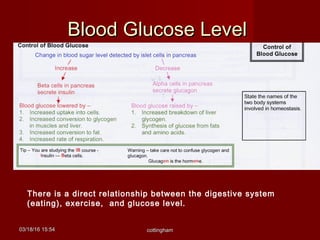
Blood Glucose LevelBlood Glucose Level
There is a direct relationship between the digestive system
(eating), exercise, and glucose level.
03/18/1603/18/16 15:5415:54 cottinghamcottingham
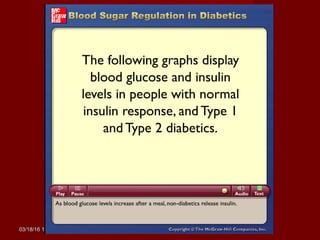
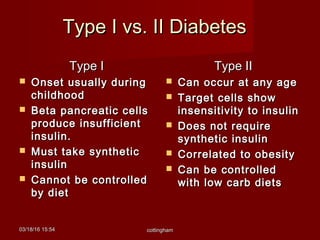
Type I vs. II DiabetesType I vs. II Diabetes
Type IType I
 Onset usually duringOnset usually during
childhoodchildhood
 Beta pancreatic cellsBeta pancreatic cells
produce insufficientproduce insufficient
insulin.insulin.
 Must take syntheticMust take synthetic
insulininsulin
 Cannot be controlledCannot be controlled
by dietby diet
Type IIType II
 Can occur at any ageCan occur at any age
 Target cells showTarget cells show
insensitivity to insulininsensitivity to insulin
 Does not requireDoes not require
synthetic insulinsynthetic insulin
 Correlated to obesityCorrelated to obesity
 Can be controlledCan be controlled
with low carb dietswith low carb diets
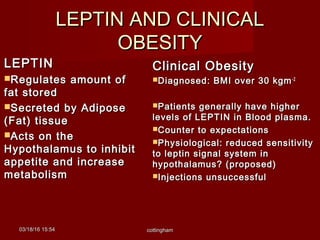
LEPTIN AND CLINICALLEPTIN AND CLINICAL
OBESITYOBESITY
LEPTINLEPTIN
Regulates amount ofRegulates amount of
fat storedfat stored
Secreted by AdiposeSecreted by Adipose
(Fat) tissue(Fat) tissue
Acts on theActs on the
Hypothalamus to inhibitHypothalamus to inhibit
appetite and increaseappetite and increase
metabolismmetabolism
Clinical ObesityClinical Obesity
Diagnosed: BMI over 30 kgmDiagnosed: BMI over 30 kgm-2-2
Patients generally have higherPatients generally have higher
levels of LEPTIN in Blood plasma.levels of LEPTIN in Blood plasma.
Counter to expectationsCounter to expectations
Physiological: reduced sensitivityPhysiological: reduced sensitivity
to leptin signal system into leptin signal system in
hypothalamus? (proposed)hypothalamus? (proposed)
Injections unsuccessfulInjections unsuccessful
03/18/1603/18/16 15:5415:54 cottinghamcottingham
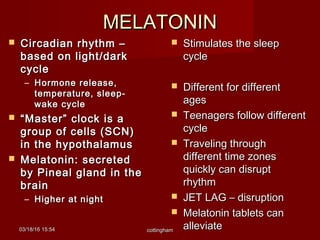
MELATONINMELATONIN
 Stimulates the sleepStimulates the sleep
cyclecycle
 Different for differentDifferent for different
agesages
 Teenagers follow differentTeenagers follow different
cyclecycle
 Traveling throughTraveling through
different time zonesdifferent time zones
quickly can disruptquickly can disrupt
rhythmrhythm
 JET LAG – disruptionJET LAG – disruption
 Melatonin tablets canMelatonin tablets can
alleviatealleviate
 Circadian rhythm –Circadian rhythm –
based on light/darkbased on light/dark
cyclecycle
– Hormone release,Hormone release,
temperature, sleep-temperature, sleep-
wake cyclewake cycle
 ““Master” clock is aMaster” clock is a
group of cells (SCN)group of cells (SCN)
in the hypothalamusin the hypothalamus
 Melatonin: secretedMelatonin: secreted
by Pineal gland in theby Pineal gland in the
brainbrain
– Higher at nightHigher at night
03/18/1603/18/16 15:5415:54 cottinghamcottingham
ENDEND
03/18/1603/18/16 15:5415:54 cottinghamcottingham

Homeostasis ib 2016

  • 1.
  • 2.
  • 3.
    03/18/1603/18/16 15:5415:54 cottinghamcottingham Homeostasisand ExcretionHomeostasis and Excretion  Homeostasis – maintaining the internalHomeostasis – maintaining the internal environment at a constant level orenvironment at a constant level or between narrow limits.between narrow limits.  Involves nervous and endocrine systems:Involves nervous and endocrine systems: – Receptors monitor level of “variable”Receptors monitor level of “variable” – Brain regulates level of variableBrain regulates level of variable – Effectors bring about changes as directed byEffectors bring about changes as directed by the brainthe brain
  • 4.
    03/18/1603/18/16 15:5415:54 cottinghamcottingham HomeostasisHomeostasis Theparameters controlled include:The parameters controlled include:  Body Temperature (Thermoregulation)Body Temperature (Thermoregulation)  Blood glucose concentrationBlood glucose concentration  Leptin and Clinical ObesityLeptin and Clinical Obesity  Melatonin and Sleep PatternsMelatonin and Sleep Patterns
  • 5.
    03/18/1603/18/16 15:5415:54 cottinghamcottingham NegativeFeedbackNegative Feedback  Has a stabilizing effect:Has a stabilizing effect:  change in “levels” alwayschange in “levels” always causes an opposite change:causes an opposite change: – Rise in levels = decrease inRise in levels = decrease in production = reduction in levelsproduction = reduction in levels – Decrease in levels = increase =Decrease in levels = increase = raise the levelsraise the levels
  • 6.
    03/18/1603/18/16 15:5415:54 cottinghamcottingham ThermoregulationThermoregulation Temperature regulation: thermoreceptorTemperature regulation: thermoreceptor – Endotherm – mammals and birdsEndotherm – mammals and birds – Ectotherm – reptiles…Ectotherm – reptiles…  Source of heat: Aerobic Cellular RespirationSource of heat: Aerobic Cellular Respiration  Main methods of heat loss: Conduction,Main methods of heat loss: Conduction, Convection, and Radiation.Convection, and Radiation.  Require coordination between nervous andRequire coordination between nervous and endocrineendocrine
  • 7.
    03/18/1603/18/16 15:5415:54 cottinghamcottingham ThermoregulationThermoregulation Thermoreceptorssend impulses to hypothalamus which stimulates the Pituitary Gland to release TSH into the Thyroid Gland to release Thyroxin Thyroxin causes the body to increase metabolic rate releasing more heat. (less thyroxin in hot weather)
  • 8.
  • 9.
  • 10.
    03/18/1603/18/16 15:5415:54 cottinghamcottingham BLOODGLUCOSEBLOOD GLUCOSECopyright © The McGraw-Hill Companies, Inc. Permission required for reproduction or display. high blood glucose low blood glucose Homeostasis (normal blood glucose)
  • 11.
    03/18/16 15:54 cottingham Copyright© The McGraw-Hill Companies, Inc. Permission required for reproduction or display. insulin high blood glucose low blood glucose After eating, pancreas secretes insulin into blood. Homeostasis (normal blood glucose)
  • 12.
    03/18/16 15:54 cottingham Copyright© The McGraw-Hill Companies, Inc. Permission required for reproduction or display. insuli n high blood glucose low blood glucose After eating, pancreas secretes insulin into blood. Homeostasis (normal blood glucose) Liver stores glucose from blood as glycogen.
  • 13.
    03/18/16 15:54 cottingham Copyright© The McGraw-Hill Companies, Inc. Permission required for reproduction or display. insulin high blood glucose low blood glucose After eating, pancreas secretes insulin into blood. Muscle cells store glycogen and build protein. Homeostasis (normal blood glucose) Liver stores glucose from blood as glycogen.
  • 14.
    03/18/16 15:54 cottingham Copyright© The McGraw-Hill Companies, Inc. Permission required for reproduction or display. insulin high blood glucose low blood glucose After eating, pancreas secretes insulin into blood. Muscle cells store glycogen and build protein. Adipose tissue uses glucose from blood to form fat. Homeostasis (normal blood glucose) Liver stores glucose from blood as glycogen.
  • 15.
    03/18/16 15:54 cottingham Copyright© The McGraw-Hill Companies, Inc. Permission required for reproduction or display. insulin high blood glucose low blood glucose After eating, pancreas secretes insulin into blood. Muscle cells store glycogen and build protein. Adipose tissue uses glucose from blood to form fat. Homeostasis (normal blood glucose) Glucose level drops. Liver stores glucose from blood as glycogen.
  • 16.
    03/18/16 15:54 cottingham Copyright© The McGraw-Hill Companies, Inc. Permission required for reproduction or display. insulin high blood glucose low blood glucose After eating, pancreas secretes insulin into blood. Muscle cells store glycogen and build protein. Adipose tissue uses glucose from blood to form fat. Before eating, pancreas secretes glucagon into blood. glucagon Homeostasis (normal blood glucose) Glucose level drops. Liver stores glucose from blood as glycogen.
  • 17.
    03/18/16 15:54 cottingham Copyright© The McGraw-Hill Companies, Inc. Permission required for reproduction or display. insulin high blood glucose low blood glucose After eating, pancreas secretes insulin into blood. Before eating, pancreas secretes glucagon into blood. glucagon Adipose tissue breaks downfat. Homeostasis (normal blood glucose) Glucose level drops. Muscle cells store glycogen and build protein. Adipose tissue uses glucose from blood to form fat. Liver stores glucose from blood as glycogen.
  • 18.
    03/18/16 15:54 cottingham Copyright© The McGraw-Hill Companies, Inc. Permission required for reproduction or display. insulin high blood glucose low blood glucose After eating, pancreas secretes insulin into blood. Before eating, pancreas secretes glucagon into blood. glucagon Liver breaks Down glycogen to glucose. Glucose enters blood. Adipose tissue breaks downfat. Homeostasis (normal blood glucose) Glucose level drops. Muscle cells store glycogen and build protein. Adipose tissue uses glucose from blood to form fat. Liver stores glucose from blood as glycogen.
  • 19.
    03/18/16 15:54 cottingham Copyright© The McGraw-Hill Companies, Inc. Permission required for reproduction or display. insulin Glucose level rises. high blood glucose low blood glucose After eating, pancreas secretes insulin into blood. Before eating, pancreas secretes glucagon into blood. glucagon Liver breaks Down glycogen to glucose. Glucose enters blood. Adipose tissue breaks downfat. Homeostasis (normal blood glucose) Glucose level drops. Muscle cells store glycogen and build protein. Adipose tissue uses glucose from blood to form fat. Liver stores glucose from blood as glycogen.
  • 20.
    03/18/1603/18/16 15:5415:54 cottinghamcottingham BloodGlucose LevelBlood Glucose Level There is a direct relationship between the digestive system (eating), exercise, and glucose level.
  • 21.
  • 22.
    03/18/1603/18/16 15:5415:54 cottinghamcottingham TypeI vs. II DiabetesType I vs. II Diabetes Type IType I  Onset usually duringOnset usually during childhoodchildhood  Beta pancreatic cellsBeta pancreatic cells produce insufficientproduce insufficient insulin.insulin.  Must take syntheticMust take synthetic insulininsulin  Cannot be controlledCannot be controlled by dietby diet Type IIType II  Can occur at any ageCan occur at any age  Target cells showTarget cells show insensitivity to insulininsensitivity to insulin  Does not requireDoes not require synthetic insulinsynthetic insulin  Correlated to obesityCorrelated to obesity  Can be controlledCan be controlled with low carb dietswith low carb diets
  • 23.
    LEPTIN AND CLINICALLEPTINAND CLINICAL OBESITYOBESITY LEPTINLEPTIN Regulates amount ofRegulates amount of fat storedfat stored Secreted by AdiposeSecreted by Adipose (Fat) tissue(Fat) tissue Acts on theActs on the Hypothalamus to inhibitHypothalamus to inhibit appetite and increaseappetite and increase metabolismmetabolism Clinical ObesityClinical Obesity Diagnosed: BMI over 30 kgmDiagnosed: BMI over 30 kgm-2-2 Patients generally have higherPatients generally have higher levels of LEPTIN in Blood plasma.levels of LEPTIN in Blood plasma. Counter to expectationsCounter to expectations Physiological: reduced sensitivityPhysiological: reduced sensitivity to leptin signal system into leptin signal system in hypothalamus? (proposed)hypothalamus? (proposed) Injections unsuccessfulInjections unsuccessful 03/18/1603/18/16 15:5415:54 cottinghamcottingham
  • 24.
    MELATONINMELATONIN  Stimulates thesleepStimulates the sleep cyclecycle  Different for differentDifferent for different agesages  Teenagers follow differentTeenagers follow different cyclecycle  Traveling throughTraveling through different time zonesdifferent time zones quickly can disruptquickly can disrupt rhythmrhythm  JET LAG – disruptionJET LAG – disruption  Melatonin tablets canMelatonin tablets can alleviatealleviate  Circadian rhythm –Circadian rhythm – based on light/darkbased on light/dark cyclecycle – Hormone release,Hormone release, temperature, sleep-temperature, sleep- wake cyclewake cycle  ““Master” clock is aMaster” clock is a group of cells (SCN)group of cells (SCN) in the hypothalamusin the hypothalamus  Melatonin: secretedMelatonin: secreted by Pineal gland in theby Pineal gland in the brainbrain – Higher at nightHigher at night 03/18/1603/18/16 15:5415:54 cottinghamcottingham
  • 25.
  • 26.
  • 27.