GL

BAL

Institute of Information Technology
HOLOGRAPHY

Presented By:Rahul Baghla
Rohitash Sharma
CONTENTS
 What is Holography
 History of Holography
 Principle of Holography
 Recording of the Hologram
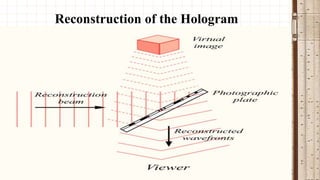
 Reconstruction of the Holography
 Holographic Properties

 Current and Future Applications
 Conclusion
What is Holography
 Holography (from the Greek, whole + write) is the science of producing
holograms.

 It is an advanced form of photography that allows an image to be recorded in
three dimensions.

 The technique of holography can also be used to optically store, retrieve, and
process information.

 Holography is a technique that allows the light scattered from an object to be
recorded and later reconstructed.
History of Holography
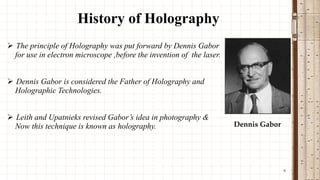
 The principle of Holography was put forward by Dennis Gabor
for use in electron microscope ,before the invention of the laser.
 Dennis Gabor is considered the Father of Holography and
Holographic Technologies.
 Leith and Upatnieks revised Gabor’s idea in photography &
Now this technique is known as holography.

Dennis Gabor

6
Principle of Holography
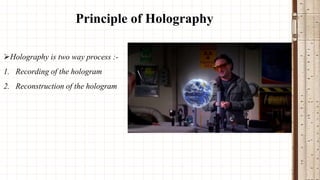
Holography is two way process :1. Recording of the hologram
2. Reconstruction of the hologram
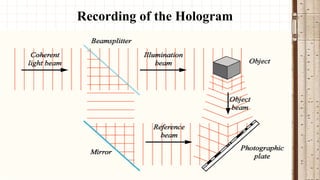
Recording of the Hologram
Reconstruction of the Hologram
Holographic Properties
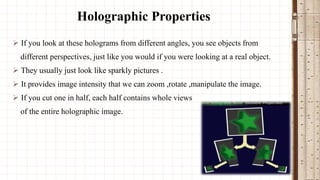
 If you look at these holograms from different angles, you see objects from
different perspectives, just like you would if you were looking at a real object.

 They usually just look like sparkly pictures .
 It provides image intensity that we can zoom ,rotate ,manipulate the image.
 If you cut one in half, each half contains whole views

of the entire holographic image.
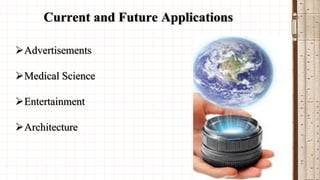
Current and Future Applications
Advertisements
Medical Science
Entertainment
Architecture
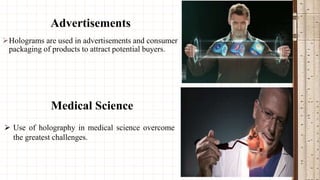
Advertisements
Holograms are used in advertisements and consumer
packaging of products to attract potential buyers.

Medical Science
 Use of holography in medical science overcome
the greatest challenges.
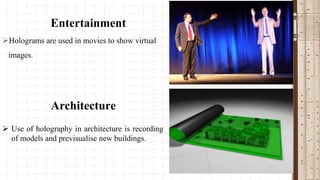
Entertainment
Holograms are used in movies to show virtual
images.

Architecture
 Use of holography in architecture is recording
of models and previsualise new buildings.
Conclusion
 Holographic Technology and Spectral Imagining has endless applications, as
far as the human mind can imagine.
 Holographic Technology is most advanced technology.
 These technologies are indeed available and getting more robust in abilities
each year.
 In future, holographic displays will be replacing all present displays in all sizes,
from small phone screen to large projectors.
Thank You !!

Any Queries ??

Holography

  • 1.
  • 2.
  • 3.
    CONTENTS  What isHolography  History of Holography  Principle of Holography  Recording of the Hologram  Reconstruction of the Holography  Holographic Properties  Current and Future Applications  Conclusion
  • 4.
    What is Holography Holography (from the Greek, whole + write) is the science of producing holograms.  It is an advanced form of photography that allows an image to be recorded in three dimensions.  The technique of holography can also be used to optically store, retrieve, and process information.  Holography is a technique that allows the light scattered from an object to be recorded and later reconstructed.
  • 6.
    History of Holography The principle of Holography was put forward by Dennis Gabor for use in electron microscope ,before the invention of the laser.  Dennis Gabor is considered the Father of Holography and Holographic Technologies.  Leith and Upatnieks revised Gabor’s idea in photography & Now this technique is known as holography. Dennis Gabor 6
  • 7.
    Principle of Holography Holographyis two way process :1. Recording of the hologram 2. Reconstruction of the hologram
  • 8.
  • 9.
  • 10.
    Holographic Properties  Ifyou look at these holograms from different angles, you see objects from different perspectives, just like you would if you were looking at a real object.  They usually just look like sparkly pictures .  It provides image intensity that we can zoom ,rotate ,manipulate the image.  If you cut one in half, each half contains whole views of the entire holographic image.
  • 11.
    Current and FutureApplications Advertisements Medical Science Entertainment Architecture
  • 12.
    Advertisements Holograms are usedin advertisements and consumer packaging of products to attract potential buyers. Medical Science  Use of holography in medical science overcome the greatest challenges.
  • 14.
    Entertainment Holograms are usedin movies to show virtual images. Architecture  Use of holography in architecture is recording of models and previsualise new buildings.
  • 16.
    Conclusion  Holographic Technologyand Spectral Imagining has endless applications, as far as the human mind can imagine.  Holographic Technology is most advanced technology.  These technologies are indeed available and getting more robust in abilities each year.  In future, holographic displays will be replacing all present displays in all sizes, from small phone screen to large projectors.
  • 17.
    Thank You !! AnyQueries ??