RAJKIYA ENGINEERING COLLEGE
AMBEDKARNAGAR-224122
UNDER THE GUIDANCE OF: Mr. Rakesh Kumar
SUBMITTED TO: Mrs. Shashi Prabha Anan
SUBMITTED BY: Renuka Raj
A
TECHNICAL PRESENTATION
ON
•What is Holography?
•History.
•Hologram Properties.
•Working.
•Holographic Systems.
•Governing Principles.
•Applications.
•Projected Cost.
•Conclusion.
•References.
AGENDA
 Holography (from the
Greek, whole + write) is
the science of producing
holograms.
 It is an advanced form of
photography that allows an
image to be recorded in
three dimensions.
 The technique of
holography can also be
used to optically store,
retrieve, and process
information.
WHAT IS HOLOGRAPHY?
TIMELINE OF HOLOGRAPHY
If you look at these holograms from different angles, you see
objects from different perspectives, just like you would if you
were looking at a real object.
They usually just look like sparkly pictures or smears of color.
If you cut one in half, each half contains whole views of the entire
holographic image.
HOLOGRAPHIC PROPERTIES
A.Reflex hologram
Illuminated by a spot
of white incandescent
light source, from front-
above.
The image consists of
light reflected by the
hologram.
Produces multicolor
holograms, makes
images optically
indistinguishable from
the original objects.
TYPES OF HOLOGRAM
B. Transmission hologram
 Viewed with laser light,
usually of the same type
used to make the recording
 Need light source behind
them.
 Virtual image can be very
sharp and deep.
C. Computer-generated holograms
 No need for a real object.
 Interference pattern is
calculated digitally, using
algorithms.
TYPES OF HOLOGRAM
 The time-varying light field
of a scene with all its
physical properties is to be
recorded and then
regenerated.
 Hence the working of
holography is divided into
two phases:
Recording
Reconstruction
HOW HOLOGRAM WORKS?
Basic tools required
to make a hologram
includes a red lasers,
lenses, beam splitter,
mirrors and
holographic film
Holograms are
recorded in darker
environment
RECORDING A HOLOGRAM
The photographic plate is illuminated with original
light source used for recording holograms.
RECONSTRUCTION OF HOLOGRAM
RECONSTRUCTING A HOLOGRAM
Video hologram is coded into light modulators.
These light modulators are illuminated by coherent light beam
source, to project video.
PROJECTION OF HOLOGRAPHIC VIDEO
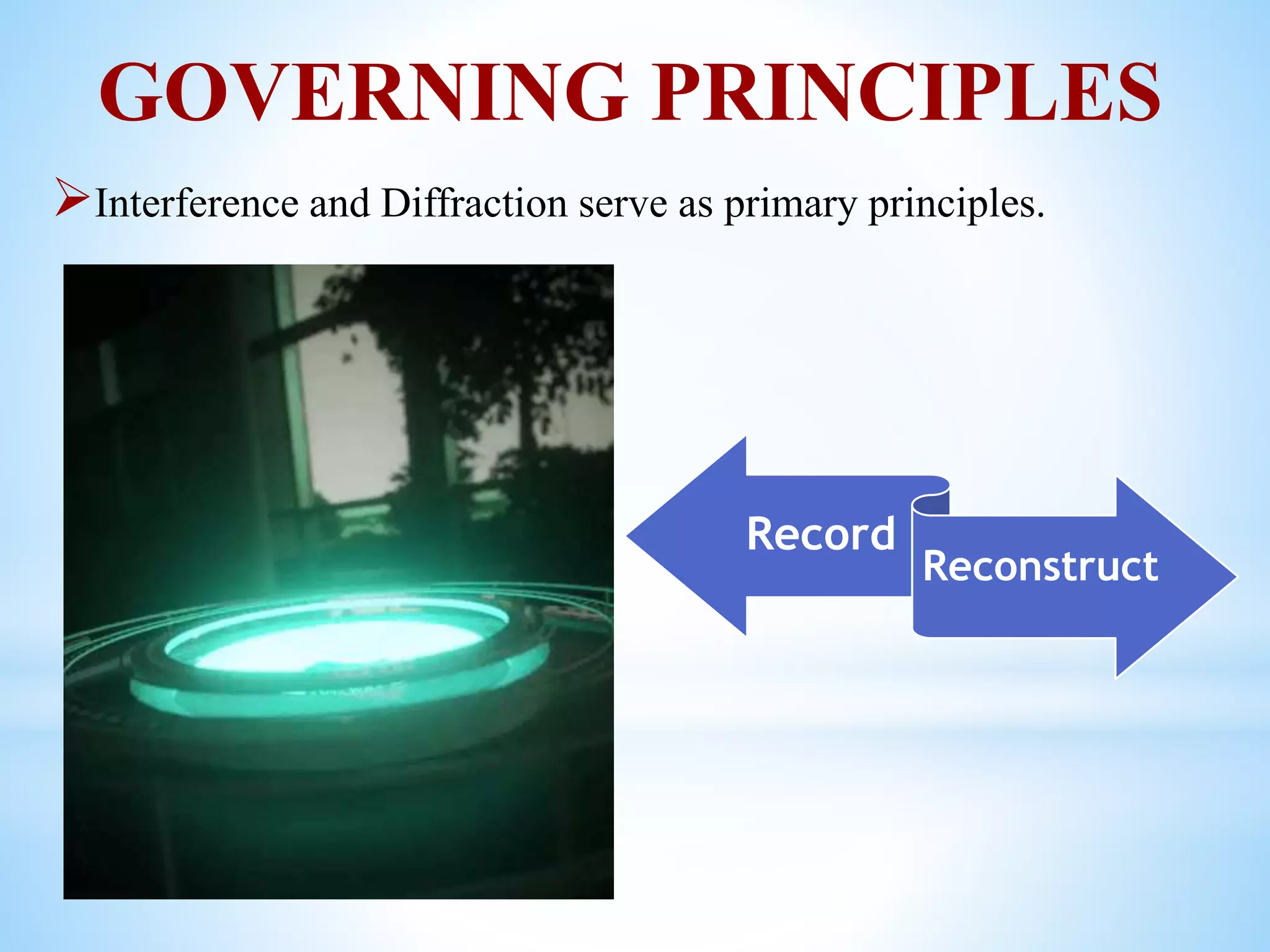
Interference and Diffraction serve as primary principles.
Record
Reconstruct
GOVERNING PRINCIPLES
Medical studio
Filming of Real people
Special effects
TV image projection
Cell phone deployment
Virtual Communication
Simulation & Planning
Teaching & Training
Entertainment
APPLICATIONS & FUTURE SCOPE
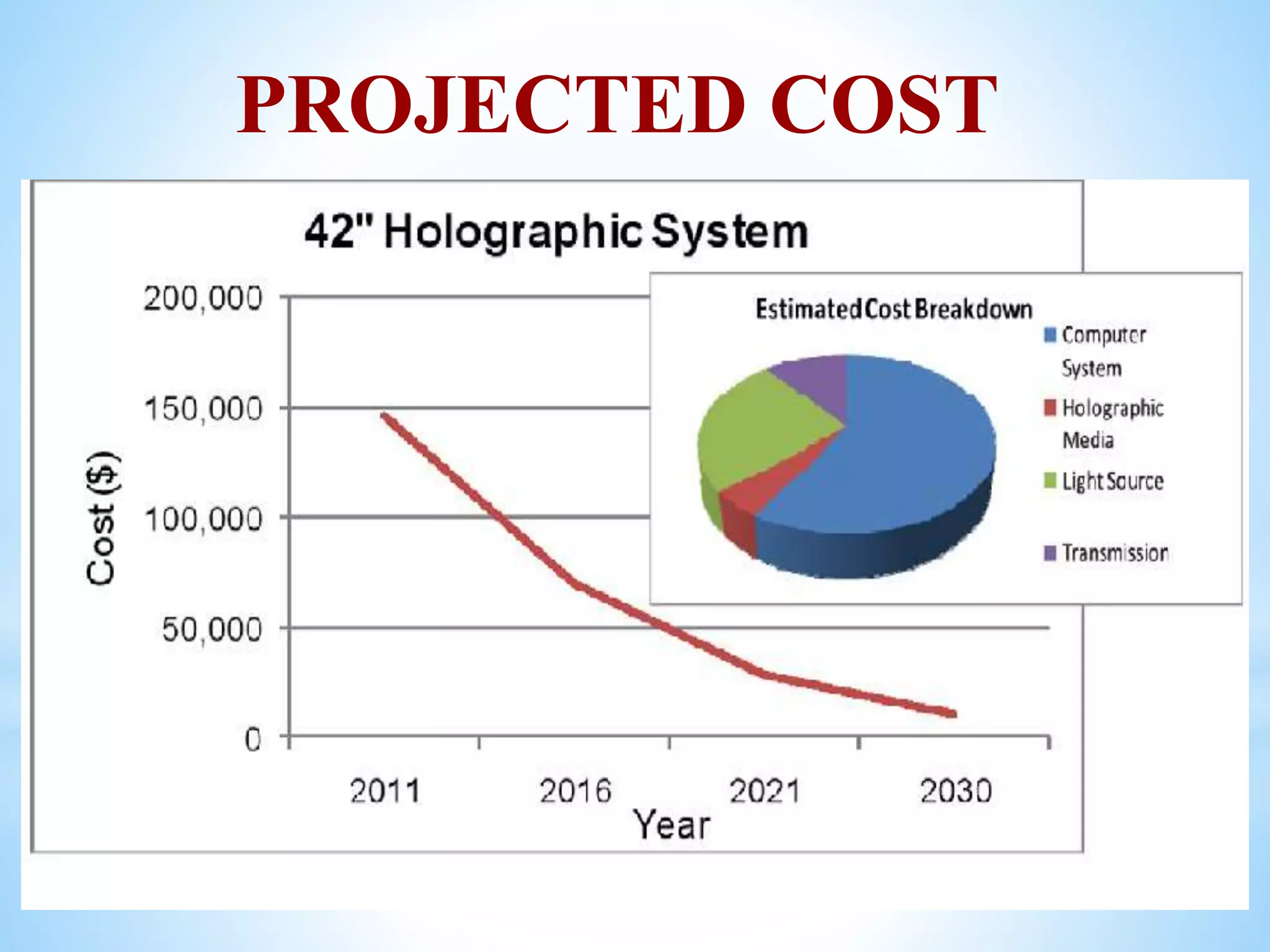
PROJECTED COST
Holographic Technology has endless applications, as
far as the human mind can imagine.
In future, holographic displays will be replacing all
present displays in all sizes, from small phone screen
to large projectors.
CONCLUSION
REFERENCES
Ahmed Elmorshidy, Ph.D. Holographic Projection
Technology: The World is Changing . Journal Of
Telecommunications, Volume 2, Issue 2, May 2010.
http://holonet.khm.de/visual_alchemy/holo_hist.html
http://www.holophile.com/history.htm
http://www.jfairstein.com/hololinks.html
Websites: http://www.holonet.khm
Holographic tech.

Holographic tech.

  • 1.
    RAJKIYA ENGINEERING COLLEGE AMBEDKARNAGAR-224122 UNDERTHE GUIDANCE OF: Mr. Rakesh Kumar SUBMITTED TO: Mrs. Shashi Prabha Anan SUBMITTED BY: Renuka Raj A TECHNICAL PRESENTATION ON
  • 2.
    •What is Holography? •History. •HologramProperties. •Working. •Holographic Systems. •Governing Principles. •Applications. •Projected Cost. •Conclusion. •References. AGENDA
  • 3.
     Holography (fromthe Greek, whole + write) is the science of producing holograms.  It is an advanced form of photography that allows an image to be recorded in three dimensions.  The technique of holography can also be used to optically store, retrieve, and process information. WHAT IS HOLOGRAPHY?
  • 4.
  • 5.
    If you lookat these holograms from different angles, you see objects from different perspectives, just like you would if you were looking at a real object. They usually just look like sparkly pictures or smears of color. If you cut one in half, each half contains whole views of the entire holographic image. HOLOGRAPHIC PROPERTIES
  • 6.
    A.Reflex hologram Illuminated bya spot of white incandescent light source, from front- above. The image consists of light reflected by the hologram. Produces multicolor holograms, makes images optically indistinguishable from the original objects. TYPES OF HOLOGRAM
  • 7.
    B. Transmission hologram Viewed with laser light, usually of the same type used to make the recording  Need light source behind them.  Virtual image can be very sharp and deep. C. Computer-generated holograms  No need for a real object.  Interference pattern is calculated digitally, using algorithms. TYPES OF HOLOGRAM
  • 8.
     The time-varyinglight field of a scene with all its physical properties is to be recorded and then regenerated.  Hence the working of holography is divided into two phases: Recording Reconstruction HOW HOLOGRAM WORKS?
  • 9.
    Basic tools required tomake a hologram includes a red lasers, lenses, beam splitter, mirrors and holographic film Holograms are recorded in darker environment RECORDING A HOLOGRAM
  • 10.
  • 11.
    The photographic plateis illuminated with original light source used for recording holograms. RECONSTRUCTION OF HOLOGRAM
  • 12.
  • 13.
    Video hologram iscoded into light modulators. These light modulators are illuminated by coherent light beam source, to project video. PROJECTION OF HOLOGRAPHIC VIDEO
  • 14.
    Interference and Diffractionserve as primary principles. Record Reconstruct GOVERNING PRINCIPLES
  • 15.
    Medical studio Filming ofReal people Special effects TV image projection Cell phone deployment Virtual Communication Simulation & Planning Teaching & Training Entertainment APPLICATIONS & FUTURE SCOPE
  • 16.
  • 17.
    Holographic Technology hasendless applications, as far as the human mind can imagine. In future, holographic displays will be replacing all present displays in all sizes, from small phone screen to large projectors. CONCLUSION
  • 18.
    REFERENCES Ahmed Elmorshidy, Ph.D.Holographic Projection Technology: The World is Changing . Journal Of Telecommunications, Volume 2, Issue 2, May 2010. http://holonet.khm.de/visual_alchemy/holo_hist.html http://www.holophile.com/history.htm http://www.jfairstein.com/hololinks.html Websites: http://www.holonet.khm