
3D
HOLOGRAPHIC
PROJECTION
Under the Guidance Of: Presented By:
Mrs. DAKODE SIR SHUBHAM MORGAONKAR
Assistant Professor Roll No : 13U441
computer Department SKNCOE Class : TE COMP
CONTENTS
• INTRODUCTION TO 3D HOLOGRAPHY
• HISTORY OF 3D HOLOGRAPHY
• IMPORTANCE AND NEED OF 3D HOLOGRAPHIC PROJECTION
• WORKING OF 3D HOLOGRAPHIC PROJECTION
• ADVANTAGES OF 3D HOLOGRAPHIC PROJECTION
• DISADVANTAGES OF 3D HOLOGRAPH
• APPLICATIONS OF 3D HOLOGRAPHIC PROJECTION
• CONCLUSION
• REFERENCES
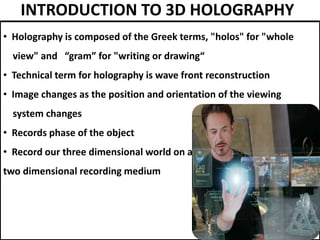
INTRODUCTION TO 3D HOLOGRAPHY
• Holography is composed of the Greek terms, "holos" for "whole
view" and “gram” for "writing or drawing“
• Technical term for holography is wave front reconstruction
• Image changes as the position and orientation of the viewing
system changes
• Records phase of the object
• Record our three dimensional world on a
two dimensional recording medium
HISTORY OF 3D HOLOGRAPHY
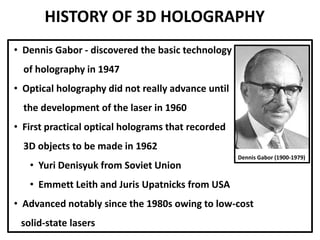
• Dennis Gabor - discovered the basic technology
of holography in 1947
• Optical holography did not really advance until
the development of the laser in 1960
• First practical optical holograms that recorded
3D objects to be made in 1962
• Yuri Denisyuk from Soviet Union
• Emmett Leith and Juris Upatnicks from USA
• Advanced notably since the 1980s owing to low-cost
solid-state lasers
Dennis Gabor (1900-1979)
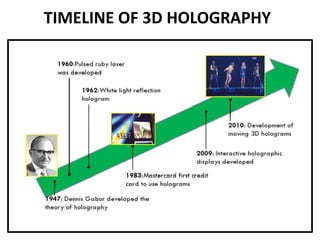
TIMELINE OF 3D HOLOGRAPHY
IMPORTANCE AND NEED OF
3D HOLOGRAPHIC PROJECTION
• Project large-scale, high-resolution images onto free space
• Accommodate multiple viewers independently and
simultaneously
• Create tremendous effects on all fields of life including
business, education, science, art and healthcare
• Enabling viewing and manipulation of virtual 3D objects in 3D
space without the need for special viewing goggles or headgear
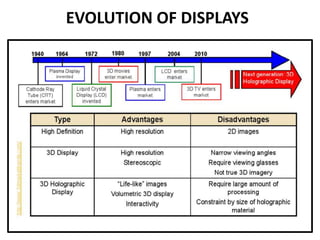
EVOLUTION OF DISPLAYS
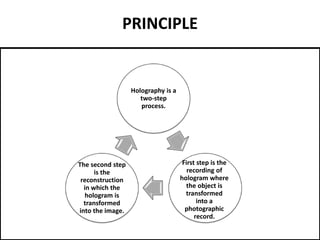
Holography is a
two-step
process.
First step is the
recording of
hologram where
the object is
transformed
into a
photographic
record.
The second step
is the
reconstruction
in which the
hologram is
transformed
into the image.
PRINCIPLE
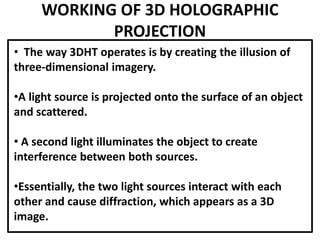
WORKING OF 3D HOLOGRAPHIC
PROJECTION
• The way 3DHT operates is by creating the illusion of
three-dimensional imagery.
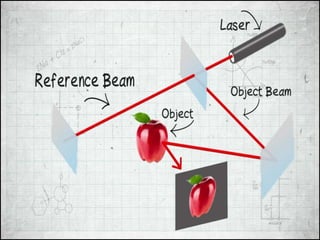
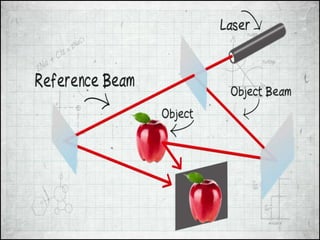
•A light source is projected onto the surface of an object
and scattered.
• A second light illuminates the object to create
interference between both sources.
•Essentially, the two light sources interact with each
other and cause diffraction, which appears as a 3D
image.
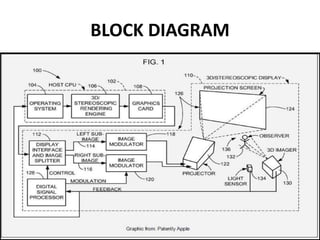
BLOCK DIAGRAM
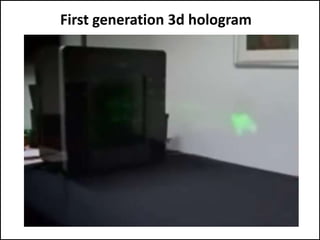
First generation 3d hologram
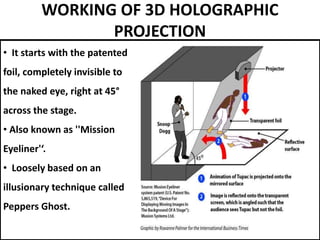
WORKING OF 3D HOLOGRAPHIC
PROJECTION
• It starts with the patented
foil, completely invisible to
the naked eye, right at 45°
across the stage.
• Also known as ''Mission
Eyeliner'‘.
• Loosely based on an
illusionary technique called
Peppers Ghost.
A setup for Mission Eyeliner
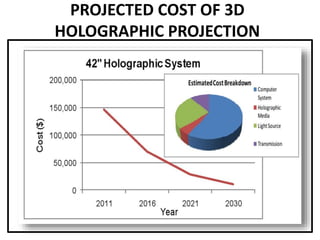
PROJECTED COST OF 3D
HOLOGRAPHIC PROJECTION
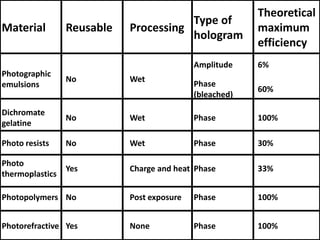
Material Reusable Processing
Type of
hologram
Theoretical
maximum
efficiency
Photographic
emulsions
No Wet
Amplitude 6%
Phase
(bleached)
60%
Dichromate
gelatine
No Wet Phase 100%
Photo resists No Wet Phase 30%
Photo
thermoplastics
Yes Charge and heat Phase 33%
Photopolymers No Post exposure Phase 100%
Photorefractive Yes None Phase 100%
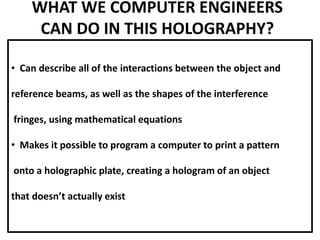
WHAT WE COMPUTER ENGINEERS
CAN DO IN THIS HOLOGRAPHY?
• Can describe all of the interactions between the object and
reference beams, as well as the shapes of the interference
fringes, using mathematical equations
• Makes it possible to program a computer to print a pattern
onto a holographic plate, creating a hologram of an object
that doesn’t actually exist
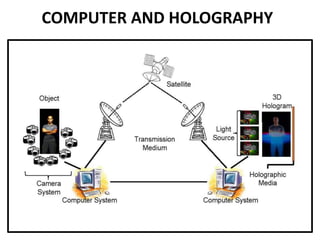
COMPUTER AND HOLOGRAPHY
ADVANTAGES OF 3D HOLOGRAPHIC
PROJECTION
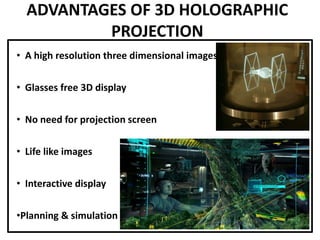
• A high resolution three dimensional images
• Glasses free 3D display
• No need for projection screen
• Life like images
• Interactive display
•Planning & simulation
DISADVANTAGES OF 3D
HOLOGRAPHIC PROJECTION
•Production cost is much higher that 2D
•Not easily see under Florescent Lighting
•Application to products is costly
•Time consuming when it comes to constructing images
APPLICATIONS OF 3D HOLOGRAPHIC
PROJECTION
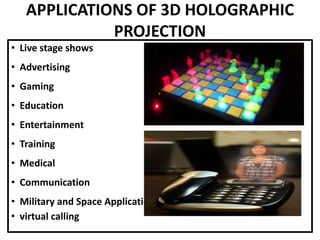
• Live stage shows
• Advertising
• Gaming
• Education
• Entertainment
• Training
• Medical
• Communication
• Military and Space Applications
• virtual calling
FUTURE SCOPE
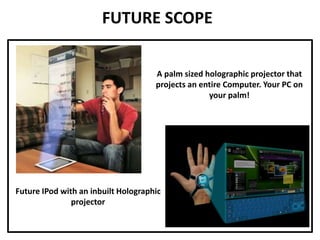
Future IPod with an inbuilt Holographic
projector
A palm sized holographic projector that
projects an entire Computer. Your PC on
your palm!
FUTURE SCOPE(cont)
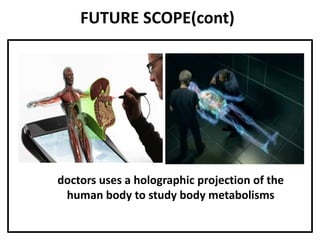
doctors uses a holographic projection of the
human body to study body metabolisms
CONCLUSION
• Holographic Technology has endless applications as far as the
human mind can imagine , Will become a very integral part of
human societies and civilizations in the future.
• In future, holographic displays will be replacing all
present displays in all sizes, from small phone screen to
large projectors.
REFERENCES
•Ahmed Elmorshidy, “Holographic Projection Technology: The
World is Changing” IEEE paper published on May 2013
•Schnars, U. & Jueptner, W. 2003, Digital Holography, First
Edition, Springer-Verlag, Berlin
•Li Weiying , JianQiao Coll. “The 3D holographic projection
technology based on three-dimensional computer graphics”
Audio, Language and Image Processing (ICALIP), 2012
•Samsung 3D holographic cell phone rear-projection screen
patent Posted on 22 February 2008 by Chris Davies
THANK YOU

3 dimentional holographic technique

  • 1.
    3D HOLOGRAPHIC PROJECTION Under the GuidanceOf: Presented By: Mrs. DAKODE SIR SHUBHAM MORGAONKAR Assistant Professor Roll No : 13U441 computer Department SKNCOE Class : TE COMP
  • 2.
    CONTENTS • INTRODUCTION TO3D HOLOGRAPHY • HISTORY OF 3D HOLOGRAPHY • IMPORTANCE AND NEED OF 3D HOLOGRAPHIC PROJECTION • WORKING OF 3D HOLOGRAPHIC PROJECTION • ADVANTAGES OF 3D HOLOGRAPHIC PROJECTION • DISADVANTAGES OF 3D HOLOGRAPH • APPLICATIONS OF 3D HOLOGRAPHIC PROJECTION • CONCLUSION • REFERENCES
  • 3.
    INTRODUCTION TO 3DHOLOGRAPHY • Holography is composed of the Greek terms, "holos" for "whole view" and “gram” for "writing or drawing“ • Technical term for holography is wave front reconstruction • Image changes as the position and orientation of the viewing system changes • Records phase of the object • Record our three dimensional world on a two dimensional recording medium
  • 4.
    HISTORY OF 3DHOLOGRAPHY • Dennis Gabor - discovered the basic technology of holography in 1947 • Optical holography did not really advance until the development of the laser in 1960 • First practical optical holograms that recorded 3D objects to be made in 1962 • Yuri Denisyuk from Soviet Union • Emmett Leith and Juris Upatnicks from USA • Advanced notably since the 1980s owing to low-cost solid-state lasers Dennis Gabor (1900-1979)
  • 5.
    TIMELINE OF 3DHOLOGRAPHY
  • 6.
    IMPORTANCE AND NEEDOF 3D HOLOGRAPHIC PROJECTION • Project large-scale, high-resolution images onto free space • Accommodate multiple viewers independently and simultaneously • Create tremendous effects on all fields of life including business, education, science, art and healthcare • Enabling viewing and manipulation of virtual 3D objects in 3D space without the need for special viewing goggles or headgear
  • 7.
  • 8.
    Holography is a two-step process. Firststep is the recording of hologram where the object is transformed into a photographic record. The second step is the reconstruction in which the hologram is transformed into the image. PRINCIPLE
  • 9.
    WORKING OF 3DHOLOGRAPHIC PROJECTION • The way 3DHT operates is by creating the illusion of three-dimensional imagery. •A light source is projected onto the surface of an object and scattered. • A second light illuminates the object to create interference between both sources. •Essentially, the two light sources interact with each other and cause diffraction, which appears as a 3D image.
  • 12.
  • 13.
  • 15.
    WORKING OF 3DHOLOGRAPHIC PROJECTION • It starts with the patented foil, completely invisible to the naked eye, right at 45° across the stage. • Also known as ''Mission Eyeliner'‘. • Loosely based on an illusionary technique called Peppers Ghost. A setup for Mission Eyeliner
  • 16.
    PROJECTED COST OF3D HOLOGRAPHIC PROJECTION
  • 17.
    Material Reusable Processing Typeof hologram Theoretical maximum efficiency Photographic emulsions No Wet Amplitude 6% Phase (bleached) 60% Dichromate gelatine No Wet Phase 100% Photo resists No Wet Phase 30% Photo thermoplastics Yes Charge and heat Phase 33% Photopolymers No Post exposure Phase 100% Photorefractive Yes None Phase 100%
  • 18.
    WHAT WE COMPUTERENGINEERS CAN DO IN THIS HOLOGRAPHY? • Can describe all of the interactions between the object and reference beams, as well as the shapes of the interference fringes, using mathematical equations • Makes it possible to program a computer to print a pattern onto a holographic plate, creating a hologram of an object that doesn’t actually exist
  • 19.
  • 20.
    ADVANTAGES OF 3DHOLOGRAPHIC PROJECTION • A high resolution three dimensional images • Glasses free 3D display • No need for projection screen • Life like images • Interactive display •Planning & simulation
  • 21.
    DISADVANTAGES OF 3D HOLOGRAPHICPROJECTION •Production cost is much higher that 2D •Not easily see under Florescent Lighting •Application to products is costly •Time consuming when it comes to constructing images
  • 22.
    APPLICATIONS OF 3DHOLOGRAPHIC PROJECTION • Live stage shows • Advertising • Gaming • Education • Entertainment • Training • Medical • Communication • Military and Space Applications • virtual calling
  • 23.
    FUTURE SCOPE Future IPodwith an inbuilt Holographic projector A palm sized holographic projector that projects an entire Computer. Your PC on your palm!
  • 24.
    FUTURE SCOPE(cont) doctors usesa holographic projection of the human body to study body metabolisms
  • 25.
    CONCLUSION • Holographic Technologyhas endless applications as far as the human mind can imagine , Will become a very integral part of human societies and civilizations in the future. • In future, holographic displays will be replacing all present displays in all sizes, from small phone screen to large projectors.
  • 26.
    REFERENCES •Ahmed Elmorshidy, “HolographicProjection Technology: The World is Changing” IEEE paper published on May 2013 •Schnars, U. & Jueptner, W. 2003, Digital Holography, First Edition, Springer-Verlag, Berlin •Li Weiying , JianQiao Coll. “The 3D holographic projection technology based on three-dimensional computer graphics” Audio, Language and Image Processing (ICALIP), 2012 •Samsung 3D holographic cell phone rear-projection screen patent Posted on 22 February 2008 by Chris Davies
  • 27.