Holography (from the Greek, whole + write) is the 
science of producing holograms 
It is an advanced form of photography that allows an 
image to be recorded in three dimensions. 
The technique of holography can also be used to 
optically store, retrieve, and process information.
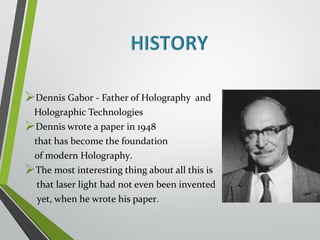
Dennis Gabor - Father of Holography and 
Holographic Technologies 
Dennis wrote a paper in 1948 
that has become the foundation 
of modern Holography. 
The most interesting thing about all this is 
that laser light had not even been invented 
yet, when he wrote his paper.
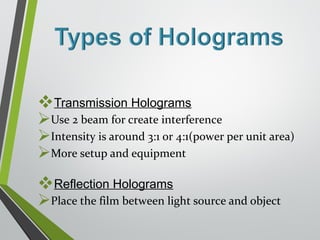
Transmission Holograms 
Use 2 beam for create interference 
Intensity is around 3:1 or 4:1(power per unit area) 
More setup and equipment 
Reflection Holograms 
Place the film between light source and object
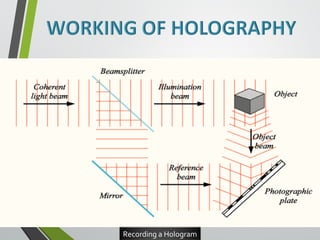
Recording a Hologram
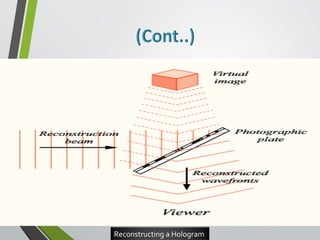
Reconstructing a Hologram
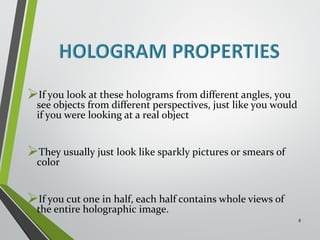
If you look at these holograms from different angles, you 
see objects from different perspectives, just like you would 
if you were looking at a real object 
They usually just look like sparkly pictures or smears of 
color 
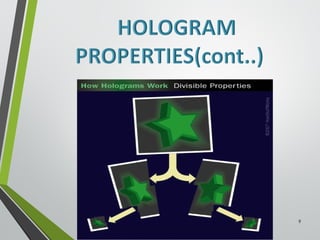
If you cut one in half, each half contains whole views of 
the entire holographic image. 
8
9
10
Entertainment 
Teaching and Training 
Virtual Communication 
Simulation and Planning 
Military and Space Application
Video Gaming Living Room 
Virtual AI Holographic Assistants 
Tv Channel Goes All High 
Extreme Sports
One on One with VR Holographic Images 
Guest Speaker Bureau 
Is Your Professor Real? 
Sport Technique Coaching and Training
Record Yourself for Future Great 
Grandchildren 
Virtual Sales Presentation 
Corporate Meetings Without Travel 
State Department VR 
The Presidential Visit
Disaster Planning 
Traffic,Transportation and Distribution Flows
Holographic Decoys and Deception 
Applications 
VR Training and Mind Conditioning 
Holographic Check Points 
Holographic Tech in Space
• Cost effective 
• Higher storage capacity 
• Increased feasibility of objects (depth) 
• Enables the achievement of multiple images on a single 
plate and 3D images 
• Ability to combine with other technologies
• Provide static images 
• Do not produce images of complex movement 
• Require complicated precise machinery to produce and 
view an image 
• Low axial resolution of inline holography 
• Reference illumination beams are collinear
Holographic Technology has endless applications as far 
as the human mind can imagine 
Holographic Technologies are not just about art or 
business communication, they are about safety , 
security , education , planning and the strength of our 
civilization here and beyond 
 Holographic Technology will became a very integral 
part of human societies and civilizations in the future
• Ahmed Elmorshidy, Ph.D. Holographic Projection 
Technology: The World is Changing . Journal Of 
Telecommunications, Volume 2, Issue 2, May 2010. 
• http://holonet.khm.de/visual_alchemy/holo_hist.html 
• http://www.holophile.com/history.htm 
• http://www.jfairstein.com/hololinks.html 
• Websites: http://www.holonet.khm
Introduction to holography

Introduction to holography

  • 3.
    Holography (from theGreek, whole + write) is the science of producing holograms It is an advanced form of photography that allows an image to be recorded in three dimensions. The technique of holography can also be used to optically store, retrieve, and process information.
  • 4.
    Dennis Gabor -Father of Holography and Holographic Technologies Dennis wrote a paper in 1948 that has become the foundation of modern Holography. The most interesting thing about all this is that laser light had not even been invented yet, when he wrote his paper.
  • 5.
    Transmission Holograms Use2 beam for create interference Intensity is around 3:1 or 4:1(power per unit area) More setup and equipment Reflection Holograms Place the film between light source and object
  • 6.
  • 7.
  • 8.
    If you lookat these holograms from different angles, you see objects from different perspectives, just like you would if you were looking at a real object They usually just look like sparkly pictures or smears of color If you cut one in half, each half contains whole views of the entire holographic image. 8
  • 9.
  • 10.
  • 11.
    Entertainment Teaching andTraining Virtual Communication Simulation and Planning Military and Space Application
  • 12.
    Video Gaming LivingRoom Virtual AI Holographic Assistants Tv Channel Goes All High Extreme Sports
  • 13.
    One on Onewith VR Holographic Images Guest Speaker Bureau Is Your Professor Real? Sport Technique Coaching and Training
  • 14.
    Record Yourself forFuture Great Grandchildren Virtual Sales Presentation Corporate Meetings Without Travel State Department VR The Presidential Visit
  • 15.
  • 16.
    Holographic Decoys andDeception Applications VR Training and Mind Conditioning Holographic Check Points Holographic Tech in Space
  • 17.
    • Cost effective • Higher storage capacity • Increased feasibility of objects (depth) • Enables the achievement of multiple images on a single plate and 3D images • Ability to combine with other technologies
  • 18.
    • Provide staticimages • Do not produce images of complex movement • Require complicated precise machinery to produce and view an image • Low axial resolution of inline holography • Reference illumination beams are collinear
  • 19.
    Holographic Technology hasendless applications as far as the human mind can imagine Holographic Technologies are not just about art or business communication, they are about safety , security , education , planning and the strength of our civilization here and beyond  Holographic Technology will became a very integral part of human societies and civilizations in the future
  • 20.
    • Ahmed Elmorshidy,Ph.D. Holographic Projection Technology: The World is Changing . Journal Of Telecommunications, Volume 2, Issue 2, May 2010. • http://holonet.khm.de/visual_alchemy/holo_hist.html • http://www.holophile.com/history.htm • http://www.jfairstein.com/hololinks.html • Websites: http://www.holonet.khm