Institute of Information
Technology
“Bluetooth Technology”
by:
“Anuj Kumar”
“Sujeet Kumar”













What is Bluetooth?
History of Bluetooth
Versions
Network Architecture
How it works?
Advantages
Disadvantages
Application Areas
Future Scope
Conclusion
References
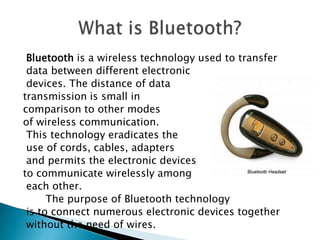
Bluetooth is a wireless technology used to transfer
data between different electronic
devices. The distance of data
transmission is small in
comparison to other modes
of wireless communication.
This technology eradicates the
use of cords, cables, adapters
and permits the electronic devices
to communicate wirelessly among
each other.
The purpose of Bluetooth technology
is to connect numerous electronic devices together
without the need of wires.
-> The name Bluetooth was inspired by “Herald Bluetooth” was
king of Denmark who ruled in 10th century.
->Bluetooth was invented in 1994 by Jaap Haartsen and Sven
Mattisson, who were working for Ericsson Mobile Platforms in
Sweden.
->Bluetooth is not owned by any company and is developed
and maintained by SIG(Special Interest Group). The SIG was
formally announced on May 20, 1998.
->The SIG comprises more than 1000 companies. The major
companies who created the technology include
Intel, Samsung, Ericsson, IBM, Motorola, Nokia, Toshiba


1998 - Bluetooth technology is officially introduced



1999 - Bluetooth 1.0 Specification is introduced.



2003 - Bluetooth Core Specification with the
announcement of Version 2.1.



2004 - Bluetooth Version 2.0 + EDR (Enhanced Data
Rate) is introduced.



2005 - Version 2.0 + EDR in late 2005.



2007 - Bluetooth Core Specification Version 2.1 + EDR



2009 - Bluetooth Core Specification Version 3.0 + HS
(High Speed) is adopted.
.

Piconet 1

Piconet 2

Slave Master

Master
Scatternet







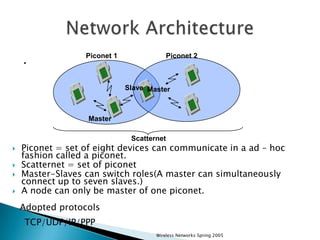
Piconet = set of eight devices can communicate in a ad – hoc
fashion called a piconet.
Scatternet = set of piconet
Master-Slaves can switch roles(A master can simultaneously
connect up to seven slaves.)
A node can only be master of one piconet.
Adopted protocols
TCP/UDP/IP/PPP
Wireless Networks Spring 2005
It comprises of a base band processor, a radio and an antenna . The
base-band processor converts the data into signals, the antenna of
another blue tooth device, within at least 30 feet distance, receives a
transmitted signal in the air.












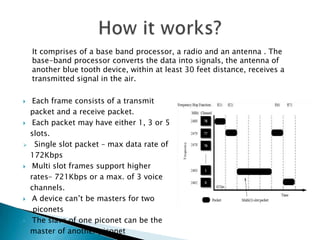
Each frame consists of a transmit
packet and a receive packet.
Each packet may have either 1, 3 or 5
slots.
Single slot packet – max data rate of
172Kbps
Multi slot frames support higher
rates– 721Kbps or a max. of 3 voice
channels.
A device can’t be masters for two
piconets
The slave of one piconet can be the
master of another piconet
•

Wireless (No Cables)

•

No Setup Needed

•

Energy Efficient

•
•

Cheap and Portable
Industry Wide Support

•

Connection is fast and easy

•

Auto recognition
•

•


•

•
•

•

Short range 10 meters or 15-30 feet depending
upon the device

Small throughput rates
- Data Rate 1.0 Mbps
First time setup can be complicated

Slow data transfer rate as compared to Wi-Fi
Security is Biggest Disadvantage as transfer takes
place through radio waves and a hacker can easily
hack it.
Limited Bandwidth









Laptops
Gaming Consoles
Headsets
Cell Phones
Printers
Cameras
And many more…
•

•
•

Bluetooth, the big improvements added to 3.0 and
4.0 were significant. While the general range of the
wireless protocol remains the same (up to 30 feet),
version 3.0 enabled a much faster theoretical data
throughput of 26Mbps compared with the 2Mbps
of version 2.1.
The real benefit of Bluetooth 4.0 is energy
efficiency.
Often, with new technology, early changes mean
reconstruction. Not With Bluetooth, instead, there
will be an improvement to the existing standard.
Bluetooth wireless technology is
optimized for different purposes in different domains
WLAN & WPAN, respectively. The same design points
that make them well-suited for their primary intended
purposes make them less well-suited for other
applications.
Bluetooth wireless technology is not a
robust networking technology; IEEE 802.11 is not the
preferred technology for WPAN applications. The IEEE
802 working groups and the Bluetooth SIG have a
cooperative relationship, and are working together on
the issues of coexistence in the spectrum that they
share.





http://en.wikipedia.org/wiki/Bluetooth
http://www.bluetomorrow.com/aboutbluetooth-technology/history-ofbluetooth/bluetooth-history.html
http://www.bluetooth.com
Bluetooth

Bluetooth

  • 1.
  • 2.
  • 3.
               What is Bluetooth? Historyof Bluetooth Versions Network Architecture How it works? Advantages Disadvantages Application Areas Future Scope Conclusion References
  • 4.
    Bluetooth is awireless technology used to transfer data between different electronic devices. The distance of data transmission is small in comparison to other modes of wireless communication. This technology eradicates the use of cords, cables, adapters and permits the electronic devices to communicate wirelessly among each other. The purpose of Bluetooth technology is to connect numerous electronic devices together without the need of wires.
  • 5.
    -> The nameBluetooth was inspired by “Herald Bluetooth” was king of Denmark who ruled in 10th century. ->Bluetooth was invented in 1994 by Jaap Haartsen and Sven Mattisson, who were working for Ericsson Mobile Platforms in Sweden. ->Bluetooth is not owned by any company and is developed and maintained by SIG(Special Interest Group). The SIG was formally announced on May 20, 1998. ->The SIG comprises more than 1000 companies. The major companies who created the technology include Intel, Samsung, Ericsson, IBM, Motorola, Nokia, Toshiba
  • 6.
     1998 - Bluetoothtechnology is officially introduced  1999 - Bluetooth 1.0 Specification is introduced.  2003 - Bluetooth Core Specification with the announcement of Version 2.1.  2004 - Bluetooth Version 2.0 + EDR (Enhanced Data Rate) is introduced.  2005 - Version 2.0 + EDR in late 2005.  2007 - Bluetooth Core Specification Version 2.1 + EDR  2009 - Bluetooth Core Specification Version 3.0 + HS (High Speed) is adopted.
  • 7.
    . Piconet 1 Piconet 2 SlaveMaster Master Scatternet     Piconet = set of eight devices can communicate in a ad – hoc fashion called a piconet. Scatternet = set of piconet Master-Slaves can switch roles(A master can simultaneously connect up to seven slaves.) A node can only be master of one piconet. Adopted protocols TCP/UDP/IP/PPP Wireless Networks Spring 2005
  • 8.
    It comprises ofa base band processor, a radio and an antenna . The base-band processor converts the data into signals, the antenna of another blue tooth device, within at least 30 feet distance, receives a transmitted signal in the air.       Each frame consists of a transmit packet and a receive packet. Each packet may have either 1, 3 or 5 slots. Single slot packet – max data rate of 172Kbps Multi slot frames support higher rates– 721Kbps or a max. of 3 voice channels. A device can’t be masters for two piconets The slave of one piconet can be the master of another piconet
  • 9.
    • Wireless (No Cables) • NoSetup Needed • Energy Efficient • • Cheap and Portable Industry Wide Support • Connection is fast and easy • Auto recognition
  • 10.
    • •  • • • • Short range 10meters or 15-30 feet depending upon the device Small throughput rates - Data Rate 1.0 Mbps First time setup can be complicated Slow data transfer rate as compared to Wi-Fi Security is Biggest Disadvantage as transfer takes place through radio waves and a hacker can easily hack it. Limited Bandwidth
  • 11.
  • 12.
    • • • Bluetooth, the bigimprovements added to 3.0 and 4.0 were significant. While the general range of the wireless protocol remains the same (up to 30 feet), version 3.0 enabled a much faster theoretical data throughput of 26Mbps compared with the 2Mbps of version 2.1. The real benefit of Bluetooth 4.0 is energy efficiency. Often, with new technology, early changes mean reconstruction. Not With Bluetooth, instead, there will be an improvement to the existing standard.
  • 13.
    Bluetooth wireless technologyis optimized for different purposes in different domains WLAN & WPAN, respectively. The same design points that make them well-suited for their primary intended purposes make them less well-suited for other applications. Bluetooth wireless technology is not a robust networking technology; IEEE 802.11 is not the preferred technology for WPAN applications. The IEEE 802 working groups and the Bluetooth SIG have a cooperative relationship, and are working together on the issues of coexistence in the spectrum that they share.
  • 14.