Applications of Lasers II
HOLOGRAPHY
Holography:
• Theory Developed in 1947 by scientist Dennis
Gabor winning the Nobel Prize in 1971
Word Origin : Holography is derived from from
the Greek word hólos, "whole" + grafē, "writing,
drawing”
What’s holography?
Holography is the process or technique of making
three-dimensional image of the object.
A hologram is produced by the interaction of two
beams of laser light :-
››one is the object beam coming through the object
›› another is the reference beam coming directly from
the source.
For a better understanding of the process, it is
necessary to understand interference and
diffraction
Interference occurs when one or more
wavefronts are superimposed.
Diffraction occurs whenever a wavefront
encounters an object.
Physics of Holography
Conventional vs. Holographic
photography
5
 Conventional:
2-d version of a 3-d scene
Photograph lacks depth perception
Film sensitive only to radiant
energy
Conventional vs. Holographic
photography
6
 Hologram:
 Freezes the intricate wavefront of light
that carries all the visual information of
the scene
 To view a hologram, the wavefront is
reconstructed
 View what we would have seen if
present at the original scene through
the window defined by the hologram
Hologram properties
7
 If you look at these holograms from
different angles, you see objects from
different perspectives, just like you
would if you were looking at a real
object
 They usually just look like sparkly
pictures or smears of color
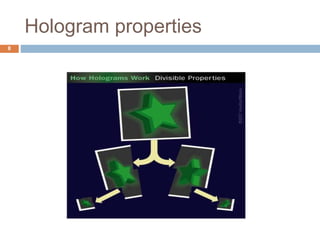
 If you cut one in half, each half contains
whole views of the entire holographic
Hologram properties
8
Principle of Holography
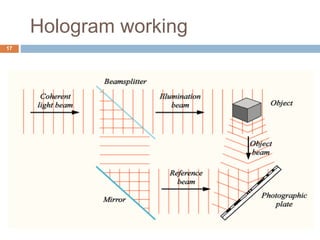
• During the recording process, object wave (wave
illuminating the object) and the reference wave (coming
directly from source) interfere in the plane of the recording
medium & produce interference fringes. This photographic
plate carrying the interference pattern is called Hologram.
• The interference fringes contain all the information about
the intensity and the phase of the scattered beam from
object.
• In the reconstruction process, the hologram acts as
diffraction grating. This is illuminated by a wave called the
reconstruction wave (in most cases this is similar to the
reference wave used for recording the hologram) and the
image of the object is reconstructed from the hologram.
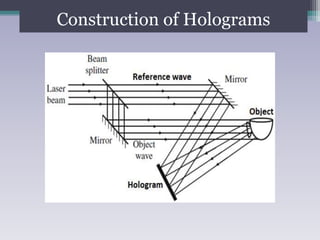
Construction of Holograms
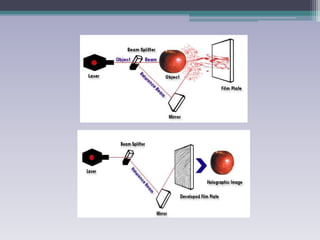
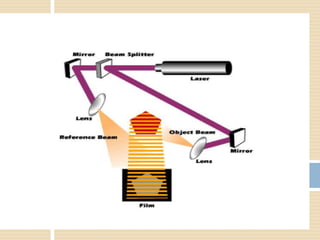
• Need a laser (highly coherent and monochromatic light), lenses, mirror,
photographic film, and an object.
• Beam splitter separates the laser light into two beams, reference beam and
object beam
• Reference beam aimed at a piece of holographic film by mirrors.
• Object beam directed at object to be recorded to illuminate object and then
meets reference beam at film.
• Produces interference pattern of object beam and reference beam which is
recorded.
• Film is developed. This is called as hologram.
• This hologram contains all the informations about the intensity and phases of
the scattered waves from the object.
Construction of Hologram
Construction of Holograms
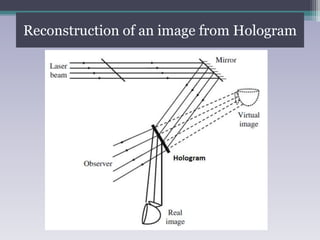
Reconstruction of an image from Hologram
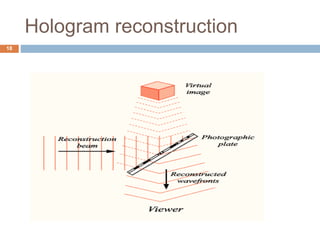
• To view the image, the hologram is again illuminated with another
laser beam called the reconstruction beam which is at same angle as
reference beam.
• Hologram acts as a diffraction grating.
• This form a real image in front of the hologram and a virtual image
behind the hologram.
• The virtual image has all the characteristic of the object. The real
image can be photographed directly without using a lens.
Reconstruction of an image from Hologram
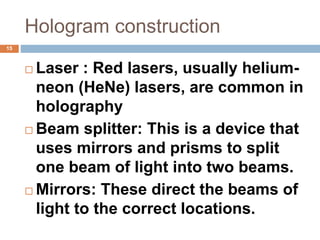
Hologram construction
15
 Laser : Red lasers, usually helium-
neon (HeNe) lasers, are common in
holography
 Beam splitter: This is a device that
uses mirrors and prisms to split
one beam of light into two beams.
 Mirrors: These direct the beams of
light to the correct locations.
Hologram construction
 Holographic film: Holographic
film can record light at a very
high resolution, which is
necessary for creating a
hologram. It's a layer of light-
sensitive compounds on a
transparent surface, like
photographic film.
16
Hologram working
17
Hologram reconstruction
18
Why Laser ?
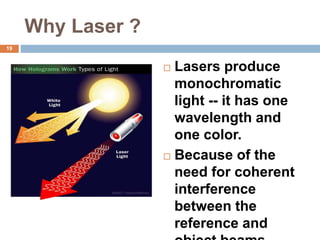
 Lasers produce
monochromatic
light -- it has one
wavelength and
one color.
 Because of the
need for coherent
interference
between the
reference and
19
20
Hologram: Some Applications
21
 Authentication.
 Virtual Display.
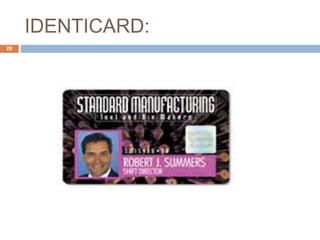
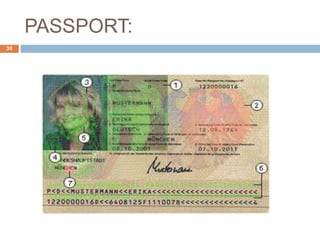
HOLOGRAM: AUTHENTICATION
22
Identitycard.
Passport.
Sticker or Tag.
Holography vs. Photography
• Photography is 2D record of a 3D object whereas holography gives a
three dimensional form of original object. If any object is hidden just
behind another object then the observer can see the hidden object in
viewing the hologram.
• Hologram is the positive pattern whereas in conventional photography
negative pattern is produced.
• In ordinary photography each region contains separate and individual
part of the original object. Destruction of a portion of a negative leads to
an irrepairable loss of information corresponding to the destroyed part.
On the other hand, each part of a hologram contains information about
the entire object. Destruction of a part of hologram does not cause a loss
of information about the object, each seaparate fragment is capable of
producing image with a reduced clarity.
Holography vs. Photography (contd)
• The information holding capacity of a hologram is
extremely high by recording several images of the
object whereas in ordinary photography a photofilm
cannot be used to record several images.
• Without the knowledge of the reference wavefront
the hologram cannot be deciphered.
Holography vs. Photography
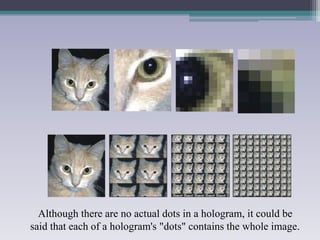
Although there are no actual dots in a hologram, it could be
said that each of a hologram's "dots" contains the whole image.
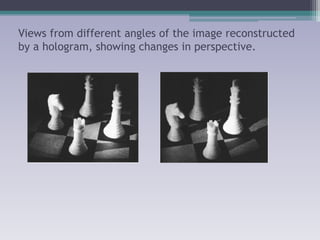
Views from different angles of the image reconstructed
by a hologram, showing changes in perspective.
Applications of Holography
• Design of containers to hold
nuclear materials
• Credit cards carry monetary
value
• Supermarket scanners
• Optical Computers
• Improve design of aircraft
wings and turbine blades
• Used in aircraft “heads-up
display”
• Art
• Archival Recording of fragile
museum artifacts
IDENTICARD:
29
PASSPORT:
30
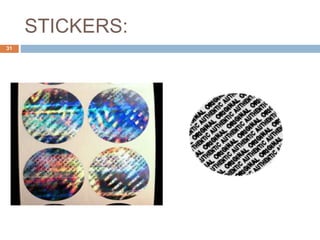
STICKERS:
31
WHY HOLOGRAM FOR
AUTHENTICATION:
32
 Hologram stickers cannot be
scanned or photocopied .
 Hologram stickers can also
create a unique and attractive
complement to your existing
packaging and product.
Virtual Display:
33
Sci-fic movies.
For trade-show booths.
Museums display .
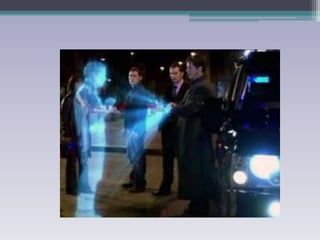
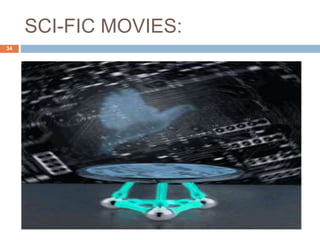
SCI-FIC MOVIES:
34
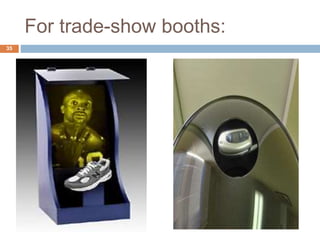
For trade-show booths:
35
36
APPLICATIONS OF HOLOGRAPHY
Optical Computers
Bio-medical Applications
Compact disk
Grocery store
Holographic Interferometery
Holographic Scanners
Holostores
Cont…
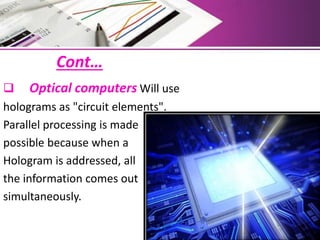
 Optical computers Will use
holograms as "circuit elements".
Parallel processing is made
possible because when a
Hologram is addressed, all
the information comes out
simultaneously.
Cont…
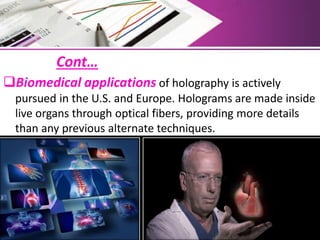
Biomedical applications of holography is actively
pursued in the U.S. and Europe. Holograms are made inside
live organs through optical fibers, providing more details
than any previous alternate techniques.
Cont…
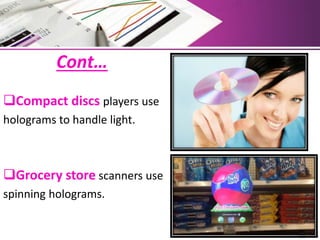
Compact discs players use
holograms to handle light.
Grocery store scanners use
spinning holograms.
Cont…
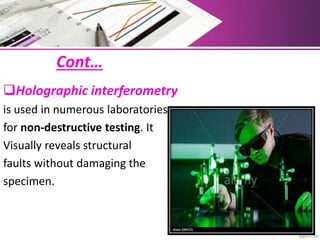
Holographic interferometry
is used in numerous laboratories
for non-destructive testing. It
Visually reveals structural
faults without damaging the
specimen.
Continue…
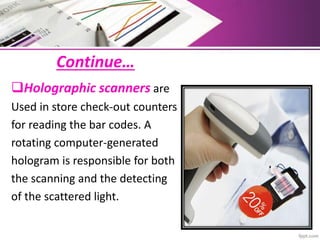
Holographic scanners are
Used in store check-out counters
for reading the bar codes. A
rotating computer-generated
hologram is responsible for both
the scanning and the detecting
of the scattered light.
Cont…
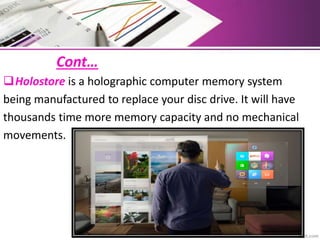
Holostore is a holographic computer memory system
being manufactured to replace your disc drive. It will have
thousands time more memory capacity and no mechanical
movements.
Cont…
Video Gaming Living Room
Cont…
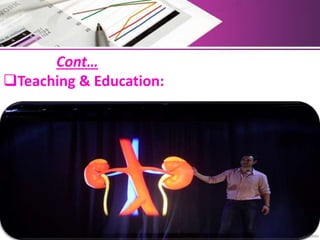
Teaching & Education:
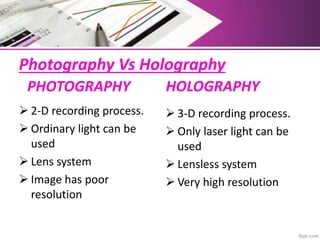
Photography Vs Holography
PHOTOGRAPHY
 2-D recording process.
 Ordinary light can be
used
 Lens system
 Image has poor
resolution
HOLOGRAPHY
 3-D recording process.
 Only laser light can be
used
 Lensless system
 Very high resolution
Advantages:
Cost effective
Higher storage capacity
Increased feasibility of objects(depth)
Enables the achievement of multiple image on a
single plate and give 3-D images
Ability to combine with other technologies
DISADVANTAGES:
Provide static images
Don not produce images of complex movement
Require complicated precise machinery to
produce and view an image
Reference illumination beams are collinear
CONCLUSION
 Holographic technology has endless applications as
far as the human mind can imagine
 Holographic technologies are not just about art or
business communication, they are about safety,
security, education ,planning and the strength of
our civilization here and beyond
 Holographic Technology will became a very integral
part of human societies and civilizations in future
BIBLIOGRAPHY
 www.scienceclasified.com/He-In/Hologram-and-
Holography.html
 www.slideshare.net/singhaishali5/introduction-to-
holography-39013364
 http://www.slideshare.net/vigneshwarvs/new-holography-
technology-all-ppt
 http://www.slideshare.net/DheerajYadav28/regeneration-
of-hologram-from-a-slice
 http://www.winnerscience.com/science/physics/laser-
physics/difference-beween-holography-and-photography/

Lecture Holography basics and applications

  • 1.
  • 2.
    Holography: • Theory Developedin 1947 by scientist Dennis Gabor winning the Nobel Prize in 1971 Word Origin : Holography is derived from from the Greek word hólos, "whole" + grafē, "writing, drawing”
  • 3.
    What’s holography? Holography isthe process or technique of making three-dimensional image of the object. A hologram is produced by the interaction of two beams of laser light :- ››one is the object beam coming through the object ›› another is the reference beam coming directly from the source.
  • 4.
    For a betterunderstanding of the process, it is necessary to understand interference and diffraction Interference occurs when one or more wavefronts are superimposed. Diffraction occurs whenever a wavefront encounters an object. Physics of Holography
  • 5.
    Conventional vs. Holographic photography 5 Conventional: 2-d version of a 3-d scene Photograph lacks depth perception Film sensitive only to radiant energy
  • 6.
    Conventional vs. Holographic photography 6 Hologram:  Freezes the intricate wavefront of light that carries all the visual information of the scene  To view a hologram, the wavefront is reconstructed  View what we would have seen if present at the original scene through the window defined by the hologram
  • 7.
    Hologram properties 7  Ifyou look at these holograms from different angles, you see objects from different perspectives, just like you would if you were looking at a real object  They usually just look like sparkly pictures or smears of color  If you cut one in half, each half contains whole views of the entire holographic
  • 8.
  • 9.
    Principle of Holography •During the recording process, object wave (wave illuminating the object) and the reference wave (coming directly from source) interfere in the plane of the recording medium & produce interference fringes. This photographic plate carrying the interference pattern is called Hologram. • The interference fringes contain all the information about the intensity and the phase of the scattered beam from object. • In the reconstruction process, the hologram acts as diffraction grating. This is illuminated by a wave called the reconstruction wave (in most cases this is similar to the reference wave used for recording the hologram) and the image of the object is reconstructed from the hologram.
  • 11.
    Construction of Holograms •Need a laser (highly coherent and monochromatic light), lenses, mirror, photographic film, and an object. • Beam splitter separates the laser light into two beams, reference beam and object beam • Reference beam aimed at a piece of holographic film by mirrors. • Object beam directed at object to be recorded to illuminate object and then meets reference beam at film. • Produces interference pattern of object beam and reference beam which is recorded. • Film is developed. This is called as hologram. • This hologram contains all the informations about the intensity and phases of the scattered waves from the object.
  • 12.
  • 13.
    Reconstruction of animage from Hologram • To view the image, the hologram is again illuminated with another laser beam called the reconstruction beam which is at same angle as reference beam. • Hologram acts as a diffraction grating. • This form a real image in front of the hologram and a virtual image behind the hologram. • The virtual image has all the characteristic of the object. The real image can be photographed directly without using a lens.
  • 14.
    Reconstruction of animage from Hologram
  • 15.
    Hologram construction 15  Laser: Red lasers, usually helium- neon (HeNe) lasers, are common in holography  Beam splitter: This is a device that uses mirrors and prisms to split one beam of light into two beams.  Mirrors: These direct the beams of light to the correct locations.
  • 16.
    Hologram construction  Holographicfilm: Holographic film can record light at a very high resolution, which is necessary for creating a hologram. It's a layer of light- sensitive compounds on a transparent surface, like photographic film. 16
  • 17.
  • 18.
  • 19.
    Why Laser ? Lasers produce monochromatic light -- it has one wavelength and one color.  Because of the need for coherent interference between the reference and 19
  • 20.
  • 21.
    Hologram: Some Applications 21 Authentication.  Virtual Display.
  • 22.
  • 23.
    Holography vs. Photography •Photography is 2D record of a 3D object whereas holography gives a three dimensional form of original object. If any object is hidden just behind another object then the observer can see the hidden object in viewing the hologram. • Hologram is the positive pattern whereas in conventional photography negative pattern is produced. • In ordinary photography each region contains separate and individual part of the original object. Destruction of a portion of a negative leads to an irrepairable loss of information corresponding to the destroyed part. On the other hand, each part of a hologram contains information about the entire object. Destruction of a part of hologram does not cause a loss of information about the object, each seaparate fragment is capable of producing image with a reduced clarity.
  • 24.
    Holography vs. Photography(contd) • The information holding capacity of a hologram is extremely high by recording several images of the object whereas in ordinary photography a photofilm cannot be used to record several images. • Without the knowledge of the reference wavefront the hologram cannot be deciphered. Holography vs. Photography
  • 25.
    Although there areno actual dots in a hologram, it could be said that each of a hologram's "dots" contains the whole image.
  • 26.
    Views from differentangles of the image reconstructed by a hologram, showing changes in perspective.
  • 27.
    Applications of Holography •Design of containers to hold nuclear materials • Credit cards carry monetary value • Supermarket scanners • Optical Computers • Improve design of aircraft wings and turbine blades • Used in aircraft “heads-up display” • Art • Archival Recording of fragile museum artifacts
  • 29.
  • 30.
  • 31.
  • 32.
    WHY HOLOGRAM FOR AUTHENTICATION: 32 Hologram stickers cannot be scanned or photocopied .  Hologram stickers can also create a unique and attractive complement to your existing packaging and product.
  • 33.
    Virtual Display: 33 Sci-fic movies. Fortrade-show booths. Museums display .
  • 34.
  • 35.
  • 36.
  • 37.
    APPLICATIONS OF HOLOGRAPHY OpticalComputers Bio-medical Applications Compact disk Grocery store Holographic Interferometery Holographic Scanners Holostores
  • 38.
    Cont…  Optical computersWill use holograms as "circuit elements". Parallel processing is made possible because when a Hologram is addressed, all the information comes out simultaneously.
  • 39.
    Cont… Biomedical applications ofholography is actively pursued in the U.S. and Europe. Holograms are made inside live organs through optical fibers, providing more details than any previous alternate techniques.
  • 40.
    Cont… Compact discs playersuse holograms to handle light. Grocery store scanners use spinning holograms.
  • 41.
    Cont… Holographic interferometry is usedin numerous laboratories for non-destructive testing. It Visually reveals structural faults without damaging the specimen.
  • 42.
    Continue… Holographic scanners are Usedin store check-out counters for reading the bar codes. A rotating computer-generated hologram is responsible for both the scanning and the detecting of the scattered light.
  • 43.
    Cont… Holostore is aholographic computer memory system being manufactured to replace your disc drive. It will have thousands time more memory capacity and no mechanical movements.
  • 44.
  • 45.
  • 46.
    Photography Vs Holography PHOTOGRAPHY 2-D recording process.  Ordinary light can be used  Lens system  Image has poor resolution HOLOGRAPHY  3-D recording process.  Only laser light can be used  Lensless system  Very high resolution
  • 47.
    Advantages: Cost effective Higher storagecapacity Increased feasibility of objects(depth) Enables the achievement of multiple image on a single plate and give 3-D images Ability to combine with other technologies
  • 48.
    DISADVANTAGES: Provide static images Donnot produce images of complex movement Require complicated precise machinery to produce and view an image Reference illumination beams are collinear
  • 49.
    CONCLUSION  Holographic technologyhas endless applications as far as the human mind can imagine  Holographic technologies are not just about art or business communication, they are about safety, security, education ,planning and the strength of our civilization here and beyond  Holographic Technology will became a very integral part of human societies and civilizations in future
  • 50.
    BIBLIOGRAPHY  www.scienceclasified.com/He-In/Hologram-and- Holography.html  www.slideshare.net/singhaishali5/introduction-to- holography-39013364 http://www.slideshare.net/vigneshwarvs/new-holography- technology-all-ppt  http://www.slideshare.net/DheerajYadav28/regeneration- of-hologram-from-a-slice  http://www.winnerscience.com/science/physics/laser- physics/difference-beween-holography-and-photography/