• C-reactive protein (CRP) is a protein made by the liver.
A CRP test measures the amount of CRP in the blood
to detect inflammation due to acute conditions or to
monitor the severity of disease in chronic conditions.
• CRP is a non-specific indicator of inflammation and
one of the most sensitive acute phase reactants. That
means that it is released into the blood within a few
hours after an injury. Markedly increased levels can
occur, for example, after trauma or a heart attack,
autoimmune disorders, and with serious bacterial
infections, such as in sepsis.
• What is the difference between CRP and hs-CRP
tests?
• Both tests are essentially the same, measuring the
same substance in the blood. However, the high
sensitivity CRP (hs-CRP) test measures very small
amounts of CRP in the blood and is ordered most
frequently for seemingly healthy people to assess their
potential risk for heart problems. It typically normal less
than 1.0 mg/L.
• The regular CRP test is ordered for those at risk for
infections or chronic inflammatory diseases. It typically
normal less than 10 mg/L
• procedure of the CRP :
• 1. All solutions and patient serum (Serum) are prepared at
room temperature.
• 2. 50 μl of Positive Control are placed in the first circle on the
latex slide and 50 μl of Negative Control in the second circle,
in order to make a comparison after the results have come
out and to ensure the viability of the solutions.
• 3. 50 μL of patient Serum are placed in the third circle on the
latex slide.
• 4. shake the latex vial gently and add 50 μl of latex solution (1
drop) to Positive Control, Negative Control, and Serum of the
patient.
• 5. Mix in a circular motion using appropriate sticks.
• 6. The latex slide is placed on the Shaker vibrator for 1-3
minutes. Stacking appears under the light.
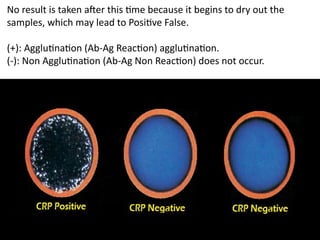
No result is taken after this time because it begins to dry out the
samples, which may lead to Positive False.
(+): Agglutination (Ab-Ag Reaction) agglutination.
(-): Non Agglutination (Ab-Ag Non Reaction) does not occur.
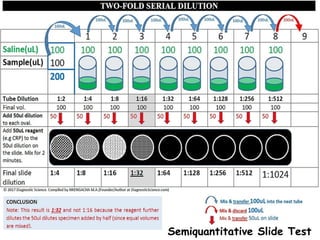
Semiquantitative Slide Test
Topic : Immunological Test [ C-Reactive Protein (CRP) ]

Topic : Immunological Test [ C-Reactive Protein (CRP) ]

  • 1.
    • C-reactive protein(CRP) is a protein made by the liver. A CRP test measures the amount of CRP in the blood to detect inflammation due to acute conditions or to monitor the severity of disease in chronic conditions. • CRP is a non-specific indicator of inflammation and one of the most sensitive acute phase reactants. That means that it is released into the blood within a few hours after an injury. Markedly increased levels can occur, for example, after trauma or a heart attack, autoimmune disorders, and with serious bacterial infections, such as in sepsis.
  • 2.
    • What isthe difference between CRP and hs-CRP tests? • Both tests are essentially the same, measuring the same substance in the blood. However, the high sensitivity CRP (hs-CRP) test measures very small amounts of CRP in the blood and is ordered most frequently for seemingly healthy people to assess their potential risk for heart problems. It typically normal less than 1.0 mg/L. • The regular CRP test is ordered for those at risk for infections or chronic inflammatory diseases. It typically normal less than 10 mg/L
  • 3.
    • procedure ofthe CRP : • 1. All solutions and patient serum (Serum) are prepared at room temperature. • 2. 50 μl of Positive Control are placed in the first circle on the latex slide and 50 μl of Negative Control in the second circle, in order to make a comparison after the results have come out and to ensure the viability of the solutions. • 3. 50 μL of patient Serum are placed in the third circle on the latex slide. • 4. shake the latex vial gently and add 50 μl of latex solution (1 drop) to Positive Control, Negative Control, and Serum of the patient. • 5. Mix in a circular motion using appropriate sticks. • 6. The latex slide is placed on the Shaker vibrator for 1-3 minutes. Stacking appears under the light.
  • 4.
    No result istaken after this time because it begins to dry out the samples, which may lead to Positive False. (+): Agglutination (Ab-Ag Reaction) agglutination. (-): Non Agglutination (Ab-Ag Non Reaction) does not occur.
  • 5.