HISTOLOGICAL TECHNIQUES
DR.RUPALI. S. MUNDE
INTRODUCTION
 Histological techniques deal with the preparation of tissue for microscopic
examination. (This is achieved by passing selected part/section of the total
tissue through series of procedures.)
 The aim of good histological technique to retain microscopic anatomy of
tissue and to obtain good staining on tissue sections.
(After staining, the section should represent the anatomy of the tissue as close
to as possible to their structure in life.)
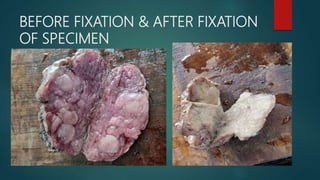
BEFORE FIXATION & AFTER FIXATION
OF SPECIMEN
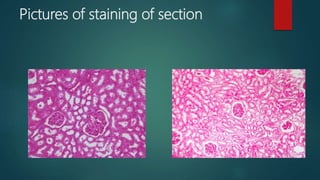
Pictures of staining of section
SPECIMEN IDENTIFICATION
 The human tissue comes from
 Surgery (Surgical pathology specimen) or
 from the Autopsy room ( Anatomical pathology specimen).
 From surgery two types of specimens are obtained:
 Incisional Biopsy: A small piece of lesions (or tumor )which is sent for evaluation
before final removal of the lesion or the tumor .
 Excisional Biopsy: The whole lesion (tumor) is removed for examination and
diagnosis it is called excisional biopsy.
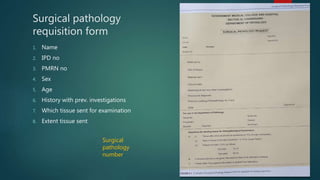
 Proper identification of specimen and properly filled requisition form is
necessary
Surgical pathology
requisition form
1. Name
2. IPD no
3. PMRN no
4. Sex
5. Age
6. History with prev. investigations
7. Which tissue sent for examination
8. Extent tissue sent
Surgical
pathology
number
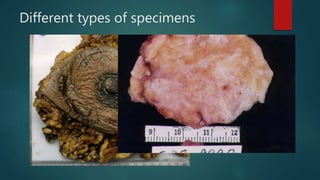
Different types of specimens
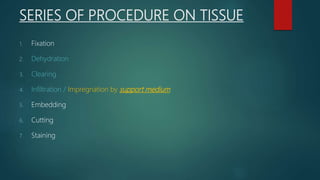
SERIES OF PROCEDURE ON TISSUE
1. Fixation
2. Dehydration
3. Clearing
4. Infiltration / Impregnation by support medium
5. Embedding
6. Cutting
7. Staining
FIXATION
 This is the process by which the constituents of cells and tissue are fixed.
This is achieved by exposing the tissue to chemical compounds, called fixatives.
 Functions: to stop degeneration/autolysis of tissue
Most fixatives act by denaturing or precipitating proteins which then form a sponge or
meshwork, tending to hold the other constituents.
 hardening : tissue will withstand subsequent treatment with various reagents with
minimum loss of architecture .
 Fixative cannot penetrate a piece of tissue thicker than 1 cm.
 For dealing with specimen thicker than this , following methods are
recommended:
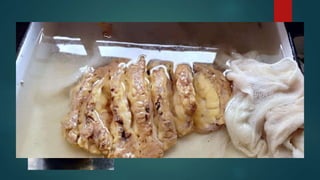
 1.Solid organ:
 Cut slices as necessary as but not thicker than 5 mm.
 2.Hollow organ: Either open or fill with fixative or pack lightly with wool
soaked in fixative.
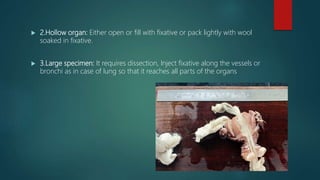
 3.Large specimen: It requires dissection, Inject fixative along the vessels or
bronchi as in case of lung so that it reaches all parts of the organs
PROPERTIES OF IDEAL FIXATIVES
 Prevents autolysis and bacterial decomposition.
 Should be non-toxic and non-allergic for user.
 Should not be very expensive and The fixation can be carried out at room
temperature
 Preserves tissue in their natural state (Preserves tissue volume) and fix all components.
 Make the cellular components insoluble to reagent used in tissue processing.
 Avoid excessive hardness of tissue.
 Allows enhanced staining of tissue.
AMOUNT OF FIXATIVE
FLUIDS  This should be approximately 10-20
times the volume of the specimen.
 Fixative should surround the specimen
on all sides
CLASSIFICATION OF FIXATIVES
Classified into three categories.
1. Tissue fixatives:
1. Simple fixative :consists of one substance (e.g. formalin). „
2. Compound fixative :has two or more substances (e.g. Bouin’s, Zenker’s
2. Cytological fixatives
3. Histochemical fixatives
TISSUE FIXATIVES
 Neutral Buffered formalin (10%):
 Tap water 900ml
 Formaldehyde (37%) 100ml
 Sodium phosphate, monobasic monohydrate 4g
 Sodium phosphate, dibasic, anhydrous 6.5gm
 Merits of formalin
1. Rapidly penetrates the tissues.
2. Normal color of tissue is retained.
3. It is cheap and easily available.
4. Best fixative for neurological tissue
 Demerits of formalin
1. Causes excessive hardening of
tissues.
2. Causes irritation of skin, mucous
membranes and conjunctiva.
3. Leads to formation of formalin
pigment in tissues having excessive
blood (at an acidic pH).
4. which can be removed by treatment
of section with picric alcohol in
solution of NaOH.
 Zenker’s formal saline:
 Distilled water 250ml
 Mercuric chloride 12.5gm
 Potassium dichromate 6.3gm
 Sodium sulfate 2.5gm
Merits
 Recommanded for striated muscle
Demerits
 Mercury component reacts with tissue pigments resulting in
inappropriate staining
 Safety and health hazards associated with mercury
 Bouin’s fluid:
 Saturated aqueous solution of picric acid 1500ml
 Formaldehyde (37%) 500ml
 Glacial acetic acid 1000ml
Merits
 fixative for renal and testicular needle biopsies
 good fixative for demonstration of glycogen
Demerits
 Makes the tissue hard and brittle.
 stains the tissues yellow.
 Causes lysis of RBCs.
CYTOLOGICAL FIXATIVES
They are cytoplasmic or nuclear and preserve respective intracellular
constituents
 Ethanol
 Methanol
 Ether
HISTOCHEMICAL FIXATIVES
Employed for demonstration of histochemical constituents and enzymes.
 Formal saline:
 Tap water 900ml
 Formaldehyde (37%) 100ml
 Sodium chloride 9g
 Cold acetone
 Absolute alcohol
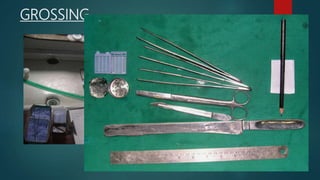
GROSSING
TISSUE PROCESSING
In order to cut thin sections of the tissues, it should have suitable hardness and
consistency when presented to the knife edge.
These properties can be imparted by infiltrating and surrounding the tissue with paraffin
wax, colloidin, low viscosity nitrocellulose, various types of resins or by freezing. This
process is called tissue processing.
TISSUE PROCESSING, contd.
 It requires 24 hours and done in many stages.
It can be subdivided into
 a) dehydration
 b) clearing
 c) impregnating
 d) embedding.
Note:
 It is important that all specimens are properly labeled before processing is
started
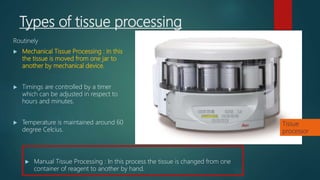
Types of tissue processing
Routinely
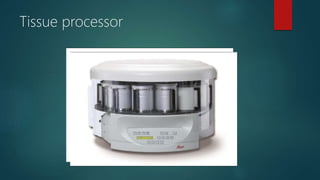
 Mechanical Tissue Processing : In this
the tissue is moved from one jar to
another by mechanical device.
 Timings are controlled by a timer
which can be adjusted in respect to
hours and minutes.
 Temperature is maintained around 60
degree Celcius.
 Manual Tissue Processing : In this process the tissue is changed from one
container of reagent to another by hand.
Tissue
processor
Tissue processor
Dehydration
 Tissues are dehydrated by using increasing strength of alcohol; e.g.50%,
70%, 90% and 100%.
 The duration for which tissues are kept in each strength of alcohol
depends upon the size of tissue, fixative used and type of tissue.
 Delicate tissue will get high degree of shrinkage by two great
concentration of alcohol.
 The volume of alcohol should be 50-100 times that of tissue
Clearing
 During dehydration water in tissue has been replaced by alcohol.
 The next step alcohol should be replaced by paraffin wax.
 As paraffin wax is not alcohol soluble, we replace alcohol with a substance in
which wax is soluble. This step is call clearing.
 Reagents used :
 Xylene
 Chloroform
 Benzene
 Carbon tetrachloride
 Toluene
 Xylene is commonly used.
 Small piece of tissue are cleared in 0.5 – 1 hour; whereas larger (5cm or
more thick) are cleared in 2-4 hours
Impregnation with wax
 This is done at melting point of paraffin wax, which is 54-60 degree
Celcius.
 Volume of wax should be about 25-30 times the volume of tissues.
 The duration of impregnation depends on size and types of tissues and
the clearing agents employed.
 Longer periods are required for larger pieces and also for harder tissue
like bones and skin as compared to liver kidney, spleen, lung etc
Impregnation with wax
 Total duration of 4 hours is sufficient for routine impregnation.
 Types of Wax employed for Impregnation:
1. Paraffin wax
2. colloidin
3. gelatin
4. paraplast
Embedding
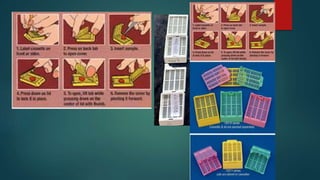
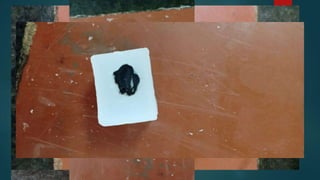
 Impregnated tissues are placed in a mould with their labels and then
fresh melted wax is poured in it and allowed to settle and solidify.
 Once the block has cooled sufficiently to form a surface skin it should be
immersed in cold water to cool it rapidly.
 After the block has completely cooled it is cut into individual blocks and
each is trimmed.
 Labels are made to adhere on the surface of the block by melting the
wax with a metal strips sufficiently wormed
L - mould
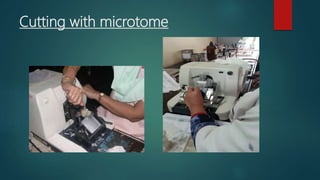
Microtomy/ or section cutting
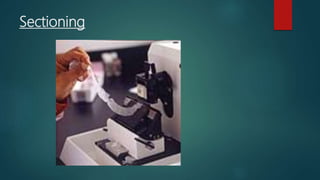
 For light microscopy, a glass knife mounted in a microtome is used to cut 4-6 um-thick
tissue sections which are mounted on a glass microscope slide.(our lab we use
disposable blade)
 For transmission electron microscopy, a diamond knife mounted in an ultramicrotome
is used to cut 50-nmthick tissue sections. Mounted sections are treated with the
appropriate stain.
 Frozen tissue embedded in a freezing medium is cut on a microtome in a cooled
machine called a cryostat
Cutting with microtome
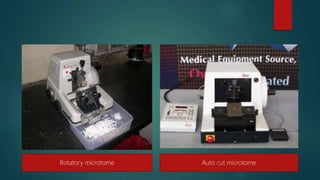
Rotatory microtome Auto cut microtome
Sectioning
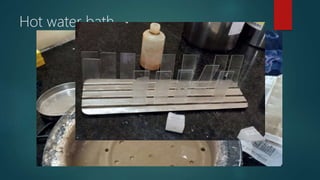
Hot water bath
Staining
 Staining is a process by which we give color to a section.
 There are hundreds of stains available.
 ROUTINELY WE USE HAEMATOXYLIN AND EOSIN (H&E) Stain.
 Classification of Stains:
 Acid stains
 Acid dyes stain basic components e.g. eosin stains cytoplasm- red/pink.
 Basic stains
 Basic dyes stain acidic components e.g. basic fuchsin stains nucleus. - bllue
 Neutral stains
 When an acid dye is combined with a basic dye a neutral dye is formed.
 As it contains both colored radicals, it gives different colors to cytoplasm and nucleus
simultaneously
Acid dye
 In an acid dye the basic component is colored and the acid component is
colorless.
 Acid dyes stain basic components e.g. eosin stains cytoplasm.
 The color imparted is shade of red
Basic dye
 In a basic dye the acid component is colored and the basic component is
colorless.
 Basic dyes stain acidic components e.g. basic fuchsin stains nucleus.
 The color imparted is shade of blue
Neutral dye
 When an acid dye is combined with a basic dye a neutral dye is formed.
 As it contains both colored radicals, it gives different colors to cytoplasm and nucleus
simultaneously.
 This is the basis of Leishman stain.
H and E stain
 Method
 1. Dewax sections, rehydrate through
descending grades of alcohol to water.
 2. Remove fixation pigments if necessary.
 3. Stain in an alum hematoxylin of choice
for a suitable time.
 4. Wash well in running tap water until
sections blue’ for 5 minutes or less.
 5. Differentiate in 1% acid alcohol (1% HCl
in 70% alcohol) for 5–10 seconds.
 6. Wash well in tap water until sections are
again ‘blue’ (10–15 minutes).
 7. Or blue by dipping in an alkaline
solution followed by a 5 minute tap water
wash.
 8. Stain in 1% eosin Y for 10 minutes.
 9. Wash in running tap water for 1–5
minutes.
 10. Dehydrate through alcohols, clear, and
mount
H&E stain
 Haematoxylin :
 This is a natural dye which is obtained from log-wood tree,
Haematoxylon campechianum.
 Dye which gives blue color to the section
 Eosin:
 Dye which gives pink color to the section
 Results
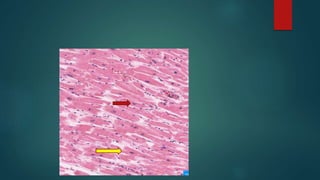
 Nuclei- blue/black
 Cytoplasm - varying shades of pink
 Muscle fibers- deep pink/red
 Red blood cells - orange/red
 Fibrin - deep pink
Thank you

Histological techniques

  • 1.
  • 2.
    INTRODUCTION  Histological techniquesdeal with the preparation of tissue for microscopic examination. (This is achieved by passing selected part/section of the total tissue through series of procedures.)  The aim of good histological technique to retain microscopic anatomy of tissue and to obtain good staining on tissue sections. (After staining, the section should represent the anatomy of the tissue as close to as possible to their structure in life.)
  • 3.
    BEFORE FIXATION &AFTER FIXATION OF SPECIMEN
  • 4.
  • 5.
    SPECIMEN IDENTIFICATION  Thehuman tissue comes from  Surgery (Surgical pathology specimen) or  from the Autopsy room ( Anatomical pathology specimen).  From surgery two types of specimens are obtained:  Incisional Biopsy: A small piece of lesions (or tumor )which is sent for evaluation before final removal of the lesion or the tumor .  Excisional Biopsy: The whole lesion (tumor) is removed for examination and diagnosis it is called excisional biopsy.  Proper identification of specimen and properly filled requisition form is necessary
  • 6.
    Surgical pathology requisition form 1.Name 2. IPD no 3. PMRN no 4. Sex 5. Age 6. History with prev. investigations 7. Which tissue sent for examination 8. Extent tissue sent Surgical pathology number
  • 7.
  • 8.
    SERIES OF PROCEDUREON TISSUE 1. Fixation 2. Dehydration 3. Clearing 4. Infiltration / Impregnation by support medium 5. Embedding 6. Cutting 7. Staining
  • 9.
    FIXATION  This isthe process by which the constituents of cells and tissue are fixed. This is achieved by exposing the tissue to chemical compounds, called fixatives.  Functions: to stop degeneration/autolysis of tissue Most fixatives act by denaturing or precipitating proteins which then form a sponge or meshwork, tending to hold the other constituents.  hardening : tissue will withstand subsequent treatment with various reagents with minimum loss of architecture .
  • 10.
     Fixative cannotpenetrate a piece of tissue thicker than 1 cm.  For dealing with specimen thicker than this , following methods are recommended:  1.Solid organ:  Cut slices as necessary as but not thicker than 5 mm.
  • 11.
     2.Hollow organ:Either open or fill with fixative or pack lightly with wool soaked in fixative.  3.Large specimen: It requires dissection, Inject fixative along the vessels or bronchi as in case of lung so that it reaches all parts of the organs
  • 12.
    PROPERTIES OF IDEALFIXATIVES  Prevents autolysis and bacterial decomposition.  Should be non-toxic and non-allergic for user.  Should not be very expensive and The fixation can be carried out at room temperature  Preserves tissue in their natural state (Preserves tissue volume) and fix all components.  Make the cellular components insoluble to reagent used in tissue processing.  Avoid excessive hardness of tissue.  Allows enhanced staining of tissue.
  • 13.
    AMOUNT OF FIXATIVE FLUIDS This should be approximately 10-20 times the volume of the specimen.  Fixative should surround the specimen on all sides
  • 14.
    CLASSIFICATION OF FIXATIVES Classifiedinto three categories. 1. Tissue fixatives: 1. Simple fixative :consists of one substance (e.g. formalin). „ 2. Compound fixative :has two or more substances (e.g. Bouin’s, Zenker’s 2. Cytological fixatives 3. Histochemical fixatives
  • 15.
    TISSUE FIXATIVES  NeutralBuffered formalin (10%):  Tap water 900ml  Formaldehyde (37%) 100ml  Sodium phosphate, monobasic monohydrate 4g  Sodium phosphate, dibasic, anhydrous 6.5gm
  • 16.
     Merits offormalin 1. Rapidly penetrates the tissues. 2. Normal color of tissue is retained. 3. It is cheap and easily available. 4. Best fixative for neurological tissue  Demerits of formalin 1. Causes excessive hardening of tissues. 2. Causes irritation of skin, mucous membranes and conjunctiva. 3. Leads to formation of formalin pigment in tissues having excessive blood (at an acidic pH). 4. which can be removed by treatment of section with picric alcohol in solution of NaOH.
  • 17.
     Zenker’s formalsaline:  Distilled water 250ml  Mercuric chloride 12.5gm  Potassium dichromate 6.3gm  Sodium sulfate 2.5gm Merits  Recommanded for striated muscle Demerits  Mercury component reacts with tissue pigments resulting in inappropriate staining  Safety and health hazards associated with mercury
  • 18.
     Bouin’s fluid: Saturated aqueous solution of picric acid 1500ml  Formaldehyde (37%) 500ml  Glacial acetic acid 1000ml Merits  fixative for renal and testicular needle biopsies  good fixative for demonstration of glycogen Demerits  Makes the tissue hard and brittle.  stains the tissues yellow.  Causes lysis of RBCs.
  • 19.
    CYTOLOGICAL FIXATIVES They arecytoplasmic or nuclear and preserve respective intracellular constituents  Ethanol  Methanol  Ether
  • 20.
    HISTOCHEMICAL FIXATIVES Employed fordemonstration of histochemical constituents and enzymes.  Formal saline:  Tap water 900ml  Formaldehyde (37%) 100ml  Sodium chloride 9g  Cold acetone  Absolute alcohol
  • 21.
  • 23.
    TISSUE PROCESSING In orderto cut thin sections of the tissues, it should have suitable hardness and consistency when presented to the knife edge. These properties can be imparted by infiltrating and surrounding the tissue with paraffin wax, colloidin, low viscosity nitrocellulose, various types of resins or by freezing. This process is called tissue processing.
  • 24.
    TISSUE PROCESSING, contd. It requires 24 hours and done in many stages. It can be subdivided into  a) dehydration  b) clearing  c) impregnating  d) embedding. Note:  It is important that all specimens are properly labeled before processing is started
  • 25.
    Types of tissueprocessing Routinely  Mechanical Tissue Processing : In this the tissue is moved from one jar to another by mechanical device.  Timings are controlled by a timer which can be adjusted in respect to hours and minutes.  Temperature is maintained around 60 degree Celcius.  Manual Tissue Processing : In this process the tissue is changed from one container of reagent to another by hand. Tissue processor
  • 26.
  • 27.
    Dehydration  Tissues aredehydrated by using increasing strength of alcohol; e.g.50%, 70%, 90% and 100%.  The duration for which tissues are kept in each strength of alcohol depends upon the size of tissue, fixative used and type of tissue.  Delicate tissue will get high degree of shrinkage by two great concentration of alcohol.  The volume of alcohol should be 50-100 times that of tissue
  • 28.
    Clearing  During dehydrationwater in tissue has been replaced by alcohol.  The next step alcohol should be replaced by paraffin wax.  As paraffin wax is not alcohol soluble, we replace alcohol with a substance in which wax is soluble. This step is call clearing.  Reagents used :  Xylene  Chloroform  Benzene  Carbon tetrachloride  Toluene
  • 29.
     Xylene iscommonly used.  Small piece of tissue are cleared in 0.5 – 1 hour; whereas larger (5cm or more thick) are cleared in 2-4 hours
  • 30.
    Impregnation with wax This is done at melting point of paraffin wax, which is 54-60 degree Celcius.  Volume of wax should be about 25-30 times the volume of tissues.  The duration of impregnation depends on size and types of tissues and the clearing agents employed.  Longer periods are required for larger pieces and also for harder tissue like bones and skin as compared to liver kidney, spleen, lung etc
  • 31.
    Impregnation with wax Total duration of 4 hours is sufficient for routine impregnation.  Types of Wax employed for Impregnation: 1. Paraffin wax 2. colloidin 3. gelatin 4. paraplast
  • 32.
    Embedding  Impregnated tissuesare placed in a mould with their labels and then fresh melted wax is poured in it and allowed to settle and solidify.  Once the block has cooled sufficiently to form a surface skin it should be immersed in cold water to cool it rapidly.  After the block has completely cooled it is cut into individual blocks and each is trimmed.  Labels are made to adhere on the surface of the block by melting the wax with a metal strips sufficiently wormed
  • 34.
  • 35.
    Microtomy/ or sectioncutting  For light microscopy, a glass knife mounted in a microtome is used to cut 4-6 um-thick tissue sections which are mounted on a glass microscope slide.(our lab we use disposable blade)  For transmission electron microscopy, a diamond knife mounted in an ultramicrotome is used to cut 50-nmthick tissue sections. Mounted sections are treated with the appropriate stain.  Frozen tissue embedded in a freezing medium is cut on a microtome in a cooled machine called a cryostat
  • 36.
  • 37.
  • 38.
  • 39.
  • 40.
    Staining  Staining isa process by which we give color to a section.  There are hundreds of stains available.  ROUTINELY WE USE HAEMATOXYLIN AND EOSIN (H&E) Stain.  Classification of Stains:  Acid stains  Acid dyes stain basic components e.g. eosin stains cytoplasm- red/pink.  Basic stains  Basic dyes stain acidic components e.g. basic fuchsin stains nucleus. - bllue  Neutral stains  When an acid dye is combined with a basic dye a neutral dye is formed.  As it contains both colored radicals, it gives different colors to cytoplasm and nucleus simultaneously
  • 41.
    Acid dye  Inan acid dye the basic component is colored and the acid component is colorless.  Acid dyes stain basic components e.g. eosin stains cytoplasm.  The color imparted is shade of red
  • 42.
    Basic dye  Ina basic dye the acid component is colored and the basic component is colorless.  Basic dyes stain acidic components e.g. basic fuchsin stains nucleus.  The color imparted is shade of blue
  • 43.
    Neutral dye  Whenan acid dye is combined with a basic dye a neutral dye is formed.  As it contains both colored radicals, it gives different colors to cytoplasm and nucleus simultaneously.  This is the basis of Leishman stain.
  • 44.
    H and Estain  Method  1. Dewax sections, rehydrate through descending grades of alcohol to water.  2. Remove fixation pigments if necessary.  3. Stain in an alum hematoxylin of choice for a suitable time.  4. Wash well in running tap water until sections blue’ for 5 minutes or less.  5. Differentiate in 1% acid alcohol (1% HCl in 70% alcohol) for 5–10 seconds.  6. Wash well in tap water until sections are again ‘blue’ (10–15 minutes).  7. Or blue by dipping in an alkaline solution followed by a 5 minute tap water wash.  8. Stain in 1% eosin Y for 10 minutes.  9. Wash in running tap water for 1–5 minutes.  10. Dehydrate through alcohols, clear, and mount
  • 45.
    H&E stain  Haematoxylin:  This is a natural dye which is obtained from log-wood tree, Haematoxylon campechianum.  Dye which gives blue color to the section  Eosin:  Dye which gives pink color to the section  Results  Nuclei- blue/black  Cytoplasm - varying shades of pink  Muscle fibers- deep pink/red  Red blood cells - orange/red  Fibrin - deep pink
  • 47.

Editor's Notes

  • #9 Confirm ascending grades of alcohol we use
  • #13 Keep the 3 basic points and ask questions , in response to which the answers will appear one by one. Notes: The fixation can be carried out at room temperature. Tissue should not be frozen once it has been placed in the fixative solution, for a peculiar ice crystals distortion will result. The speed of fixation of most fixative is almost 1 mm/hour. Therefore, a fixation time of several hours is needed for most specimens.
  • #15 Insert picture Fixation is affected by: Size and thickness of piece of tissue. Tissue covered by large amount of mucous fix slowly. Tissue covered by blood or organ containing very large amount of blood also fix slowly. Fatty and lipomatous tissue fix slowly. Fixation is accelerated by agitation. Fixation is accelerated by maintaining temperature around 60 degree celcius.
  • #18 Advantages and disadvantages, tissues which require special/specific fixatives Examples: zenkers / boiun’s
  • #23 Explain histochemical constituents
  • #26 What is colliding??
  • #39 Rotary microtome , explain and picture
  • #42 Ribbon and serial sections
  • #44 Examples of acid, basic and neutral stains
  • #48 Haematoxylin source
  • #49 H& E stain in short and salient points