History of Health Care &  Nursing Rasheed Ahmed Khan Nursing instructor ION(DUHS)
NURSING: DEFINITIONS   Nursing (as an art)   Is the art of caring sick and well individual. It refers to the dynamic skills and methods in assisting sick and well individual in their recovery and in the promotion and maintenance of health. It involves the creative application of knowledge in the service of people  Nursing (as a science)   It is the “body of abstract knowledge” arrived through scientific research and logical analysis.  Is the scientific knowledge and skills in assisting individual to achieve optimal health. It is the diagnosis and treatment of human responses to actual or potential problem.
Cont ………… Nursing (as a profession ) Profession- a calling in which its members profess to have acquired special knowledge by training or experience, or both so that they may guide, advise or save others in that special field. Florence Nightingale   Nursing is the act of utilizing the environment of the patient to assist him in his recovery.
Cont ………. Virginia Henderson   Nursing is the act of assisting the individual, sick or well, in the performance of those activities contributing to health or its recovery (or to a peaceful death) that he would perform independently if he had the necessary strength, will, or knowledge, and to do this in such a way as to help him gain independence as rapidly as possible.
Cont ……….. Canadian Nurses Association (CNA)   Nursing is a dynamic, caring, helping relationship in which the nurse assist the client to achieve and obtain optimal health. – 1987  Themes that are common to these definition:  •  Nursing is caring  •  Nursing is an art  •  Nursing is a science  •  Nursing is client-centered  •  Nursing is holistic  •  Nursing is concerned with health promotion, health maintenance, and health restoration  •  Nursing is a helping profession
Cont …….. American Nurses Association (ANA) 1973  Nursing is direct, goal oriented, and adaptable to the needs of the individual, the family, and community during health and illness.  1980  Nursing is the diagnosis and treatment of human responses to actual or potential health problems.


Cont …….. 1995   ANA acknowledge four essential features of contemporary nursing practice:  •  Attention to the full range of human experiences and responses to health and illness.  •  Integration of objective data with knowledge gained from  understanding of the client or group’s subjective experience.  •  Application of scientific knowledge to the processes of  diagnosis and treatment.  •  Provision of caring relationship that facilitates health and healing.
Nurse: Definition   Nurse   •  Comes from a Latin word “to nourish” or “to cherish  •  One who cares for the sick, the injured, and the physically, mentally, and emotionally disabled  •  One who advise and instruct individuals, families, groups and communities in the prevention, treatment of illness and diseases and in the promotion of health.  •  An essential member of a health team who cares for individuals, families and communities in disease and illness prevention and   in the promotion of  health.
Patient: Definition   Patient   •  Comes from a Latin word, “to Suffer” or “to Bear”  •  An individual who is in the state of physical, mental, and emotional imbalance •  An individual who seeks for nursing assistance, medical assistance, or for surgery due to illness or a disease.  •  Is an individual who is waiting or undergoing medical or surgical care. One who is physically or mentally disabled.
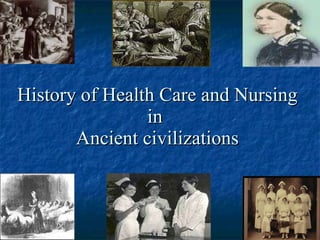
History of Health Care and Nursing in  Ancient civilizations
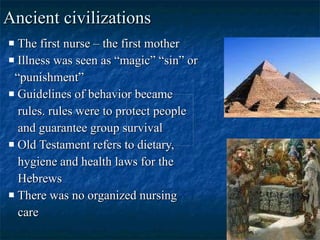
Ancient civilizations The first nurse – the first mother Illness was seen as “magic” “sin” or “ punishment” Guidelines of behavior became rules. rules were to protect people and guarantee group survival Old Testament refers to dietary, hygiene and health laws for the Hebrews There was no organized nursing care
Evolution of Nursing   As an instinctive response to the desire to keep healthy, the sick  Responsibility – nurturing children, care of the elderly and the sick  Education – Through trial & error and information sharing, intuition  Religions – accepting  the illness but Superstition & magic
Ancient Societies   Nomadic  Solidarity for mutual protection  Belief in the power of Gods Black and white magic  Ingenious techniques of  health practices, Med & Surg treatments, Massage, fomentation, trephining, bone setting, amputation, hot and cold baths.
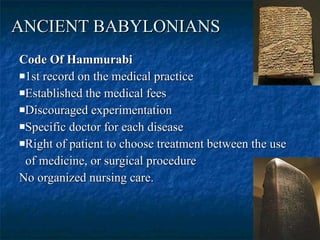
ANCIENT BABYLONIANS   Code Of Hammurabi   1st record on the medical practice Established the medical fees  Discouraged experimentation  Specific doctor for each disease  Right of patient to choose treatment between the use  of medicine, or surgical procedure No organized nursing care.
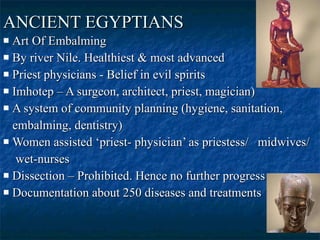
ANCIENT EGYPTIANS   Art Of Embalming  By river Nile. Healthiest & most advanced  Priest physicians - Belief in evil spirits  Imhotep – A surgeon, architect, priest, magician)  A system of community planning (hygiene, sanitation,  embalming, dentistry)  Women assisted ‘priest- physician’ as priestess/  midwives/ wet-nurses  Dissection – Prohibited. Hence no further progress  Documentation about 250 diseases and treatments
HEBREW   Motivated  servant of God  ‘ Mosaic code’- Isolation, hygiene, rest & sleep, hrs of work, disposal of excreta, disinfection, regulations to check animals before slaughtering/ eating  Religion ‘Do not eat meat past the 3 rd day’  King gave health power to ‘priest physician’  Priest physician – took the role of health inspector Basic nursing practices were existed.
Cont ……… Purification of man and his food  The ritual of Circumcision – on the 8th day after birth  Mosaic Law  Meant as a survival for health and hygienic reason only  Use of pharmacologic drugs
ANCIENT CHINA   By the Yellow river  Confucius – Patriarchal role  Importance to rule of etiquette  Value of family as a unit  Women inferior to men  ‘ Yang’ & ‘Yin’ – Active (male) & passive (female) force  2000 BC – Dissection done, circulation, pulse, elaborate materia medica, importance to hygiene
Cont…….. Rule of physical exam – ‘Look, listen, ask and feel’  Baths to reduce fever 1000 BC - Sen Lung (Father of medicine), used veg and animal drugs, vaccination, physiotherapy, treated syphilis and gonorrhea  1200 BC - Liver diet for anemia,  Hence nursing was impossible
ANCIENT INDIAN   First civilizations were highly developed   1500 BC   Ayurveda  Explains hygiene, disease prevention, major/ minor surgery, children’s disease, inoculation, materia medica, disease of CNS & GUS  1400 BC- Sushruta ‘ Father of Surgery’ in India. Charaka wrote ‘Internal  medicine’
ANCIENT INDIAN   King Ashoka (272 – 236 BC)  Public hospitals with male nurses and some older women, hospitals for animals. Universities (monasteries) of Taxila & Nalanda (Bihar)  Nurses should have 3 qualities – high standards, skills and trustworthiness 1 AD  Superstition & magic replaced by more up-to-date practice.  But medicine remained in the hands of priest physician, who refused to touch blood and pathological tissue
ANCIANT INDIAN 1000 AD Brahmin influences gained strength and re-established itself. Buddhism declined. Brahmins were priest physicians  Rigid Hindu caste system. No dissection. Superstition and magic replaced practice of medicine
ANCIENT GREEK   Apollo (son of God) – God of health  Asculapus (son of Apollo) – God of healing  Epigone – (Asculapus’ wife) – The soother  Hygeia – (daughter of Asculapus ) – Goddess of health  Temples – became social, intellectual and medical centers Aristotle – differentiated arteries from vein
Hippocrates in the 5th century •  Known as “Father of Medicine” Hippocratic oath is from him Said Illness had specific causes: black bile, yellow bile and red bile Developed terms prognosis, diagnosis, cure Diagnosis—identifying disease scientifically Prognosis—predicting possible outcome Cure—  restoration of health NURSES à function of untrained slaves
ANCIENT ROMANS   Medical advances borrowed from Greece after they  conquered it  Clung to superstitions  Had good hygiene and sanitation  Made drainage systems, drinking water aqueduct, public baths, hospitals (for soldiers and slaves)  Men & women of good  character did nursing  Two classes  Patricians  Plebicians
Nursing in Early Christian Era Women began nursing as an expression of Christianity (acts of mercy) Women were recognized (first recording in history) as important members of community Phoebe considered the first Deaconess and visiting nurse Fabiola started the first public hospital in Rome
Early Middle Ages (AD 476-1000) “Dark Ages” Learning stopped and Christianity retreated behind the walls of monasteries due to the wars occurring in the land (The Roman Empire collapsed) Focus was on care and comfort (foundation of nursing)  science declined Nursing care was controlled by the Catholic Church
High Middle Ages (1000-1475) Small states emerged after wars Catholic Church became dominant Medicine declined Monastatic orders began with strict discipline, Obedience and devotion Monasteries became the place for education of medicine and nursing. But Too strict > Diminished interest in work > decline of monasteries between 9th and 10th century.
Cont …….. 12th – 16th century – Ruled by religious order  Nursing done by dedicated women, who took vows, but could not leave or get married.  Also nursing brothers.  Age – Between 16 – 24 yrs
The Crusades •  Europe rose to reclaim the Holy Land from the Muslims •  Hospitals developed on the battlefields •  Knight Hospitaliers of St. John’s of Jerusalem cared for the injured •  Knights organized nursing care •  Had a probationary period before you could wear the  “ white” robes of knighthood •  Nursing became acceptable for women and encouraged by  Catholic Church
The Bubonic Plague (1347-1350) Ended the middle ages Was very deadly Germs carried by rats Killed ¼ of the entire world population “ ring around the rosy”
Renaissance (1400-1600) “Rebirth” Interest increased in science and discovery; medicine increased Nursing declined
The Reformation Led by Martin Luther The birth of protestantism; end of dominance of the Catholic Church Women remained subordinate, women did not work outside the home “ Wayward” women of low status became “nurses” instead of going to jail
18th, early 19th centuries The sick and poor were in great numbers ”change” was needed, the stage was set for those with “social” vision 19th century Era of social reform for prisons, public health and care of the poor Pastor Theodur Fliedner opened the Kaiserwerth  Deaconess Institute—the first REAL nursing school Its most famous student: Florence Nightengale (1820-1910)
Florence Nightingale Mother of Modern Nursing Went to Kaiserwerth for 3 months On Oct. 21, 1854, left with 38 women for the Crimean War, British casualties were high; within 6 months,  death rate cut in half Made rounds at night with a lamp “Lady of the Lamp” Opened the Nightingale School of Nursing in 1860 where she stressed good food, clean air and sanitation Wrote textbooks on nursing Wrote famous “Notes on Nursing” Some of her ideas are still valid today
Late 19th Century, 20 Century to NOW Civil War shaped nursing by dramatizing the need for  nursing care Clara Barton established hospitals for both sides and for all colors of people; later founded the American Red Cross Bellevue Hospital 1873 opened the New York Training School modeled after Nightingale school Linda Richards first U.S. Trained nurse, 1873 Mary Mahoney first black nurse trained in 1879


History of nursing

  • 1.
    History of HealthCare & Nursing Rasheed Ahmed Khan Nursing instructor ION(DUHS)
  • 2.
    NURSING: DEFINITIONS Nursing (as an art) Is the art of caring sick and well individual. It refers to the dynamic skills and methods in assisting sick and well individual in their recovery and in the promotion and maintenance of health. It involves the creative application of knowledge in the service of people Nursing (as a science) It is the “body of abstract knowledge” arrived through scientific research and logical analysis. Is the scientific knowledge and skills in assisting individual to achieve optimal health. It is the diagnosis and treatment of human responses to actual or potential problem.
  • 3.
    Cont ………… Nursing(as a profession ) Profession- a calling in which its members profess to have acquired special knowledge by training or experience, or both so that they may guide, advise or save others in that special field. Florence Nightingale Nursing is the act of utilizing the environment of the patient to assist him in his recovery.
  • 4.
    Cont ………. VirginiaHenderson Nursing is the act of assisting the individual, sick or well, in the performance of those activities contributing to health or its recovery (or to a peaceful death) that he would perform independently if he had the necessary strength, will, or knowledge, and to do this in such a way as to help him gain independence as rapidly as possible.
  • 5.
    Cont ……….. CanadianNurses Association (CNA) Nursing is a dynamic, caring, helping relationship in which the nurse assist the client to achieve and obtain optimal health. – 1987 Themes that are common to these definition: • Nursing is caring • Nursing is an art • Nursing is a science • Nursing is client-centered • Nursing is holistic • Nursing is concerned with health promotion, health maintenance, and health restoration • Nursing is a helping profession
  • 6.
    Cont …….. AmericanNurses Association (ANA) 1973 Nursing is direct, goal oriented, and adaptable to the needs of the individual, the family, and community during health and illness. 1980 Nursing is the diagnosis and treatment of human responses to actual or potential health problems.
  • 7.
    Cont …….. 1995 ANA acknowledge four essential features of contemporary nursing practice: • Attention to the full range of human experiences and responses to health and illness. • Integration of objective data with knowledge gained from understanding of the client or group’s subjective experience. • Application of scientific knowledge to the processes of diagnosis and treatment. • Provision of caring relationship that facilitates health and healing.
  • 8.
    Nurse: Definition Nurse • Comes from a Latin word “to nourish” or “to cherish • One who cares for the sick, the injured, and the physically, mentally, and emotionally disabled • One who advise and instruct individuals, families, groups and communities in the prevention, treatment of illness and diseases and in the promotion of health. • An essential member of a health team who cares for individuals, families and communities in disease and illness prevention and in the promotion of health.
  • 9.
    Patient: Definition Patient • Comes from a Latin word, “to Suffer” or “to Bear” • An individual who is in the state of physical, mental, and emotional imbalance • An individual who seeks for nursing assistance, medical assistance, or for surgery due to illness or a disease. • Is an individual who is waiting or undergoing medical or surgical care. One who is physically or mentally disabled.
  • 10.
    History of HealthCare and Nursing in Ancient civilizations
  • 11.
    Ancient civilizations Thefirst nurse – the first mother Illness was seen as “magic” “sin” or “ punishment” Guidelines of behavior became rules. rules were to protect people and guarantee group survival Old Testament refers to dietary, hygiene and health laws for the Hebrews There was no organized nursing care
  • 12.
    Evolution of Nursing As an instinctive response to the desire to keep healthy, the sick Responsibility – nurturing children, care of the elderly and the sick Education – Through trial & error and information sharing, intuition Religions – accepting the illness but Superstition & magic
  • 13.
    Ancient Societies Nomadic Solidarity for mutual protection Belief in the power of Gods Black and white magic Ingenious techniques of health practices, Med & Surg treatments, Massage, fomentation, trephining, bone setting, amputation, hot and cold baths.
  • 14.
    ANCIENT BABYLONIANS Code Of Hammurabi 1st record on the medical practice Established the medical fees Discouraged experimentation Specific doctor for each disease Right of patient to choose treatment between the use of medicine, or surgical procedure No organized nursing care.
  • 15.
    ANCIENT EGYPTIANS Art Of Embalming By river Nile. Healthiest & most advanced Priest physicians - Belief in evil spirits Imhotep – A surgeon, architect, priest, magician) A system of community planning (hygiene, sanitation, embalming, dentistry) Women assisted ‘priest- physician’ as priestess/ midwives/ wet-nurses Dissection – Prohibited. Hence no further progress Documentation about 250 diseases and treatments
  • 16.
    HEBREW Motivated servant of God ‘ Mosaic code’- Isolation, hygiene, rest & sleep, hrs of work, disposal of excreta, disinfection, regulations to check animals before slaughtering/ eating Religion ‘Do not eat meat past the 3 rd day’ King gave health power to ‘priest physician’ Priest physician – took the role of health inspector Basic nursing practices were existed.
  • 17.
    Cont ……… Purificationof man and his food The ritual of Circumcision – on the 8th day after birth Mosaic Law Meant as a survival for health and hygienic reason only Use of pharmacologic drugs
  • 18.
    ANCIENT CHINA By the Yellow river Confucius – Patriarchal role Importance to rule of etiquette Value of family as a unit Women inferior to men ‘ Yang’ & ‘Yin’ – Active (male) & passive (female) force 2000 BC – Dissection done, circulation, pulse, elaborate materia medica, importance to hygiene
  • 19.
    Cont…….. Rule ofphysical exam – ‘Look, listen, ask and feel’ Baths to reduce fever 1000 BC - Sen Lung (Father of medicine), used veg and animal drugs, vaccination, physiotherapy, treated syphilis and gonorrhea 1200 BC - Liver diet for anemia, Hence nursing was impossible
  • 20.
    ANCIENT INDIAN First civilizations were highly developed 1500 BC Ayurveda Explains hygiene, disease prevention, major/ minor surgery, children’s disease, inoculation, materia medica, disease of CNS & GUS 1400 BC- Sushruta ‘ Father of Surgery’ in India. Charaka wrote ‘Internal medicine’
  • 21.
    ANCIENT INDIAN King Ashoka (272 – 236 BC) Public hospitals with male nurses and some older women, hospitals for animals. Universities (monasteries) of Taxila & Nalanda (Bihar) Nurses should have 3 qualities – high standards, skills and trustworthiness 1 AD Superstition & magic replaced by more up-to-date practice. But medicine remained in the hands of priest physician, who refused to touch blood and pathological tissue
  • 22.
    ANCIANT INDIAN 1000AD Brahmin influences gained strength and re-established itself. Buddhism declined. Brahmins were priest physicians Rigid Hindu caste system. No dissection. Superstition and magic replaced practice of medicine
  • 23.
    ANCIENT GREEK Apollo (son of God) – God of health Asculapus (son of Apollo) – God of healing Epigone – (Asculapus’ wife) – The soother Hygeia – (daughter of Asculapus ) – Goddess of health Temples – became social, intellectual and medical centers Aristotle – differentiated arteries from vein
  • 24.
    Hippocrates in the5th century • Known as “Father of Medicine” Hippocratic oath is from him Said Illness had specific causes: black bile, yellow bile and red bile Developed terms prognosis, diagnosis, cure Diagnosis—identifying disease scientifically Prognosis—predicting possible outcome Cure— restoration of health NURSES à function of untrained slaves
  • 25.
    ANCIENT ROMANS Medical advances borrowed from Greece after they conquered it Clung to superstitions Had good hygiene and sanitation Made drainage systems, drinking water aqueduct, public baths, hospitals (for soldiers and slaves) Men & women of good character did nursing Two classes Patricians Plebicians
  • 26.
    Nursing in EarlyChristian Era Women began nursing as an expression of Christianity (acts of mercy) Women were recognized (first recording in history) as important members of community Phoebe considered the first Deaconess and visiting nurse Fabiola started the first public hospital in Rome
  • 27.
    Early Middle Ages(AD 476-1000) “Dark Ages” Learning stopped and Christianity retreated behind the walls of monasteries due to the wars occurring in the land (The Roman Empire collapsed) Focus was on care and comfort (foundation of nursing) science declined Nursing care was controlled by the Catholic Church
  • 28.
    High Middle Ages(1000-1475) Small states emerged after wars Catholic Church became dominant Medicine declined Monastatic orders began with strict discipline, Obedience and devotion Monasteries became the place for education of medicine and nursing. But Too strict > Diminished interest in work > decline of monasteries between 9th and 10th century.
  • 29.
    Cont …….. 12th– 16th century – Ruled by religious order Nursing done by dedicated women, who took vows, but could not leave or get married. Also nursing brothers. Age – Between 16 – 24 yrs
  • 30.
    The Crusades • Europe rose to reclaim the Holy Land from the Muslims • Hospitals developed on the battlefields • Knight Hospitaliers of St. John’s of Jerusalem cared for the injured • Knights organized nursing care • Had a probationary period before you could wear the “ white” robes of knighthood • Nursing became acceptable for women and encouraged by Catholic Church
  • 31.
    The Bubonic Plague(1347-1350) Ended the middle ages Was very deadly Germs carried by rats Killed ¼ of the entire world population “ ring around the rosy”
  • 32.
    Renaissance (1400-1600) “Rebirth”Interest increased in science and discovery; medicine increased Nursing declined
  • 33.
    The Reformation Ledby Martin Luther The birth of protestantism; end of dominance of the Catholic Church Women remained subordinate, women did not work outside the home “ Wayward” women of low status became “nurses” instead of going to jail
  • 34.
    18th, early 19thcenturies The sick and poor were in great numbers ”change” was needed, the stage was set for those with “social” vision 19th century Era of social reform for prisons, public health and care of the poor Pastor Theodur Fliedner opened the Kaiserwerth Deaconess Institute—the first REAL nursing school Its most famous student: Florence Nightengale (1820-1910)
  • 35.
    Florence Nightingale Motherof Modern Nursing Went to Kaiserwerth for 3 months On Oct. 21, 1854, left with 38 women for the Crimean War, British casualties were high; within 6 months, death rate cut in half Made rounds at night with a lamp “Lady of the Lamp” Opened the Nightingale School of Nursing in 1860 where she stressed good food, clean air and sanitation Wrote textbooks on nursing Wrote famous “Notes on Nursing” Some of her ideas are still valid today
  • 36.
    Late 19th Century,20 Century to NOW Civil War shaped nursing by dramatizing the need for nursing care Clara Barton established hospitals for both sides and for all colors of people; later founded the American Red Cross Bellevue Hospital 1873 opened the New York Training School modeled after Nightingale school Linda Richards first U.S. Trained nurse, 1873 Mary Mahoney first black nurse trained in 1879
  • 37.
  • 38.