Introduction
• Nursing beganas a desire to keep people healthy and
to provide comfort and assurance to the sick.
• Although the general goals of nursing have remained
relatively the same over the centuries, ever-
advancing science and the changing of society’s
needs have deeply influenced the practice of nursing.
• Nursing is an art and science to deliver care with
compassion and respect for a client’s need.
• Nursing today has undergone evolution from the past
to the present.
3.
Historical Perspective
• Duringwar times, the focus of nursing was to
provide care to the wounded soldiers.
• Women's Role: Traditionally role of a female as a
wife, mother, daughter and sister included the
care and nurturing other family members.
• Generally care provided was related to the
physical maintenance and comfort.
• Thus traditional role of nurse is to provide care,
nurture, comfort and support.
4.
• Religion: playssignificant role in the development of nursing
• From Christianity, the impact of good Samaritan on Western nursing.
Led by the belief that love and caring for others were important,
women made the first visits to sick people, male gave nursing care and
buried the dead.
• Nursing became a respected vocation.
• Many wealthy kings of the Roman Empire got converted to Christianity
and used their wealth to serve the poor, sick, and homeless.
• The knights of Saint Lazarus dedicated themselves to the care of
people with leprosy, syphilis and chronic skin conditions.
• Early religious values such as self-denial, spiritual calling and devotion
to duty dominated nursing throughout it’s history.
5.
• War: theCivil war (1860-1865) stimulated the growth of
nursing in the United States. Clara Barron, founder of
American red Cross took care of soldiers in the battlefield.
• Florence Nightingale was asked during the Crimean War
(1584-1856) to recruit a contingent of female nurses to
provide care to the sick and wounded soldiers.
• During World War 1, many American, British and French
women volunteered for nursing services.
• During world war II, Auxillary health care workers were
prominent.
6.
• Social Attitudes:before mid 1800s nursing was
without organization, education or social status.
• With the contribution of Florence Nightingale in latter
part of 19th
century respect grew for the nursing.
Nurses were now considered as noble, compassionate,
moral, religious, dedicated and self-sacrificing.
• There is evolution from the image of doctor’s
handmaiden, guardian angel or angel of mercy,
heroine potrayal.
• Nursing in hospital expanded in late 19th
century.
7.
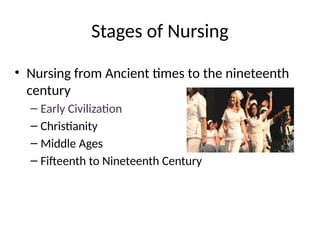
Stages of Nursing
•Nursing from Ancient times to the nineteenth
century
– Early Civilization
– Christianity
– Middle Ages
– Fifteenth to Nineteenth Century
8.
Early Civilization
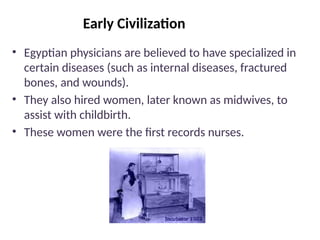
• Egyptianphysicians are believed to have specialized in
certain diseases (such as internal diseases, fractured
bones, and wounds).
• They also hired women, later known as midwives, to
assist with childbirth.
• These women were the first records nurses.
9.
Early Civilization
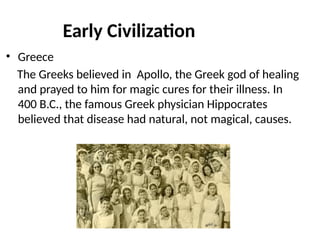
• Greece
TheGreeks believed in Apollo, the Greek god of healing
and prayed to him for magic cures for their illness. In
400 B.C., the famous Greek physician Hippocrates
believed that disease had natural, not magical, causes.
10.
Early Civilization
• RomanEmpire
After 300 B.C., early physicians built on the groundwork
of their Egyptian and Greek predecessors. The Romans
are best known for advances in the health of the public.
11.
Early Civilization
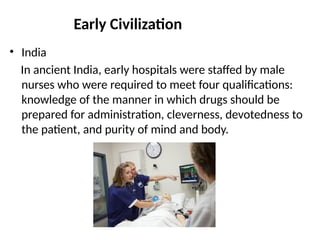
• India
Inancient India, early hospitals were staffed by male
nurses who were required to meet four qualifications:
knowledge of the manner in which drugs should be
prepared for administration, cleverness, devotedness to
the patient, and purity of mind and body.
12.
Christianity
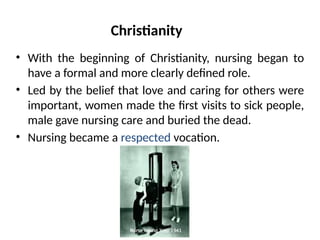
• With thebeginning of Christianity, nursing began to
have a formal and more clearly defined role.
• Led by the belief that love and caring for others were
important, women made the first visits to sick people,
male gave nursing care and buried the dead.
• Nursing became a respected vocation.
13.
Middle Ages
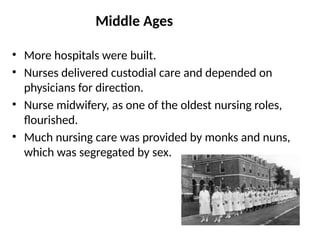
• Morehospitals were built.
• Nurses delivered custodial care and depended on
physicians for direction.
• Nurse midwifery, as one of the oldest nursing roles,
flourished.
• Much nursing care was provided by monks and nuns,
which was segregated by sex.
14.
Fifteenth to Nineteenth
Century
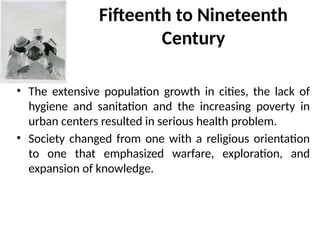
•The extensive population growth in cities, the lack of
hygiene and sanitation and the increasing poverty in
urban centers resulted in serious health problem.
• Society changed from one with a religious orientation
to one that emphasized warfare, exploration, and
expansion of knowledge.
15.
• Many monasteriesand convents closed, leading to a
tremendous shortage of people to care for the sick.
• Women who had committed crimes were recruited
into nursing in lieu of serving sentences.
• The only acceptable nursing role was within a
religious order where services were provided as part
of Christianity charity.
16.
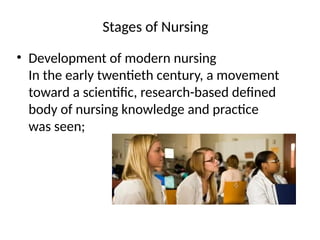
Stages of Nursing
•Development of modern nursing
In the early twentieth century, a movement
toward a scientific, research-based defined
body of nursing knowledge and practice
was seen;
17.
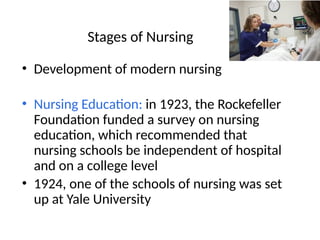
Stages of Nursing
•Development of modern nursing
• Nursing Education: in 1923, the Rockefeller
Foundation funded a survey on nursing
education, which recommended that
nursing schools be independent of hospital
and on a college level
• 1924, one of the schools of nursing was set
up at Yale University
18.
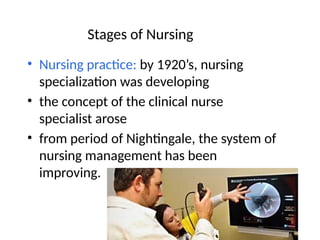
Stages of Nursing
•Nursing practice: by 1920’s, nursing
specialization was developing
• the concept of the clinical nurse
specialist arose
• from period of Nightingale, the system of
nursing management has been
improving.
19.
Development of Nursing
•20th
Century: movement toward a scientific,
research based defined body of nursing
knowledge and practice.
• Nurses began to assume expanded and advanced
practice roles.
• Mary Adelaide contributed in the affiliation of
nursing education with universities.
• 1901: Army Nurse Corps was established.
• 1908: Navy Nurses Corps.
• 1920s: development of specialization, and
graduate nurses.
20.
• 1940s &1950s: speciality nursing organization such
as Association of Operating Room Nurses, American
Association of Critical Care Nurses, Oncology Society
etc.
• More hospitals were built.
• Nurses delivered custodial care and depended on
physicians for direction.
• Nurse midwifery, as one of the oldest nursing roles,
flourished.
• Much nursing care was provided by monks and nuns
21.
Nursing in India
•1664 the East India Company started a hospital for
soldiers
• 1935 onwards- State-wise councils started developing
• 1947 - Indian Nursing Council (INC) Act passed by the
Parliament
• Now India has 23 State Nursing Councils
• Colleges of Nursing started in Delhi (1946) and Vellore
(1947)
• Nursing education in the country integrated into the
system of higher education.
22.
Development of NursingEducation in India
• Earlier type was military type
• 1894: nursing orderlies training started in Indian Station
hospitals by medical officers
• 1854: 1st
training school for midwives in Madras
• 1867: 1st
training school for Indian girls established at
St.Stephen’s Hospital, Delhi
• 1871: 1st
school of Nursing in Government General Hospital,
Madras, with 6months diploma midwives program, 4 students.
• 1886: Training of Dias initiated by missionaries
• 18890-1900: many new school established in parts of India
• 1908: TNAI
23.
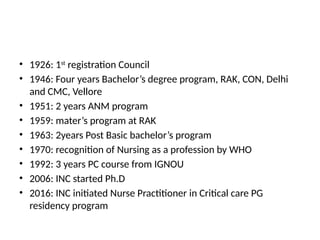
• 1926: 1st
registrationCouncil
• 1946: Four years Bachelor’s degree program, RAK, CON, Delhi
and CMC, Vellore
• 1951: 2 years ANM program
• 1959: mater’s program at RAK
• 1963: 2years Post Basic bachelor’s program
• 1970: recognition of Nursing as a profession by WHO
• 1992: 3 years PC course from IGNOU
• 2006: INC started Ph.D
• 2016: INC initiated Nurse Practitioner in Critical care PG
residency program
24.
Changes in NursingDuring the 20th
• Early twentieth century, a movement toward a
scientific, research-based defined body of
nursing knowledge and practice was seen.
• Nurses began to assume expanded and advance
practice roles.
• As education developed, nursing practice also
expanded.
• By the year 1920s nursing specialization was
developing.
25.
• Century Contemporarynursing 1965: American Nurses
Association stated Education should take place in institutions of
learning
• Many hospital-based nursing programs were disbanded
• Trend was changed from “training” nurses to “educating” nurses
• The ANA took the stance that Robb and Nutting had proposed
back in 1903 that nursing education should take place in an
institution of learning.
• ANA 2 levels of nursing RN has a BSN Technical nursing has an
associated degree
• Assistants to nurses: preservice programs in vocational education
than on the job training
26.
• Certification: Thenurse is granted recognition for
competency in a specific area of nursing.
• Eligibility: Current RN license Minimum 2 years’
experience in the designated area
• Currently practicing in the designated area
• Some areas include gerontologic, medical-surgical,
psychiatric and mental health, and adult nurse
practitioner
• In 1976 the ANA offered certification testing for RNs.
27.
Nursing in the21st Century
• Demographics: more elderly, more chronic illness, more inner-city
health care centers versus rural clinics
• Women’s health care issues: management of menopause, new
vaccinations (HPV), preventative care and oncologic care specific to
women
• Men in nursing
• Human rights: Patient’s bills of rights
• Medically underserved: high health care costs, homelessness,
unemployment.
• Advanced practice nurses are one answer to some of these
problems.
• Threat of bioterrorism: Disaster preparedness for nuclear, chemical,
and biologic attacks.
• Nurses function in the roles of triage, crisis response team
members, and vaccination research.
28.
Nursing leaders
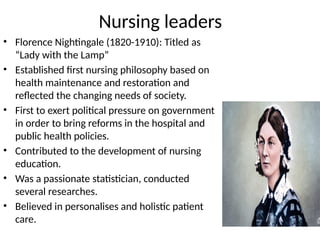
• FlorenceNightingale (1820-1910): Titled as
“Lady with the Lamp”
• Established first nursing philosophy based on
health maintenance and restoration and
reflected the changing needs of society.
• First to exert political pressure on government
in order to bring reforms in the hospital and
public health policies.
• Contributed to the development of nursing
education.
• Was a passionate statistician, conducted
several researches.
• Believed in personalises and holistic patient
care.
29.
• Volunteered duringcrimean war in 1853.
• Brought many reforms in hygiene, sanitation and
nursing practice.
• Nightingale established the Nightingale Training
School for Nursed at St. Thomas’ hospital in London;
the school served as a model for other training school.
• In 1860, Florence Nightingale laid the foundation of
professional when the first school of nursing was
established.
30.
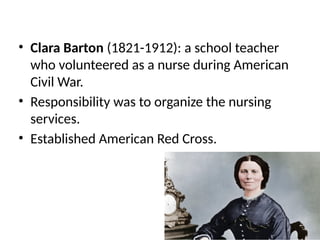
• Clara Barton(1821-1912): a school teacher
who volunteered as a nurse during American
Civil War.
• Responsibility was to organize the nursing
services.
• Established American Red Cross.
31.
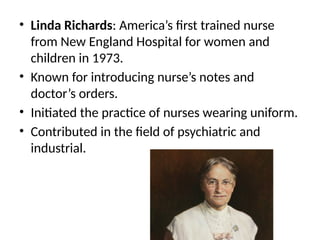
• Linda Richards:America’s first trained nurse
from New England Hospital for women and
children in 1973.
• Known for introducing nurse’s notes and
doctor’s orders.
• Initiated the practice of nurses wearing uniform.
• Contributed in the field of psychiatric and
industrial.
32.
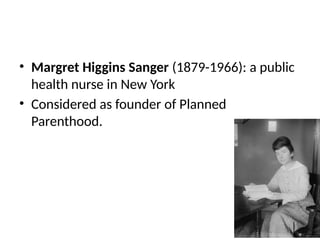
• Margret HigginsSanger (1879-1966): a public
health nurse in New York
• Considered as founder of Planned
Parenthood.
33.
• Virginia Henderson:one of the first modern
nurses to define nursing as “a unique function
of the nurse is to assist the individual, sick or
well, in the performance of those activities
contributing to health or it’s recovery (or to
peaceful) that he would perform unaided if he
had the necessary strength, will or knowledge,
and to do this in such a way as to help him
gainindependence as rapidly as possible”.
34.
Definition
• Nursing, asan integral part of the health care system, encompasses the
promotion of health, prevention of illness, and care of physically ill, mentally
ill, and disabled people of all ages, in all health care and other community
settings.
• Within this broad spectrum of health care, the phenomena of particular
concern to nurses are individual, family, and group "responses to actual or
potential health problems" (ANA, 1980).
• Within the total health care environment, nurses share with other health
professionals and those in other sectors of public service the functions of
planning, implementation, and evaluation to ensure the adequacy of the
health system for promoting health, preventing illness, and caring for ill and
disabled people. (ICN, 1987)
35.
Definition of aNurse
• The nurse is a person who has completed a program of basic, generalized
nursing education and is authorized by the appropriate regulatory
authority to practice nursing in his/her country.
• Basic nursing education is a formally recognised programme of study
providing a broad and sound foundation in the behavioural, life, and
nursing sciences for the general practice of nursing, for a leadership role,
and for post-basic education for specialty or advanced nursing practice.
• The nurse is prepared and authorized :
• To engage in the general scope of nursing practice, including the
promotion of health, prevention of illness, and care of physically ill,
mentally ill, and disabled people of all ages and in all health care and
other community settings
• To carry out health care teaching
• To participate fully as a member of the health care team
• To supervise and train nursing and health care auxiliaries
• To be involved in research
(ICN, 1987)
36.
• Nursing integratesthe art and science of caring and
focuses on the protection, promotion, and optimization of
health and human functioning; prevention of illness and
injury; facilitation of healing; and alleviation of suffering
through compassionate presence.
• Nursing is the diagnosis and treatment of human
responses and advocacy in the care of individuals, families,
groups, communities, and populations in recognition of the
connection of all humanity.
ANA (2021). Nursing: Scope and Standards of Practice,
Fourth Edition, p. 1.
37.
• The uniquefunction of nurses in caring for
individuals, sick or well, is to assess their responses
to their health status and to assist them in the
performance of those activities contributing to
health or recovery or to dignified death that they
would perform unaided if they had the necessary
strength, will, or knowledge and to do this in such a
way as to help them gain full of partial
independence as rapidly as possible
(Henderson, 1977, p.4).
38.
Nursing as aProfession
• Nursing can be described as both an art and a
science; a heart and a mind. At its heart, lies a
fundamental respect for human dignity and an
intuition for a patient’s needs.
• Nursing has been defined as an occupation
that requires extensive education, special
knowledge, skill and preparation.
39.
Characteristics of aProfession
• Requires an extended education of it’s members as well as
a basic liberal foundation
• Has a theoretical body of knowledge leading to defined
skills, abilities and norms.
• Provides specific services
• Members have autonomy in decision making and practice.
• Has a whole code of ethics for practice.
• Service orientation
• Ongoing research
• Professional organization
40.
Nursing Education
• Originidea to teach the knowledge and skills that
would enable a nurse to practice in a hospital
setting.
• With new scientific knowledge, advances in
technology, culture, political and socio-economy,
nursing programs have also been evolved with
changes in curriculum.
• Current focus is on critical thinking and application of
nursing and supporting knowledge to health
promotion, maintenance and restoration.
41.
Aims and Competencies
•To promote health
• To prevent illness
• To restore health
• To facilitate coping with disability or death
42.
Promoting Health
• Motivatedby the desire to increase a person’s well being
and health potential.
• Patient centered health promotion guides nursing
activities.
• Through knowledge and skill the nurse is able to enhance
quality of life and encourage acceptance of responsibility
for one’s own health.
• She increases health awareness and teaches self care
activities to maximize achievement ofgoals.
• Encourages health promotion by information and referral.
43.
Preventing Illness
• Useof educational programs, literature,
television, radio or internet on healthy diet,
regular exercise and the importance of good
health habits.
• Health assessments in institutions, clinics, and
community setting help to identify areas of
strength and risk for illness.
44.
Restoring Health
• Performingassessments that detect an illness.
• Referring abnormal findings for furthur
findings.
• Providing direct care of the person
• Collaborating with other health care providers
in planning care.
• Planning teaching and carrying out
rehabilitation
45.
Nursing as aProfessional Discipline
• Nursing is recognized increasing as a profession on the
following criteria
• Well-defined body of a specific and unique knowledge
• Strong service orientation
• Recognized authority by a professional group
• Code of ethics
• Personal organization that sets standards.
• Ongoing research
• Autonomy and self regulation
46.
Characteristics of aProfession
• Has practitioners who are motivated by altruism
• Can be taught through a process of professional
education.
• Is basically intellectual (as opposed to physical).
• Improves its techniques by the use of scientific
method.
• Functions autonomously.
47.
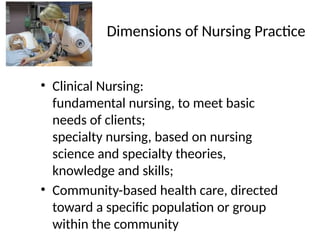
Dimensions of NursingPractice
• Clinical Nursing:
fundamental nursing, to meet basic
needs of clients;
specialty nursing, based on nursing
science and specialty theories,
knowledge and skills;
• Community-based health care, directed
toward a specific population or group
within the community
48.
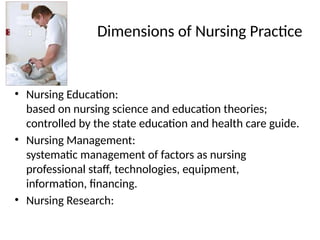
Dimensions of NursingPractice
• Nursing Education:
based on nursing science and education theories;
controlled by the state education and health care guide.
• Nursing Management:
systematic management of factors as nursing
professional staff, technologies, equipment,
information, financing.
• Nursing Research:
49.
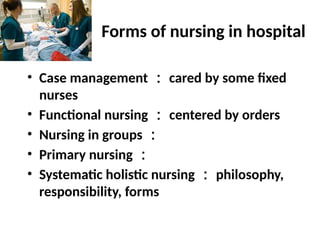
Forms of nursingin hospital
• Case management : cared by some fixed
nurses
• Functional nursing : centered by orders
• Nursing in groups :
• Primary nursing :
• Systematic holistic nursing : philosophy,
responsibility, forms
 Most read