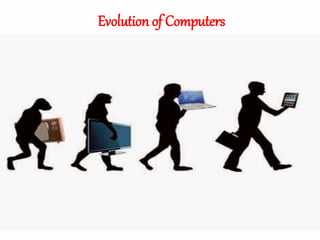
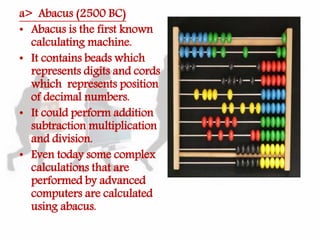
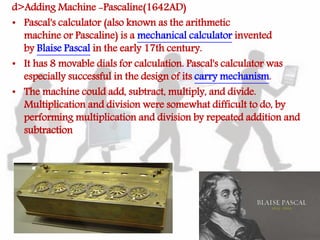
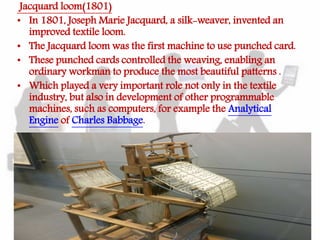
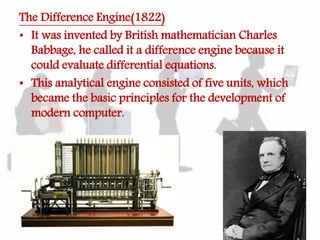
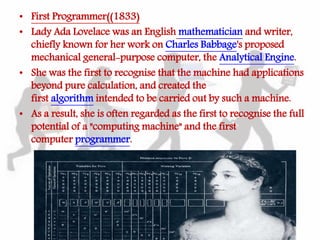
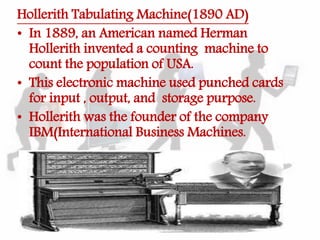
This document summarizes the evolution of early computing devices from the abacus in 2500 BC to the Hollerith tabulating machine in 1890 AD. It describes the abacus, Napier's bones, the slide rule, early mechanical calculators like the Pascaline and Leibniz calculator, the Jacquard loom which used punched cards, Charles Babbage's Analytical Engine, Ada Lovelace's work programming it, and Herman Hollerith's punched card tabulating machine, which laid the foundations for IBM. Key developments included the use of beads to represent digits, rods for multiplication, scales for calculation, and punched cards that could store and process data programmatically.