 Lecture No. 4
 Presented by: Amna Anwar Shaikh
 Introduction to Information & Communication
Technology
ABACUS ( 300 B.C. by the Babylonians )
• The abacus was an early aid for
mathematical computations. Its only
value is that it aids the memory of
the human performing the
calculation.
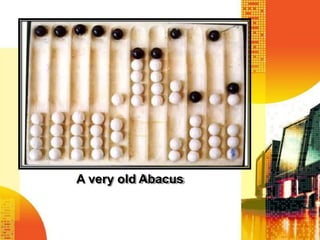
A very old Abacus
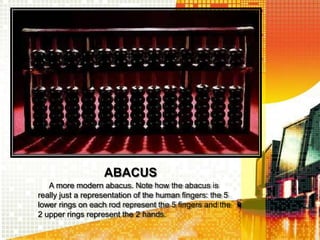
ABACUS
A more modern abacus. Note how the abacus is
really just a representation of the human fingers: the 5
lower rings on each rod represent the 5 fingers and the
2 upper rings represent the 2 hands.
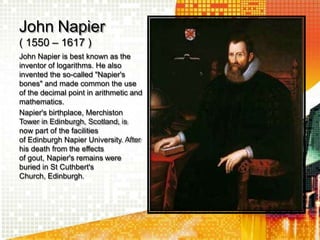
John Napier
( 1550 – 1617 )
John Napier is best known as the
inventor of logarithms. He also
invented the so-called "Napier's
bones" and made common the use
of the decimal point in arithmetic and
mathematics.
Napier's birthplace, Merchiston
Tower in Edinburgh, Scotland, is
now part of the facilities
of Edinburgh Napier University. After
his death from the effects
of gout, Napier's remains were
buried in St Cuthbert's
Church, Edinburgh.
NAPIER'S BONES
In 1617 an eccentric Scotsman named
John Napier invented logarithms, which
are a technology that allows multiplication
to be performed via addition. The magic
ingredient is the logarithm of each
operand, which was originally obtained
from a printed table. But Napier also
invented an alternative to tables, where
the logarithm values were carved on ivory
sticks.
An original set of Napier's Bones
[photo courtesy IBM]
A more modern set of Napier's Bones
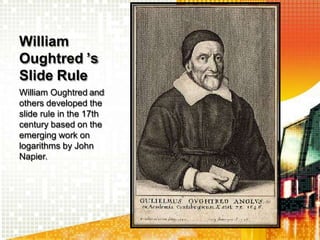
William
Oughtred ’s
Slide Rule
William Oughtred and
others developed the
slide rule in the 17th
century based on the
emerging work on
logarithms by John
Napier.
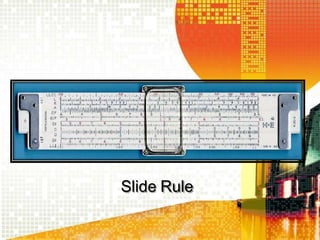
Slide Rule
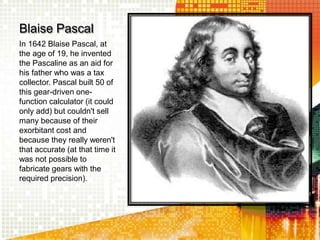
Blaise Pascal
In 1642 Blaise Pascal, at
the age of 19, he invented
the Pascaline as an aid for
his father who was a tax
collector. Pascal built 50 of
this gear-driven one-
function calculator (it could
only add) but couldn't sell
many because of their
exorbitant cost and
because they really weren't
that accurate (at that time it
was not possible to
fabricate gears with the
required precision).
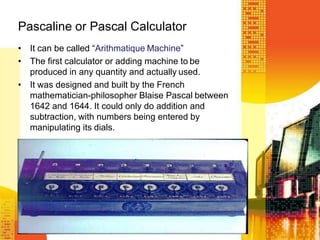
Pascaline or Pascal Calculator
• It can be called “Arithmatique Machine”
• The first calculator or adding machine to be
produced in any quantity and actually used.
• It was designed and built by the French
mathematician-philosopher Blaise Pascal between
1642 and 1644. It could only do addition and
subtraction, with numbers being entered by
manipulating its dials.
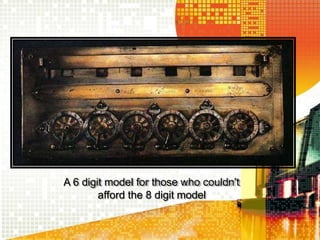
A 6 digit model for those who couldn't
afford the 8 digit model
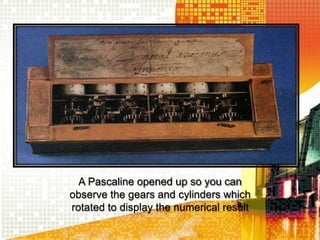
A Pascaline opened up so you can
observe the gears and cylinders which
rotated to display the numerical result
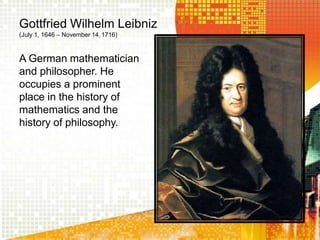
Gottfried Wilhelm Leibniz
(July 1, 1646 – November 14,1716)
A German mathematician
and philosopher. He
occupies a prominent
place in the history of
mathematics and the
history of philosophy.
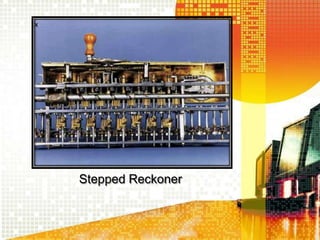
Stepped Reckoner
• The Step Reckoner (or Stepped Reckoner)
was a digital mechanical
calculator invented by German
mathematician Gottfried Wilhelm
Leibniz around 1672 and completed in
1694.
Stepped Reckoner
x
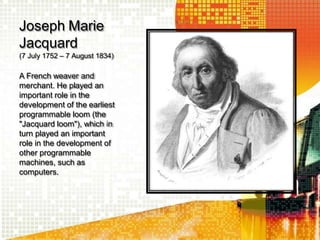
Joseph Marie
Jacquard
(7 July 1752 – 7 August 1834)
A French weaver and
merchant. He played an
important role in the
development of the earliest
programmable loom (the
"Jacquard loom"), which in
turn played an important
role in the development of
other programmable
machines, such as
computers.
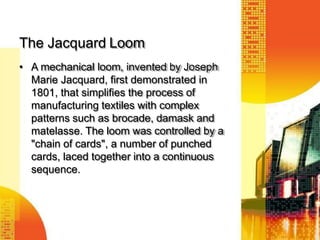
The Jacquard Loom
• A mechanical loom, invented by Joseph
Marie Jacquard, first demonstrated in
1801, that simplifies the process of
manufacturing textiles with complex
patterns such as brocade, damask and
matelasse. The loom was controlled by a
"chain of cards", a number of punched
cards, laced together into a continuous
sequence.
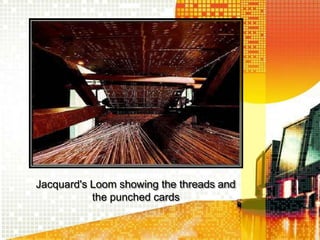
Jacquard's Loom showing the threads and
the punched cards
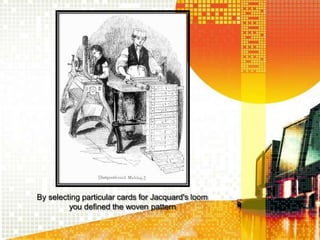
By selecting particular cards for Jacquard's loom
you defined the woven pattern
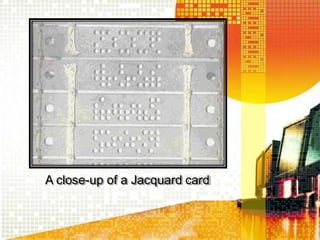
A close-up of a Jacquard card
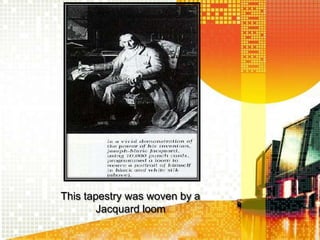
This tapestry was woven by a
Jacquard loom
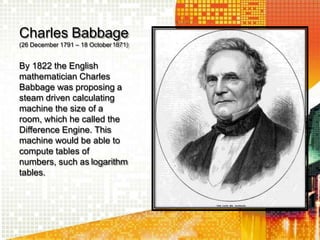
Charles Babbage
(26 December 1791 – 18 October1871)
By 1822 the English
mathematician Charles
Babbage was proposing a
steam driven calculating
machine the size of a
room, which he called the
Difference Engine. This
machine would be able to
compute tables of
numbers, such as logarithm
tables.
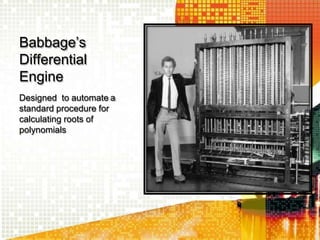
Babbage’s
Differential
Engine
Designed to automate a
standard procedure for
calculating roots of
polynomials
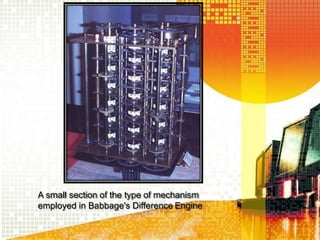
A small section of the type of mechanism
employed in Babbage's Difference Engine
The Analytical Engine
• It was a proposed
mechanical general-purpose
computer designed by English
mathematician Charles Babbage.
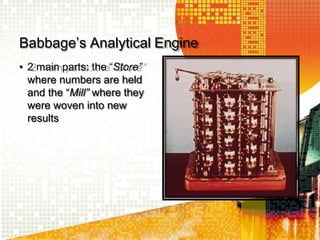
Babbage’s Analytical Engine
• 2 main parts: the “Store”
where numbers are held
and the “Mill” where they
were woven into new
results
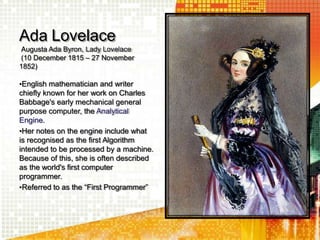
Ada Lovelace
Augusta Ada Byron, Lady Lovelace
(10 December 1815 – 27 November
1852)
•English mathematician and writer
chiefly known for her work on Charles
Babbage's early mechanical general
purpose computer, the Analytical
Engine.
•Her notes on the engine include what
is recognised as the first Algorithm
intended to be processed by a machine.
Because of this, she is often described
as the world's first computer
programmer.
•Referred to as the “First Programmer”
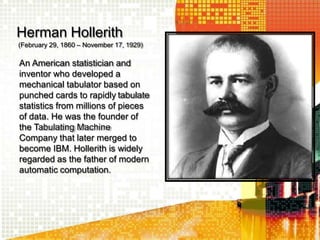
Herman Hollerith
(February 29, 1860 – November 17, 1929)
An American statistician and
inventor who developed a
mechanical tabulator based on
punched cards to rapidly tabulate
statistics from millions of pieces
of data. He was the founder of
the Tabulating Machine
Company that later merged to
become IBM. Hollerith is widely
regarded as the father of modern
automatic computation.
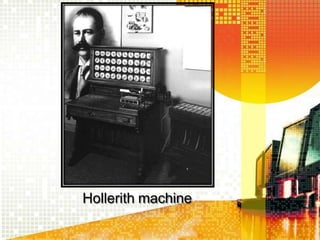
Hollerith machine
Hollerith machine
• The first automatic data processing system. It was
used to count the 1890 U.S. census. Developed by
Herman Hollerith, a statistician who had worked for the
Census Bureau, the system used a hand punch to
record the data as holes in dollar-bill-sized punch
cards and a tabulating machine to count them. The
tabulating machine contained a spring-loaded pin for
each potential hole in the card. When a card was
placed in the reader and the handle was pushed
down, the pins that passed through the holes closed
electrical circuits causing counters to be incremented
and a lid in the sorting box to open.
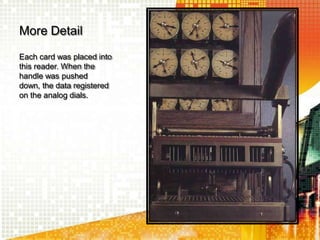
More Detail
Each card was placed into
this reader. When the
handle was pushed
down, the data registered
on the analog dials.
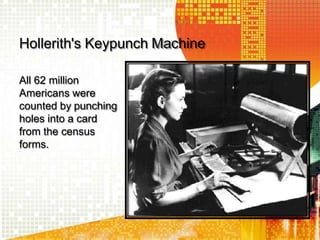
Hollerith's Keypunch Machine
All 62 million
Americans were
counted by punching
holes into a card
from the census
forms.
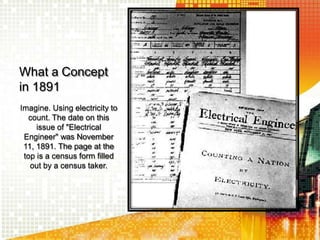
What a Concept
in 1891
Imagine. Using electricity to
count. The date on this
issue of "Electrical
Engineer" was November
11, 1891. The page at the
top is a census form filled
out by a census taker.
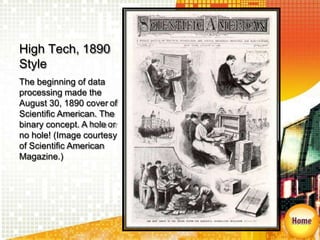
High Tech, 1890
Style
The beginning of data
processing made the
August 30, 1890 cover of
Scientific American. The
binary concept. A hole or
no hole! (Image courtesy
of Scientific American
Magazine.)
EARLY DEVELOPMENTS
IN ELECTRONIC DATA
PROCESSING
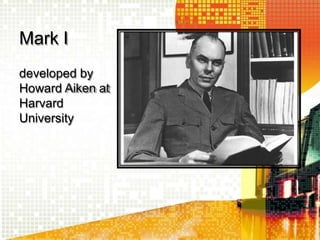
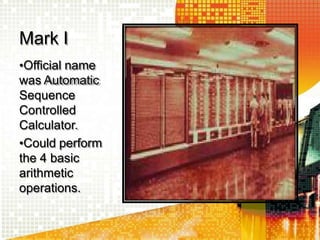
Mark I
developed by
Howard Aiken at
Harvard
University
Mark I
•Official name
was Automatic
Sequence
Controlled
Calculator.
•Could perform
the 4 basic
arithmetic
operations.
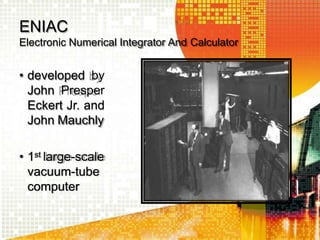
ENIAC
Electronic Numerical Integrator And Calculator
• developed by
John Presper
Eckert Jr. and
John Mauchly
• 1st large-scale
vacuum-tube
computer
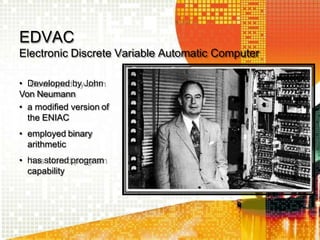
EDVAC
Electronic Discrete Variable Automatic Computer
• Developed by John
Von Neumann
• a modified version of
the ENIAC
• employed binary
arithmetic
• has stored program
capability
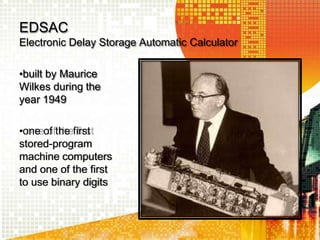
EDSAC
Electronic Delay Storage Automatic Calculator
•built by Maurice
Wilkes during the
year 1949
•one of the first
stored-program
machine computers
and one of the first
to use binary digits
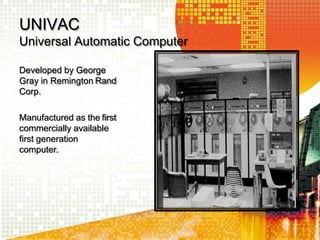
UNIVAC
Universal Automatic Computer
Developed by George
Gray in Remington Rand
Corp.
Manufactured as the first
commercially available
first generation
computer.
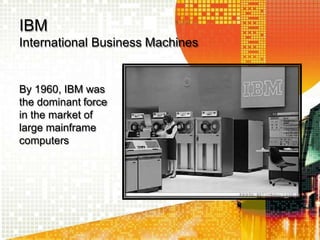
IBM
International Business Machines
By 1960, IBM was
the dominant force
in the market of
large mainframe
computers
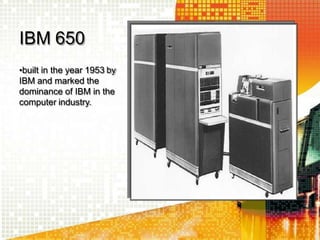
IBM 650
•built in the year 1953 by
IBM and marked the
dominance of IBM in the
computer industry.
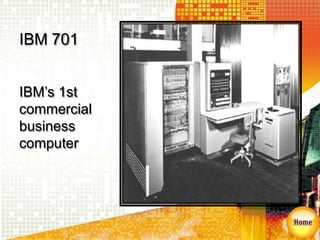
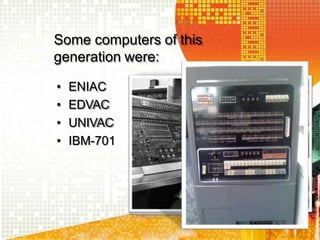
IBM 701
IBM’s 1st
commercial
business
computer
GENERATIONS OF
COMPUTER
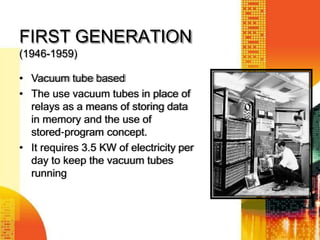
FIRST GENERATION
(1946-1959)
• Vacuum tube based
• The use vacuum tubes in place of
relays as a means of storing data
in memory and the use of
stored‐program concept.
• It requires 3.5 KW of electricity per
day to keep the vacuum tubes
running
Generation in computer terminology
is a change in technology a computer
is/was being used.
Initially, the generation term was used
to distinguish between varying hardware
technologies. But nowadays, generation
includes both hardware and
software, which together make up an
entire computer system.
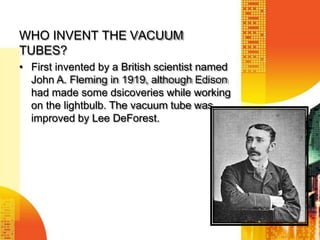
WHO INVENT THE VACUUM
TUBES?
• First invented by a British scientist named
John A. Fleming in 1919, although Edison
had made some dsicoveries while working
on the lightbulb. The vacuum tube was
improved by Lee DeForest.
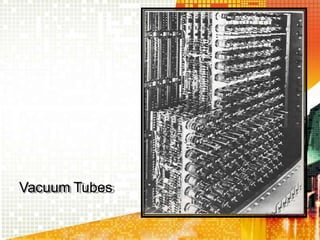
Vacuum Tubes
The main features of First Generation
are:
• Vacuum tube technology
• Unreliable
• Supported Machine language only
• Very costly
• Generate lot of heat
• Slow Input/Output device
• Huge size
• Need ofA.C.
• Non-portable
• Consumed lot of electricity
Some computers of this
generation were:
• ENIAC
• EDVAC
• UNIVAC
• IBM-701
SECOND GENERATION
(1959-1965)
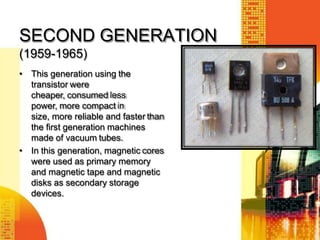
• This generation using the
transistor were
cheaper, consumed less
power, more compact in
size, more reliable and faster than
the first generation machines
made of vacuum tubes.
• In this generation, magnetic cores
were used as primary memory
and magnetic tape and magnetic
disks as secondary storage
devices.
WHO INVENTED THE
TRANSISTORS?
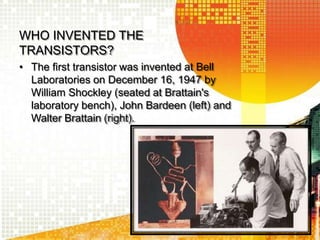
• The first transistor was invented at Bell
Laboratories on December 16, 1947 by
William Shockley (seated at Brattain's
laboratory bench), John Bardeen (left) and
Walter Brattain (right).
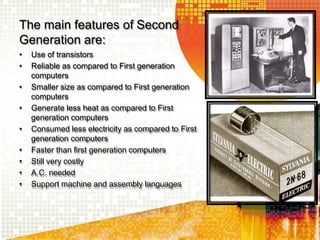
The main features of Second
Generation are:
• Use of transistors
• Reliable as compared to First generation
computers
• Smaller size as compared to First generation
computers
• Generate less heat as compared to First
generation computers
• Consumed less electricity as compared to First
generation computers
• Faster than first generation computers
• Still very costly
• A.C. needed
• Support machine and assembly languages
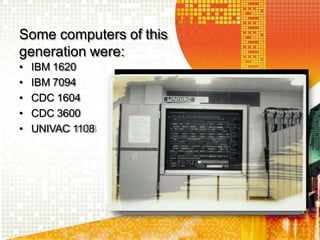
Some computers of this
generation were:
• IBM 1620
• IBM 7094
• CDC 1604
• CDC 3600
• UNIVAC 1108
THIRD GENERATION
(1965-1971)
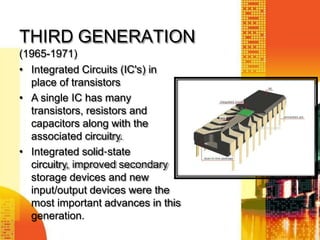
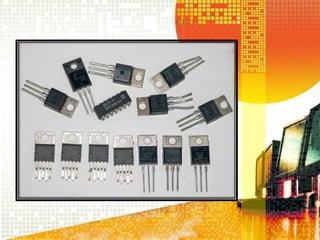
• Integrated Circuits (IC's) in
place of transistors
• A single IC has many
transistors, resistors and
capacitors along with the
associated circuitry.
• Integrated solid‐state
circuitry, improved secondary
storage devices and new
input/output devices were the
most important advances in this
generation.
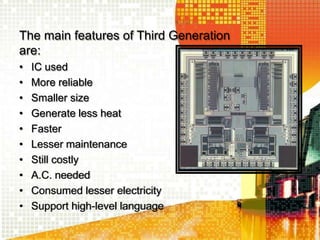
The main features of Third Generation
are:
• IC used
• More reliable
• Smaller size
• Generate less heat
• Faster
• Lesser maintenance
• Still costly
• A.C. needed
• Consumed lesser electricity
• Support high-level language
WHO INVENT THE IC?
• The idea of integrating electronic circuits into a
single device was born, when the German physicist
and engineer Werner Jacobi (de) developed and
patented the first known integrated transistor
amplifier in 1949 and the British radio
engineer Geoffrey Dummer proposed to integrate a
variety of standard electronic components in a
monolithic semiconductor crystal in 1952. A year
later, Harwick Johnson filed a patent for a
prototype integrated circuit (IC).
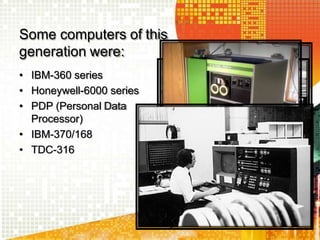
Some computers of this
generation were:
• IBM-360 series
• Honeywell-6000 series
• PDP (Personal Data
Processor)
• IBM-370/168
• TDC-316
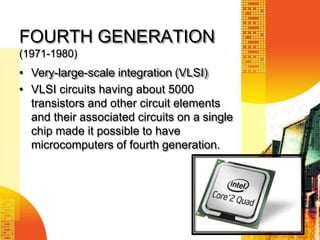
FOURTH GENERATION
(1971-1980)
• Very-large-scale integration (VLSI)
• VLSI circuits having about 5000
transistors and other circuit elements
and their associated circuits on a single
chip made it possible to have
microcomputers of fourth generation.
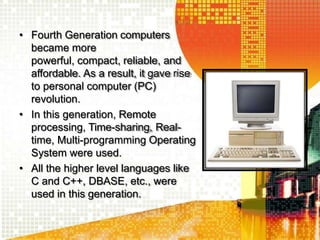
• Fourth Generation computers
became more
powerful, compact, reliable, and
affordable. As a result, it gave rise
to personal computer (PC)
revolution.
• In this generation, Remote
processing, Time-sharing, Real-
time, Multi-programming Operating
System were used.
• All the higher level languages like
C and C++, DBASE, etc., were
used in this generation.
The main features of Fourth
Generation are:
• VLSI technology used
• Very cheap
• Portable and reliable
• Use of PC's
• Very small size
• Pipeline processing
• No A.C. needed
• Concept of internet was introduced
• Great developments in the fields of
networks
• Computers became easily available
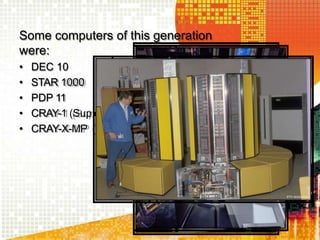
Some computers of this generation
were:
• DEC 10
• STAR 1000
• PDP 11
• CRAY-1 (Sup
• CRAY-X-MP (
er
Su
C
p
omputer)
er Computer)
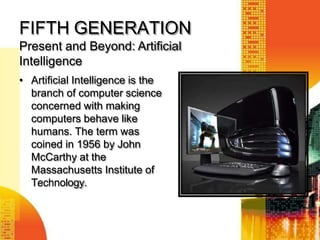
FIFTH GENERATION
Present and Beyond: Artificial
Intelligence
• Artificial Intelligence is the
branch of computer science
concerned with making
computers behave like
humans. The term was
coined in 1956 by John
McCarthy at the
Massachusetts Institute of
Technology.
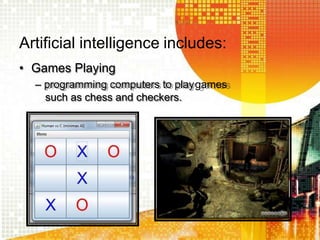
Artificial intelligence includes:
• Games Playing
– programming computers to playgames
such as chess and checkers.
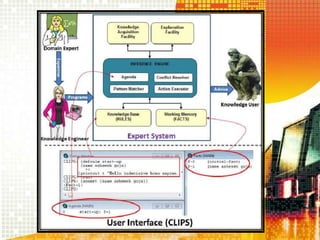
• Expert Systems
– programming computers to make
decisions in real-life situations (for
example, some expert systems
help doctors diagnose diseases
based on symptoms)
• Natural Language
– programming computers to
understand natural human
languages
• Neural Networks
– Systems that simulate intelligence
by attempting to reproduce the
types of physical connections that
occur in animal brains
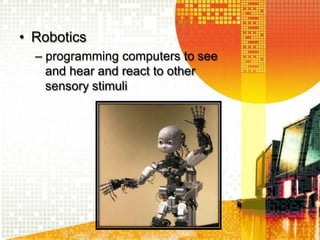
• Robotics
– programming computers to see
and hear and react to other
sensory stimuli
history

history

  • 1.
     Lecture No.4  Presented by: Amna Anwar Shaikh  Introduction to Information & Communication Technology
  • 2.
    ABACUS ( 300B.C. by the Babylonians ) • The abacus was an early aid for mathematical computations. Its only value is that it aids the memory of the human performing the calculation.
  • 3.
    A very oldAbacus
  • 4.
    ABACUS A more modernabacus. Note how the abacus is really just a representation of the human fingers: the 5 lower rings on each rod represent the 5 fingers and the 2 upper rings represent the 2 hands.
  • 5.
    John Napier ( 1550– 1617 ) John Napier is best known as the inventor of logarithms. He also invented the so-called "Napier's bones" and made common the use of the decimal point in arithmetic and mathematics. Napier's birthplace, Merchiston Tower in Edinburgh, Scotland, is now part of the facilities of Edinburgh Napier University. After his death from the effects of gout, Napier's remains were buried in St Cuthbert's Church, Edinburgh.
  • 6.
    NAPIER'S BONES In 1617an eccentric Scotsman named John Napier invented logarithms, which are a technology that allows multiplication to be performed via addition. The magic ingredient is the logarithm of each operand, which was originally obtained from a printed table. But Napier also invented an alternative to tables, where the logarithm values were carved on ivory sticks.
  • 7.
    An original setof Napier's Bones [photo courtesy IBM] A more modern set of Napier's Bones
  • 8.
    William Oughtred ’s Slide Rule WilliamOughtred and others developed the slide rule in the 17th century based on the emerging work on logarithms by John Napier.
  • 9.
  • 10.
    Blaise Pascal In 1642Blaise Pascal, at the age of 19, he invented the Pascaline as an aid for his father who was a tax collector. Pascal built 50 of this gear-driven one- function calculator (it could only add) but couldn't sell many because of their exorbitant cost and because they really weren't that accurate (at that time it was not possible to fabricate gears with the required precision).
  • 11.
    Pascaline or PascalCalculator • It can be called “Arithmatique Machine” • The first calculator or adding machine to be produced in any quantity and actually used. • It was designed and built by the French mathematician-philosopher Blaise Pascal between 1642 and 1644. It could only do addition and subtraction, with numbers being entered by manipulating its dials.
  • 12.
    A 6 digitmodel for those who couldn't afford the 8 digit model
  • 13.
    A Pascaline openedup so you can observe the gears and cylinders which rotated to display the numerical result
  • 14.
    Gottfried Wilhelm Leibniz (July1, 1646 – November 14,1716) A German mathematician and philosopher. He occupies a prominent place in the history of mathematics and the history of philosophy.
  • 15.
    Stepped Reckoner • TheStep Reckoner (or Stepped Reckoner) was a digital mechanical calculator invented by German mathematician Gottfried Wilhelm Leibniz around 1672 and completed in 1694.
  • 16.
  • 17.
    Joseph Marie Jacquard (7 July1752 – 7 August 1834) A French weaver and merchant. He played an important role in the development of the earliest programmable loom (the "Jacquard loom"), which in turn played an important role in the development of other programmable machines, such as computers.
  • 18.
    The Jacquard Loom •A mechanical loom, invented by Joseph Marie Jacquard, first demonstrated in 1801, that simplifies the process of manufacturing textiles with complex patterns such as brocade, damask and matelasse. The loom was controlled by a "chain of cards", a number of punched cards, laced together into a continuous sequence.
  • 19.
    Jacquard's Loom showingthe threads and the punched cards
  • 20.
    By selecting particularcards for Jacquard's loom you defined the woven pattern
  • 21.
    A close-up ofa Jacquard card
  • 22.
    This tapestry waswoven by a Jacquard loom
  • 23.
    Charles Babbage (26 December1791 – 18 October1871) By 1822 the English mathematician Charles Babbage was proposing a steam driven calculating machine the size of a room, which he called the Difference Engine. This machine would be able to compute tables of numbers, such as logarithm tables.
  • 24.
    Babbage’s Differential Engine Designed to automatea standard procedure for calculating roots of polynomials
  • 25.
    A small sectionof the type of mechanism employed in Babbage's Difference Engine
  • 26.
    The Analytical Engine •It was a proposed mechanical general-purpose computer designed by English mathematician Charles Babbage.
  • 27.
    Babbage’s Analytical Engine •2 main parts: the “Store” where numbers are held and the “Mill” where they were woven into new results
  • 28.
    Ada Lovelace Augusta AdaByron, Lady Lovelace (10 December 1815 – 27 November 1852) •English mathematician and writer chiefly known for her work on Charles Babbage's early mechanical general purpose computer, the Analytical Engine. •Her notes on the engine include what is recognised as the first Algorithm intended to be processed by a machine. Because of this, she is often described as the world's first computer programmer. •Referred to as the “First Programmer”
  • 29.
    Herman Hollerith (February 29,1860 – November 17, 1929) An American statistician and inventor who developed a mechanical tabulator based on punched cards to rapidly tabulate statistics from millions of pieces of data. He was the founder of the Tabulating Machine Company that later merged to become IBM. Hollerith is widely regarded as the father of modern automatic computation.
  • 30.
  • 31.
    Hollerith machine • Thefirst automatic data processing system. It was used to count the 1890 U.S. census. Developed by Herman Hollerith, a statistician who had worked for the Census Bureau, the system used a hand punch to record the data as holes in dollar-bill-sized punch cards and a tabulating machine to count them. The tabulating machine contained a spring-loaded pin for each potential hole in the card. When a card was placed in the reader and the handle was pushed down, the pins that passed through the holes closed electrical circuits causing counters to be incremented and a lid in the sorting box to open.
  • 32.
    More Detail Each cardwas placed into this reader. When the handle was pushed down, the data registered on the analog dials.
  • 33.
    Hollerith's Keypunch Machine All62 million Americans were counted by punching holes into a card from the census forms.
  • 34.
    What a Concept in1891 Imagine. Using electricity to count. The date on this issue of "Electrical Engineer" was November 11, 1891. The page at the top is a census form filled out by a census taker.
  • 35.
    High Tech, 1890 Style Thebeginning of data processing made the August 30, 1890 cover of Scientific American. The binary concept. A hole or no hole! (Image courtesy of Scientific American Magazine.)
  • 36.
  • 37.
    Mark I developed by HowardAiken at Harvard University
  • 38.
    Mark I •Official name wasAutomatic Sequence Controlled Calculator. •Could perform the 4 basic arithmetic operations.
  • 39.
    ENIAC Electronic Numerical IntegratorAnd Calculator • developed by John Presper Eckert Jr. and John Mauchly • 1st large-scale vacuum-tube computer
  • 40.
    EDVAC Electronic Discrete VariableAutomatic Computer • Developed by John Von Neumann • a modified version of the ENIAC • employed binary arithmetic • has stored program capability
  • 41.
    EDSAC Electronic Delay StorageAutomatic Calculator •built by Maurice Wilkes during the year 1949 •one of the first stored-program machine computers and one of the first to use binary digits
  • 42.
    UNIVAC Universal Automatic Computer Developedby George Gray in Remington Rand Corp. Manufactured as the first commercially available first generation computer.
  • 43.
    IBM International Business Machines By1960, IBM was the dominant force in the market of large mainframe computers
  • 44.
    IBM 650 •built inthe year 1953 by IBM and marked the dominance of IBM in the computer industry.
  • 45.
  • 46.
  • 49.
    FIRST GENERATION (1946-1959) • Vacuumtube based • The use vacuum tubes in place of relays as a means of storing data in memory and the use of stored‐program concept. • It requires 3.5 KW of electricity per day to keep the vacuum tubes running
  • 50.
    Generation in computerterminology is a change in technology a computer is/was being used. Initially, the generation term was used to distinguish between varying hardware technologies. But nowadays, generation includes both hardware and software, which together make up an entire computer system.
  • 51.
    WHO INVENT THEVACUUM TUBES? • First invented by a British scientist named John A. Fleming in 1919, although Edison had made some dsicoveries while working on the lightbulb. The vacuum tube was improved by Lee DeForest.
  • 52.
  • 53.
    The main featuresof First Generation are: • Vacuum tube technology • Unreliable • Supported Machine language only • Very costly • Generate lot of heat • Slow Input/Output device • Huge size • Need ofA.C. • Non-portable • Consumed lot of electricity
  • 54.
    Some computers ofthis generation were: • ENIAC • EDVAC • UNIVAC • IBM-701
  • 55.
    SECOND GENERATION (1959-1965) • Thisgeneration using the transistor were cheaper, consumed less power, more compact in size, more reliable and faster than the first generation machines made of vacuum tubes. • In this generation, magnetic cores were used as primary memory and magnetic tape and magnetic disks as secondary storage devices.
  • 56.
    WHO INVENTED THE TRANSISTORS? •The first transistor was invented at Bell Laboratories on December 16, 1947 by William Shockley (seated at Brattain's laboratory bench), John Bardeen (left) and Walter Brattain (right).
  • 57.
    The main featuresof Second Generation are: • Use of transistors • Reliable as compared to First generation computers • Smaller size as compared to First generation computers • Generate less heat as compared to First generation computers • Consumed less electricity as compared to First generation computers • Faster than first generation computers • Still very costly • A.C. needed • Support machine and assembly languages
  • 58.
    Some computers ofthis generation were: • IBM 1620 • IBM 7094 • CDC 1604 • CDC 3600 • UNIVAC 1108
  • 59.
    THIRD GENERATION (1965-1971) • IntegratedCircuits (IC's) in place of transistors • A single IC has many transistors, resistors and capacitors along with the associated circuitry. • Integrated solid‐state circuitry, improved secondary storage devices and new input/output devices were the most important advances in this generation.
  • 60.
    The main featuresof Third Generation are: • IC used • More reliable • Smaller size • Generate less heat • Faster • Lesser maintenance • Still costly • A.C. needed • Consumed lesser electricity • Support high-level language
  • 62.
    WHO INVENT THEIC? • The idea of integrating electronic circuits into a single device was born, when the German physicist and engineer Werner Jacobi (de) developed and patented the first known integrated transistor amplifier in 1949 and the British radio engineer Geoffrey Dummer proposed to integrate a variety of standard electronic components in a monolithic semiconductor crystal in 1952. A year later, Harwick Johnson filed a patent for a prototype integrated circuit (IC).
  • 63.
    Some computers ofthis generation were: • IBM-360 series • Honeywell-6000 series • PDP (Personal Data Processor) • IBM-370/168 • TDC-316
  • 64.
    FOURTH GENERATION (1971-1980) • Very-large-scaleintegration (VLSI) • VLSI circuits having about 5000 transistors and other circuit elements and their associated circuits on a single chip made it possible to have microcomputers of fourth generation.
  • 65.
    • Fourth Generationcomputers became more powerful, compact, reliable, and affordable. As a result, it gave rise to personal computer (PC) revolution. • In this generation, Remote processing, Time-sharing, Real- time, Multi-programming Operating System were used. • All the higher level languages like C and C++, DBASE, etc., were used in this generation.
  • 66.
    The main featuresof Fourth Generation are: • VLSI technology used • Very cheap • Portable and reliable • Use of PC's • Very small size • Pipeline processing • No A.C. needed • Concept of internet was introduced • Great developments in the fields of networks • Computers became easily available
  • 67.
    Some computers ofthis generation were: • DEC 10 • STAR 1000 • PDP 11 • CRAY-1 (Sup • CRAY-X-MP ( er Su C p omputer) er Computer)
  • 68.
    FIFTH GENERATION Present andBeyond: Artificial Intelligence • Artificial Intelligence is the branch of computer science concerned with making computers behave like humans. The term was coined in 1956 by John McCarthy at the Massachusetts Institute of Technology.
  • 69.
    Artificial intelligence includes: •Games Playing – programming computers to playgames such as chess and checkers.
  • 70.
    • Expert Systems –programming computers to make decisions in real-life situations (for example, some expert systems help doctors diagnose diseases based on symptoms)
  • 72.
    • Natural Language –programming computers to understand natural human languages • Neural Networks – Systems that simulate intelligence by attempting to reproduce the types of physical connections that occur in animal brains
  • 73.
    • Robotics – programmingcomputers to see and hear and react to other sensory stimuli