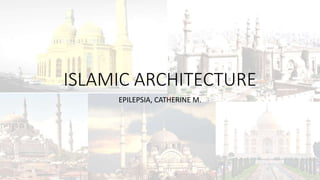
ISLAMIC ARCHITECTURE
EPILEPSIA, CATHERINE M.
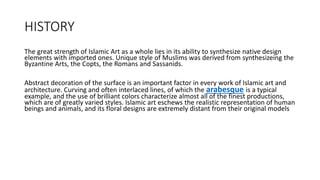
The great strength of Islamic Art as a whole lies in its ability to synthesize native design
elements with imported ones. Unique style of Muslims was derived from synthesizeing the
Byzantine Arts, the Copts, the Romans and Sassanids.
Abstract decoration of the surface is an important factor in every work of Islamic art and
architecture. Curving and often interlaced lines, of which the arabesque is a typical
example, and the use of brilliant colors characterize almost all of the finest productions,
which are of greatly varied styles. Islamic art eschews the realistic representation of human
beings and animals, and its floral designs are extremely distant from their original models
HISTORY
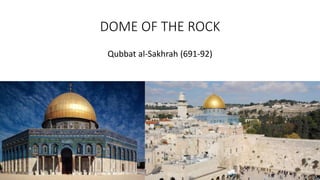
DOME OF THE ROCK
Qubbat al-Sakhrah (691-92)
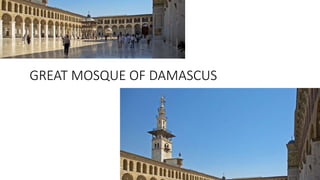
GREAT MOSQUE OF DAMASCUS
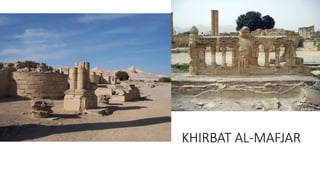
KHIRBAT AL-MAFJAR
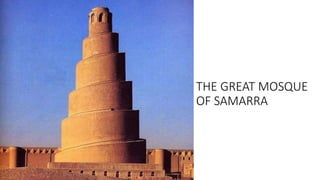
THE GREAT MOSQUE
OF SAMARRA
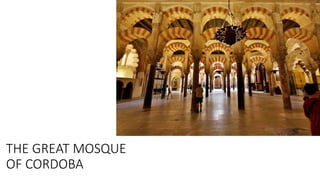
THE GREAT MOSQUE
OF CORDOBA
CHARACTERISTICS
EARLIER TRADITIONS
WESTERN TRADITION- The regions of the newly conquered Byzantine
Empire (Southwestern Anatolia, Syria, Egypt and Maghreb) supplied
architects, masons, mosaicists and other craftsmen to the new Islamic
rulers. They were trained in Byzantine Architecture and decorating in
Byzantine Style, which had developed Hellenistic and ancient Roman
Architecture
EASTERN TRADITION- Mesopotamia and Persia, despite adopting
elements of Helllenistic and Roman representative style, retained their
independen architectural traditions
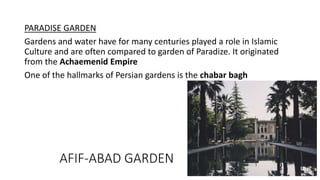
PARADISE GARDEN
Gardens and water have for many centuries played a role in Islamic
Culture and are often compared to garden of Paradize. It originated
from the Achaemenid Empire
One of the hallmarks of Persian gardens is the chabar bagh
AFIF-ABAD GARDEN
COURTYARD (SEHAN)
-Found in secular and religious structures
-When within a residence or other secular building is a private courtyard and
walled garden. It is used for: the aesthetics of plants, water, architectural elements,
and natural light; for cooler space with fountains and shade, and source of breezes
into the structure, during summer heat; and a protected and proscribed place
where the women of the house need not be covered in the hijab clothing
traditionally necessary in public.
-A sehan—courtyard is in within almost every mosque in Islamic architecture. The
courtyards are open to the sky and surrounded on all sides by structures with halls
and rooms, and often a shaded semi-open arcade. Sehans usually feature a
centrally positioned ritual cleansing pool under an open domed pavilion called
a howz. A mosque courtyard is used for performing ablutions, and a 'patio' for rest
or gathering.
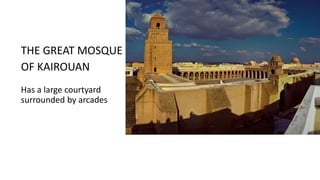
THE GREAT MOSQUE
OF KAIROUAN
Has a large courtyard
surrounded by arcades
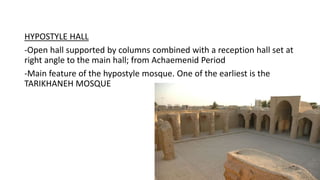
HYPOSTYLE HALL
-Open hall supported by columns combined with a reception hall set at
right angle to the main hall; from Achaemenid Period
-Main feature of the hypostyle mosque. One of the earliest is the
TARIKHANEH MOSQUE
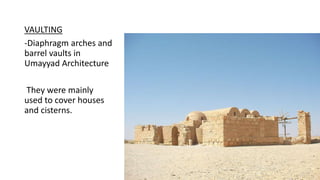
VAULTING
-Diaphragm arches and
barrel vaults in
Umayyad Architecture
They were mainly
used to cover houses
and cisterns.
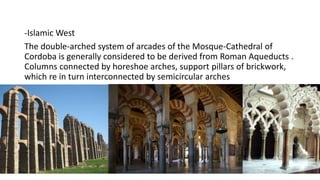
-Islamic West
The double-arched system of arcades of the Mosque-Cathedral of
Cordoba is generally considered to be derived from Roman Aqueducts .
Columns connected by horeshoe arches, support pillars of brickwork,
which re in turn interconnected by semicircular arches
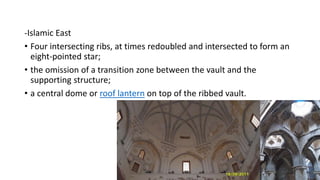
-Islamic East
• Four intersecting ribs, at times redoubled and intersected to form an
eight-pointed star;
• the omission of a transition zone between the vault and the
supporting structure;
• a central dome or roof lantern on top of the ribbed vault.
-Domes
Based on the model of pre-existing Byzantine domes, the Ottoman
Architecture developed a specific form of monumental, representative
building: Wide central domes with huge diameters were erected on top
of a centre-plan building. Despite their enormous weight, the domes
appear virtually weightless. Some of the most elaborate domed
buildings have been constructed by the Ottoman architect Mimar
Sinan.
REGIONAL STYLES
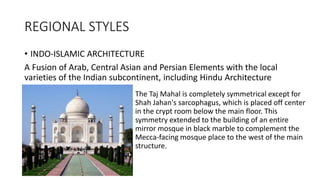
• INDO-ISLAMIC ARCHITECTURE
A Fusion of Arab, Central Asian and Persian Elements with the local
varieties of the Indian subcontinent, including Hindu Architecture
The Taj Mahal is completely symmetrical except for
Shah Jahan's sarcophagus, which is placed off center
in the crypt room below the main floor. This
symmetry extended to the building of an entire
mirror mosque in black marble to complement the
Mecca-facing mosque place to the west of the main
structure.
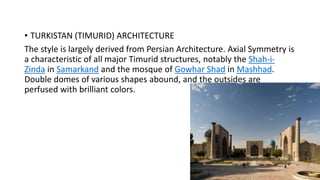
• TURKISTAN (TIMURID) ARCHITECTURE
The style is largely derived from Persian Architecture. Axial Symmetry is
a characteristic of all major Timurid structures, notably the Shah-i-
Zinda in Samarkand and the mosque of Gowhar Shad in Mashhad.
Double domes of various shapes abound, and the outsides are
perfused with brilliant colors.
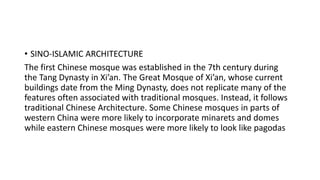
• SINO-ISLAMIC ARCHITECTURE
The first Chinese mosque was established in the 7th century during
the Tang Dynasty in Xi’an. The Great Mosque of Xi’an, whose current
buildings date from the Ming Dynasty, does not replicate many of the
features often associated with traditional mosques. Instead, it follows
traditional Chinese Architecture. Some Chinese mosques in parts of
western China were more likely to incorporate minarets and domes
while eastern Chinese mosques were more likely to look like pagodas
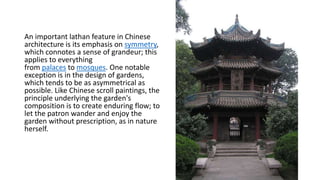
An important lathan feature in Chinese
architecture is its emphasis on symmetry,
which connotes a sense of grandeur; this
applies to everything
from palaces to mosques. One notable
exception is in the design of gardens,
which tends to be as asymmetrical as
possible. Like Chinese scroll paintings, the
principle underlying the garden's
composition is to create enduring flow; to
let the patron wander and enjoy the
garden without prescription, as in nature
herself.

HISTORY: Islamic Architecture 1.0

  • 1.
  • 2.
    The great strengthof Islamic Art as a whole lies in its ability to synthesize native design elements with imported ones. Unique style of Muslims was derived from synthesizeing the Byzantine Arts, the Copts, the Romans and Sassanids. Abstract decoration of the surface is an important factor in every work of Islamic art and architecture. Curving and often interlaced lines, of which the arabesque is a typical example, and the use of brilliant colors characterize almost all of the finest productions, which are of greatly varied styles. Islamic art eschews the realistic representation of human beings and animals, and its floral designs are extremely distant from their original models HISTORY
  • 3.
    DOME OF THEROCK Qubbat al-Sakhrah (691-92)
  • 4.
  • 5.
  • 6.
  • 7.
  • 8.
    CHARACTERISTICS EARLIER TRADITIONS WESTERN TRADITION-The regions of the newly conquered Byzantine Empire (Southwestern Anatolia, Syria, Egypt and Maghreb) supplied architects, masons, mosaicists and other craftsmen to the new Islamic rulers. They were trained in Byzantine Architecture and decorating in Byzantine Style, which had developed Hellenistic and ancient Roman Architecture EASTERN TRADITION- Mesopotamia and Persia, despite adopting elements of Helllenistic and Roman representative style, retained their independen architectural traditions
  • 9.
    PARADISE GARDEN Gardens andwater have for many centuries played a role in Islamic Culture and are often compared to garden of Paradize. It originated from the Achaemenid Empire One of the hallmarks of Persian gardens is the chabar bagh AFIF-ABAD GARDEN
  • 10.
    COURTYARD (SEHAN) -Found insecular and religious structures -When within a residence or other secular building is a private courtyard and walled garden. It is used for: the aesthetics of plants, water, architectural elements, and natural light; for cooler space with fountains and shade, and source of breezes into the structure, during summer heat; and a protected and proscribed place where the women of the house need not be covered in the hijab clothing traditionally necessary in public. -A sehan—courtyard is in within almost every mosque in Islamic architecture. The courtyards are open to the sky and surrounded on all sides by structures with halls and rooms, and often a shaded semi-open arcade. Sehans usually feature a centrally positioned ritual cleansing pool under an open domed pavilion called a howz. A mosque courtyard is used for performing ablutions, and a 'patio' for rest or gathering.
  • 11.
    THE GREAT MOSQUE OFKAIROUAN Has a large courtyard surrounded by arcades
  • 12.
    HYPOSTYLE HALL -Open hallsupported by columns combined with a reception hall set at right angle to the main hall; from Achaemenid Period -Main feature of the hypostyle mosque. One of the earliest is the TARIKHANEH MOSQUE
  • 13.
    VAULTING -Diaphragm arches and barrelvaults in Umayyad Architecture They were mainly used to cover houses and cisterns.
  • 14.
    -Islamic West The double-archedsystem of arcades of the Mosque-Cathedral of Cordoba is generally considered to be derived from Roman Aqueducts . Columns connected by horeshoe arches, support pillars of brickwork, which re in turn interconnected by semicircular arches
  • 15.
    -Islamic East • Fourintersecting ribs, at times redoubled and intersected to form an eight-pointed star; • the omission of a transition zone between the vault and the supporting structure; • a central dome or roof lantern on top of the ribbed vault.
  • 16.
    -Domes Based on themodel of pre-existing Byzantine domes, the Ottoman Architecture developed a specific form of monumental, representative building: Wide central domes with huge diameters were erected on top of a centre-plan building. Despite their enormous weight, the domes appear virtually weightless. Some of the most elaborate domed buildings have been constructed by the Ottoman architect Mimar Sinan.
  • 17.
    REGIONAL STYLES • INDO-ISLAMICARCHITECTURE A Fusion of Arab, Central Asian and Persian Elements with the local varieties of the Indian subcontinent, including Hindu Architecture The Taj Mahal is completely symmetrical except for Shah Jahan's sarcophagus, which is placed off center in the crypt room below the main floor. This symmetry extended to the building of an entire mirror mosque in black marble to complement the Mecca-facing mosque place to the west of the main structure.
  • 18.
    • TURKISTAN (TIMURID)ARCHITECTURE The style is largely derived from Persian Architecture. Axial Symmetry is a characteristic of all major Timurid structures, notably the Shah-i- Zinda in Samarkand and the mosque of Gowhar Shad in Mashhad. Double domes of various shapes abound, and the outsides are perfused with brilliant colors.
  • 19.
    • SINO-ISLAMIC ARCHITECTURE Thefirst Chinese mosque was established in the 7th century during the Tang Dynasty in Xi’an. The Great Mosque of Xi’an, whose current buildings date from the Ming Dynasty, does not replicate many of the features often associated with traditional mosques. Instead, it follows traditional Chinese Architecture. Some Chinese mosques in parts of western China were more likely to incorporate minarets and domes while eastern Chinese mosques were more likely to look like pagodas
  • 20.
    An important lathanfeature in Chinese architecture is its emphasis on symmetry, which connotes a sense of grandeur; this applies to everything from palaces to mosques. One notable exception is in the design of gardens, which tends to be as asymmetrical as possible. Like Chinese scroll paintings, the principle underlying the garden's composition is to create enduring flow; to let the patron wander and enjoy the garden without prescription, as in nature herself.

Editor's Notes

  • #3 In the century after the death (AD 632) of the prophet Muhammad, his Arab followers spread his teachings through Egypt and N Africa, as far west as Spain, and as far east as Sassanid Persia. Because of their rapid expansion and the paucity of the earlier artistic heritage of the Arabian Peninsula, the Muslims derived their unique style from synthesizing the arts of the Byzantines, the Copts, the Romans, and the Sassanids. The great strength of Islamic art as a whole lies in its ability to synthesize native design elements with imported ones. . While the prohibition against depicting living forms is not contained in the Qur'an, it is widely thought that the non-representational character of Islamic ornament has its source in the traditional theological prohibition against imitating God's works. 
  • #10 the four-part garden laid out with axial paths that intersect at the garden's centre. This highly structured geometrical scheme, called the chahar bagh, became a powerful metaphor for the organization and domestication of the landscape, itself a symbol of political territory
  • #13 Hypostyle hall[edit] A Hypostyle, i.e., an open hall supported by columns combined with a reception hall set at right angle to the main hall, is considered to be derived from architectural traditions of Achaemenid period Persian assembly halls ("apadana"). This type of building originated from the Roman-style basilica with an adjacent courtyard surrounded by colonnades, like Trajan's Forum in Rome. The Roman type of building has developed out of the Greekagora. In Islamic architecture, the hypostyle hall is the main feature of the hypostyle mosque. One of the earliest hypostyle mosques is the Tarikhaneh Mosque, dating back to the 8th century.[24]