ISLAMIC
ARCHITECTURE
Joy Alope and Nina Cabral
DFR1A
Islamic Architecture
-Includes a wider range of secular and religious
styles from the foundation of Islam to the present
day
-Owes its origin to similar structures in Roman,
Byzantine and Persian lands (which the Muslims
conquered in the 7th and 8th centuries)
-East - It was influenced by Chinese and Indian
architectures as Islam spread to Southeast Asia
Islamic Architecture
-Principal Islamic Architectural types:
-The Mosque
-The Tomb
-The Palace
-The Fort
-Some scholars believe there is no connection
between Islam and architecture
Influences
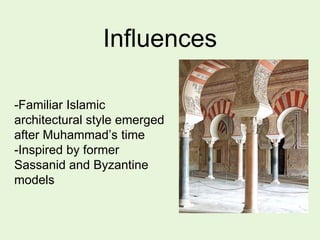
-Familiar Islamic
architectural style emerged
after Muhammad’s time
-Inspired by former
Sassanid and Byzantine
models
Influences
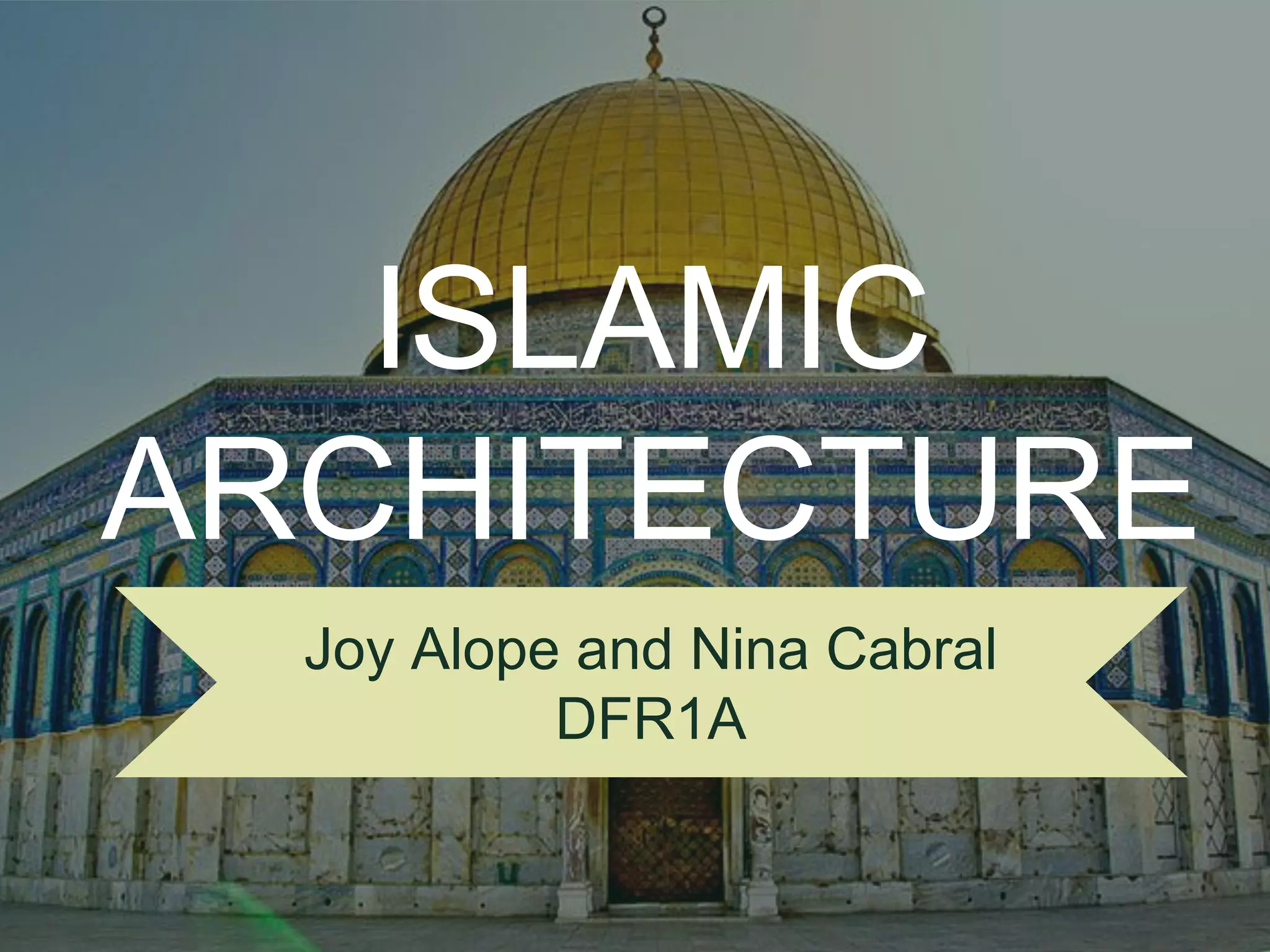
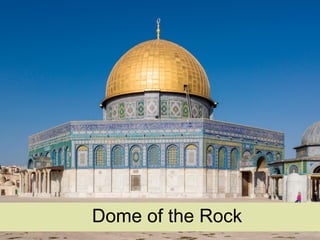
Dome of the Rock
-one of the most important buildings in Islamic
architecture
-patterned after the nearby Church of the Holy
Sepulchre
-Byzantine Christian artists were employed to make
its elaborate mosaics against a golden background
-features interior vaulted spaces, circular dome, use
of stylised repeating decorative arabesque patterns
Influences
Dome of the Rock
Influences-horseshoe arch - popular feature
-Some say the Muslims got this from the
Visigoths in Spain but they might have gotten it
from Syria and Persia (where it was used by the
Byzantines as early as the 5th century)
-Umayyads accentuated the curvature of the
horseshoe after the Moorish invasion of Spain
Influences
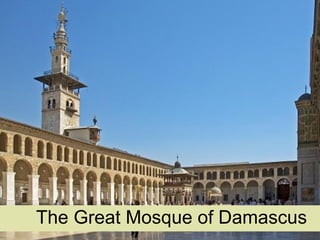
The Great Mosque of Damascus
-built on the site of basilica of John the Baptist
after the the Islamic invasion of Damascus
-bears a great resemblance to 6th and 7th
century Christian basilicas
-to fit Islamic style of prayer, the structure was
expanded along the transversal axis
The Great Mosque of Damascus
Influences
-Abbasid architecture in Iraq (shown in the Fortress of Al-
Ukhaidir) demonstrated the ―the despotic and the pleasure-
loving character of the dynasty‖ due to its grand size but
cramped living quarters
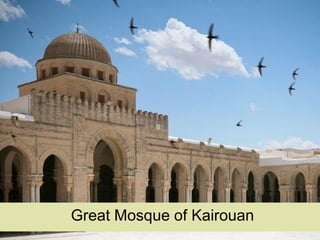
-Great Mosque of Kairouan (in Tunisia)
-considered the ancestor of all the mosques in the western
Islamic world
-original marble columns and sculptures were of Roman
workmanship brought in from Carthage
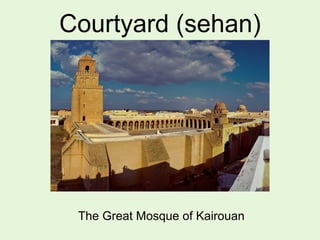
-is constituted of a massive square minaret, a large
courtyard surrounded by porticos and a huge hypostyle
prayer hall covered on its axis by two cupolas
The Great Mosque of DamascusGreat Mosque of Kairouan
Influences
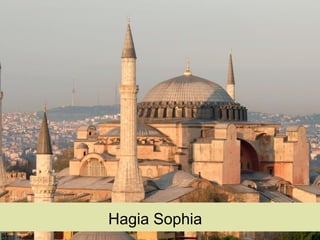
-The Hagia Sophia (Istanbul) also influenced
Islamic architecture
-Ottomans captured city from the Byzantines
-converted the basilica to a mosque (now a
museum)
-incorporated Byzantine architectural elements
into their own work (e.g. domes)
Hagia Sophia
Influences
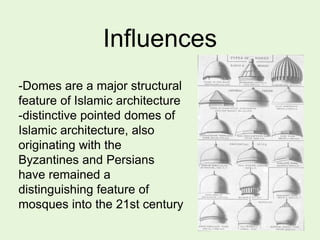
-Domes are a major structural
feature of Islamic architecture
-distinctive pointed domes of
Islamic architecture, also
originating with the
Byzantines and Persians
have remained a
distinguishing feature of
mosques into the 21st century
Influences
-Distinguishing motifs
-ordered repetition
-radiating structures
-rhythmic and metric patterns
-Fractal geometry = key utility
-Other significant features include columns, piers
and arches, organized and interwoven with
alternating sequences of niches and colonnettes
Characteristics
1.Assimilation of earlier traditions
2.Paradise Garden
3.Courtyard (Sehan)
4.Hypostyle hall
5.Vaulting
6.Muqarnas
7.Ornaments
Assimilation of earlier traditions
-influenced by two different ancient traditions:
Western
-regions of the newly conquered Byzantine
Empire supplied architects, masons, mosaicists
and other craftsmen to the new Islamic rulers
-artisans - trained in Byzantine architecture and
decorative arts and continued building in
Byzantine style (developed out of Hellenistic
and ancient Roman architecture)
Assimilation of earlier traditions
Eastern
-Mesopotamia and Persia kept their independent
architectural traditions which came from Sasanian
architecture and its predecessors
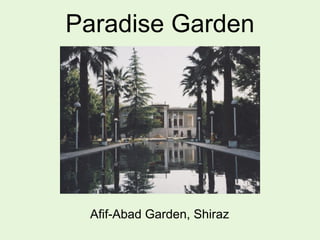
Paradise Garden
-Gardens and water played an essential role in
Islamic culture
-often compared to the garden of Paradise
-comparison originates from the Achaemenid Empire
-classical form of the Persian Paradise garden, or the
Charbagh, comprises a rectangular irrigated space
with elevated pathways, which divide the garden into
four sections of equal size
Paradise Garden
Afif-Abad Garden, Shiraz
Courtyard (sehan)
CHARACTERISTICS:
-is in within almost every mosque in Islamic
architecture.
-are open to the sky and surrounded on all sides by
structures with halls and rooms, and often a shaded
semi-open arcade.
-usually feature a centrally positioned ritual cleansing
pool under an open domed pavilion called a howz.
USE:
•for performing ablutions, and a 'patio' for rest or
gathering.
Courtyard (sehan)
The Great Mosque of Kairouan
Hypostyle Hall
-Hypostyle - open hall supported by columns
combined with a reception hall set at a right angle to
the main hall
-originates from the Roman-style basilica with an
adjacent courtyard surrounded by colonnades, like
Trajan’s forum in Rome
-hypostyle hall is the main feature of the hypostyle
mosque
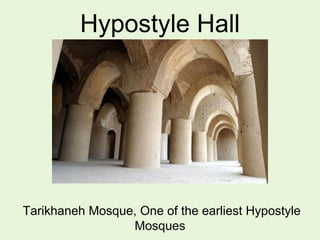
Hypostyle Hall
Tarikhaneh Mosque, One of the earliest Hypostyle
Mosques
Vaulting
-Follows two distinct architectural styles:
-Whilst Umayyad architecture continues Syrian
traditions of the 6th and 7th century
-Eastern Islamic architecture was mainly
influenced by Sasanian styles and forms.
Vaulting
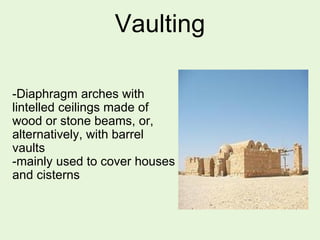
-Diaphragm arches with
lintelled ceilings made of
wood or stone beams, or,
alternatively, with barrel
vaults
-mainly used to cover houses
and cisterns
Vaulting
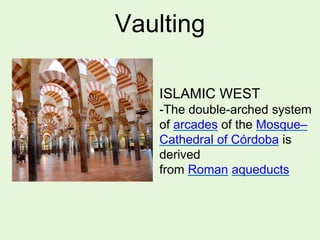
ISLAMIC WEST
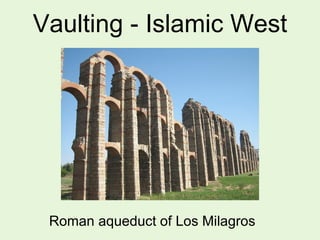
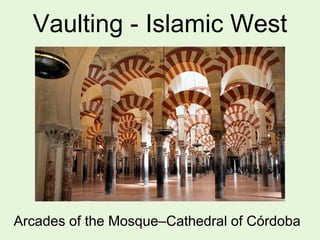
-The double-arched system
of arcades of the Mosque–
Cathedral of Córdoba is
derived
from Roman aqueducts
Vaulting
ISLAMIC WEST
CHARACTERISTICS:
•Columns are connected by horseshoe arches
•Supported by pillars of brickwork
•interconnected by semicircular arches supporting the
flat timberwork ceiling
Vaulting - Islamic West
Roman aqueduct of Los Milagros
Vaulting - Islamic West
Arcades of the Mosque–Cathedral of Córdoba
Vaulting - Islamic West
Arcades of the Mosque–Cathedral of Córdoba
CHARACTERISTICS:
basic architectural design was changed:
•Horseshoe arches were now upper row of arcades
•the vaults above the mihrab wall are constructed as
ribbed vaults.
•the ribs intersect one another off-center, forming an
eight-pointed star in the center which is superseded by
a pendentive dome.
Vaulting - Islamic West
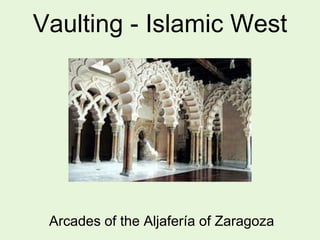
Arcades of the Aljafería of Zaragoza
Vaulting - Islamic West
Arcades of the Aljafería of Zaragoza
CHARACTERISTICS:
•eight-ribbed dome
•ribbed dome was further developed in the Maghreb
Vaulting
ISLAMIC EAST
•The system of squinches in the upper angles of a square
room to form a base to receive
an octagonal or spherical dome, was already known
in Sasanian architecture.
•The spherical triangles of the squinches were split up
into further subdivisions of niches, resulting in an
interplay of supporting structures forming an
ornamental spatial pattern which hides the weight of the
structure.
Vaulting
ISLAMIC EAST
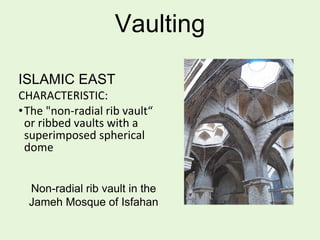
CHARACTERISTIC:
•The "non-radial rib vault“
or ribbed vaults with a
superimposed spherical
dome
Non-radial rib vault in the
Jameh Mosque of Isfahan
Vaulting
ISLAMIC EAST
Main Characteristics
1. Four intersecting ribs, at times redoubled and
intersected to form an eight-pointed star;
2. the omission of a transition zone between the vault
and the supporting structure;
3. a central dome or roof lantern on top of the ribbed
vault.
Vaulting
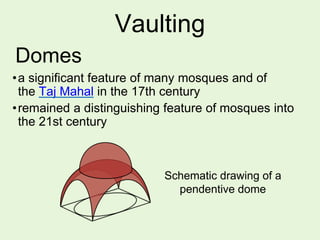
•a significant feature of many mosques and of
the Taj Mahal in the 17th century
•remained a distinguishing feature of mosques into
the 21st century
Domes
Schematic drawing of a
pendentive dome
Vaulting
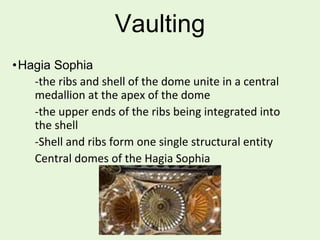
•Hagia Sophia
-the ribs and shell of the dome unite in a central
medallion at the apex of the dome
-the upper ends of the ribs being integrated into
the shell
-Shell and ribs form one single structural entity
Central domes of the Hagia Sophia
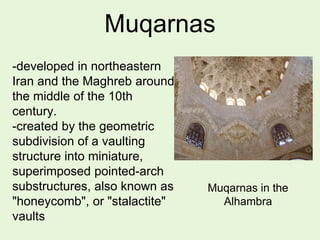
Muqarnas
-developed in northeastern
Iran and the Maghreb around
the middle of the 10th
century.
-created by the geometric
subdivision of a vaulting
structure into miniature,
superimposed pointed-arch
substructures, also known as
"honeycomb", or "stalactite"
vaults
Muqarnas in the
Alhambra
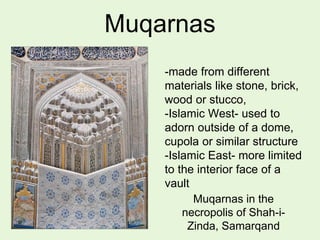
Muqarnas
-made from different
materials like stone, brick,
wood or stucco,
-Islamic West- used to
adorn outside of a dome,
cupola or similar structure
-Islamic East- more limited
to the interior face of a
vault
Muqarnas in the
necropolis of Shah-i-
Zinda, Samarqand
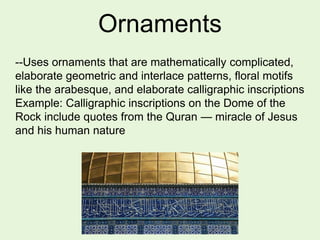
Ornaments
--Uses ornaments that are mathematically complicated,
elaborate geometric and interlace patterns, floral motifs
like the arabesque, and elaborate calligraphic inscriptions
Example: Calligraphic inscriptions on the Dome of the
Rock include quotes from the Quran — miracle of Jesus
and his human nature

HISTORY: Islamic Architecture 2.0

  • 1.
  • 2.
    Islamic Architecture -Includes awider range of secular and religious styles from the foundation of Islam to the present day -Owes its origin to similar structures in Roman, Byzantine and Persian lands (which the Muslims conquered in the 7th and 8th centuries) -East - It was influenced by Chinese and Indian architectures as Islam spread to Southeast Asia
  • 3.
    Islamic Architecture -Principal IslamicArchitectural types: -The Mosque -The Tomb -The Palace -The Fort -Some scholars believe there is no connection between Islam and architecture
  • 4.
    Influences -Familiar Islamic architectural styleemerged after Muhammad’s time -Inspired by former Sassanid and Byzantine models
  • 5.
    Influences Dome of theRock -one of the most important buildings in Islamic architecture -patterned after the nearby Church of the Holy Sepulchre -Byzantine Christian artists were employed to make its elaborate mosaics against a golden background -features interior vaulted spaces, circular dome, use of stylised repeating decorative arabesque patterns
  • 6.
  • 7.
    Influences-horseshoe arch -popular feature -Some say the Muslims got this from the Visigoths in Spain but they might have gotten it from Syria and Persia (where it was used by the Byzantines as early as the 5th century) -Umayyads accentuated the curvature of the horseshoe after the Moorish invasion of Spain
  • 8.
    Influences The Great Mosqueof Damascus -built on the site of basilica of John the Baptist after the the Islamic invasion of Damascus -bears a great resemblance to 6th and 7th century Christian basilicas -to fit Islamic style of prayer, the structure was expanded along the transversal axis
  • 9.
    The Great Mosqueof Damascus
  • 10.
    Influences -Abbasid architecture inIraq (shown in the Fortress of Al- Ukhaidir) demonstrated the ―the despotic and the pleasure- loving character of the dynasty‖ due to its grand size but cramped living quarters -Great Mosque of Kairouan (in Tunisia) -considered the ancestor of all the mosques in the western Islamic world -original marble columns and sculptures were of Roman workmanship brought in from Carthage -is constituted of a massive square minaret, a large courtyard surrounded by porticos and a huge hypostyle prayer hall covered on its axis by two cupolas
  • 11.
    The Great Mosqueof DamascusGreat Mosque of Kairouan
  • 12.
    Influences -The Hagia Sophia(Istanbul) also influenced Islamic architecture -Ottomans captured city from the Byzantines -converted the basilica to a mosque (now a museum) -incorporated Byzantine architectural elements into their own work (e.g. domes)
  • 13.
  • 14.
    Influences -Domes are amajor structural feature of Islamic architecture -distinctive pointed domes of Islamic architecture, also originating with the Byzantines and Persians have remained a distinguishing feature of mosques into the 21st century
  • 15.
    Influences -Distinguishing motifs -ordered repetition -radiatingstructures -rhythmic and metric patterns -Fractal geometry = key utility -Other significant features include columns, piers and arches, organized and interwoven with alternating sequences of niches and colonnettes
  • 16.
    Characteristics 1.Assimilation of earliertraditions 2.Paradise Garden 3.Courtyard (Sehan) 4.Hypostyle hall 5.Vaulting 6.Muqarnas 7.Ornaments
  • 17.
    Assimilation of earliertraditions -influenced by two different ancient traditions: Western -regions of the newly conquered Byzantine Empire supplied architects, masons, mosaicists and other craftsmen to the new Islamic rulers -artisans - trained in Byzantine architecture and decorative arts and continued building in Byzantine style (developed out of Hellenistic and ancient Roman architecture)
  • 18.
    Assimilation of earliertraditions Eastern -Mesopotamia and Persia kept their independent architectural traditions which came from Sasanian architecture and its predecessors
  • 19.
    Paradise Garden -Gardens andwater played an essential role in Islamic culture -often compared to the garden of Paradise -comparison originates from the Achaemenid Empire -classical form of the Persian Paradise garden, or the Charbagh, comprises a rectangular irrigated space with elevated pathways, which divide the garden into four sections of equal size
  • 20.
  • 21.
    Courtyard (sehan) CHARACTERISTICS: -is inwithin almost every mosque in Islamic architecture. -are open to the sky and surrounded on all sides by structures with halls and rooms, and often a shaded semi-open arcade. -usually feature a centrally positioned ritual cleansing pool under an open domed pavilion called a howz. USE: •for performing ablutions, and a 'patio' for rest or gathering.
  • 22.
    Courtyard (sehan) The GreatMosque of Kairouan
  • 23.
    Hypostyle Hall -Hypostyle -open hall supported by columns combined with a reception hall set at a right angle to the main hall -originates from the Roman-style basilica with an adjacent courtyard surrounded by colonnades, like Trajan’s forum in Rome -hypostyle hall is the main feature of the hypostyle mosque
  • 24.
    Hypostyle Hall Tarikhaneh Mosque,One of the earliest Hypostyle Mosques
  • 25.
    Vaulting -Follows two distinctarchitectural styles: -Whilst Umayyad architecture continues Syrian traditions of the 6th and 7th century -Eastern Islamic architecture was mainly influenced by Sasanian styles and forms.
  • 26.
    Vaulting -Diaphragm arches with lintelledceilings made of wood or stone beams, or, alternatively, with barrel vaults -mainly used to cover houses and cisterns
  • 27.
    Vaulting ISLAMIC WEST -The double-archedsystem of arcades of the Mosque– Cathedral of Córdoba is derived from Roman aqueducts
  • 28.
    Vaulting ISLAMIC WEST CHARACTERISTICS: •Columns areconnected by horseshoe arches •Supported by pillars of brickwork •interconnected by semicircular arches supporting the flat timberwork ceiling
  • 29.
    Vaulting - IslamicWest Roman aqueduct of Los Milagros
  • 30.
    Vaulting - IslamicWest Arcades of the Mosque–Cathedral of Córdoba
  • 31.
    Vaulting - IslamicWest Arcades of the Mosque–Cathedral of Córdoba CHARACTERISTICS: basic architectural design was changed: •Horseshoe arches were now upper row of arcades •the vaults above the mihrab wall are constructed as ribbed vaults. •the ribs intersect one another off-center, forming an eight-pointed star in the center which is superseded by a pendentive dome.
  • 32.
    Vaulting - IslamicWest Arcades of the Aljafería of Zaragoza
  • 33.
    Vaulting - IslamicWest Arcades of the Aljafería of Zaragoza CHARACTERISTICS: •eight-ribbed dome •ribbed dome was further developed in the Maghreb
  • 34.
    Vaulting ISLAMIC EAST •The systemof squinches in the upper angles of a square room to form a base to receive an octagonal or spherical dome, was already known in Sasanian architecture. •The spherical triangles of the squinches were split up into further subdivisions of niches, resulting in an interplay of supporting structures forming an ornamental spatial pattern which hides the weight of the structure.
  • 35.
    Vaulting ISLAMIC EAST CHARACTERISTIC: •The "non-radialrib vault“ or ribbed vaults with a superimposed spherical dome Non-radial rib vault in the Jameh Mosque of Isfahan
  • 36.
    Vaulting ISLAMIC EAST Main Characteristics 1.Four intersecting ribs, at times redoubled and intersected to form an eight-pointed star; 2. the omission of a transition zone between the vault and the supporting structure; 3. a central dome or roof lantern on top of the ribbed vault.
  • 37.
    Vaulting •a significant featureof many mosques and of the Taj Mahal in the 17th century •remained a distinguishing feature of mosques into the 21st century Domes Schematic drawing of a pendentive dome
  • 38.
    Vaulting •Hagia Sophia -the ribsand shell of the dome unite in a central medallion at the apex of the dome -the upper ends of the ribs being integrated into the shell -Shell and ribs form one single structural entity Central domes of the Hagia Sophia
  • 39.
    Muqarnas -developed in northeastern Iranand the Maghreb around the middle of the 10th century. -created by the geometric subdivision of a vaulting structure into miniature, superimposed pointed-arch substructures, also known as "honeycomb", or "stalactite" vaults Muqarnas in the Alhambra
  • 40.
    Muqarnas -made from different materialslike stone, brick, wood or stucco, -Islamic West- used to adorn outside of a dome, cupola or similar structure -Islamic East- more limited to the interior face of a vault Muqarnas in the necropolis of Shah-i- Zinda, Samarqand
  • 41.
    Ornaments --Uses ornaments thatare mathematically complicated, elaborate geometric and interlace patterns, floral motifs like the arabesque, and elaborate calligraphic inscriptions Example: Calligraphic inscriptions on the Dome of the Rock include quotes from the Quran — miracle of Jesus and his human nature