ISLAMIC
ARCHITECTURE
Islamic Architecture can be defined as a
building tradition of Muslim population of the
Middle East or any other country where Islam
has been dominant.
Flourished principally in the countries of Southern
Asia and Northern Africa.
Other important communities were established in
isolation outside the geographial block, in places such
as Zanzibar, Madagascar and China
Countries into which islam first expanded were
already rich in building tradition and materials like
marble, ceramic, gypsum & metal works were largely
introduced
The Arab groups, which were the spearhead of the
advance of Islam were essentially Tribal
Women played secondary roll, almost inevitably
assuming major share of domestic, and sometimes of
the agricultural burden
Men performed the significant public duties and
controlled all public affairs & this social structure had
direct architectural consequences in the layout of
domestic and public buildings
Year of start of the religion- A D 622
Place of Start- In Mecca & Saudi Arabia
Founder-Mohammed (Born-B C570)
Sacred text - Quran ( Koran )
House of worship – Mosque
Symbols - Moon & star
Five pillars of Islam - Shahada, Salat, Zakat, Swam, Hajj
THE FIVE PILLARS
Shahadah: Sincerely reciting the Muslim
profession of faith.
Salat: Performing ritual prayers in the proper way
five times each day.
Zakat: Paying charity tax to benefit the poor and
the needy.
Sawm: Fasting during the month of Ramadan.
Hajj: Pilgrimage to Mecca.
JAMI : mosque , principal place of worship
MASJID : small prayer house (Persia, India)
MADRASSAH : public school (Egypt)
SARAY : palace
Mihrab : niche oriented towards Mecca
Mimber : raised platform for ceremonial
announcements
Iwan / Ivan : open-fronted vault facing on to a court.
Bab : gateway
Sahn : courtyard of a mosque
Minaret : tower from which call to prayer is made.
Harem: women's private quarters of a palace
Selamik : men's quarters of a palace
Kibla / Kible: axis orientated towards Mecca
Chatti (India) : kiosk
Mosque : Centre place of worship
Madrassah: public school
Hammam : a structural design for a hot bathhouse
Caravanserai : a road side inn for travellers
Casbah : a fortress
Mausoleum: a tomb or a monument
 Balance & Symmetry
 Concept of perfect creation
 Formal landscape
 Centered upon god
 Use of masonry
 Courtyard -is so fundamental feature of a mosque
is also in its several variations according to the
function the courtyards were cloistered and arcaded
and the side were punctuated with gateways , prayer
chambers or arched porches ( Iwans)
 Minaret : a tall tower in, or continuous to a mosque
arch stairs leading up to one or more balconies.
 Kiosk : used in isolation as a little ornamental
pavilion, emphasizing a roof or providing a focus in
a pleasure garden; it might take the form of the
massive tomb , high and domed, or it might be
repeated to form a cloister , terrace or court
 Mashrabiya - projecting window enclosed with
carved wood lattice work
 Mihrab - semicircular niche in the wall of a mosque
that indicates the Kibla
 Sahn- a courtyard combined with ablution area
 Water : In hot climate the water from courtyard
pools and fountains cools as it decorates, water can
not only reflect architecture but multiply the
decorative themes , it can also serve a means of
emphasising the visual axes
 Calligraphy : calligraphy is closely linked to
geometry the proportions of letters are governed by
mathematics
 Geometric
 Arabesque
 The most important form of opening was the
pointed arch which was principally two and four
cantered and generally constructed as a true arch
through corbelled plane (common in India)
 Window openings are frequently small and
traditionally closed with wooden shutters , iron
bars, marble grilles
 Domes were widely used throughout the Islamic
world : Domes used in Persia, Mughal and Egyptian
turned to be pointed in contrast to the
hemispherical Turkish version of domes
 Wind-scoops were added to the construction
techniques in order to meet the climatic conditions
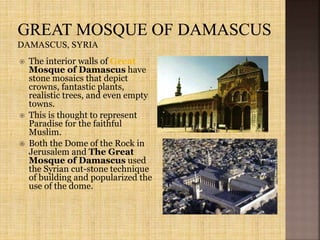
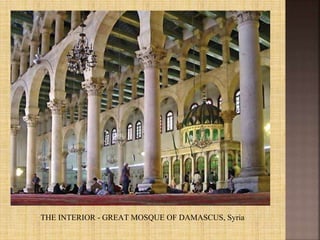
 The interior walls of Great
Mosque of Damascus have
stone mosaics that depict
crowns, fantastic plants,
realistic trees, and even empty
towns.
 This is thought to represent
Paradise for the faithful
Muslim.
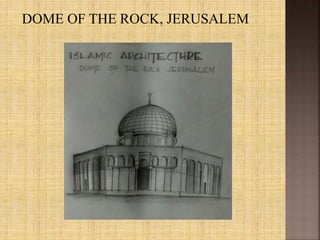
 Both the Dome of the Rock in
Jerusalem and The Great
Mosque of Damascus used
the Syrian cut-stone technique
of building and popularized the
use of the dome.
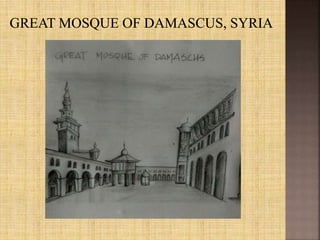
The mosque occupies a huge quadrangle 515 x 330 feet
(157 x100 m) and contains a large open courtyard surrounded by
an arcade of arches supported by slender columns. The liwan, or
hall of worship, running the length of the south side of the
mosque, is divided into three long aisles by rows of columns and
arches. A transept with a central octagonal dome originally
wooden, cuts across the aisles at their midpoint. The marble
grilles that cover the windows in the south wall are the earliest
example of geometric interlace in Islamic.
The walls of the mosque were once covered with more
than an acre of mosaics depicting a fanciful landscape
thought to be the Quʾrānic paradise, but only fragments
survive. The mosque was destroyed by Timur in 1401,
rebuilt by the Arabs, and damaged by fire in 1893.
Although it could not be restored to its original
splendour, the mosque is still an impressive architectural
monument
THE INTERIOR - GREAT MOSQUE OF DAMASCUS, Syria
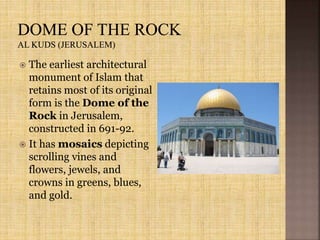
 The earliest architectural
monument of Islam that
retains most of its original
form is the Dome of the
Rock in Jerusalem,
constructed in 691-92.
 It has mosaics depicting
scrolling vines and
flowers, jewels, and
crowns in greens, blues,
and gold.
 The Architecture of the Mosque
 The Great Mosque of Damascus has the
utmost importance in the Muslim world
asthe oldest congregational mosque in
Islamic architecture. Its plan as a
congregationalmosque consists of a prayer
hall,
 haram
 and a large courtyard. It is rectangular
inshape, the northern part belongs to the
mosque complex and the southern
part belongsto the prayer hall,
 haram
 .The courtyard is surrounded by four exterior
walls, cloistered arcades, called as
 riwaq
 , enclosures the courtyard on the three
sides which are double-tiered in shape.The
arches consists of two levels, one has semi-
circular arches and second is smaller double
arches shown below in the figure
DOME OF THE ROCK, JERUSALEM
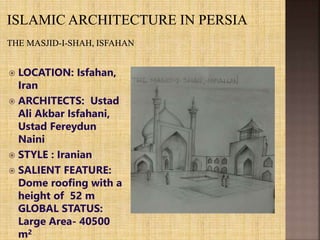
 LOCATION: Isfahan,
Iran
 ARCHITECTS: Ustad
Ali Akbar Isfahani,
Ustad Fereydun
Naini
 STYLE : Iranian
 SALIENT FEATURE:
Dome roofing with a
height of 52 m
GLOBAL STATUS:
Large Area- 40500
m2
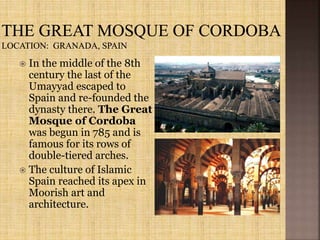
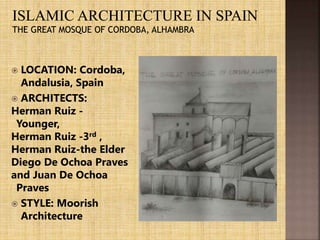
 In the middle of the 8th
century the last of the
Umayyad escaped to
Spain and re-founded the
dynasty there. The Great
Mosque of Cordoba
was begun in 785 and is
famous for its rows of
double-tiered arches.
 The culture of Islamic
Spain reached its apex in
Moorish art and
architecture.
 LOCATION: Cordoba,
Andalusia, Spain
 ARCHITECTS:
Herman Ruiz -
Younger,
Herman Ruiz -3rd ,
Herman Ruiz-the Elder
Diego De Ochoa Praves
and Juan De Ochoa
Praves
 STYLE: Moorish
Architecture
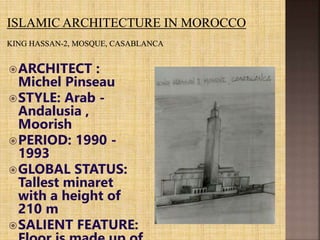
ARCHITECT :
Michel Pinseau
STYLE: Arab -
Andalusia ,
Moorish
PERIOD: 1990 -
1993
GLOBAL STATUS:
Tallest minaret
with a height of
210 m
SALIENT FEATURE:
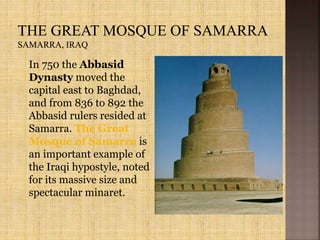
In 750 the Abbasid
Dynasty moved the
capital east to Baghdad,
and from 836 to 892 the
Abbasid rulers resided at
Samarra. The Great
Mosque of Samarra is
an important example of
the Iraqi hypostyle, noted
for its massive size and
spectacular minaret.
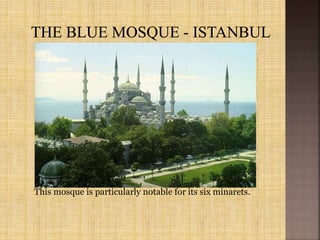
This mosque is particularly notable for its six minarets.
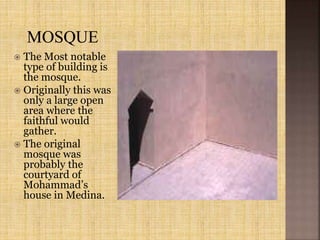
 The Most notable
type of building is
the mosque.
 Originally this was
only a large open
area where the
faithful would
gather.
 The original
mosque was
probably the
courtyard of
Mohammad’s
house in Medina.
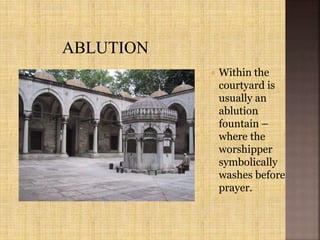
 Within the
courtyard is
usually an
ablution
fountain –
where the
worshipper
symbolically
washes before
prayer.
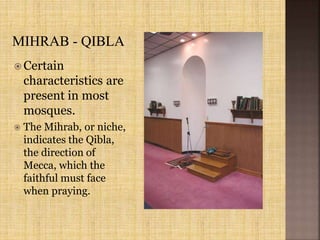
 Certain
characteristics are
present in most
mosques.
 The Mihrab, or niche,
indicates the Qibla,
the direction of
Mecca, which the
faithful must face
when praying.
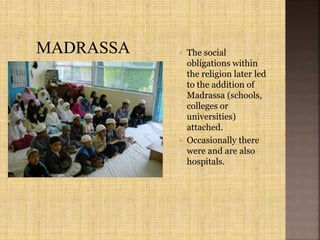
 The social
obligations within
the religion later led
to the addition of
Madrassa (schools,
colleges or
universities)
attached.
 Occasionally there
were and are also
hospitals.
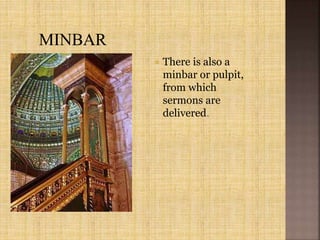
 There is also a
minbar or pulpit,
from which
sermons are
delivered.
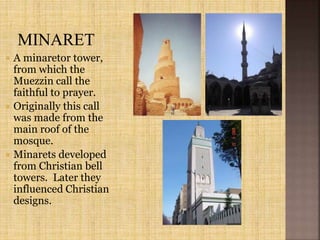
 A minaretor tower,
from which the
Muezzin call the
faithful to prayer.
 Originally this call
was made from the
main roof of the
mosque.
 Minarets developed
from Christian bell
towers. Later they
influenced Christian
designs.

ISLAMIC_ARCHITECTURE.pptx

  • 1.
  • 2.
    Islamic Architecture canbe defined as a building tradition of Muslim population of the Middle East or any other country where Islam has been dominant.
  • 3.
    Flourished principally inthe countries of Southern Asia and Northern Africa. Other important communities were established in isolation outside the geographial block, in places such as Zanzibar, Madagascar and China
  • 4.
    Countries into whichislam first expanded were already rich in building tradition and materials like marble, ceramic, gypsum & metal works were largely introduced
  • 5.
    The Arab groups,which were the spearhead of the advance of Islam were essentially Tribal Women played secondary roll, almost inevitably assuming major share of domestic, and sometimes of the agricultural burden Men performed the significant public duties and controlled all public affairs & this social structure had direct architectural consequences in the layout of domestic and public buildings
  • 6.
    Year of startof the religion- A D 622 Place of Start- In Mecca & Saudi Arabia Founder-Mohammed (Born-B C570) Sacred text - Quran ( Koran ) House of worship – Mosque Symbols - Moon & star Five pillars of Islam - Shahada, Salat, Zakat, Swam, Hajj
  • 7.
    THE FIVE PILLARS Shahadah:Sincerely reciting the Muslim profession of faith. Salat: Performing ritual prayers in the proper way five times each day. Zakat: Paying charity tax to benefit the poor and the needy. Sawm: Fasting during the month of Ramadan. Hajj: Pilgrimage to Mecca.
  • 8.
    JAMI : mosque, principal place of worship MASJID : small prayer house (Persia, India) MADRASSAH : public school (Egypt) SARAY : palace
  • 9.
    Mihrab : nicheoriented towards Mecca Mimber : raised platform for ceremonial announcements Iwan / Ivan : open-fronted vault facing on to a court. Bab : gateway Sahn : courtyard of a mosque Minaret : tower from which call to prayer is made. Harem: women's private quarters of a palace Selamik : men's quarters of a palace Kibla / Kible: axis orientated towards Mecca Chatti (India) : kiosk
  • 10.
    Mosque : Centreplace of worship Madrassah: public school Hammam : a structural design for a hot bathhouse Caravanserai : a road side inn for travellers Casbah : a fortress Mausoleum: a tomb or a monument
  • 11.
     Balance &Symmetry  Concept of perfect creation  Formal landscape  Centered upon god  Use of masonry
  • 12.
     Courtyard -isso fundamental feature of a mosque is also in its several variations according to the function the courtyards were cloistered and arcaded and the side were punctuated with gateways , prayer chambers or arched porches ( Iwans)  Minaret : a tall tower in, or continuous to a mosque arch stairs leading up to one or more balconies.  Kiosk : used in isolation as a little ornamental pavilion, emphasizing a roof or providing a focus in a pleasure garden; it might take the form of the massive tomb , high and domed, or it might be repeated to form a cloister , terrace or court
  • 13.
     Mashrabiya -projecting window enclosed with carved wood lattice work  Mihrab - semicircular niche in the wall of a mosque that indicates the Kibla  Sahn- a courtyard combined with ablution area
  • 14.
     Water :In hot climate the water from courtyard pools and fountains cools as it decorates, water can not only reflect architecture but multiply the decorative themes , it can also serve a means of emphasising the visual axes  Calligraphy : calligraphy is closely linked to geometry the proportions of letters are governed by mathematics  Geometric  Arabesque
  • 15.
     The mostimportant form of opening was the pointed arch which was principally two and four cantered and generally constructed as a true arch through corbelled plane (common in India)
  • 16.
     Window openingsare frequently small and traditionally closed with wooden shutters , iron bars, marble grilles
  • 17.
     Domes werewidely used throughout the Islamic world : Domes used in Persia, Mughal and Egyptian turned to be pointed in contrast to the hemispherical Turkish version of domes  Wind-scoops were added to the construction techniques in order to meet the climatic conditions
  • 18.
     The interiorwalls of Great Mosque of Damascus have stone mosaics that depict crowns, fantastic plants, realistic trees, and even empty towns.  This is thought to represent Paradise for the faithful Muslim.  Both the Dome of the Rock in Jerusalem and The Great Mosque of Damascus used the Syrian cut-stone technique of building and popularized the use of the dome.
  • 20.
    The mosque occupiesa huge quadrangle 515 x 330 feet (157 x100 m) and contains a large open courtyard surrounded by an arcade of arches supported by slender columns. The liwan, or hall of worship, running the length of the south side of the mosque, is divided into three long aisles by rows of columns and arches. A transept with a central octagonal dome originally wooden, cuts across the aisles at their midpoint. The marble grilles that cover the windows in the south wall are the earliest example of geometric interlace in Islamic.
  • 21.
    The walls ofthe mosque were once covered with more than an acre of mosaics depicting a fanciful landscape thought to be the Quʾrānic paradise, but only fragments survive. The mosque was destroyed by Timur in 1401, rebuilt by the Arabs, and damaged by fire in 1893. Although it could not be restored to its original splendour, the mosque is still an impressive architectural monument
  • 22.
    THE INTERIOR -GREAT MOSQUE OF DAMASCUS, Syria
  • 23.
     The earliestarchitectural monument of Islam that retains most of its original form is the Dome of the Rock in Jerusalem, constructed in 691-92.  It has mosaics depicting scrolling vines and flowers, jewels, and crowns in greens, blues, and gold.
  • 24.
     The Architectureof the Mosque  The Great Mosque of Damascus has the utmost importance in the Muslim world asthe oldest congregational mosque in Islamic architecture. Its plan as a congregationalmosque consists of a prayer hall,  haram  and a large courtyard. It is rectangular inshape, the northern part belongs to the mosque complex and the southern part belongsto the prayer hall,  haram  .The courtyard is surrounded by four exterior walls, cloistered arcades, called as  riwaq  , enclosures the courtyard on the three sides which are double-tiered in shape.The arches consists of two levels, one has semi- circular arches and second is smaller double arches shown below in the figure
  • 25.
    DOME OF THEROCK, JERUSALEM
  • 27.
     LOCATION: Isfahan, Iran ARCHITECTS: Ustad Ali Akbar Isfahani, Ustad Fereydun Naini  STYLE : Iranian  SALIENT FEATURE: Dome roofing with a height of 52 m GLOBAL STATUS: Large Area- 40500 m2
  • 28.
     In themiddle of the 8th century the last of the Umayyad escaped to Spain and re-founded the dynasty there. The Great Mosque of Cordoba was begun in 785 and is famous for its rows of double-tiered arches.  The culture of Islamic Spain reached its apex in Moorish art and architecture.
  • 29.
     LOCATION: Cordoba, Andalusia,Spain  ARCHITECTS: Herman Ruiz - Younger, Herman Ruiz -3rd , Herman Ruiz-the Elder Diego De Ochoa Praves and Juan De Ochoa Praves  STYLE: Moorish Architecture
  • 30.
    ARCHITECT : Michel Pinseau STYLE:Arab - Andalusia , Moorish PERIOD: 1990 - 1993 GLOBAL STATUS: Tallest minaret with a height of 210 m SALIENT FEATURE:
  • 31.
    In 750 theAbbasid Dynasty moved the capital east to Baghdad, and from 836 to 892 the Abbasid rulers resided at Samarra. The Great Mosque of Samarra is an important example of the Iraqi hypostyle, noted for its massive size and spectacular minaret.
  • 32.
    This mosque isparticularly notable for its six minarets.
  • 33.
     The Mostnotable type of building is the mosque.  Originally this was only a large open area where the faithful would gather.  The original mosque was probably the courtyard of Mohammad’s house in Medina.
  • 34.
     Within the courtyardis usually an ablution fountain – where the worshipper symbolically washes before prayer.
  • 35.
     Certain characteristics are presentin most mosques.  The Mihrab, or niche, indicates the Qibla, the direction of Mecca, which the faithful must face when praying.
  • 36.
     The social obligationswithin the religion later led to the addition of Madrassa (schools, colleges or universities) attached.  Occasionally there were and are also hospitals.
  • 37.
     There isalso a minbar or pulpit, from which sermons are delivered.
  • 38.
     A minaretortower, from which the Muezzin call the faithful to prayer.  Originally this call was made from the main roof of the mosque.  Minarets developed from Christian bell towers. Later they influenced Christian designs.