ISLAMIC ARCHITECTURE Ar. Angel Roselin
ISLAMIC ARCHITECTURE
• Unlike Hindu architecture that is confined to temples, the Islamic architecture in India is
represented by many different types of buildings – religious and secular.
• Indo Islamic architecture is the architecture of the Indian subcontinent produced by and for
Islamic patrons and purposes.
Islam spread in India in the 7th and
8th centuries CE. Cheraman Juma
Mosque built in 1568.
Thazhathangadi Juma masjid Mishkal masjid
FACTORS INFLUENCING ISLAMIC ARCHITECTURE IN INDIA
Geographical : Central position of India especially
Delhi lead to invasions and trade from Middle east.
Architectural style : Technology, form, elements such
as domes, minarets, vaults, arches etc.
Religious : Spread of Islam religion and Sufism in
India.
Social : The rule of Islamic rulers in certain regions
lead to a Islamic architectural style developments.
Historical : Invasions by Turks, Mongols and trade
between Arab.
Geological : Materials obtained from the ruins of
temples used in initial stages for Islamic architecture
development
TYPOLOGIES: RELIGIOUS TYPOLOGY
Mosque : Centre of Islamic architecture and
society. Used for religious and congregational
purpose.
Madrasa : Educational centre separate
from the mosque including lecture halls,
libraries, residences, baths and a courtyard.
Juma masjid , Old Delhi Madrasa Mahmud Gawan, Bidar
TYPOLOGIES: RELIGIOUS TYPOLOGY
Tomb : Any structurally enclosed space used
for burial.
Dargah : Memorials of saints
Humayun’s Tomb , Old Delhi
Auliya Allah Dargah
Kabristan – Muslim Cemetery
TYPOLOGIES: SECULAR TYPOLOGY
1. Palaces – Residences of royalty
Fatehpur Sikri Palace complex Tuqlaqbad fort
2. Forts – Defence wall structures
3. Hammams – Public
Bathhouses
5. Minars - Towers
4. Caravan serais – Inn for
travellers
6. Suqs (markets or bazaars)
Amber fort
Caravan serai at Fatehpur Sikri Qutub Minar Charminar Bazaar
TYPOLOGIES: SECULAR TYPOLOGY
7. Baghs or Gardens
9. Kos minar
11. Darwazas or Gateways
8. Residences
10. Pavilions
Birbal’s Residence
Panch Mahal Buland Darwaza
BUILDING MATERIALS
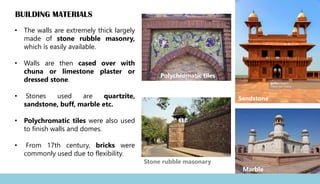
• The walls are extremely thick largely
made of stone rubble masonry,
which is easily available.
• Walls are then cased over with
chuna or limestone plaster or
dressed stone.
• Stones used are quartzite,
sandstone, buff, marble etc.
• Polychromatic tiles were also used
to finish walls and domes.
• From 17th century, bricks were
commonly used due to flexibility.
Polychromatic tiles
Marble
Sandstone
Stone rubble masonary
CONSTRUCTION TECHNIQUES
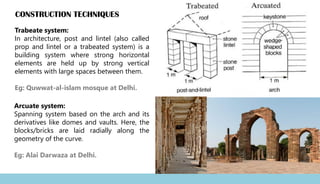
Trabeate system:
In architecture, post and lintel (also called
prop and lintel or a trabeated system) is a
building system where strong horizontal
elements are held up by strong vertical
elements with large spaces between them.
Eg: Quwwat-al-islam mosque at Delhi.
Arcuate system:
Spanning system based on the arch and its
derivatives like domes and vaults. Here, the
blocks/bricks are laid radially along the
geometry of the curve.
Eg: Alai Darwaza at Delhi.
CONSTRUCTION TECHNIQUES : ARCHES
Corbel Arches or False Arches : A corbel
arch (or corbeled / corbelled arch) is an arch-
like construction method that uses
the architectural technique of corbeling to
span a space or void in a structure, such as an
entranceway in a wall or as the span of a
bridge.
True Arches : A true arch is composed of
wedge-shaped blocks (typically of a durable
stone), called voussoirs, with a key stone in
the center holding them into place.
Maqsura at Quwwat-al-islam mosque First true arch in Balban’s tomb.
CONSTRUCTION TECHNIQUES : ARCHES
Pointed Arch
4 centered Arch Traverse Arch
Horse shoe Arch
Trifoliate Arch
Semicircular Arch
CONSTRUCTION TECHNIQUES : ARCHES
CONSTRUCTION TECHNIQUES : DOMES
Corbel Dome: Corbel domes achieve their shape by extending each horizontal layer of stones
inward slightly farther than the lower one until they meet at the top.
Dome at Quwwat-al-islam mosque
CONSTRUCTION TECHNIQUES : DOMES
True Dome: True domes are those structure in a state of compression, with constituent
elements of wedge-shaped voussoirs, the joints of which align with a central point.
Dome at Humayun’s Tomb
CONSTRUCTION TECHNIQUES : DOMES
Shallow Dome: Shallow dome has the
height of dome lesser than the radius of its
base.
Dome at Alai Darwaza
Hemispherical Dome: Height of dome is same
than the radius of its base. Radius of curvature is
constant.
CONSTRUCTION TECHNIQUES : DOMES
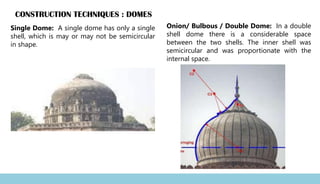
Single Dome: A single dome has only a single
shell, which is may or may not be semicircular
in shape.
Onion/ Bulbous / Double Dome: In a double
shell dome there is a considerable space
between the two shells. The inner shell was
semicircular and was proportionate with the
internal space.
CONSTRUCTION TECHNIQUES : DOMES
True Dome: True domes are those structure in a state of compression, with constituent
elements of wedge-shaped voussoirs, the joints of which align with a central point.
Dome at Humayun’s Tomb
CONSTRUCTION TECHNIQUES : DOMES
Pendatives are triangular arched segments
pointed at the corner of square base and
circular at the top to provide a base to the
dome.
Squinches are diagonal niches at the corners in
the form of arch/arches or corbelling to transfer
the square into octagonal base to make it
structurally stable .
CONSTRUCTION TECHNIQUES : DOMES
ORNAMENTATION ELEMENTS
Pietra Dura: Pietra dura is a term for the inlay technique of using cut and fitted, highly polished
coloured stones to create images.
https://youtu.be/RoP7XCnsfbY
ORNAMENTATION ELEMENTS
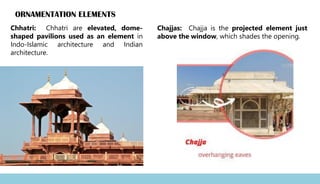
Chhatri: Chhatri are elevated, dome-
shaped pavilions used as an element in
Indo-Islamic architecture and Indian
architecture.
Chajjas: Chajja is the projected element just
above the window, which shades the opening.
ORNAMENTATION ELEMENTS
Jharoka: The Jharokha is a stone
window projecting from the wall face
of a building, in an upper story,
overlooking a street, market, court or
any other open space.
Guldastas: Corner
finial, or pinnacle.
Kanguras: A decorative
undulating pattern found
directly above the molding at
the top of many Mughal
facades.
ORNAMENTATION ELEMENTS
Jalli: A jali or jaali, is the term for
a perforated stone or latticed screen,
usually with an ornamental pattern
constructed through the use of
calligraphy and geometry.
• Most Islamic decoration was geometric , restricted and
banned any representation of human or animal forms.
• Inscriptions could be purely religious (but calligraphy
can also be a decorative abstraction).
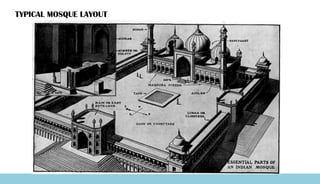
TYPICAL MOSQUE LAYOUT
ELEMENTS IN MOSQUE
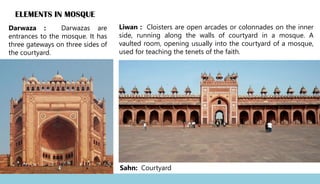
Darwaza : Darwazas are
entrances to the mosque. It has
three gateways on three sides of
the courtyard.
Liwan : Cloisters are open arcades or colonnades on the inner
side, running along the walls of courtyard in a mosque. A
vaulted room, opening usually into the courtyard of a mosque,
used for teaching the tenets of the faith.
Sahn: Courtyard
ELEMENTS IN MOSQUE
Qibla Wall: Orients the prayer lines toward Mecca.
Mihrab: The arched opening in the qibla wall
which centers the participant’s attention on the
prayers.
Mimbar: A raised
platform where the Imam
leads the faithful in prayer.
The Imam also faces
toward Mecca.
ELEMENTS IN MOSQUE
Minaret/ Minar : Minar means a tower or turret. Minaret is a type of tower typically built into or
adjacent to mosques.

Islamic Architecture _India

  • 1.
  • 2.
    ISLAMIC ARCHITECTURE • UnlikeHindu architecture that is confined to temples, the Islamic architecture in India is represented by many different types of buildings – religious and secular. • Indo Islamic architecture is the architecture of the Indian subcontinent produced by and for Islamic patrons and purposes. Islam spread in India in the 7th and 8th centuries CE. Cheraman Juma Mosque built in 1568. Thazhathangadi Juma masjid Mishkal masjid
  • 3.
    FACTORS INFLUENCING ISLAMICARCHITECTURE IN INDIA Geographical : Central position of India especially Delhi lead to invasions and trade from Middle east. Architectural style : Technology, form, elements such as domes, minarets, vaults, arches etc. Religious : Spread of Islam religion and Sufism in India. Social : The rule of Islamic rulers in certain regions lead to a Islamic architectural style developments. Historical : Invasions by Turks, Mongols and trade between Arab. Geological : Materials obtained from the ruins of temples used in initial stages for Islamic architecture development
  • 4.
    TYPOLOGIES: RELIGIOUS TYPOLOGY Mosque: Centre of Islamic architecture and society. Used for religious and congregational purpose. Madrasa : Educational centre separate from the mosque including lecture halls, libraries, residences, baths and a courtyard. Juma masjid , Old Delhi Madrasa Mahmud Gawan, Bidar
  • 5.
    TYPOLOGIES: RELIGIOUS TYPOLOGY Tomb: Any structurally enclosed space used for burial. Dargah : Memorials of saints Humayun’s Tomb , Old Delhi Auliya Allah Dargah Kabristan – Muslim Cemetery
  • 6.
    TYPOLOGIES: SECULAR TYPOLOGY 1.Palaces – Residences of royalty Fatehpur Sikri Palace complex Tuqlaqbad fort 2. Forts – Defence wall structures 3. Hammams – Public Bathhouses 5. Minars - Towers 4. Caravan serais – Inn for travellers 6. Suqs (markets or bazaars) Amber fort Caravan serai at Fatehpur Sikri Qutub Minar Charminar Bazaar
  • 7.
    TYPOLOGIES: SECULAR TYPOLOGY 7.Baghs or Gardens 9. Kos minar 11. Darwazas or Gateways 8. Residences 10. Pavilions Birbal’s Residence Panch Mahal Buland Darwaza
  • 8.
    BUILDING MATERIALS • Thewalls are extremely thick largely made of stone rubble masonry, which is easily available. • Walls are then cased over with chuna or limestone plaster or dressed stone. • Stones used are quartzite, sandstone, buff, marble etc. • Polychromatic tiles were also used to finish walls and domes. • From 17th century, bricks were commonly used due to flexibility. Polychromatic tiles Marble Sandstone Stone rubble masonary
  • 9.
    CONSTRUCTION TECHNIQUES Trabeate system: Inarchitecture, post and lintel (also called prop and lintel or a trabeated system) is a building system where strong horizontal elements are held up by strong vertical elements with large spaces between them. Eg: Quwwat-al-islam mosque at Delhi. Arcuate system: Spanning system based on the arch and its derivatives like domes and vaults. Here, the blocks/bricks are laid radially along the geometry of the curve. Eg: Alai Darwaza at Delhi.
  • 10.
    CONSTRUCTION TECHNIQUES :ARCHES Corbel Arches or False Arches : A corbel arch (or corbeled / corbelled arch) is an arch- like construction method that uses the architectural technique of corbeling to span a space or void in a structure, such as an entranceway in a wall or as the span of a bridge. True Arches : A true arch is composed of wedge-shaped blocks (typically of a durable stone), called voussoirs, with a key stone in the center holding them into place. Maqsura at Quwwat-al-islam mosque First true arch in Balban’s tomb.
  • 11.
    CONSTRUCTION TECHNIQUES :ARCHES Pointed Arch 4 centered Arch Traverse Arch Horse shoe Arch Trifoliate Arch Semicircular Arch
  • 12.
  • 13.
    CONSTRUCTION TECHNIQUES :DOMES Corbel Dome: Corbel domes achieve their shape by extending each horizontal layer of stones inward slightly farther than the lower one until they meet at the top. Dome at Quwwat-al-islam mosque
  • 14.
    CONSTRUCTION TECHNIQUES :DOMES True Dome: True domes are those structure in a state of compression, with constituent elements of wedge-shaped voussoirs, the joints of which align with a central point. Dome at Humayun’s Tomb
  • 15.
    CONSTRUCTION TECHNIQUES :DOMES Shallow Dome: Shallow dome has the height of dome lesser than the radius of its base. Dome at Alai Darwaza Hemispherical Dome: Height of dome is same than the radius of its base. Radius of curvature is constant.
  • 16.
    CONSTRUCTION TECHNIQUES :DOMES Single Dome: A single dome has only a single shell, which is may or may not be semicircular in shape. Onion/ Bulbous / Double Dome: In a double shell dome there is a considerable space between the two shells. The inner shell was semicircular and was proportionate with the internal space.
  • 17.
    CONSTRUCTION TECHNIQUES :DOMES True Dome: True domes are those structure in a state of compression, with constituent elements of wedge-shaped voussoirs, the joints of which align with a central point. Dome at Humayun’s Tomb
  • 18.
    CONSTRUCTION TECHNIQUES :DOMES Pendatives are triangular arched segments pointed at the corner of square base and circular at the top to provide a base to the dome. Squinches are diagonal niches at the corners in the form of arch/arches or corbelling to transfer the square into octagonal base to make it structurally stable .
  • 19.
  • 20.
    ORNAMENTATION ELEMENTS Pietra Dura:Pietra dura is a term for the inlay technique of using cut and fitted, highly polished coloured stones to create images. https://youtu.be/RoP7XCnsfbY
  • 21.
    ORNAMENTATION ELEMENTS Chhatri: Chhatriare elevated, dome- shaped pavilions used as an element in Indo-Islamic architecture and Indian architecture. Chajjas: Chajja is the projected element just above the window, which shades the opening.
  • 22.
    ORNAMENTATION ELEMENTS Jharoka: TheJharokha is a stone window projecting from the wall face of a building, in an upper story, overlooking a street, market, court or any other open space. Guldastas: Corner finial, or pinnacle. Kanguras: A decorative undulating pattern found directly above the molding at the top of many Mughal facades.
  • 23.
    ORNAMENTATION ELEMENTS Jalli: Ajali or jaali, is the term for a perforated stone or latticed screen, usually with an ornamental pattern constructed through the use of calligraphy and geometry. • Most Islamic decoration was geometric , restricted and banned any representation of human or animal forms. • Inscriptions could be purely religious (but calligraphy can also be a decorative abstraction).
  • 24.
  • 25.
    ELEMENTS IN MOSQUE Darwaza: Darwazas are entrances to the mosque. It has three gateways on three sides of the courtyard. Liwan : Cloisters are open arcades or colonnades on the inner side, running along the walls of courtyard in a mosque. A vaulted room, opening usually into the courtyard of a mosque, used for teaching the tenets of the faith. Sahn: Courtyard
  • 26.
    ELEMENTS IN MOSQUE QiblaWall: Orients the prayer lines toward Mecca. Mihrab: The arched opening in the qibla wall which centers the participant’s attention on the prayers. Mimbar: A raised platform where the Imam leads the faithful in prayer. The Imam also faces toward Mecca.
  • 27.
    ELEMENTS IN MOSQUE Minaret/Minar : Minar means a tower or turret. Minaret is a type of tower typically built into or adjacent to mosques.