IslamIc archItecture

      Comparative
    Civilizations 12
       K.J. Benoy
Mosques
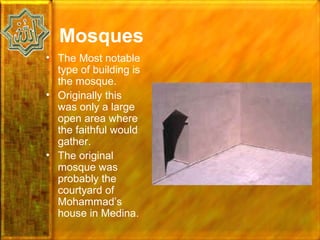
• The Most notable
  type of building is
  the mosque.
• Originally this
  was only a large
  open area where
  the faithful would
  gather.
• The original
  mosque was
  probably the
  courtyard of
  Mohammad’s
  house in Medina.
Mosques


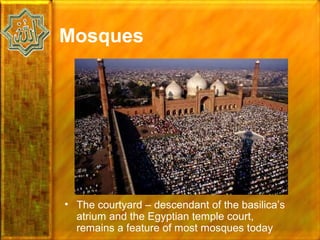
• The courtyard – descendant of the basilica’s
  atrium and the Egyptian temple court,
  remains a feature of most mosques today
Mosques
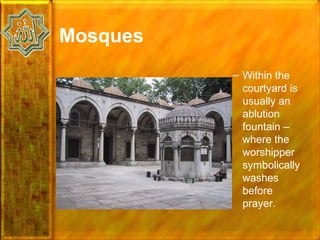
          – Within the
            courtyard is
            usually an
            ablution
            fountain –
            where the
            worshipper
            symbolically
            washes
            before
            prayer.
Mosques
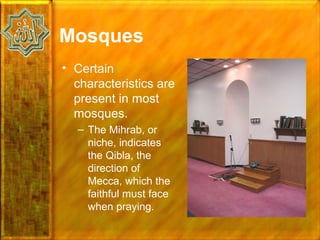
• Certain
  characteristics are
  present in most
  mosques.
  – The Mihrab, or
    niche, indicates
    the Qibla, the
    direction of
    Mecca, which the
    faithful must face
    when praying.
Mosques


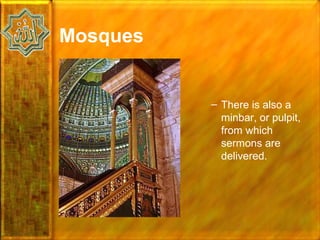
          – There is also a
            minbar, or pulpit,
            from which
            sermons are
            delivered.
Mosques
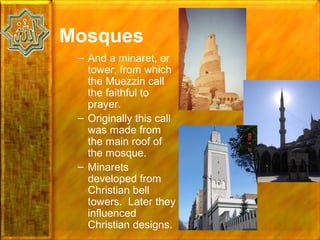
 – And a minaret, or
   tower, from which
   the Muezzin call
   the faithful to
   prayer.
 – Originally this call
   was made from
   the main roof of
   the mosque.
 – Minarets
   developed from
   Christian bell
   towers. Later they
   influenced
   Christian designs.
Mosques
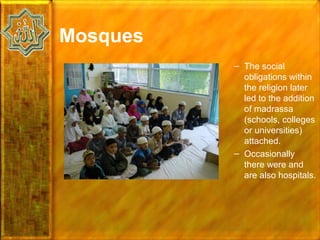
          – The social
            obligations within
            the religion later
            led to the addition
            of madrassa
            (schools, colleges
            or universities)
            attached.
          – Occasionally
            there were and
            are also hospitals.
Mosques
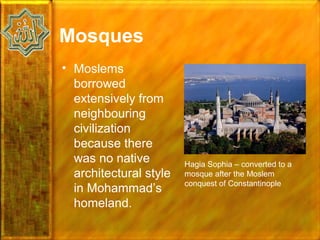
• Moslems
  borrowed
  extensively from
  neighbouring
  civilization
  because there
  was no native         Hagia Sophia – converted to a
  architectural style   mosque after the Moslem
                        conquest of Constantinople
  in Mohammad’s
  homeland.
The Blue Mosque - Istanbul

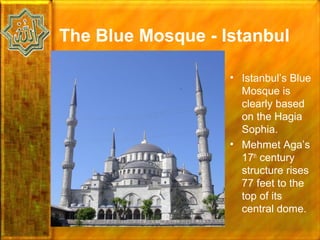
                   • Istanbul’s Blue
                     Mosque is
                     clearly based
                     on the Hagia
                     Sophia.
                   • Mehmet Aga’s
                     17th century
                     structure rises
                     77 feet to the
                     top of its
                     central dome.
The Blue Mosque - Istanbul
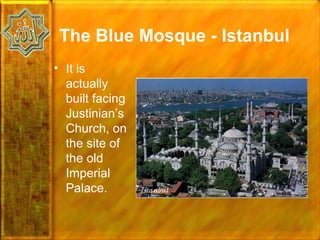
• It is
  actually
  built facing
  Justinian’s
  Church, on
  the site of
  the old
  Imperial
  Palace.
The Blue Mosque - Istanbul


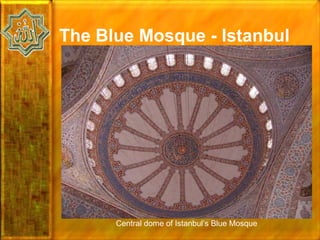
      Central dome of Istanbul’s Blue Mosque
The Blue Mosque - Istanbul


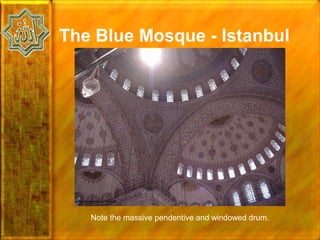
   Note the massive pendentive and windowed drum.
The Blue Mosque - Istanbul
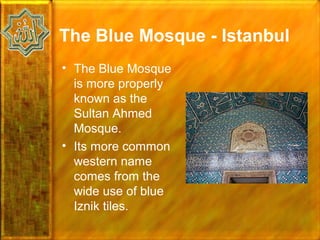
• The Blue Mosque
  is more properly
  known as the
  Sultan Ahmed
  Mosque.
• Its more common
  western name
  comes from the
  wide use of blue
  Iznik tiles.
The Blue Mosque - Istanbul


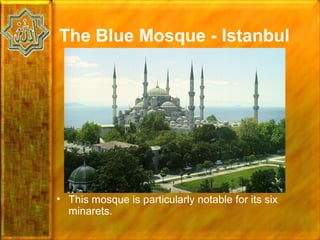
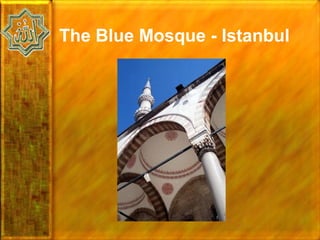
• This mosque is particularly notable for its six
  minarets.
The Blue Mosque - Istanbul
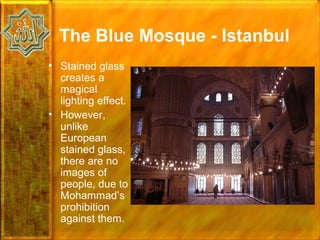
• Stained glass
  creates a
  magical
  lighting effect.
• However,
  unlike
  European
  stained glass,
  there are no
  images of
  people, due to
  Mohammad’s
  prohibition
  against them.
The Blue Mosque - Istanbul
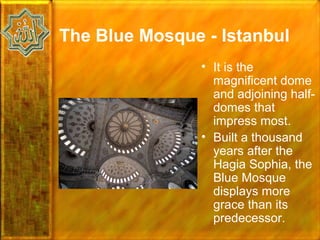
                • It is the
                  magnificent dome
                  and adjoining half-
                  domes that
                  impress most.
                • Built a thousand
                  years after the
                  Hagia Sophia, the
                  Blue Mosque
                  displays more
                  grace than its
                  predecessor.
The Great Mosque at Samarra, Iraq

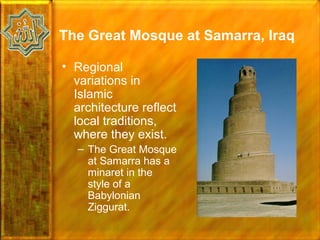
• Regional
  variations in
  Islamic
  architecture reflect
  local traditions,
  where they exist.
   – The Great Mosque
     at Samarra has a
     minaret in the
     style of a
     Babylonian
     Ziggurat.
The Grand Mosque - Mecca


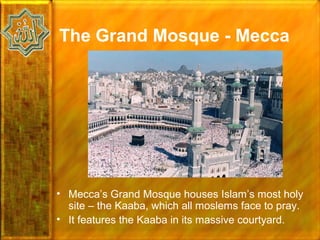
• Mecca’s Grand Mosque houses Islam’s most holy
  site – the Kaaba, which all moslems face to pray.
• It features the Kaaba in its massive courtyard.
The Grand Mosque - Mecca


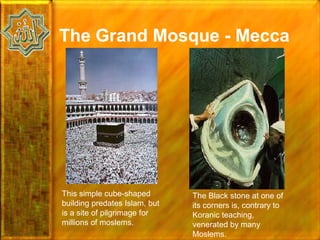
This simple cube-shaped        The Black stone at one of
building predates Islam, but   its corners is, contrary to
is a site of pilgrimage for    Koranic teaching,
millions of moslems.           venerated by many
                               Moslems.
The Dome of the Rock - Jerusalem
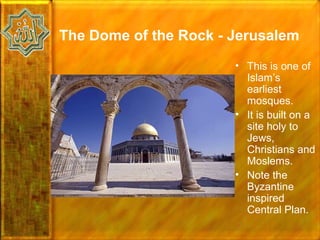
                       • This is one of
                         Islam’s
                         earliest
                         mosques.
                       • It is built on a
                         site holy to
                         Jews,
                         Christians and
                         Moslems.
                       • Note the
                         Byzantine
                         inspired
                         Central Plan.
The Dome of the Rock - Jerusalem


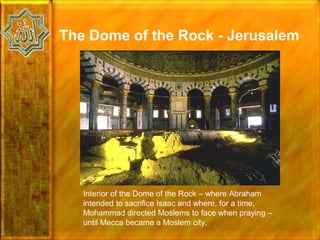
   Interior of the Dome of the Rock – where Abraham
   intended to sacrifice Isaac and where, for a time,
   Mohammad directed Moslems to face when praying –
   until Mecca became a Moslem city.
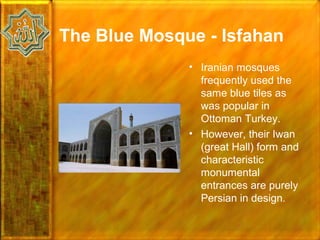
The Blue Mosque - Isfahan
              • Iranian mosques
                frequently used the
                same blue tiles as
                was popular in
                Ottoman Turkey.
              • However, their Iwan
                (great Hall) form and
                characteristic
                monumental
                entrances are purely
                Persian in design.
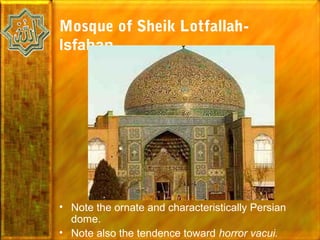
Mosque of Sheik Lotfallah-
Isfahan


• Note the ornate and characteristically Persian
  dome.
• Note also the tendence toward horror vacui.
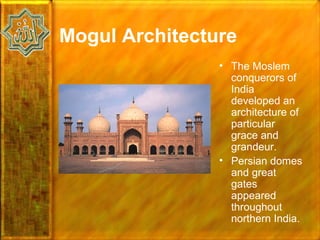
Mogul Architecture
                • The Moslem
                  conquerors of
                  India
                  developed an
                  architecture of
                  particular
                  grace and
                  grandeur.
                • Persian domes
                  and great
                  gates
                  appeared
                  throughout
                  northern India.
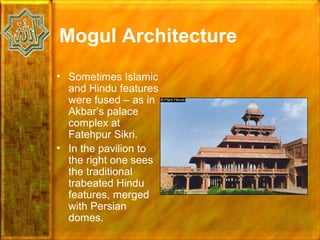
Mogul Architecture
• Sometimes Islamic
  and Hindu features
  were fused – as in
  Akbar’s palace
  complex at
  Fatehpur Sikri.
• In the pavilion to
  the right one sees
  the traditional
  trabeated Hindu
  features, merged
  with Persian
  domes.
The Taj Mahal
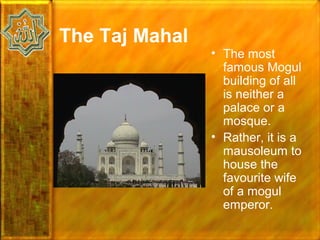
                • The most
                  famous Mogul
                  building of all
                  is neither a
                  palace or a
                  mosque.
                • Rather, it is a
                  mausoleum to
                  house the
                  favourite wife
                  of a mogul
                  emperor.
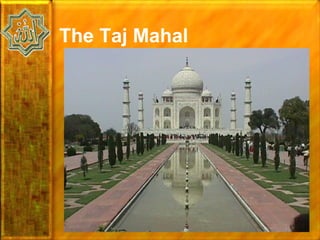
The Taj Mahal
The Taj Mahal
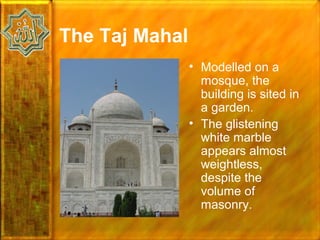
                • Modelled on a
                  mosque, the
                  building is sited in
                  a garden.
                • The glistening
                  white marble
                  appears almost
                  weightless,
                  despite the
                  volume of
                  masonry.
The Taj Mahal
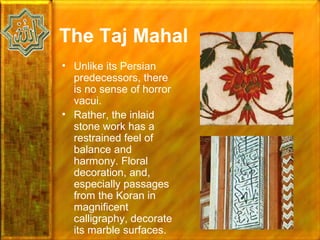
• Unlike its Persian
  predecessors, there
  is no sense of horror
  vacui.
• Rather, the inlaid
  stone work has a
  restrained feel of
  balance and
  harmony. Floral
  decoration, and,
  especially passages
  from the Koran in
  magnificent
  calligraphy, decorate
  its marble surfaces.
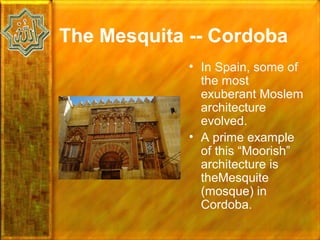
The Mesquita -- Cordoba
             • In Spain, some of
               the most
               exuberant Moslem
               architecture
               evolved.
             • A prime example
               of this “Moorish”
               architecture is
               theMesquite
               (mosque) in
               Cordoba.
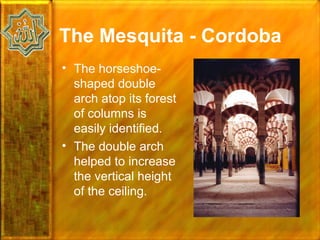
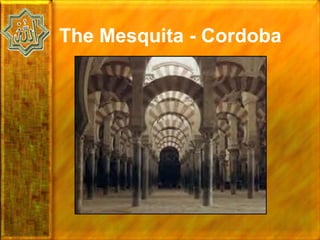
The Mesquita - Cordoba
• The horseshoe-
  shaped double
  arch atop its forest
  of columns is
  easily identified.
• The double arch
  helped to increase
  the vertical height
  of the ceiling.
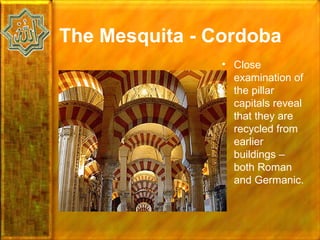
The Mesquita - Cordoba
                • Close
                  examination of
                  the pillar
                  capitals reveal
                  that they are
                  recycled from
                  earlier
                  buildings –
                  both Roman
                  and Germanic.
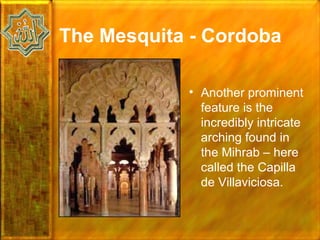
The Mesquita - Cordoba

            • Another prominent
              feature is the
              incredibly intricate
              arching found in
              the Mihrab – here
              called the Capilla
              de Villaviciosa.
The Mesquita - Cordoba


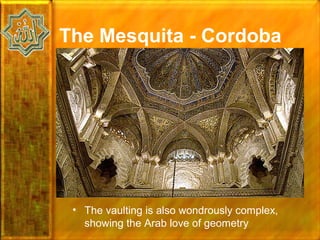
 • The vaulting is also wondrously complex,
   showing the Arab love of geometry
The Mesquita - Cordoba
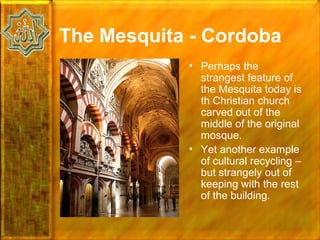
            • Perhaps the
              strangest feature of
              the Mesquita today is
              th Christian church
              carved out of the
              middle of the original
              mosque.
            • Yet another example
              of cultural recycling –
              but strangely out of
              keeping with the rest
              of the building.
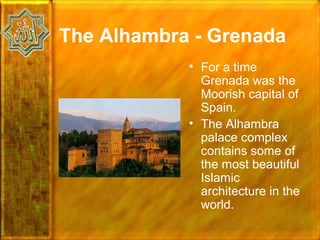
The Alhambra - Grenada
            • For a time
              Grenada was the
              Moorish capital of
              Spain.
            • The Alhambra
              palace complex
              contains some of
              the most beautiful
              Islamic
              architecture in the
              world.
The Alhambra - Grenada


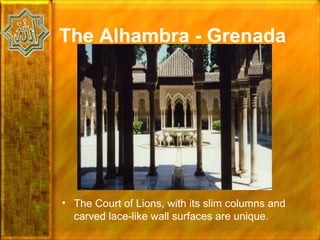
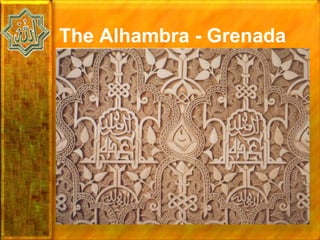
• The Court of Lions, with its slim columns and
  carved lace-like wall surfaces are unique.
The Alhambra - Grenada
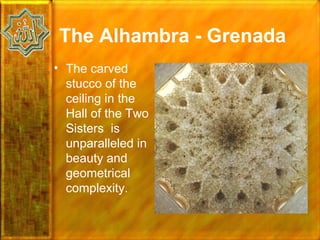
• The carved
  stucco of the
  ceiling in the
  Hall of the Two
  Sisters is
  unparalleled in
  beauty and
  geometrical
  complexity.
The Alhambra - Grenada
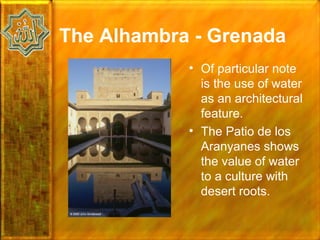
            • Of particular note
              is the use of water
              as an architectural
              feature.
            • The Patio de los
              Aranyanes shows
              the value of water
              to a culture with
              desert roots.
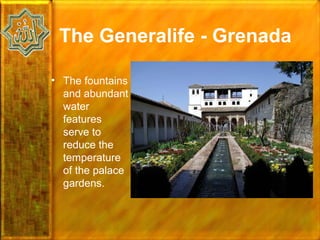
The Generalife - Grenada

• The fountains
  and abundant
  water
  features
  serve to
  reduce the
  temperature
  of the palace
  gardens.
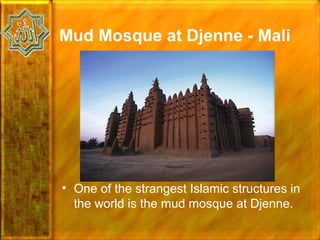
Mud Mosque at Djenne - Mali


• One of the strangest Islamic structures in
  the world is the mud mosque at Djenne.
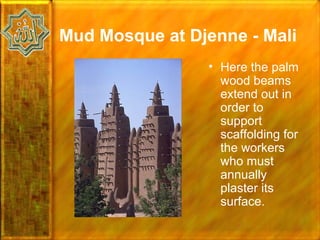
Mud Mosque at Djenne - Mali
                • Here the palm
                  wood beams
                  extend out in
                  order to
                  support
                  scaffolding for
                  the workers
                  who must
                  annually
                  plaster its
                  surface.
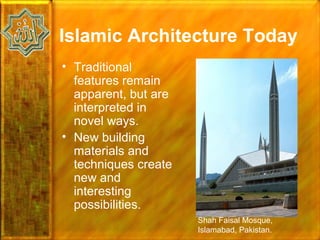
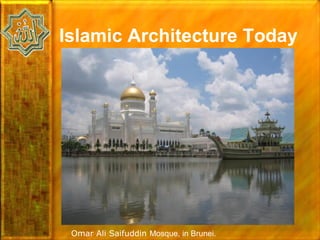
Islamic Architecture Today
• Traditional
  features remain
  apparent, but are
  interpreted in
  novel ways.
• New building
  materials and
  techniques create
  new and
  interesting
  possibilities.
                      Shah Faisal Mosque,
                      Islamabad, Pakistan.
Islamic Architecture Today


 Omar Ali Saifuddin Mosque, in Brunei.
Finis

Islamic Architecture

  • 1.
    IslamIc archItecture Comparative Civilizations 12 K.J. Benoy
  • 2.
    Mosques • The Mostnotable type of building is the mosque. • Originally this was only a large open area where the faithful would gather. • The original mosque was probably the courtyard of Mohammad’s house in Medina.
  • 3.
    Mosques • The courtyard– descendant of the basilica’s atrium and the Egyptian temple court, remains a feature of most mosques today
  • 4.
    Mosques – Within the courtyard is usually an ablution fountain – where the worshipper symbolically washes before prayer.
  • 5.
    Mosques • Certain characteristics are present in most mosques. – The Mihrab, or niche, indicates the Qibla, the direction of Mecca, which the faithful must face when praying.
  • 6.
    Mosques – There is also a minbar, or pulpit, from which sermons are delivered.
  • 7.
    Mosques – Anda minaret, or tower, from which the Muezzin call the faithful to prayer. – Originally this call was made from the main roof of the mosque. – Minarets developed from Christian bell towers. Later they influenced Christian designs.
  • 8.
    Mosques – The social obligations within the religion later led to the addition of madrassa (schools, colleges or universities) attached. – Occasionally there were and are also hospitals.
  • 9.
    Mosques • Moslems borrowed extensively from neighbouring civilization because there was no native Hagia Sophia – converted to a architectural style mosque after the Moslem conquest of Constantinople in Mohammad’s homeland.
  • 10.
    The Blue Mosque- Istanbul • Istanbul’s Blue Mosque is clearly based on the Hagia Sophia. • Mehmet Aga’s 17th century structure rises 77 feet to the top of its central dome.
  • 11.
    The Blue Mosque- Istanbul • It is actually built facing Justinian’s Church, on the site of the old Imperial Palace.
  • 12.
    The Blue Mosque- Istanbul Central dome of Istanbul’s Blue Mosque
  • 13.
    The Blue Mosque- Istanbul Note the massive pendentive and windowed drum.
  • 14.
    The Blue Mosque- Istanbul • The Blue Mosque is more properly known as the Sultan Ahmed Mosque. • Its more common western name comes from the wide use of blue Iznik tiles.
  • 15.
    The Blue Mosque- Istanbul • This mosque is particularly notable for its six minarets.
  • 16.
    The Blue Mosque- Istanbul
  • 17.
    The Blue Mosque- Istanbul • Stained glass creates a magical lighting effect. • However, unlike European stained glass, there are no images of people, due to Mohammad’s prohibition against them.
  • 18.
    The Blue Mosque- Istanbul • It is the magnificent dome and adjoining half- domes that impress most. • Built a thousand years after the Hagia Sophia, the Blue Mosque displays more grace than its predecessor.
  • 19.
    The Great Mosqueat Samarra, Iraq • Regional variations in Islamic architecture reflect local traditions, where they exist. – The Great Mosque at Samarra has a minaret in the style of a Babylonian Ziggurat.
  • 20.
    The Grand Mosque- Mecca • Mecca’s Grand Mosque houses Islam’s most holy site – the Kaaba, which all moslems face to pray. • It features the Kaaba in its massive courtyard.
  • 21.
    The Grand Mosque- Mecca This simple cube-shaped The Black stone at one of building predates Islam, but its corners is, contrary to is a site of pilgrimage for Koranic teaching, millions of moslems. venerated by many Moslems.
  • 22.
    The Dome ofthe Rock - Jerusalem • This is one of Islam’s earliest mosques. • It is built on a site holy to Jews, Christians and Moslems. • Note the Byzantine inspired Central Plan.
  • 23.
    The Dome ofthe Rock - Jerusalem Interior of the Dome of the Rock – where Abraham intended to sacrifice Isaac and where, for a time, Mohammad directed Moslems to face when praying – until Mecca became a Moslem city.
  • 24.
    The Blue Mosque- Isfahan • Iranian mosques frequently used the same blue tiles as was popular in Ottoman Turkey. • However, their Iwan (great Hall) form and characteristic monumental entrances are purely Persian in design.
  • 25.
    Mosque of SheikLotfallah- Isfahan • Note the ornate and characteristically Persian dome. • Note also the tendence toward horror vacui.
  • 26.
    Mogul Architecture • The Moslem conquerors of India developed an architecture of particular grace and grandeur. • Persian domes and great gates appeared throughout northern India.
  • 27.
    Mogul Architecture • SometimesIslamic and Hindu features were fused – as in Akbar’s palace complex at Fatehpur Sikri. • In the pavilion to the right one sees the traditional trabeated Hindu features, merged with Persian domes.
  • 28.
    The Taj Mahal • The most famous Mogul building of all is neither a palace or a mosque. • Rather, it is a mausoleum to house the favourite wife of a mogul emperor.
  • 29.
  • 30.
    The Taj Mahal • Modelled on a mosque, the building is sited in a garden. • The glistening white marble appears almost weightless, despite the volume of masonry.
  • 31.
    The Taj Mahal •Unlike its Persian predecessors, there is no sense of horror vacui. • Rather, the inlaid stone work has a restrained feel of balance and harmony. Floral decoration, and, especially passages from the Koran in magnificent calligraphy, decorate its marble surfaces.
  • 32.
    The Mesquita --Cordoba • In Spain, some of the most exuberant Moslem architecture evolved. • A prime example of this “Moorish” architecture is theMesquite (mosque) in Cordoba.
  • 33.
    The Mesquita -Cordoba • The horseshoe- shaped double arch atop its forest of columns is easily identified. • The double arch helped to increase the vertical height of the ceiling.
  • 34.
  • 35.
    The Mesquita -Cordoba • Close examination of the pillar capitals reveal that they are recycled from earlier buildings – both Roman and Germanic.
  • 36.
    The Mesquita -Cordoba • Another prominent feature is the incredibly intricate arching found in the Mihrab – here called the Capilla de Villaviciosa.
  • 37.
    The Mesquita -Cordoba • The vaulting is also wondrously complex, showing the Arab love of geometry
  • 38.
    The Mesquita -Cordoba • Perhaps the strangest feature of the Mesquita today is th Christian church carved out of the middle of the original mosque. • Yet another example of cultural recycling – but strangely out of keeping with the rest of the building.
  • 39.
    The Alhambra -Grenada • For a time Grenada was the Moorish capital of Spain. • The Alhambra palace complex contains some of the most beautiful Islamic architecture in the world.
  • 40.
    The Alhambra -Grenada • The Court of Lions, with its slim columns and carved lace-like wall surfaces are unique.
  • 41.
  • 42.
    The Alhambra -Grenada • The carved stucco of the ceiling in the Hall of the Two Sisters is unparalleled in beauty and geometrical complexity.
  • 43.
    The Alhambra -Grenada • Of particular note is the use of water as an architectural feature. • The Patio de los Aranyanes shows the value of water to a culture with desert roots.
  • 44.
    The Generalife -Grenada • The fountains and abundant water features serve to reduce the temperature of the palace gardens.
  • 45.
    Mud Mosque atDjenne - Mali • One of the strangest Islamic structures in the world is the mud mosque at Djenne.
  • 46.
    Mud Mosque atDjenne - Mali • Here the palm wood beams extend out in order to support scaffolding for the workers who must annually plaster its surface.
  • 47.
    Islamic Architecture Today •Traditional features remain apparent, but are interpreted in novel ways. • New building materials and techniques create new and interesting possibilities. Shah Faisal Mosque, Islamabad, Pakistan.
  • 48.
    Islamic Architecture Today Omar Ali Saifuddin Mosque, in Brunei.
  • 49.