Islamic Mosque
Architecture
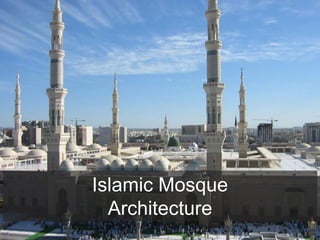
Masji Al-Nabawi, Medina -- the second holiest mosque in Islam, it marks the final
resting place of the prophet Muhammad
A mosque (masjid in Arabic) is a place where Muslims can gather for prayer
Muslim religious practices do not require ceremonial space
Muslim prayer can be conducted anywhere: all you need to know is which direction
faces towards Mecca
But on Fridays, Muslims gather together for communal prayer, and the mosque
provides a non-hierarchical space in which to do this
Standard elements of the Muslim Mosque includes the Sahn, or courtyard, and an
ablutions fountain
The fountain is used for cleansing before prayer
The Minaret is a tower used by the Muezzin to call the faithful to prayer
It is similar to Christian bell towers, that are similarly used to announce the time for
worship
Inside the Mosque, there is a Qibla wall that faces in the direction of Mecca
The Mihrab is an indentation in the wall that faces in the direction of Mecca
It usually takes the form of a decorated niche, and simply indicates which direction to
pray
The Minbar is a structure located next to the Mihrab
Similar to a pulpit in a Christian church, the Minbar is where the prayer leader, or
Imam, gives the Friday sermon
This is a Mihrab from a mosque in Isfahan, Iran – and is currently in the Metropolitan
Museum of Art
It exhibits several typical features of Islamic art
The pointed arch was a variant on the Roman arch, and is a distinctive element of
Islamic architecture
The decoration of the niche is made with ceramic tiles, a common material in Islamic
decoration
The decorative motifs include geometric patterns, stylized plant forms, and calligraphy
– all of which were common in Islamic ornamentation
The Mihrab is similar to the apse of a Christian church, in that it provides a focal point
for prayer
But a major difference is that in Islamic religious architecture, figural imagery is strictly
forbidden
Great Mosque, Damascus, Syria, 706-715
One of the oldest surviving Islamic mosques is the Great Mosque of Damascus, built
by the Umayyad Caliphs in the 8th century
Just as Early Christians re-purposed the Roman basilica for the Early Christian church,
Islamic architects also appropriated Roman models for their mosques
Great Mosque, Damascus, Syria, 706-715
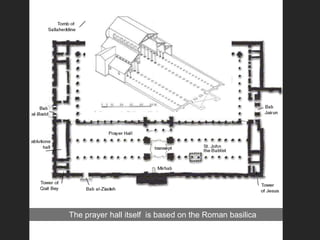
The Great Mosque at Damascus is preceded by a Sahn, with an ablutions fountain
The piers with arches surrounding the courtyard resemble Roman aqueducts
The prayer hall itself is based on the Roman basilica
The interior has Corinthian columns, and Roman-style arches
Great Mosque, Kairouan, Tunisia, c, 836-875
The Great Mosque at Kairouan, Tunisia is an example of a hypostyle mosque
The mosque is preceded by a courtyard, with a minaret tower, and the prayer hall itself
is a broad rectangular building
It is called a “hypostyle” mosque, because inside the prayer hall the roof is held up be
a forest of columns
Inside the mosque we see Corinthian columns, and a variation on the standard Roman
round arch
Islamic architects introduced the Horseshoe arch – a variation on the Roman arch, and
distinctive of Islamic architecture
Mihrab from the Madrasa Imami, Isfahan, Iran, c. 1354
Glazed tilework
Metropolitan Museum
The Pointed, or “ogival” arch, was another distinctively Islamic variation
Great Mosque, Córdoba, Spain, 8thc
A spectacular hypostyle mosque was built by the Umayyad Caliphs of Spain
Great Mosque, Córdoba, Spain, 8thc
It is the largest mosque in the Islamic west
The prayer hall has 514 columns, topped by double-tiered arches
Here we see the distinctive use of the horseshoe arch
And Roman-style Corinthian columns
Great Mosque, Isfahan, Iran; begun 1073
In the 11th century the four-iwan mosque replaced the hypostyle mosque
Great Mosque, Isfahan, Iran; begun 1073
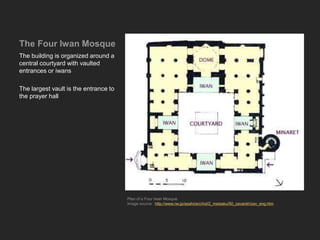
The “iwans” refer to the monumental entrances off the central courtyard
The Four Iwan Mosque
The building is organized around a
central courtyard with vaulted
entrances or iwans
The largest vault is the entrance to
the prayer hall
Plan of a Four Iwan Mosque
Image source: http://www.ne.jp/asahi/arc/ind/2_meisaku/50_zavareh/zav_eng.htm
The entrances and the onion-shaped dome are decorated with intricately patterned
ceramic tiles
Here we see the three major elements of Islamic ornamentation: geometric patterns,
vegetal patterns, and calligraphy
This is a view of one of the domes from the interior
Image source: http://travel.webshots.com/photo/1475927287015862856xWIKOd
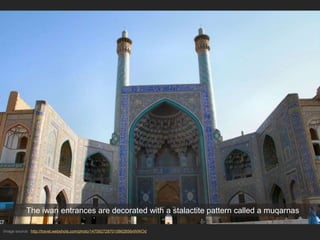
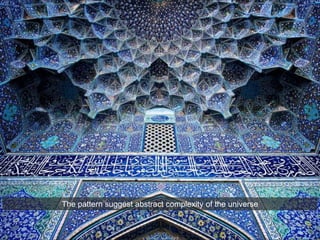
The iwan entrances are decorated with a stalactite pattern called a muqarnas
The complex patterns of the muqarnas extends the use of geometric pattern to
architecture
The pattern suggest abstract complexity of the universe
Sinan the Great,
Mosque of Selim II,
Edirne, Turkey, 1568-
1575
One of the greatest Islamic architects was Sinan the Great, who built the Mosque of
Selim II, in Turkey
Based on the Hagia Sophia (which it rivals in size), the building is an example of a
central plan mosque
It is spectacular in it decoration and design
Watch the Smarthistory discussion to learn more

Islamic Mosque Architecture

  • 1.
  • 2.
    Masji Al-Nabawi, Medina-- the second holiest mosque in Islam, it marks the final resting place of the prophet Muhammad A mosque (masjid in Arabic) is a place where Muslims can gather for prayer
  • 3.
    Muslim religious practicesdo not require ceremonial space
  • 4.
    Muslim prayer canbe conducted anywhere: all you need to know is which direction faces towards Mecca
  • 5.
    But on Fridays,Muslims gather together for communal prayer, and the mosque provides a non-hierarchical space in which to do this
  • 6.
    Standard elements ofthe Muslim Mosque includes the Sahn, or courtyard, and an ablutions fountain
  • 7.
    The fountain isused for cleansing before prayer
  • 8.
    The Minaret isa tower used by the Muezzin to call the faithful to prayer
  • 9.
    It is similarto Christian bell towers, that are similarly used to announce the time for worship
  • 10.
    Inside the Mosque,there is a Qibla wall that faces in the direction of Mecca
  • 11.
    The Mihrab isan indentation in the wall that faces in the direction of Mecca
  • 12.
    It usually takesthe form of a decorated niche, and simply indicates which direction to pray
  • 13.
    The Minbar isa structure located next to the Mihrab
  • 14.
    Similar to apulpit in a Christian church, the Minbar is where the prayer leader, or Imam, gives the Friday sermon
  • 15.
    This is aMihrab from a mosque in Isfahan, Iran – and is currently in the Metropolitan Museum of Art
  • 16.
    It exhibits severaltypical features of Islamic art
  • 17.
    The pointed archwas a variant on the Roman arch, and is a distinctive element of Islamic architecture
  • 18.
    The decoration ofthe niche is made with ceramic tiles, a common material in Islamic decoration
  • 19.
    The decorative motifsinclude geometric patterns, stylized plant forms, and calligraphy – all of which were common in Islamic ornamentation
  • 20.
    The Mihrab issimilar to the apse of a Christian church, in that it provides a focal point for prayer
  • 21.
    But a majordifference is that in Islamic religious architecture, figural imagery is strictly forbidden
  • 22.
    Great Mosque, Damascus,Syria, 706-715 One of the oldest surviving Islamic mosques is the Great Mosque of Damascus, built by the Umayyad Caliphs in the 8th century
  • 23.
    Just as EarlyChristians re-purposed the Roman basilica for the Early Christian church, Islamic architects also appropriated Roman models for their mosques
  • 24.
    Great Mosque, Damascus,Syria, 706-715 The Great Mosque at Damascus is preceded by a Sahn, with an ablutions fountain
  • 26.
    The piers witharches surrounding the courtyard resemble Roman aqueducts
  • 27.
    The prayer hallitself is based on the Roman basilica
  • 28.
    The interior hasCorinthian columns, and Roman-style arches
  • 29.
    Great Mosque, Kairouan,Tunisia, c, 836-875 The Great Mosque at Kairouan, Tunisia is an example of a hypostyle mosque
  • 30.
    The mosque ispreceded by a courtyard, with a minaret tower, and the prayer hall itself is a broad rectangular building
  • 31.
    It is calleda “hypostyle” mosque, because inside the prayer hall the roof is held up be a forest of columns
  • 32.
    Inside the mosquewe see Corinthian columns, and a variation on the standard Roman round arch
  • 33.
    Islamic architects introducedthe Horseshoe arch – a variation on the Roman arch, and distinctive of Islamic architecture
  • 34.
    Mihrab from theMadrasa Imami, Isfahan, Iran, c. 1354 Glazed tilework Metropolitan Museum The Pointed, or “ogival” arch, was another distinctively Islamic variation
  • 35.
    Great Mosque, Córdoba,Spain, 8thc A spectacular hypostyle mosque was built by the Umayyad Caliphs of Spain
  • 36.
    Great Mosque, Córdoba,Spain, 8thc It is the largest mosque in the Islamic west
  • 37.
    The prayer hallhas 514 columns, topped by double-tiered arches
  • 38.
    Here we seethe distinctive use of the horseshoe arch
  • 39.
  • 40.
    Great Mosque, Isfahan,Iran; begun 1073 In the 11th century the four-iwan mosque replaced the hypostyle mosque
  • 41.
    Great Mosque, Isfahan,Iran; begun 1073 The “iwans” refer to the monumental entrances off the central courtyard
  • 42.
    The Four IwanMosque The building is organized around a central courtyard with vaulted entrances or iwans The largest vault is the entrance to the prayer hall Plan of a Four Iwan Mosque Image source: http://www.ne.jp/asahi/arc/ind/2_meisaku/50_zavareh/zav_eng.htm
  • 43.
    The entrances andthe onion-shaped dome are decorated with intricately patterned ceramic tiles
  • 44.
    Here we seethe three major elements of Islamic ornamentation: geometric patterns, vegetal patterns, and calligraphy
  • 45.
    This is aview of one of the domes from the interior
  • 46.
    Image source: http://travel.webshots.com/photo/1475927287015862856xWIKOd Theiwan entrances are decorated with a stalactite pattern called a muqarnas
  • 47.
    The complex patternsof the muqarnas extends the use of geometric pattern to architecture
  • 48.
    The pattern suggestabstract complexity of the universe
  • 50.
    Sinan the Great, Mosqueof Selim II, Edirne, Turkey, 1568- 1575 One of the greatest Islamic architects was Sinan the Great, who built the Mosque of Selim II, in Turkey
  • 51.
    Based on theHagia Sophia (which it rivals in size), the building is an example of a central plan mosque
  • 52.
    It is spectacularin it decoration and design
  • 53.
    Watch the Smarthistorydiscussion to learn more