ISLAMIC MOSQUE
SUBMITTED BY
VAIBHAV MUDGAL
B.Arch 3rd Year
Ideal School of Architecture
Introduction
• A Mosque/Masjid is a place of worship for the followers of islam.
• Most of the mosques have a particular architectural features which in todays time
has become a identity which are elaborated Domes, Minarets & Prayer halls.
• The mosque played a major role in the spread of education in Muslim world and
this has been its main characteristics throughout the history.
• Since the earliest days mosque has been a centre of muslim community, a place
of prayer only.
• In a mosque there are strict restriction on the uses of the area formally
demarcated as mosque.
• Mecca is considered to be the first mosque ever built.
• It is situated in Hejaz, Saudi Arabia.
• The Mosque is built around the house of Prophet
Muhammad
The Architectural Features of a Mosque
• The architecture of a mosque is shaped most strongly by the regional traditions
of the time and place where it was built. As a result, style, layout, and decoration
can vary greatly.
• Nevertheless, because of the common function of the mosque as a place of
congregational prayer, certain architectural features appear in mosques all over
the world which are mentioned down below:
• Prayer Hall
• Sahn
• Mihareb
• Minaret
• Qubba
Prayer Hall
• The large central area for prayer is called a musalla. No furniture is needed, as
worshippers sit, kneel, and bow directly on the floor,a few chairs or benches to
assist elderly or disabled worshippers.
Sahn (courtyard)
• The most fundamental necessity of congregational mosque architecture is that it
be able to hold the entire male population of a city or town. In many mosques
prayer hall is adjoined to an open courtyard, called a sahn. Within the courtyard
one often finds a fountain, its waters both a welcome respite in hot lands, and
important for the ablutions (ritual cleansing) done before prayer.
Fountain
Open Courtyard
Mihrab (niche)
• Another essential element of a mosque is a mihrab—a niche in the wall that
indicates the direction of Mecca, towards which all Muslims pray.
• The direction of Mecca is called the qibla,and so the wall
in which the mihrab is set is called the qibla wall.
• No matter where a mosque is, its mihrab indicates
the direction of Mecca (or as near that direction
as science and geography were able to place it).
Therefore, a mihrab in India will be to the west.
Minaret (tower)
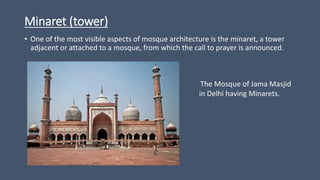
• One of the most visible aspects of mosque architecture is the minaret, a tower
adjacent or attached to a mosque, from which the call to prayer is announced.
The Mosque of Jama Masjid
in Delhi having Minarets.
• Minarets take many different forms—from the famous spiral minaret of Samarra,
to the tall, pencil minarets of Ottoman Turkey. Not solely functional in nature, the
minaret serves as a powerful visual reminder of the presence of Islam.
The Sultan Ahmed
Mosque or Blue
Mosque in Turkey.
Qubba (dome)
• Most mosques also feature one or more domes, called qubba in Arabic.
• While not a ritual requirement like the mihrab, a dome does possess significance
within the mosque—as a symbolic representation of the vault of heaven.
• Some mosque types incorporate multiple domes.
The Sultan Ahmed
Mosque showing multiple
domes.
• The interior decoration of a dome often emphasizes this symbolism,
using intricate geometric, stellate, or vegetal motifs to create
breathtaking patterns meant to awe and inspire.
Some Famous Mosque Around the world
Al-Masjid an-Nabawi – Medina, Saudi Arabia
Sultan Ahmed Mosque or Blue Mosque-Turkey
Biblography
• https://www.khanacademy.org/humanities/art-islam/beginners-
guide-islamic/a/introduction-to-mosque-architecture
• Picture-en.wikipedia.org
• defence.pk
• Transworldexpedition
• http://www.metmuseum.org/learn/for-educators/publications-for-
educators/art-of-the-islamic-world/unit-one/the-mosque
• http://religions.iloveindia.com/mosques/
THANK YOU

Islamic Mosque

  • 1.
    ISLAMIC MOSQUE SUBMITTED BY VAIBHAVMUDGAL B.Arch 3rd Year Ideal School of Architecture
  • 2.
    Introduction • A Mosque/Masjidis a place of worship for the followers of islam. • Most of the mosques have a particular architectural features which in todays time has become a identity which are elaborated Domes, Minarets & Prayer halls. • The mosque played a major role in the spread of education in Muslim world and this has been its main characteristics throughout the history. • Since the earliest days mosque has been a centre of muslim community, a place of prayer only. • In a mosque there are strict restriction on the uses of the area formally demarcated as mosque.
  • 3.
    • Mecca isconsidered to be the first mosque ever built. • It is situated in Hejaz, Saudi Arabia. • The Mosque is built around the house of Prophet Muhammad
  • 4.
    The Architectural Featuresof a Mosque • The architecture of a mosque is shaped most strongly by the regional traditions of the time and place where it was built. As a result, style, layout, and decoration can vary greatly. • Nevertheless, because of the common function of the mosque as a place of congregational prayer, certain architectural features appear in mosques all over the world which are mentioned down below: • Prayer Hall • Sahn • Mihareb • Minaret • Qubba
  • 5.
    Prayer Hall • Thelarge central area for prayer is called a musalla. No furniture is needed, as worshippers sit, kneel, and bow directly on the floor,a few chairs or benches to assist elderly or disabled worshippers.
  • 6.
    Sahn (courtyard) • Themost fundamental necessity of congregational mosque architecture is that it be able to hold the entire male population of a city or town. In many mosques prayer hall is adjoined to an open courtyard, called a sahn. Within the courtyard one often finds a fountain, its waters both a welcome respite in hot lands, and important for the ablutions (ritual cleansing) done before prayer. Fountain Open Courtyard
  • 7.
    Mihrab (niche) • Anotheressential element of a mosque is a mihrab—a niche in the wall that indicates the direction of Mecca, towards which all Muslims pray. • The direction of Mecca is called the qibla,and so the wall in which the mihrab is set is called the qibla wall. • No matter where a mosque is, its mihrab indicates the direction of Mecca (or as near that direction as science and geography were able to place it). Therefore, a mihrab in India will be to the west.
  • 8.
    Minaret (tower) • Oneof the most visible aspects of mosque architecture is the minaret, a tower adjacent or attached to a mosque, from which the call to prayer is announced. The Mosque of Jama Masjid in Delhi having Minarets.
  • 9.
    • Minarets takemany different forms—from the famous spiral minaret of Samarra, to the tall, pencil minarets of Ottoman Turkey. Not solely functional in nature, the minaret serves as a powerful visual reminder of the presence of Islam. The Sultan Ahmed Mosque or Blue Mosque in Turkey.
  • 10.
    Qubba (dome) • Mostmosques also feature one or more domes, called qubba in Arabic. • While not a ritual requirement like the mihrab, a dome does possess significance within the mosque—as a symbolic representation of the vault of heaven. • Some mosque types incorporate multiple domes. The Sultan Ahmed Mosque showing multiple domes.
  • 11.
    • The interiordecoration of a dome often emphasizes this symbolism, using intricate geometric, stellate, or vegetal motifs to create breathtaking patterns meant to awe and inspire.
  • 12.
    Some Famous MosqueAround the world Al-Masjid an-Nabawi – Medina, Saudi Arabia
  • 13.
    Sultan Ahmed Mosqueor Blue Mosque-Turkey
  • 14.
    Biblography • https://www.khanacademy.org/humanities/art-islam/beginners- guide-islamic/a/introduction-to-mosque-architecture • Picture-en.wikipedia.org •defence.pk • Transworldexpedition • http://www.metmuseum.org/learn/for-educators/publications-for- educators/art-of-the-islamic-world/unit-one/the-mosque • http://religions.iloveindia.com/mosques/
  • 15.