The History of the Internet
History of the Internet and the World Wide Web I   nternet vs.  i   nternet An internet (small “i”)  refers to  any  network of computers The Internet (large “I”) is a specific name Given to the communication network comprised of hundreds of thousands of inter-connected networks … .
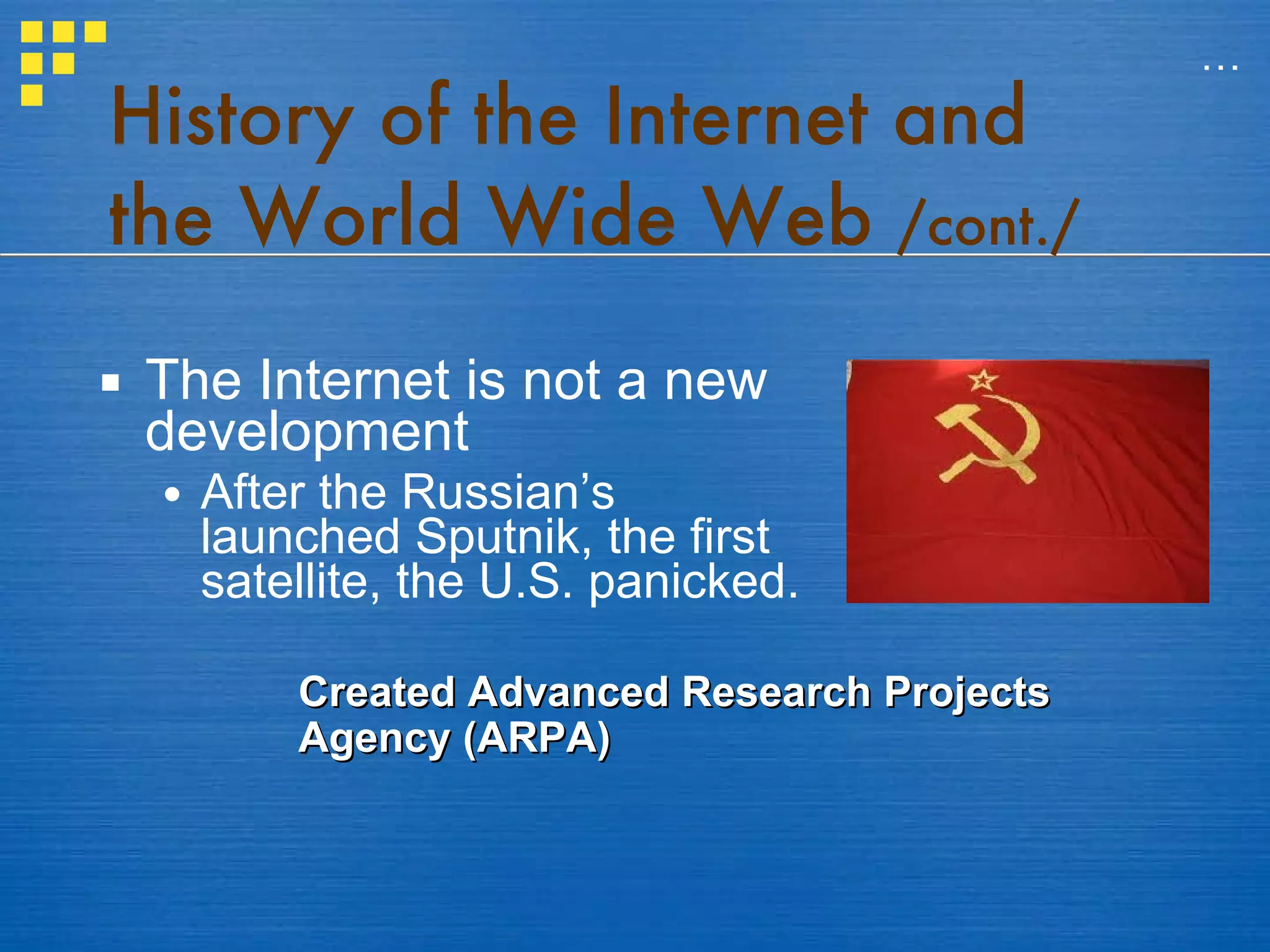
History of the Internet and the World Wide Web  /cont./ The Internet is not a new development After the Russian’s launched Sputnik, the first satellite, the U.S. panicked.  … Created Advanced Research Projects Agency (ARPA)
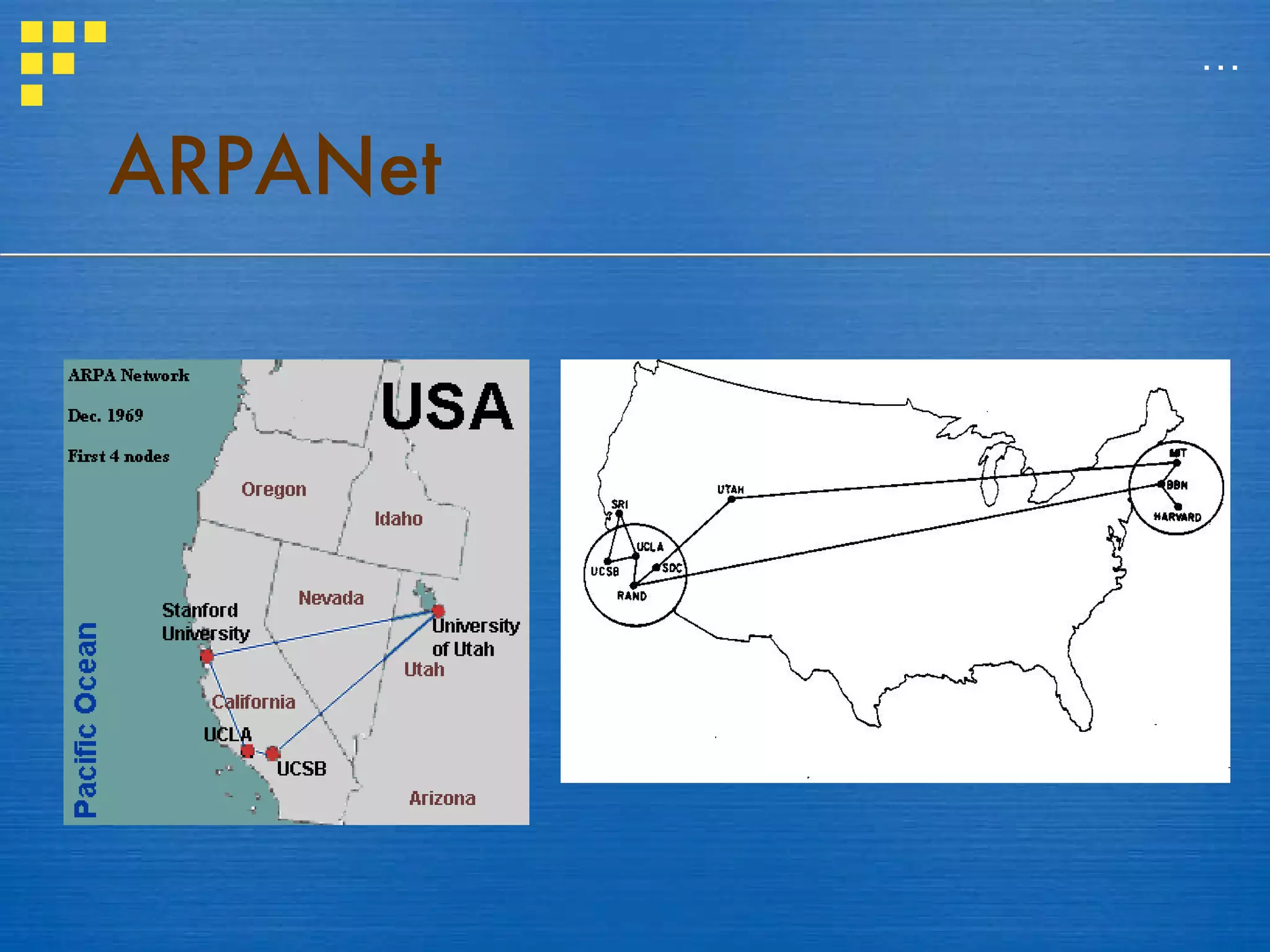
History of the Internet and the World Wide Web  /cont./ The  Department of Defense  got together with the Massachusetts Institute of Technology  (MIT)  and created… ARPAnet  (Advanced Research Projects Agency) to develop an alternative communication system that could enable the military to function in the event of a nuclear strike. …
ARPANet …
History of the Internet and the World Wide Web  /cont./ 1970’s brought about Stanford University’s testing and development of early internet protocols Vinton Cerf -- Father of the Internet 1980’s & National Science Foundation NSF obtained control of network for government and educational use ..
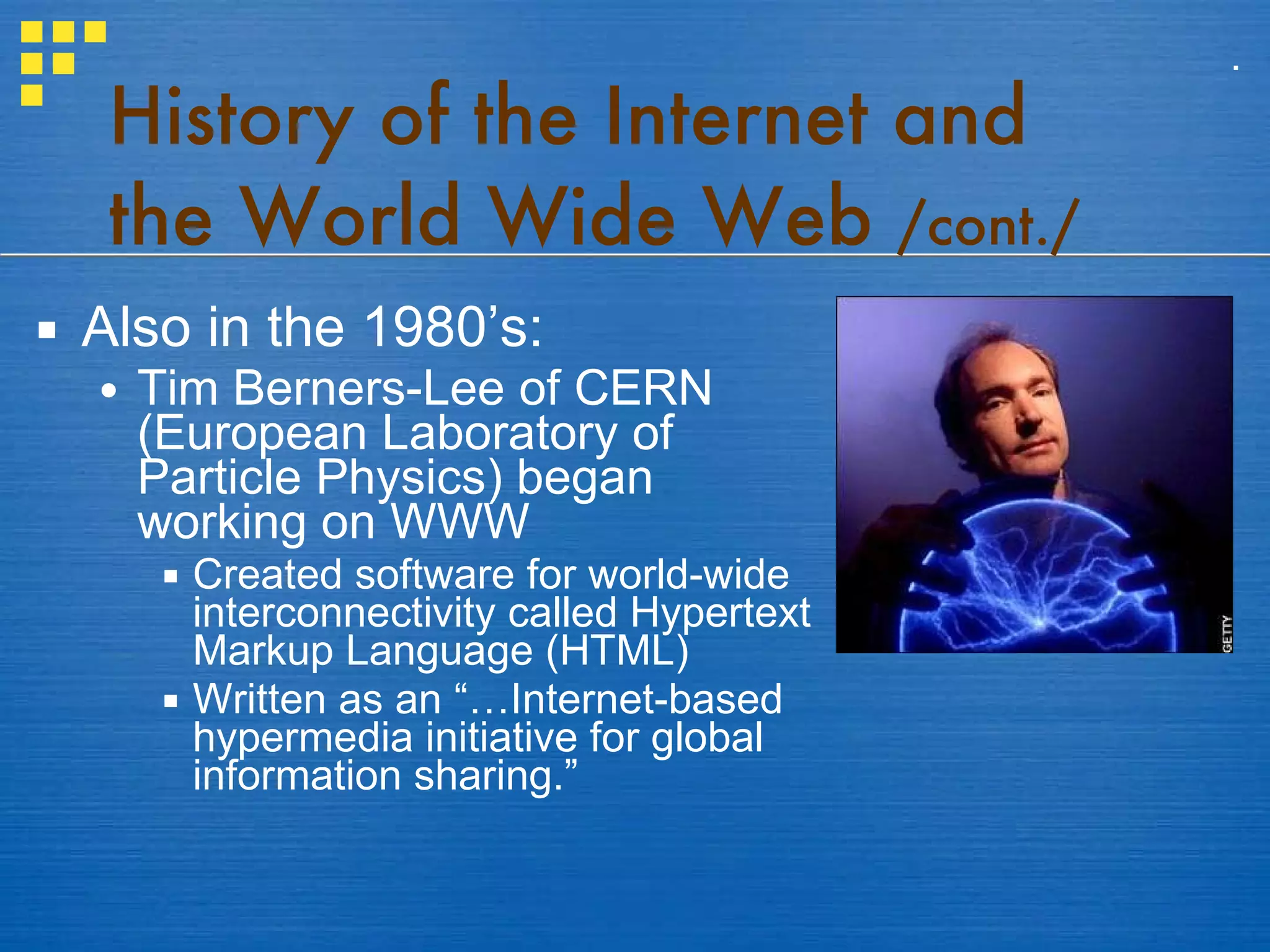
History of the Internet and the World Wide Web  /cont./ Also in the 1980’s: Tim Berners-Lee of CERN (European Laboratory of Particle Physics) began working on WWW Created software for world-wide interconnectivity called Hypertext Markup Language (HTML) Written as an “…Internet-based hypermedia initiative for global information sharing.” .
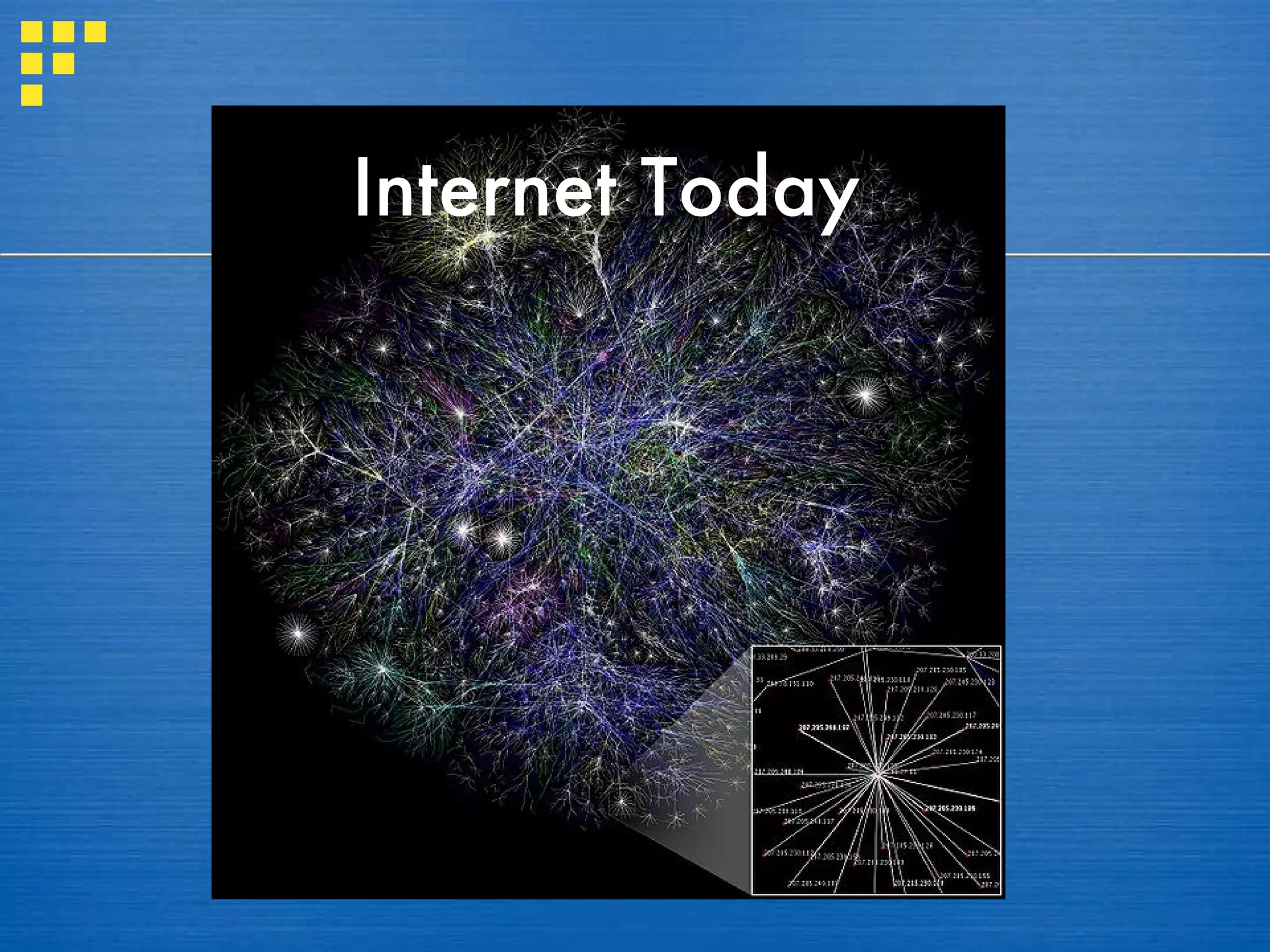
Internet Today
History of the Internet and the World Wide Web  /cont./ Internet surfing --  pre-browser era Before the Web, information retrieval was accomplished through a number of complicated steps and commands Difficult Time consuming Required greater-than-normal understanding of computing in order to operate “ Private” until 1993 with the birth of Mosaic
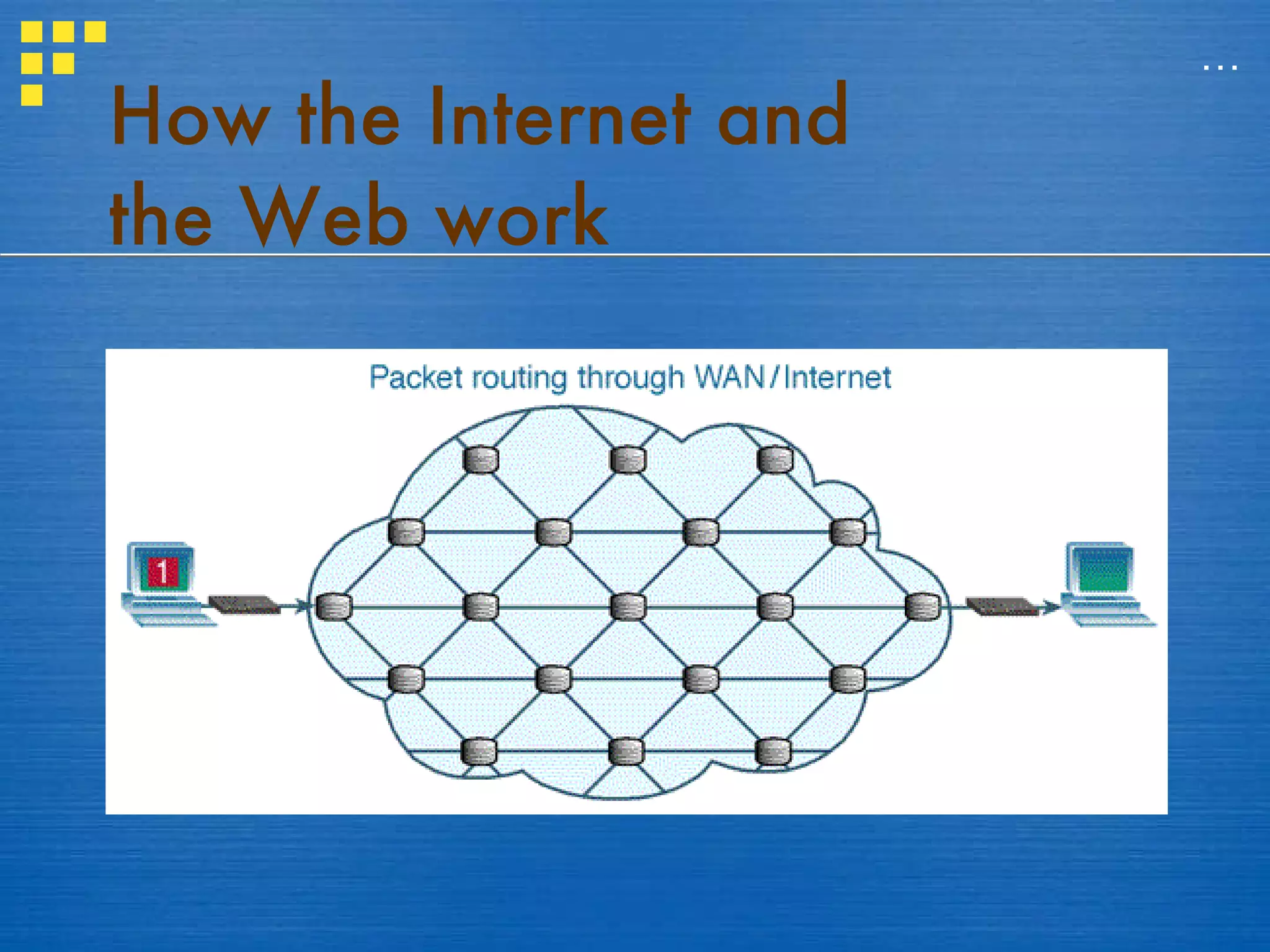
How the Internet and  the Web work The internet as a Packet-Switched network Bundles of data are broken up, transmitted, and reassembled at the other end Transmitted data are mixed together with all the other data on the internet until it reaches it final destination …
How the Internet and  the Web work …
How the Internet and  the Web work  /cont./ Data flows through the internet via many interconnected computers Clients, Servers, and Routers Clients: Originating User’s Computer Server: Powerful, Continuous Internet Access Router: Computers that link networks together ..
How the Internet and  the Web work  /cont./ TCP/IP Sets definitions for how data transmission takes place. TCP (Transmission Control Protocols) Defines  how  computers communicate with each other IP (Internet Protocols) Tells routers how to reassemble data packets .
How the Internet and  the Web work  /cont./ Several types of Internet Protocols: HTTP (Hypertext Transfer Protocol) WWW Documents WAIS (Wide Area Info System Protocol) Rules for accessing text-only file indices FTP (File Transfer Protocol) Data transfer from one computer to another Telnet (Terminal Emulation Protocol) Used when logging into another system
Connecting to the Internet Internet Service Providers (ISP’s) Flashnet, EV1, PDQ.net A company that provides the connection between remote locations and the internet The two most important ISP Services: Fast, reliable service with no busy signals Reliable email delivery in less than 5 minutes Individuals pay a monthly subscription rate for permission to dial-in to their server … ..
Connecting to the Internet  /cont./ Online Services AOL, CompuServe, Prodigy ISP’s on steroids Provide extra services in addition to the plain “net connection” On-line databases Govt. and Commercial information Search engines Many Online Services provide their own browsers … .
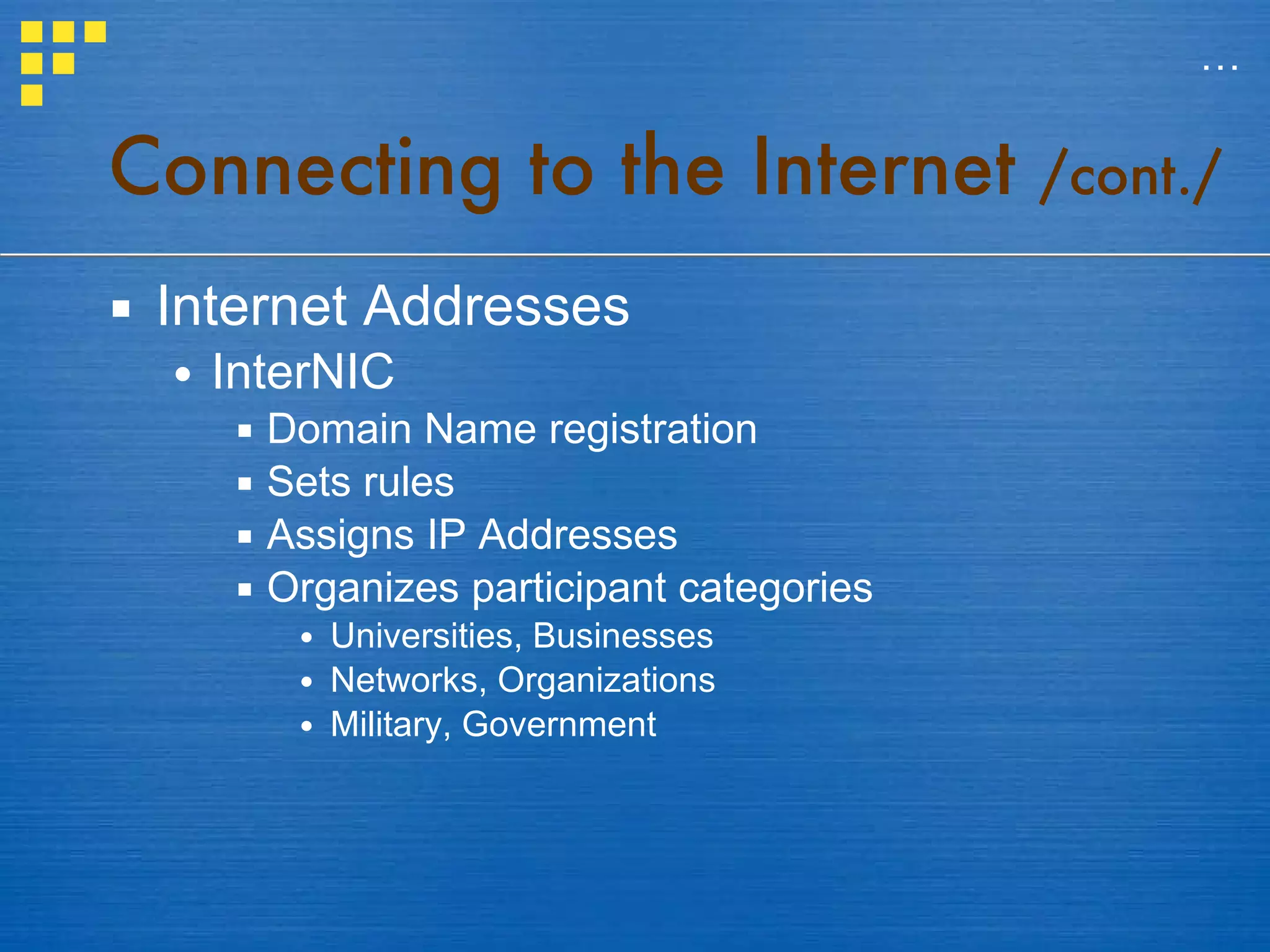
Internet Addresses InterNIC Domain Name registration Sets rules Assigns IP Addresses Organizes participant categories Universities, Businesses Networks, Organizations Military, Government Connecting to the Internet  /cont./ …
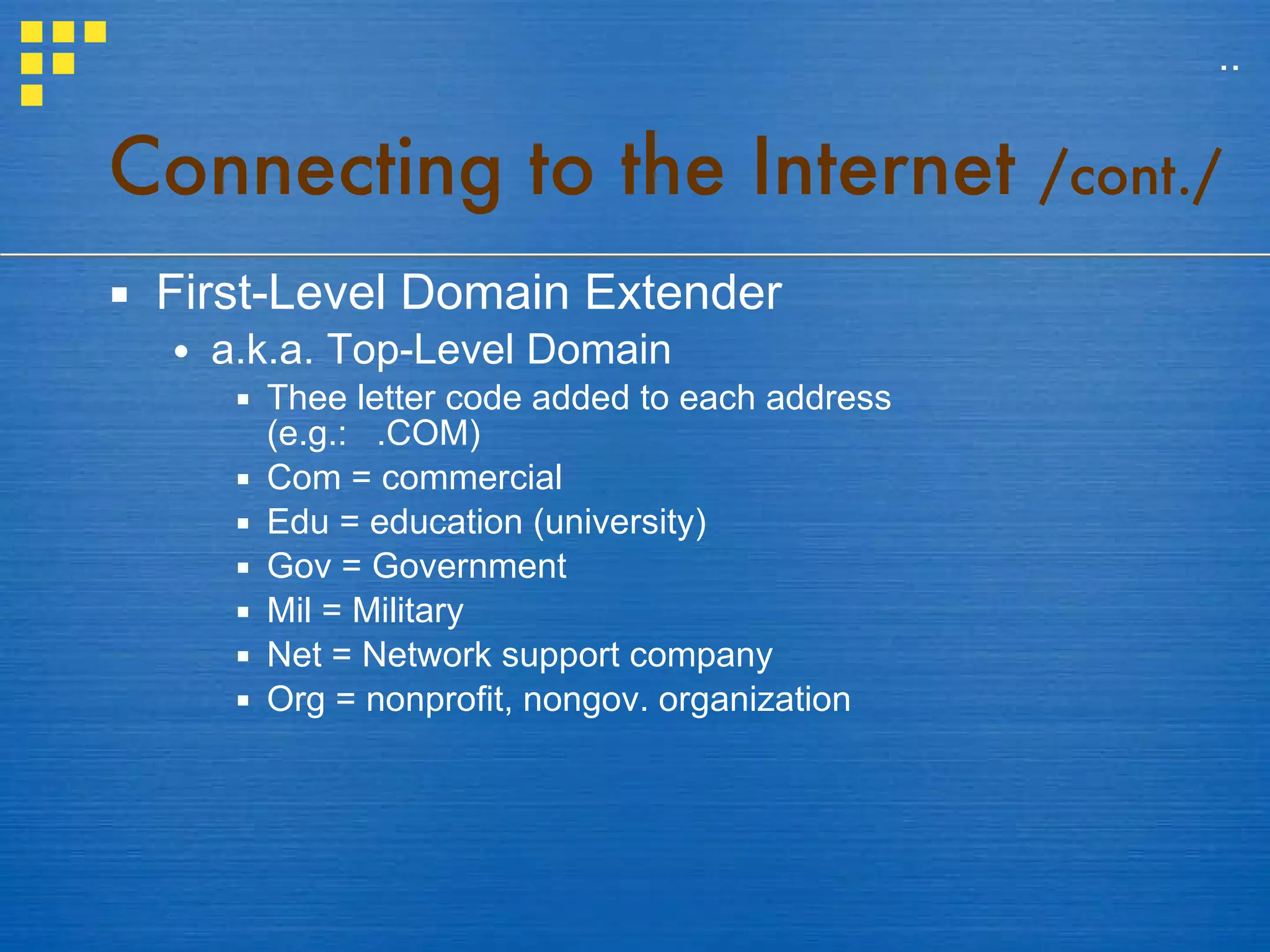
First-Level Domain Extender a.k.a. Top-Level Domain Thee letter code added to each address  (e.g.:  .COM) Com = commercial Edu = education (university) Gov = Government Mil = Military Net = Network support company Org = nonprofit, nongov. organization Connecting to the Internet  /cont./ ..
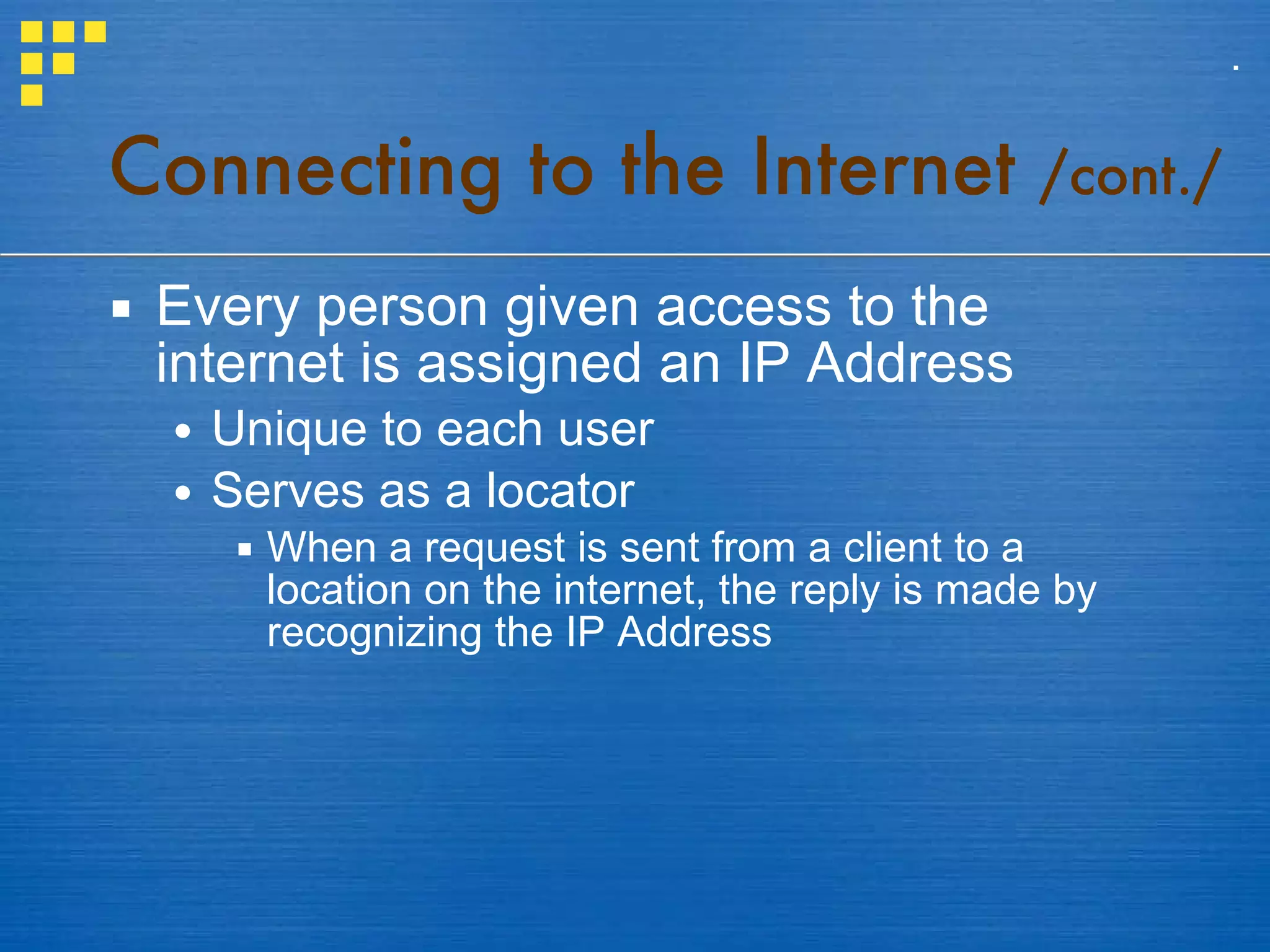
Every person given access to the internet is assigned an IP Address Unique to each user Serves as a locator When a request is sent from a client to a location on the internet, the reply is made by recognizing the IP Address Connecting to the Internet  /cont./ .
Internet Addresses (aka Canonical Addresses) are associated with the IP Address Registered at the same time Also called DNS (Domain Name System) [email_address] (e.g.: smccombs@uh.edu) Connecting to the Internet  /cont./
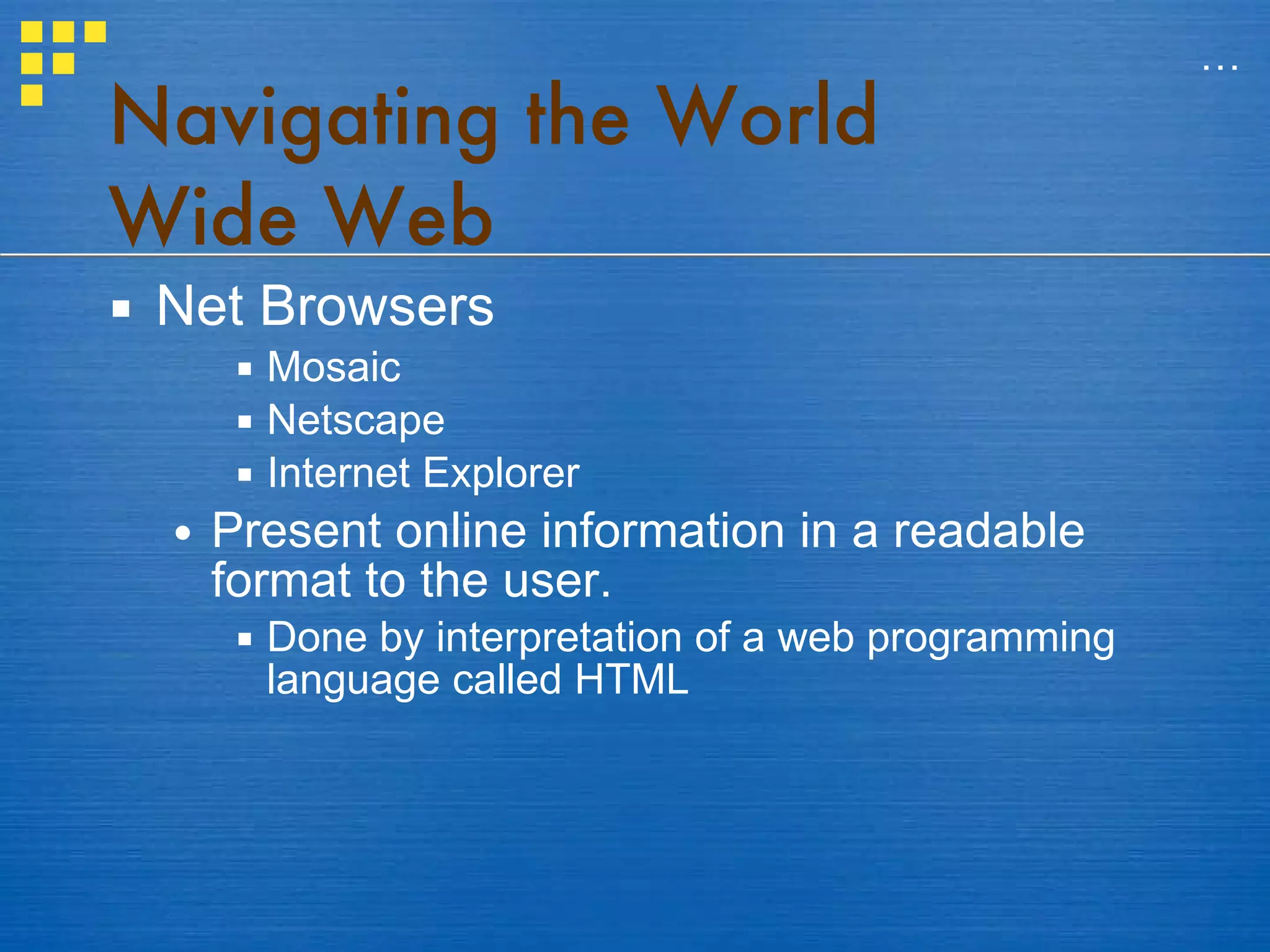
Navigating the World Wide Web Net Browsers Mosaic Netscape Internet Explorer Present online information in a readable format to the user. Done by interpretation of a web programming language called HTML …
Navigating the World Wide Web  /cont./ Hypertext Markup Language (HTML) World Wide Web Programming Language Consists of a series of commands that tell browsers how to read and present data to the user. Uses tags to accomplish page formatting Not actually a programming language Lacks compiling ability ..
Making Web Pages Dynamic Scripting Web Programming using JAVA or VBScript Used in conjunction with HTML HTML = Static SCRIPTING = Dynamic JavaScript, VBScript programming code written within HTML Document that causes interactivity Navigating the World Wide Web  /cont./ .
Moving around the web: Two Methods Hot Links and Buttons Links are hidden HTML commands that, when activated, can take a user to another web site  URL The URL (Uniform Resource Locator) is the HTML’s specific web address URL by Bookmarking or Favorites Navigating the World Wide Web  /cont./
Web Browser Selection Personal Preference Although some determining factors: Security Size of browser Cost Not really an issue any more Compatibility
End Chapter 1 Presentation The Internet and the World Wide Web

History & Basic Structure of the Internet

  • 1.
    The History ofthe Internet
  • 2.
    History of theInternet and the World Wide Web I nternet vs. i nternet An internet (small “i”) refers to any network of computers The Internet (large “I”) is a specific name Given to the communication network comprised of hundreds of thousands of inter-connected networks … .
  • 3.
    History of theInternet and the World Wide Web /cont./ The Internet is not a new development After the Russian’s launched Sputnik, the first satellite, the U.S. panicked. … Created Advanced Research Projects Agency (ARPA)
  • 4.
    History of theInternet and the World Wide Web /cont./ The Department of Defense got together with the Massachusetts Institute of Technology (MIT) and created… ARPAnet (Advanced Research Projects Agency) to develop an alternative communication system that could enable the military to function in the event of a nuclear strike. …
  • 5.
  • 6.
    History of theInternet and the World Wide Web /cont./ 1970’s brought about Stanford University’s testing and development of early internet protocols Vinton Cerf -- Father of the Internet 1980’s & National Science Foundation NSF obtained control of network for government and educational use ..
  • 7.
    History of theInternet and the World Wide Web /cont./ Also in the 1980’s: Tim Berners-Lee of CERN (European Laboratory of Particle Physics) began working on WWW Created software for world-wide interconnectivity called Hypertext Markup Language (HTML) Written as an “…Internet-based hypermedia initiative for global information sharing.” .
  • 8.
  • 9.
    History of theInternet and the World Wide Web /cont./ Internet surfing -- pre-browser era Before the Web, information retrieval was accomplished through a number of complicated steps and commands Difficult Time consuming Required greater-than-normal understanding of computing in order to operate “ Private” until 1993 with the birth of Mosaic
  • 10.
    How the Internetand the Web work The internet as a Packet-Switched network Bundles of data are broken up, transmitted, and reassembled at the other end Transmitted data are mixed together with all the other data on the internet until it reaches it final destination …
  • 11.
    How the Internetand the Web work …
  • 12.
    How the Internetand the Web work /cont./ Data flows through the internet via many interconnected computers Clients, Servers, and Routers Clients: Originating User’s Computer Server: Powerful, Continuous Internet Access Router: Computers that link networks together ..
  • 13.
    How the Internetand the Web work /cont./ TCP/IP Sets definitions for how data transmission takes place. TCP (Transmission Control Protocols) Defines how computers communicate with each other IP (Internet Protocols) Tells routers how to reassemble data packets .
  • 14.
    How the Internetand the Web work /cont./ Several types of Internet Protocols: HTTP (Hypertext Transfer Protocol) WWW Documents WAIS (Wide Area Info System Protocol) Rules for accessing text-only file indices FTP (File Transfer Protocol) Data transfer from one computer to another Telnet (Terminal Emulation Protocol) Used when logging into another system
  • 15.
    Connecting to theInternet Internet Service Providers (ISP’s) Flashnet, EV1, PDQ.net A company that provides the connection between remote locations and the internet The two most important ISP Services: Fast, reliable service with no busy signals Reliable email delivery in less than 5 minutes Individuals pay a monthly subscription rate for permission to dial-in to their server … ..
  • 16.
    Connecting to theInternet /cont./ Online Services AOL, CompuServe, Prodigy ISP’s on steroids Provide extra services in addition to the plain “net connection” On-line databases Govt. and Commercial information Search engines Many Online Services provide their own browsers … .
  • 17.
    Internet Addresses InterNICDomain Name registration Sets rules Assigns IP Addresses Organizes participant categories Universities, Businesses Networks, Organizations Military, Government Connecting to the Internet /cont./ …
  • 18.
    First-Level Domain Extendera.k.a. Top-Level Domain Thee letter code added to each address (e.g.: .COM) Com = commercial Edu = education (university) Gov = Government Mil = Military Net = Network support company Org = nonprofit, nongov. organization Connecting to the Internet /cont./ ..
  • 19.
    Every person givenaccess to the internet is assigned an IP Address Unique to each user Serves as a locator When a request is sent from a client to a location on the internet, the reply is made by recognizing the IP Address Connecting to the Internet /cont./ .
  • 20.
    Internet Addresses (akaCanonical Addresses) are associated with the IP Address Registered at the same time Also called DNS (Domain Name System) [email_address] (e.g.: smccombs@uh.edu) Connecting to the Internet /cont./
  • 21.
    Navigating the WorldWide Web Net Browsers Mosaic Netscape Internet Explorer Present online information in a readable format to the user. Done by interpretation of a web programming language called HTML …
  • 22.
    Navigating the WorldWide Web /cont./ Hypertext Markup Language (HTML) World Wide Web Programming Language Consists of a series of commands that tell browsers how to read and present data to the user. Uses tags to accomplish page formatting Not actually a programming language Lacks compiling ability ..
  • 23.
    Making Web PagesDynamic Scripting Web Programming using JAVA or VBScript Used in conjunction with HTML HTML = Static SCRIPTING = Dynamic JavaScript, VBScript programming code written within HTML Document that causes interactivity Navigating the World Wide Web /cont./ .
  • 24.
    Moving around theweb: Two Methods Hot Links and Buttons Links are hidden HTML commands that, when activated, can take a user to another web site URL The URL (Uniform Resource Locator) is the HTML’s specific web address URL by Bookmarking or Favorites Navigating the World Wide Web /cont./
  • 25.
    Web Browser SelectionPersonal Preference Although some determining factors: Security Size of browser Cost Not really an issue any more Compatibility
  • 26.
    End Chapter 1Presentation The Internet and the World Wide Web