PRESENTED TO:
DR.SAKSHI CHHABRA
PRESENTED BY:
TUSHAR JAIN 52010033
MITANSHI JAIN 52010031
SHUBHAM THAKRE 52010024
RAKSHA GUPTA 52010021
• Introduction
• What is www?
• History
• Inventions
• Structure
• Components
• Fundamental concepts
• Difference between www and internet
• How web works?
• Web 2.0
INTRODUCTION
What is “World Wide Web” ? The World Wide Web,
or the Web (which gives us the acronym www), is the
name for one of the ways that the internet lets people
browse documents connected by hypertext links. The
concept of the Web was perfected at CERN (Conseil
European pour la Recherche Nucléaire, or
the European Organization for Nuclear Research) in
1991 by a group of researchers which included Tim-
Berners Lee, the creator of the hyperlink, who is today
considered the father of the Web.
What is World Wide Web?
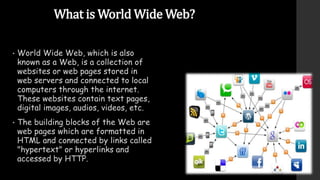
• World Wide Web, which is also
known as a Web, is a collection of
websites or web pages stored in
web servers and connected to local
computers through the internet.
These websites contain text pages,
digital images, audios, videos, etc.
• The building blocks of the Web are
web pages which are formatted in
HTML and connected by links called
"hypertext" or hyperlinks and
accessed by HTTP.
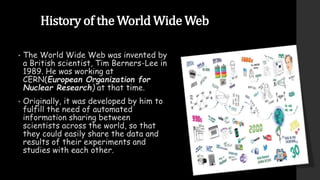
History of the World Wide Web
• The World Wide Web was invented by
a British scientist, Tim Berners-Lee in
1989. He was working at
CERN(European Organization for
Nuclear Research) at that time.
• Originally, it was developed by him to
fulfill the need of automated
information sharing between
scientists across the world, so that
they could easily share the data and
results of their experiments and
studies with each other.
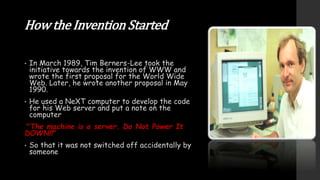
How the Invention Started
• In March 1989, Tim Berners-Lee took the
initiative towards the invention of WWW and
wrote the first proposal for the World Wide
Web. Later, he wrote another proposal in May
1990.
• He used a NeXT computer to develop the code
for his Web server and put a note on the
computer
"The machine is a server. Do Not Power It
DOWN!!"
• So that it was not switched off accidentally by
someone
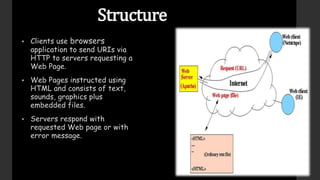
Structure
 Clients use browsers
application to send URIs via
HTTP to servers requesting a
Web Page.
 Web Pages instructed using
HTML and consists of text,
sounds, graphics plus
embedded files.
 Servers respond with
requested Web page or with
error message.
 The Web page returned by the servers is generated by the
client's browser.
 Page is written with Hyper text Markup Language(HTML).
 Displaying text, graphics and sound in browser.
 Writing data as well.
 The entire system runs over standard networking protocols.
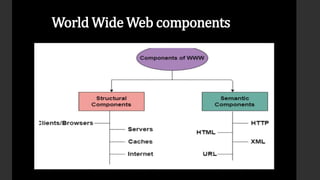
World Wide Web components
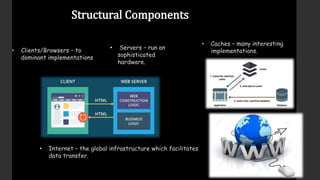
Structural Components
• Clients/Browsers – to
dominant implementations
• Caches – many interesting
implementations.
• Internet – the global infrastructure which facilitates
data transfer.
• Servers – run on
sophisticated
hardware.
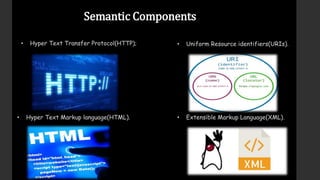
Semantic Components
• Hyper Text Transfer Protocol(HTTP);
• Hyper Text Markup language(HTML). • Extensible Markup Language(XML).
• Uniform Resource identifiers(URIs).
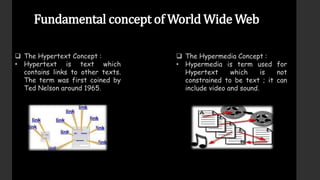
Fundamental concept of World Wide Web
 The Hypertext Concept :
• Hypertext is text which
contains links to other texts.
The term was first coined by
Ted Nelson around 1965.
 The Hypermedia Concept :
• Hypermedia is term used for
Hypertext which is not
constrained to be text ; it can
include video and sound.
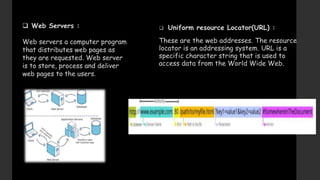
 Uniform resource Locator(URL) :
These are the web addresses. The resource
locator is an addressing system. URL is a
specific character string that is used to
access data from the World Wide Web.
 Web Servers :
Web servers a computer program
that distributes web pages as
they are requested. Web server
is to store, process and deliver
web pages to the users.
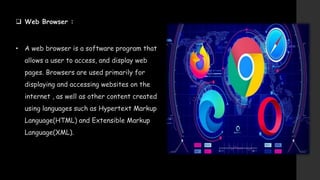
 Web Browser :
• A web browser is a software program that
allows a user to access, and display web
pages. Browsers are used primarily for
displaying and accessing websites on the
internet , as well as other content created
using languages such as Hypertext Markup
Language(HTML) and Extensible Markup
Language(XML).
World Wide Web
• The terms World Wide Web (WWW) and the Internet are so often used
interchangeably that the fundamental difference between the two is easily
forgotten.
• In simple words, WWW is just a common point of connectivity for information
sharing that is facilitated by a global network of computers
Internet
• The internet, on the other hand, is a connection between computers
and countless other devices that form a huge network of systems.
• Internet is a global system of interconnected computer networks that
use the TCP/IP protocol to link devices worldwide.
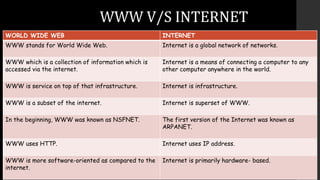
WORLD WIDE WEB INTERNET
WWW stands for World Wide Web. Internet is a global network of networks.
WWW which is a collection of information which is
accessed via the internet.
Internet is a means of connecting a computer to any
other computer anywhere in the world.
WWW is service on top of that infrastructure. Internet is infrastructure.
WWW is a subset of the internet. Internet is superset of WWW.
In the beginning, WWW was known as NSFNET. The first version of the Internet was known as
ARPANET.
WWW uses HTTP. Internet uses IP address.
WWW is more software-oriented as compared to the
internet.
Internet is primarily hardware- based.
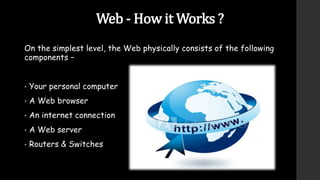
Web - How it Works ?
On the simplest level, the Web physically consists of the following
components −
• Your personal computer
• A Web browser
• An internet connection
• A Web server
• Routers & Switches
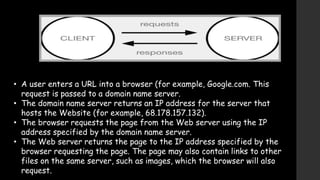
• A user enters a URL into a browser (for example, Google.com. This
request is passed to a domain name server.
• The domain name server returns an IP address for the server that
hosts the Website (for example, 68.178.157.132).
• The browser requests the page from the Web server using the IP
address specified by the domain name server.
• The Web server returns the page to the IP address specified by the
browser requesting the page. The page may also contain links to other
files on the same server, such as images, which the browser will also
request.
Introduction
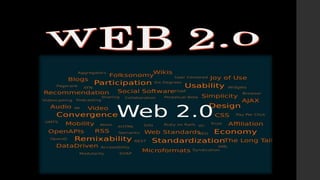
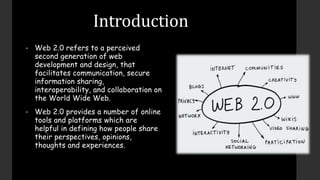
• Web 2.0 refers to a perceived
second generation of web
development and design, that
facilitates communication, secure
information sharing,
interoperability, and collaboration on
the World Wide Web.
• Web 2.0 provides a number of online
tools and platforms which are
helpful in defining how people share
their perspectives, opinions,
thoughts and experiences.
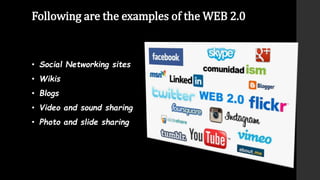
Following are the examples of the WEB 2.0
• Social Networking sites
• Wikis
• Blogs
• Video and sound sharing
• Photo and slide sharing
Social Networks
A social network service uses software to build online social
networks for communities of people who share interests and
activities or who are interested in exploring the interests and
activities of others.
Example:
Wiki
A wiki is a collection of web pages designed to enable anyone who
accesses it to contribute or modify content, using a simplified
markup language. Wikis are often used to create collaborative
websites and to power community websites.
Example :
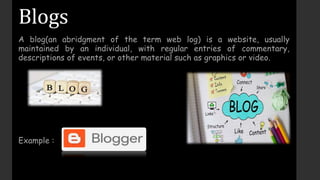
Blogs
A blog(an abridgment of the term web log) is a website, usually
maintained by an individual, with regular entries of commentary,
descriptions of events, or other material such as graphics or video.
Example :
Video Sharing
A video hosting service, also said a video sharing service allows
individuals to upload video clips to an internet website. The video
host will then store the video on its server, and show the
individual different types of code to allow others to view this
video. Because ,many users do not have personal web space.
Example:
world wide web
world wide web

world wide web

  • 1.
    PRESENTED TO: DR.SAKSHI CHHABRA PRESENTEDBY: TUSHAR JAIN 52010033 MITANSHI JAIN 52010031 SHUBHAM THAKRE 52010024 RAKSHA GUPTA 52010021
  • 2.
    • Introduction • Whatis www? • History • Inventions • Structure • Components • Fundamental concepts • Difference between www and internet • How web works? • Web 2.0
  • 3.
    INTRODUCTION What is “WorldWide Web” ? The World Wide Web, or the Web (which gives us the acronym www), is the name for one of the ways that the internet lets people browse documents connected by hypertext links. The concept of the Web was perfected at CERN (Conseil European pour la Recherche Nucléaire, or the European Organization for Nuclear Research) in 1991 by a group of researchers which included Tim- Berners Lee, the creator of the hyperlink, who is today considered the father of the Web.
  • 4.
    What is WorldWide Web? • World Wide Web, which is also known as a Web, is a collection of websites or web pages stored in web servers and connected to local computers through the internet. These websites contain text pages, digital images, audios, videos, etc. • The building blocks of the Web are web pages which are formatted in HTML and connected by links called "hypertext" or hyperlinks and accessed by HTTP.
  • 5.
    History of theWorld Wide Web • The World Wide Web was invented by a British scientist, Tim Berners-Lee in 1989. He was working at CERN(European Organization for Nuclear Research) at that time. • Originally, it was developed by him to fulfill the need of automated information sharing between scientists across the world, so that they could easily share the data and results of their experiments and studies with each other.
  • 6.
    How the InventionStarted • In March 1989, Tim Berners-Lee took the initiative towards the invention of WWW and wrote the first proposal for the World Wide Web. Later, he wrote another proposal in May 1990. • He used a NeXT computer to develop the code for his Web server and put a note on the computer "The machine is a server. Do Not Power It DOWN!!" • So that it was not switched off accidentally by someone
  • 7.
    Structure  Clients usebrowsers application to send URIs via HTTP to servers requesting a Web Page.  Web Pages instructed using HTML and consists of text, sounds, graphics plus embedded files.  Servers respond with requested Web page or with error message.
  • 8.
     The Webpage returned by the servers is generated by the client's browser.  Page is written with Hyper text Markup Language(HTML).  Displaying text, graphics and sound in browser.  Writing data as well.  The entire system runs over standard networking protocols.
  • 9.
    World Wide Webcomponents
  • 10.
    Structural Components • Clients/Browsers– to dominant implementations • Caches – many interesting implementations. • Internet – the global infrastructure which facilitates data transfer. • Servers – run on sophisticated hardware.
  • 11.
    Semantic Components • HyperText Transfer Protocol(HTTP); • Hyper Text Markup language(HTML). • Extensible Markup Language(XML). • Uniform Resource identifiers(URIs).
  • 12.
    Fundamental concept ofWorld Wide Web  The Hypertext Concept : • Hypertext is text which contains links to other texts. The term was first coined by Ted Nelson around 1965.  The Hypermedia Concept : • Hypermedia is term used for Hypertext which is not constrained to be text ; it can include video and sound.
  • 13.
     Uniform resourceLocator(URL) : These are the web addresses. The resource locator is an addressing system. URL is a specific character string that is used to access data from the World Wide Web.  Web Servers : Web servers a computer program that distributes web pages as they are requested. Web server is to store, process and deliver web pages to the users.
  • 14.
     Web Browser: • A web browser is a software program that allows a user to access, and display web pages. Browsers are used primarily for displaying and accessing websites on the internet , as well as other content created using languages such as Hypertext Markup Language(HTML) and Extensible Markup Language(XML).
  • 15.
    World Wide Web •The terms World Wide Web (WWW) and the Internet are so often used interchangeably that the fundamental difference between the two is easily forgotten. • In simple words, WWW is just a common point of connectivity for information sharing that is facilitated by a global network of computers
  • 16.
    Internet • The internet,on the other hand, is a connection between computers and countless other devices that form a huge network of systems. • Internet is a global system of interconnected computer networks that use the TCP/IP protocol to link devices worldwide.
  • 17.
    WORLD WIDE WEBINTERNET WWW stands for World Wide Web. Internet is a global network of networks. WWW which is a collection of information which is accessed via the internet. Internet is a means of connecting a computer to any other computer anywhere in the world. WWW is service on top of that infrastructure. Internet is infrastructure. WWW is a subset of the internet. Internet is superset of WWW. In the beginning, WWW was known as NSFNET. The first version of the Internet was known as ARPANET. WWW uses HTTP. Internet uses IP address. WWW is more software-oriented as compared to the internet. Internet is primarily hardware- based.
  • 18.
    Web - Howit Works ? On the simplest level, the Web physically consists of the following components − • Your personal computer • A Web browser • An internet connection • A Web server • Routers & Switches
  • 19.
    • A userenters a URL into a browser (for example, Google.com. This request is passed to a domain name server. • The domain name server returns an IP address for the server that hosts the Website (for example, 68.178.157.132). • The browser requests the page from the Web server using the IP address specified by the domain name server. • The Web server returns the page to the IP address specified by the browser requesting the page. The page may also contain links to other files on the same server, such as images, which the browser will also request.
  • 21.
    Introduction • Web 2.0refers to a perceived second generation of web development and design, that facilitates communication, secure information sharing, interoperability, and collaboration on the World Wide Web. • Web 2.0 provides a number of online tools and platforms which are helpful in defining how people share their perspectives, opinions, thoughts and experiences.
  • 22.
    Following are theexamples of the WEB 2.0 • Social Networking sites • Wikis • Blogs • Video and sound sharing • Photo and slide sharing
  • 23.
    Social Networks A socialnetwork service uses software to build online social networks for communities of people who share interests and activities or who are interested in exploring the interests and activities of others. Example:
  • 24.
    Wiki A wiki isa collection of web pages designed to enable anyone who accesses it to contribute or modify content, using a simplified markup language. Wikis are often used to create collaborative websites and to power community websites. Example :
  • 25.
    Blogs A blog(an abridgmentof the term web log) is a website, usually maintained by an individual, with regular entries of commentary, descriptions of events, or other material such as graphics or video. Example :
  • 26.
    Video Sharing A videohosting service, also said a video sharing service allows individuals to upload video clips to an internet website. The video host will then store the video on its server, and show the individual different types of code to allow others to view this video. Because ,many users do not have personal web space. Example: