Internet
Architecture
Fortunately, nobody owns the Internet, there is no
centralized control, and nobody can turn it off. Its evolution
depends on rough consensus about technical proposals, and
on running code. Engineering feed-back from real
implementations is more important than any architectural
principles.
Internet
The Internet is a worldwide, publicly accessible network of
interconnected computer networks that transmit data by
packet switching using the standard Internet Protocol (IP).
It is a "network of networks" A better way for us to start
visualizing the Internet is as an opaque cloud to which
hosts connect.
The power of the Internet is from respecting the end-to-end
principle.
What is the Internet architecture?
It is by definition a meta-network, a constantly changing
collection of thousands of individual networks
intercommunicating with a common protocol.
A short form of the compound word "inter-networking".
This architecture is based in the very specification of the
standard TCP/IP protocol, designed to connect any two
networks which may be very different in internal hardware,
software, and technical design.
Internet Path
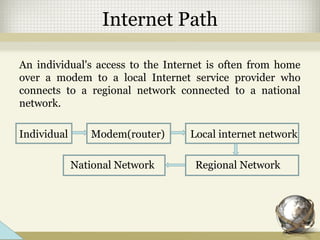
An individual's access to the Internet is often from home
over a modem to a local Internet service provider who
connects to a regional network connected to a national
network.
Individual Modem(router) Local internet network
National Network Regional Network
Data Communication
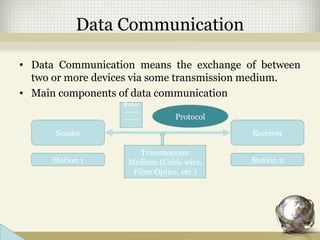
• Data Communication means the exchange of between
two or more devices via some transmission medium.
• Main components of data communication
Sender Receiver
Station 1 Station 2
Protocol
Rules
------
------
--
Transmission
Medium (Cable wire,
Fibre Optics, etc.)
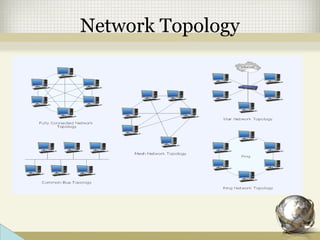
Network Topology
Protocols
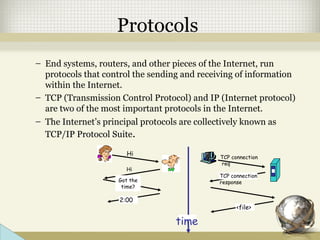
– End systems, routers, and other pieces of the Internet, run
protocols that control the sending and receiving of information
within the Internet.
– TCP (Transmission Control Protocol) and IP (Internet protocol)
are two of the most important protocols in the Internet.
– The Internet’s principal protocols are collectively known as
TCP/IP Protocol Suite.
Hi
Hi
Got the
time?
2:00
TCP connection
req
TCP connection
response
<file>
time
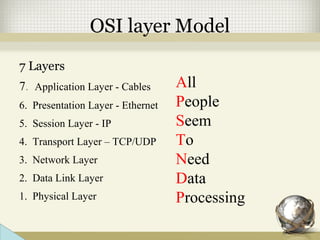
OSI layer Model
7 Layers
7. Application Layer - Cables
6. Presentation Layer - Ethernet
5. Session Layer - IP
4. Transport Layer – TCP/UDP
3. Network Layer
2. Data Link Layer
1. Physical Layer
All
People
Seem
To
Need
Data
Processing
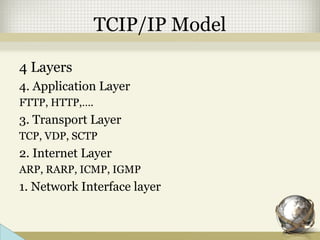
TCIP/IP Model
4 Layers
4. Application Layer
FTTP, HTTP,….
3. Transport Layer
TCP, VDP, SCTP
2. Internet Layer
ARP, RARP, ICMP, IGMP
1. Network Interface layer
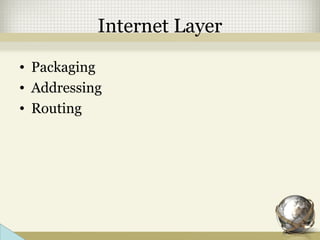
Internet Layer
• Packaging
• Addressing
• Routing
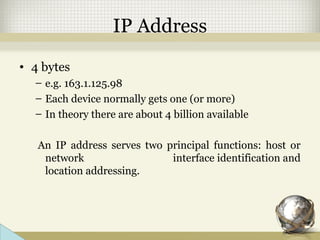
IP Address
• 4 bytes
– e.g. 163.1.125.98
– Each device normally gets one (or more)
– In theory there are about 4 billion available
An IP address serves two principal functions: host or
network interface identification and
location addressing.
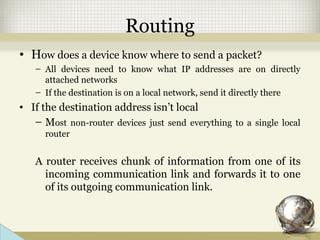
Routing
• How does a device know where to send a packet?
– All devices need to know what IP addresses are on directly
attached networks
– If the destination is on a local network, send it directly there
• If the destination address isn’t local
– Most non-router devices just send everything to a single local
router
A router receives chunk of information from one of its
incoming communication link and forwards it to one
of its outgoing communication link.
Continue…
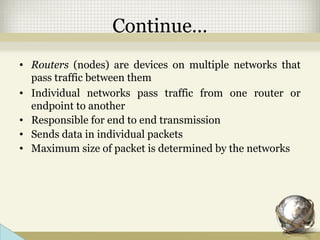
• Routers (nodes) are devices on multiple networks that
pass traffic between them
• Individual networks pass traffic from one router or
endpoint to another
• Responsible for end to end transmission
• Sends data in individual packets
• Maximum size of packet is determined by the networks
Terms to familiarize
• Domain name
• DNS Lookup
• Reverse DNS Lookup
• DNS Server
• HTTP
Interaction with Internet
• Suppose you type
http://www.flipkart.com
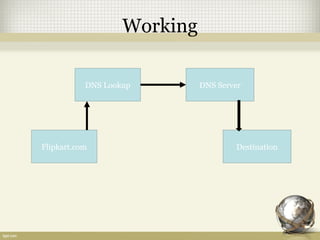
Working
Flipkart.com
DNS Lookup DNS Server
Destination
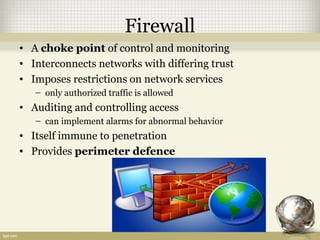
Firewall
• A choke point of control and monitoring
• Interconnects networks with differing trust
• Imposes restrictions on network services
– only authorized traffic is allowed
• Auditing and controlling access
– can implement alarms for abnormal behavior
• Itself immune to penetration
• Provides perimeter defence
Food for thought!
Internet vs. internet
Difference between:
internet, intranet and extranet
LAN vs. WAN
Why Circuit Switching is not appropriate for
data traffic?
Thank You
By:
Md. Zeeshan
Naman Rastogi

Internet architecture

  • 1.
  • 2.
    Fortunately, nobody ownsthe Internet, there is no centralized control, and nobody can turn it off. Its evolution depends on rough consensus about technical proposals, and on running code. Engineering feed-back from real implementations is more important than any architectural principles.
  • 3.
    Internet The Internet isa worldwide, publicly accessible network of interconnected computer networks that transmit data by packet switching using the standard Internet Protocol (IP). It is a "network of networks" A better way for us to start visualizing the Internet is as an opaque cloud to which hosts connect. The power of the Internet is from respecting the end-to-end principle.
  • 4.
    What is theInternet architecture? It is by definition a meta-network, a constantly changing collection of thousands of individual networks intercommunicating with a common protocol. A short form of the compound word "inter-networking". This architecture is based in the very specification of the standard TCP/IP protocol, designed to connect any two networks which may be very different in internal hardware, software, and technical design.
  • 5.
    Internet Path An individual'saccess to the Internet is often from home over a modem to a local Internet service provider who connects to a regional network connected to a national network. Individual Modem(router) Local internet network National Network Regional Network
  • 6.
    Data Communication • DataCommunication means the exchange of between two or more devices via some transmission medium. • Main components of data communication Sender Receiver Station 1 Station 2 Protocol Rules ------ ------ -- Transmission Medium (Cable wire, Fibre Optics, etc.)
  • 7.
  • 8.
    Protocols – End systems,routers, and other pieces of the Internet, run protocols that control the sending and receiving of information within the Internet. – TCP (Transmission Control Protocol) and IP (Internet protocol) are two of the most important protocols in the Internet. – The Internet’s principal protocols are collectively known as TCP/IP Protocol Suite. Hi Hi Got the time? 2:00 TCP connection req TCP connection response <file> time
  • 9.
    OSI layer Model 7Layers 7. Application Layer - Cables 6. Presentation Layer - Ethernet 5. Session Layer - IP 4. Transport Layer – TCP/UDP 3. Network Layer 2. Data Link Layer 1. Physical Layer All People Seem To Need Data Processing
  • 10.
    TCIP/IP Model 4 Layers 4.Application Layer FTTP, HTTP,…. 3. Transport Layer TCP, VDP, SCTP 2. Internet Layer ARP, RARP, ICMP, IGMP 1. Network Interface layer
  • 11.
    Internet Layer • Packaging •Addressing • Routing
  • 12.
    IP Address • 4bytes – e.g. 163.1.125.98 – Each device normally gets one (or more) – In theory there are about 4 billion available An IP address serves two principal functions: host or network interface identification and location addressing.
  • 13.
    Routing • How doesa device know where to send a packet? – All devices need to know what IP addresses are on directly attached networks – If the destination is on a local network, send it directly there • If the destination address isn’t local – Most non-router devices just send everything to a single local router A router receives chunk of information from one of its incoming communication link and forwards it to one of its outgoing communication link.
  • 14.
    Continue… • Routers (nodes)are devices on multiple networks that pass traffic between them • Individual networks pass traffic from one router or endpoint to another • Responsible for end to end transmission • Sends data in individual packets • Maximum size of packet is determined by the networks
  • 15.
    Terms to familiarize •Domain name • DNS Lookup • Reverse DNS Lookup • DNS Server • HTTP
  • 16.
    Interaction with Internet •Suppose you type http://www.flipkart.com
  • 17.
  • 18.
    Firewall • A chokepoint of control and monitoring • Interconnects networks with differing trust • Imposes restrictions on network services – only authorized traffic is allowed • Auditing and controlling access – can implement alarms for abnormal behavior • Itself immune to penetration • Provides perimeter defence
  • 19.
    Food for thought! Internetvs. internet Difference between: internet, intranet and extranet LAN vs. WAN Why Circuit Switching is not appropriate for data traffic?
  • 20.

Editor's Notes

  • #4 It consists of millions of smaller domestic, academic, business, and government networks, which together carry various information and services, such as electronic mail, online chat, file transfer, and the interlinked web pages and other documents of the World Wide Web
  • #5 Meta network= network of network
  • #8 Star Mesh Bus Ring
  • #9 A Protocol is a set of rules and regulations that governs the exchange of information between two or more entities.
  • #10 IP : Internet Protocol Open Systems Interconnection (OSI) model UDP : User Datagram Protocol RTP, traceroute TCP : Transmission Control Protocol HTTP, FTP, ssh. You don’t need to know the layers just the idea that it is layered.
  • #11 TCP/IP stands for = Transmission Control Protocol/ Internet Protocol
  • #13 4 byte= 32 bit
  • #16 Domain: Name of an IP DNS Lookup: Converting domain into its respective IP DNS Server: Server that handles the DNS lookup queries HTTP: Protocol used by browser to communicate with websites. Rules of communication with websites All web application on your computer open something known as virtual port to communicate with remote. You can check it by typing netstat –n in cmd. Virtual ports are part of TCP/IP networking.
  • #18 DNS Lookup: ping flipkart.com in cmd.
  • #20 Intranet is shared content accessed by members within a single organization. Extranet is shared content accessed by groups through cross-enterprise boundaries. Internet is global communication accessed through the Web Internet: Global net. Internet: national net Circuit Switching: Inefficient (for data traffic) Set up (connection) takes time