What is the Internet?
• A network of networks, joining many government,
university and private computers together and providing
an infrastructure for the use of E-mail, bulletin boards, file
archives, hypertext documents, databases and other
computational resources
• The vast collection of computer networks which form and
act as a single huge network for transport of data and
messages across distances which can be anywhere from
the same office to anywhere in the world.
What is the Internet?
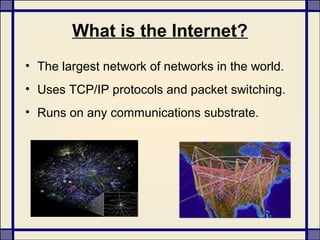
• The largest network of networks in the world.
• Uses TCP/IP protocols and packet switching.
• Runs on any communications substrate.
Brief History of the Internet
• 1968 - DARPA (Defense Advanced Research Projects Agency)
contracts with BBN (Bolt, Beranek & Newman) to create
ARPANET
• 1970 - First five nodes:
– UCLA
– Stanford
– UC Santa Barbara
– U of Utah, and
– BBN
• 1974 - TCP specification by Vint Cerf
• 1984 - On January 1, the Internet with its 1000 hosts
converts en masse to using TCP/IP for its messaging
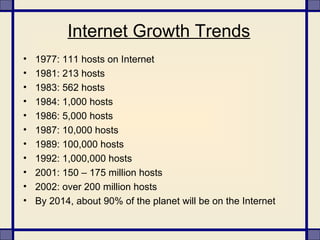
Internet Growth Trends
• 1977: 111 hosts on Internet
• 1981: 213 hosts
• 1983: 562 hosts
• 1984: 1,000 hosts
• 1986: 5,000 hosts
• 1987: 10,000 hosts
• 1989: 100,000 hosts
• 1992: 1,000,000 hosts
• 2001: 150 – 175 million hosts
• 2002: over 200 million hosts
• By 2014, about 90% of the planet will be on the Internet
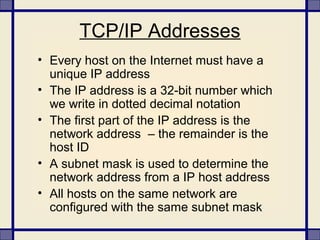
TCP/IP Addresses
• Every host on the Internet must have a
unique IP address
• The IP address is a 32-bit number which
we write in dotted decimal notation
• The first part of the IP address is the
network address – the remainder is the
host ID
• A subnet mask is used to determine the
network address from a IP host address
• All hosts on the same network are
configured with the same subnet mask
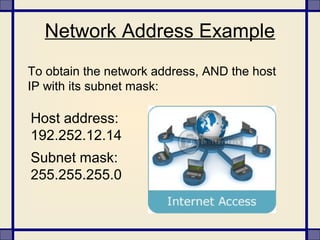
Network Address Example
Host address:
192.252.12.14
Subnet mask:
255.255.255.0
To obtain the network address, AND the host
IP with its subnet mask:
Obtaining an Internet Network
Address
• IP network addresses must be unique, or
the Internet will not be stable
• The Internet Network Information Centre
(InterNIC) was originally responsible for
issuing Internet network addresses
• Today, the Internet Assigned Number
Authority (IANA) issues network
addresses to Information Service
Providers (ISPs)
• ISPs split networks up into subnets and
sell them on to their customers
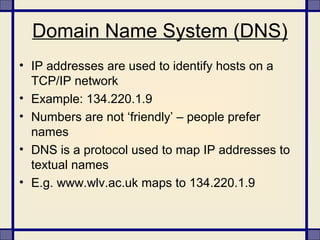
Domain Name System (DNS)
• IP addresses are used to identify hosts on a
TCP/IP network
• Example: 134.220.1.9
• Numbers are not ‘friendly’ – people prefer
names
• DNS is a protocol used to map IP addresses to
textual names
• E.g. www.wlv.ac.uk maps to 134.220.1.9
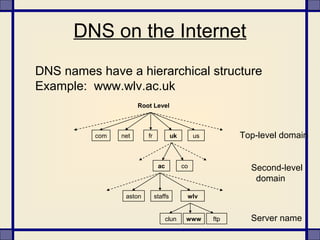
DNS on the Internet
DNS names have a hierarchical structure
Example: www.wlv.ac.uk
com net fr uk us
Root Level
ac co
aston wlvstaffs
ftpwwwclun
Top-level domain
Second-level
domain
Server name
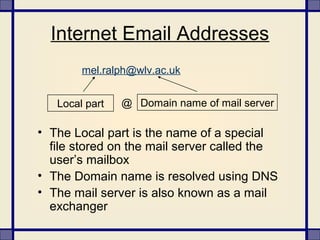
Internet Email Addresses
• The Local part is the name of a special
file stored on the mail server called the
user’s mailbox
• The Domain name is resolved using DNS
• The mail server is also known as a mail
exchanger
Local part Domain name of mail server@
mel.ralph@wlv.ac.uk
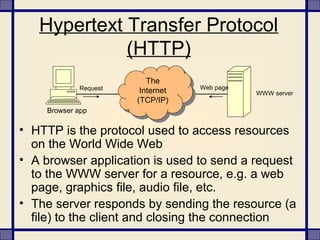
Hypertext Transfer Protocol
(HTTP)
• HTTP is the protocol used to access resources
on the World Wide Web
• A browser application is used to send a request
to the WWW server for a resource, e.g. a web
page, graphics file, audio file, etc.
• The server responds by sending the resource (a
file) to the client and closing the connection
Request
Browser app
WWW server
The
Internet
(TCP/IP)
The
Internet
(TCP/IP)
Web page
Uniform Resource Locator (URL)
• URL is the standard for specifying the
whereabouts of a resource (such as a web page)
on the Internet
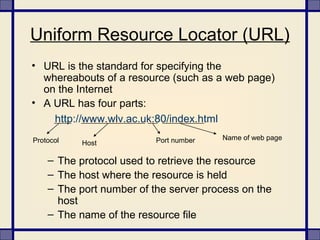
• A URL has four parts:
– The protocol used to retrieve the resource
– The host where the resource is held
– The port number of the server process on the
host
– The name of the resource file
http://www.wlv.ac.uk:80/index.html
Protocol Host Port number Name of web page
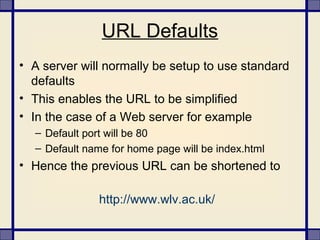
URL Defaults
• A server will normally be setup to use standard
defaults
• This enables the URL to be simplified
• In the case of a Web server for example
– Default port will be 80
– Default name for home page will be index.html
• Hence the previous URL can be shortened to
http://www.wlv.ac.uk/
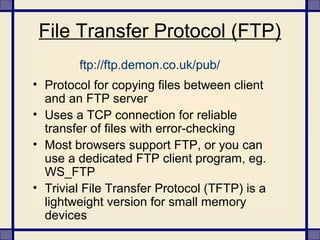
File Transfer Protocol (FTP)
• Protocol for copying files between client
and an FTP server
• Uses a TCP connection for reliable
transfer of files with error-checking
• Most browsers support FTP, or you can
use a dedicated FTP client program, eg.
WS_FTP
• Trivial File Transfer Protocol (TFTP) is a
lightweight version for small memory
devices
ftp://ftp.demon.co.uk/pub/
Telnet
• Telnet allows a user to run commands
and programs remotely on another
computer across the Internet
• The user runs a Telnet client program
on the local host
• A Telnet server process must be
running on the remote host
• The user must have the necessary
permissions and password to access
the remote host
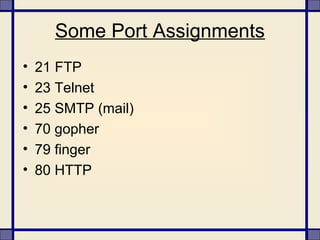
Some Port Assignments
• 21 FTP
• 23 Telnet
• 25 SMTP (mail)
• 70 gopher
• 79 finger
• 80 HTTP
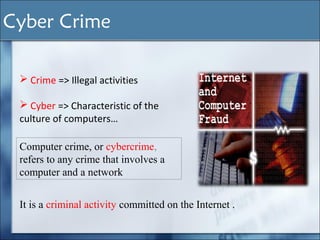
 Crime => Illegal activities
 Cyber => Characteristic of the
culture of computers…
Computer crime, or cybercrime,
refers to any crime that involves a
computer and a network
It is a criminal activity committed on the Internet .
Cyber Crime
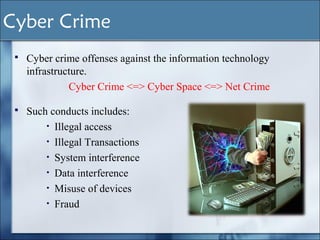
 Such conducts includes:
• Illegal access
• Illegal Transactions
• System interference
• Data interference
• Misuse of devices
• Fraud
 Cyber crime offenses against the information technology
infrastructure.
Cyber Crime <=> Cyber Space <=> Net Crime
Cyber Crime
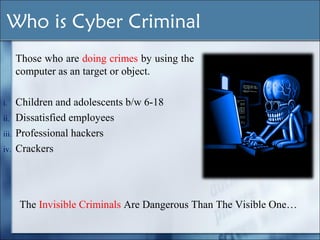
The Invisible Criminals Are Dangerous Than The Visible One…
Who is Cyber Criminal
Those who are doing crimes by using the
computer as an target or object.
i. Children and adolescents b/w 6-18
ii. Dissatisfied employees
iii. Professional hackers
iv. Crackers
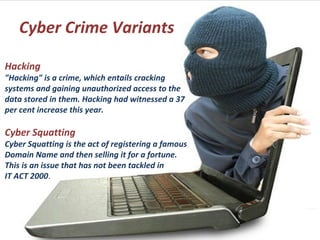
Cyber Crime Variants
Hacking
"Hacking" is a crime, which entails cracking
systems and gaining unauthorized access to the
data stored in them. Hacking had witnessed a 37
per cent increase this year.
Cyber Squatting
Cyber Squatting is the act of registering a famous
Domain Name and then selling it for a fortune.
This is an issue that has not been tackled in
IT ACT 2000.
 
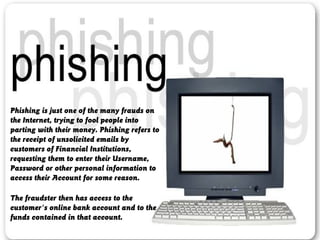
Phishing is just one of the many frauds on
the Internet, trying to fool people into
parting with their money. Phishing refers to
the receipt of unsolicited emails by
customers of Financial Institutions,
requesting them to enter their Username,
Password or other personal information to
access their Account for some reason.
The fraudster then has access to the
customer's online bank account and to the
funds contained in that account.
Cyber Stalking is use of the Internet or other
electronic means to stalk someone. This term
is used interchangeably with online
harassment and online abuse. Stalking
generally involves harassing or threatening
behaviour that an individual engages in
repeatedly, such as following a person,
appearing at a person's home or place of
business, making harassing phone calls,
leaving written messages or objects, or
vandalizing a person's property.
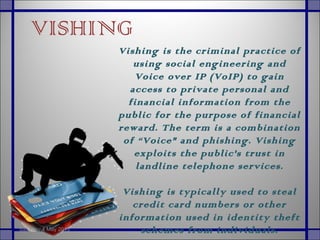
Vishing is the criminal practice of
using social engineering and
Voice over IP (VoIP) to gain
access to private personal and
financial information from the
public for the purpose of financial
reward. The term is a combination
of “Voice" and phishing. Vishing
exploits the public's trust in
landline telephone services.
 
Vishing is typically used to steal
credit card numbers or other
information used in identity theft
schemes from individuals.
VISHING
Saturday 4 May 2013
Internet

Internet

  • 2.
    What is theInternet? • A network of networks, joining many government, university and private computers together and providing an infrastructure for the use of E-mail, bulletin boards, file archives, hypertext documents, databases and other computational resources • The vast collection of computer networks which form and act as a single huge network for transport of data and messages across distances which can be anywhere from the same office to anywhere in the world.
  • 3.
    What is theInternet? • The largest network of networks in the world. • Uses TCP/IP protocols and packet switching. • Runs on any communications substrate.
  • 4.
    Brief History ofthe Internet • 1968 - DARPA (Defense Advanced Research Projects Agency) contracts with BBN (Bolt, Beranek & Newman) to create ARPANET • 1970 - First five nodes: – UCLA – Stanford – UC Santa Barbara – U of Utah, and – BBN • 1974 - TCP specification by Vint Cerf • 1984 - On January 1, the Internet with its 1000 hosts converts en masse to using TCP/IP for its messaging
  • 5.
    Internet Growth Trends •1977: 111 hosts on Internet • 1981: 213 hosts • 1983: 562 hosts • 1984: 1,000 hosts • 1986: 5,000 hosts • 1987: 10,000 hosts • 1989: 100,000 hosts • 1992: 1,000,000 hosts • 2001: 150 – 175 million hosts • 2002: over 200 million hosts • By 2014, about 90% of the planet will be on the Internet
  • 6.
    TCP/IP Addresses • Everyhost on the Internet must have a unique IP address • The IP address is a 32-bit number which we write in dotted decimal notation • The first part of the IP address is the network address – the remainder is the host ID • A subnet mask is used to determine the network address from a IP host address • All hosts on the same network are configured with the same subnet mask
  • 7.
    Network Address Example Hostaddress: 192.252.12.14 Subnet mask: 255.255.255.0 To obtain the network address, AND the host IP with its subnet mask:
  • 8.
    Obtaining an InternetNetwork Address • IP network addresses must be unique, or the Internet will not be stable • The Internet Network Information Centre (InterNIC) was originally responsible for issuing Internet network addresses • Today, the Internet Assigned Number Authority (IANA) issues network addresses to Information Service Providers (ISPs) • ISPs split networks up into subnets and sell them on to their customers
  • 9.
    Domain Name System(DNS) • IP addresses are used to identify hosts on a TCP/IP network • Example: 134.220.1.9 • Numbers are not ‘friendly’ – people prefer names • DNS is a protocol used to map IP addresses to textual names • E.g. www.wlv.ac.uk maps to 134.220.1.9
  • 10.
    DNS on theInternet DNS names have a hierarchical structure Example: www.wlv.ac.uk com net fr uk us Root Level ac co aston wlvstaffs ftpwwwclun Top-level domain Second-level domain Server name
  • 11.
    Internet Email Addresses •The Local part is the name of a special file stored on the mail server called the user’s mailbox • The Domain name is resolved using DNS • The mail server is also known as a mail exchanger Local part Domain name of mail server@ mel.ralph@wlv.ac.uk
  • 12.
    Hypertext Transfer Protocol (HTTP) •HTTP is the protocol used to access resources on the World Wide Web • A browser application is used to send a request to the WWW server for a resource, e.g. a web page, graphics file, audio file, etc. • The server responds by sending the resource (a file) to the client and closing the connection Request Browser app WWW server The Internet (TCP/IP) The Internet (TCP/IP) Web page
  • 13.
    Uniform Resource Locator(URL) • URL is the standard for specifying the whereabouts of a resource (such as a web page) on the Internet • A URL has four parts: – The protocol used to retrieve the resource – The host where the resource is held – The port number of the server process on the host – The name of the resource file http://www.wlv.ac.uk:80/index.html Protocol Host Port number Name of web page
  • 14.
    URL Defaults • Aserver will normally be setup to use standard defaults • This enables the URL to be simplified • In the case of a Web server for example – Default port will be 80 – Default name for home page will be index.html • Hence the previous URL can be shortened to http://www.wlv.ac.uk/
  • 15.
    File Transfer Protocol(FTP) • Protocol for copying files between client and an FTP server • Uses a TCP connection for reliable transfer of files with error-checking • Most browsers support FTP, or you can use a dedicated FTP client program, eg. WS_FTP • Trivial File Transfer Protocol (TFTP) is a lightweight version for small memory devices ftp://ftp.demon.co.uk/pub/
  • 16.
    Telnet • Telnet allowsa user to run commands and programs remotely on another computer across the Internet • The user runs a Telnet client program on the local host • A Telnet server process must be running on the remote host • The user must have the necessary permissions and password to access the remote host
  • 17.
    Some Port Assignments •21 FTP • 23 Telnet • 25 SMTP (mail) • 70 gopher • 79 finger • 80 HTTP
  • 19.
     Crime =>Illegal activities  Cyber => Characteristic of the culture of computers… Computer crime, or cybercrime, refers to any crime that involves a computer and a network It is a criminal activity committed on the Internet . Cyber Crime
  • 20.
     Such conductsincludes: • Illegal access • Illegal Transactions • System interference • Data interference • Misuse of devices • Fraud  Cyber crime offenses against the information technology infrastructure. Cyber Crime <=> Cyber Space <=> Net Crime Cyber Crime
  • 21.
    The Invisible CriminalsAre Dangerous Than The Visible One… Who is Cyber Criminal Those who are doing crimes by using the computer as an target or object. i. Children and adolescents b/w 6-18 ii. Dissatisfied employees iii. Professional hackers iv. Crackers
  • 22.
    Cyber Crime Variants Hacking "Hacking"is a crime, which entails cracking systems and gaining unauthorized access to the data stored in them. Hacking had witnessed a 37 per cent increase this year. Cyber Squatting Cyber Squatting is the act of registering a famous Domain Name and then selling it for a fortune. This is an issue that has not been tackled in IT ACT 2000.  
  • 23.
    Phishing is justone of the many frauds on the Internet, trying to fool people into parting with their money. Phishing refers to the receipt of unsolicited emails by customers of Financial Institutions, requesting them to enter their Username, Password or other personal information to access their Account for some reason. The fraudster then has access to the customer's online bank account and to the funds contained in that account.
  • 24.
    Cyber Stalking isuse of the Internet or other electronic means to stalk someone. This term is used interchangeably with online harassment and online abuse. Stalking generally involves harassing or threatening behaviour that an individual engages in repeatedly, such as following a person, appearing at a person's home or place of business, making harassing phone calls, leaving written messages or objects, or vandalizing a person's property.
  • 25.
    Vishing is thecriminal practice of using social engineering and Voice over IP (VoIP) to gain access to private personal and financial information from the public for the purpose of financial reward. The term is a combination of “Voice" and phishing. Vishing exploits the public's trust in landline telephone services.   Vishing is typically used to steal credit card numbers or other information used in identity theft schemes from individuals. VISHING Saturday 4 May 2013

Editor's Notes