WELCOME
MIS – 104:
Computing
Fundamentals
BBA
Department of MIS
University of Dhaka
Ashis Talukder, EMA, Department
of MIS, DU
3
Books
1.Introduction to Computer
Peter Norton
2. Computer Fundamentals
Dr. M Lutfar
Rahman
3. Computer Fundamentals
Pradeep K. Sinha
Ashis Talukder, EMA, Department
of MIS, DU
4
Course Outline
1. Computer:
Introduction
Characteristics
Use (Specially in Business)
History
Generation
2. Classification of Computer:
 Size & volume of data processing
 Micro, mini, mainframe, super
 Working principle
 Analog, digital, hybrid
 Purpose of use
 Special purpose, general purpose
Ashis Talukder, EMA, Department
of MIS, DU
5
Introduction
 ORIGIN:-
 The word `COMPUTER`comes from `COMPUTE`
means `to calculate`and computer means
`calculating machine`
 DEFINITION:-
 computer is an automatic electronic device which
store,retrives & process data to show necessary
results.
 Cannot think but carry out instructions using 0 & 1
Ashis Talukder, EMA, Department
of MIS, DU
6
 On the basis of Size & Data process
 Microcomputer
 Minicomputer
 Mainframe Computer
 Super Computer
Classification of computer
Ashis Talukder, EMA, Department
of MIS, DU
7
Micro Computer
 Smallest among all digital computer.
 usually 01 processor. Uses- Usually in the office
& home
 Micro computer known a PC, are micro processor
based small desktop, laptop, notebook, palmtop,
PDA system varying with size, speed, processing
capacity.
 The brain of computer is μ processor, a silicon
drip containing millions of CKT to perform
arithmetic and logic operation and to contrast
input output system.
Ashis Talukder, EMA, Department
of MIS, DU
8
Micro Computer
 Early computers had single μ processor, primary
& secondary and input output device with limited
processing power, now days micro computers
have wider processing capabilities with wide
rang of input output devices.
 In addition to general purpose computations,
micro computers are also used for special
purpose applications in a automobile, airplane,
toys, clerks and also in multi tasking, multi user
networking.
Ashis Talukder, EMA, Department
of MIS, DU
9
Mini Computer
 High speed, More than 01 I/O is found, With the help of
`TERMINAL` hundreds of people can work together.
 Ex- IBM-S/34, IBM-S/36, PDP-11
 Uses- Industry, Quality control, Research
 It is larger in size as compared to micro Computers and has
higher memory and storage capacity, speed and price.
 It supports multi processor input output device
Ashis Talukder, EMA, Department
of MIS, DU
10
Mini Computer
 It perform basic arithmetic and logic functions and supports
some of the programming language used with large
computer.
 They are suited for processing tasks that do not require
accent to loge volume of stored data.
 Some expensive mini computers are capable of supporting
number of terminals in time shored mode.
 They are used in industry, research and in news king.
Ashis Talukder, EMA, Department
of MIS, DU
11
Mainframe Computer
 A large computer generally consists of modules mounted on
a mainframe. known as mainframe computer.
 As compared to micro and mini computers, it has greater
processing speed, greater storage capacity, a larger variety
of input output devices, support for a number of high
speed storage device, multi programming and time sharing
environment.
 It requires high trained staff to run efficiently.
Ashis Talukder, EMA, Department
of MIS, DU
12
Mainframe Computer
 All types of high level `Peripheral System`
 languages & software are used. With the `TIME
SHARING/SLICE` system hundreds of people
work together.
 MULTIPROGRAMMING & Large scale input is
operated by highly trained operator.
 Ex-CYBER-170, IBM-4300, UNIVAC-1100
 Uses- Census, Space research, Large business &
universities, Military, WAN etc
Ashis Talukder, EMA, Department
of MIS, DU
13
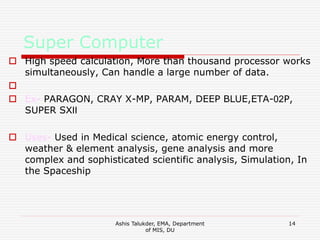
Super Computer
 The most powerful, expensive, with
highest processing speed computer is
super computer.
 The astronomical cost of super computers
has limited their development to only a
few hundred world wide and it is
considered a national wealth.
Ashis Talukder, EMA, Department
of MIS, DU
14
Super Computer
 High speed calculation, More than thousand processor works
simultaneously, Can handle a large number of data.

 Ex- PARAGON, CRAY X-MP, PARAM, DEEP BLUE,ETA-02P,
SUPER SXII
 Uses- Used in Medical science, atomic energy control,
weather & element analysis, gene analysis and more
complex and sophisticated scientific analysis, Simulation, In
the Spaceship
Ashis Talukder, EMA, Department
of MIS, DU
15
 On the basis of Working principal
 Analog
 Digital
 Hybrid
Classification of computer
Ashis Talukder, EMA, Department
of MIS, DU
16
Analog
 Works by using `continuously varying Analog
signal`,
 no memory is found,
 shows output directly with the help of
`indicator/plotter/graph/metre`,
 only one task can perform at a given period of
time.
 Represents physical quantities such as Distance.
 Accuracy is less than 0.1%
 Ex- Speedometer, Slide roll, Operational
amplifier etc.
Ashis Talukder, EMA, Department
of MIS, DU
17
Digital
 Made on the basis of Digital signal.
 Works on `Binary system`. Mathematical
calculation with 0 & 1 is done for problem
solving.
 Requires storage capacity.
 Accuracy is high as result is shown with more
places of number after Decimal.
 Shows result on the screen. Can access several
tasks at time.
 Ex- Desktop, Laptop etc
 Uses- Official works, Playing games etc
Ashis Talukder, EMA, Department
of MIS, DU
18
Hybrid
 Combination of `Analog & Digital` system of
data processing.
 In this system data is input by analog method,
then it is processed and shows result digitally.
 Use- Used where both application of Analog and
digital is needed.
 Ex- In hospital, Spaceship, Missile etc
Ashis Talukder, EMA, Department
of MIS, DU
19
 03.On the basis of Purpose
 Special Purpose
 General Purpose
Classification of computer
Ashis Talukder, EMA, Department
of MIS, DU
20
General Purpose
 Used to execute different types of tasks using
the same hardware.
 It is done using `Stored Programme Concept`.
 These are `more versatile` but `comparatively
slow` than the special purpose computer.
 Ex- Desktop, Palmtop, laptop etc
 Uses- Home, Office etc
Ashis Talukder, EMA, Department
of MIS, DU
21
Special Purpose
 Designed for special/specific task
execution
 As it performs only one major task its
`efficiency` and `speed` is more.
 Also known as `Dedicated computer`.
 Ex- Autorefractometer
 Uses- Traffic signal control, Toll collection
on highway, In the Automobiles etc
Question...???
Next Class
Ashis Talukder, EMA, Department
of MIS, DU
24
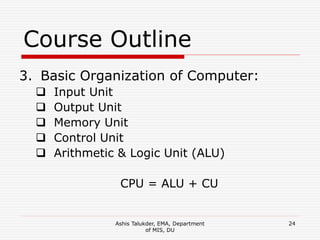
Course Outline
3. Basic Organization of Computer:
 Input Unit
 Output Unit
 Memory Unit
 Control Unit
 Arithmetic & Logic Unit (ALU)
CPU = ALU + CU
Ashis Talukder, EMA, Department
of MIS, DU
25
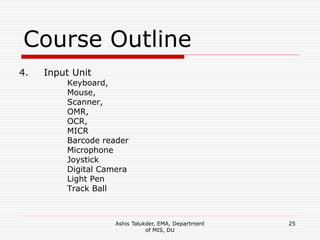
Course Outline
4. Input Unit
Keyboard,
Mouse,
Scanner,
OMR,
OCR,
MICR
Barcode reader
Microphone
Joystick
Digital Camera
Light Pen
Track Ball
Question...???

Lec 3 classification

  • 1.
  • 2.
  • 3.
    Ashis Talukder, EMA,Department of MIS, DU 3 Books 1.Introduction to Computer Peter Norton 2. Computer Fundamentals Dr. M Lutfar Rahman 3. Computer Fundamentals Pradeep K. Sinha
  • 4.
    Ashis Talukder, EMA,Department of MIS, DU 4 Course Outline 1. Computer: Introduction Characteristics Use (Specially in Business) History Generation 2. Classification of Computer:  Size & volume of data processing  Micro, mini, mainframe, super  Working principle  Analog, digital, hybrid  Purpose of use  Special purpose, general purpose
  • 5.
    Ashis Talukder, EMA,Department of MIS, DU 5 Introduction  ORIGIN:-  The word `COMPUTER`comes from `COMPUTE` means `to calculate`and computer means `calculating machine`  DEFINITION:-  computer is an automatic electronic device which store,retrives & process data to show necessary results.  Cannot think but carry out instructions using 0 & 1
  • 6.
    Ashis Talukder, EMA,Department of MIS, DU 6  On the basis of Size & Data process  Microcomputer  Minicomputer  Mainframe Computer  Super Computer Classification of computer
  • 7.
    Ashis Talukder, EMA,Department of MIS, DU 7 Micro Computer  Smallest among all digital computer.  usually 01 processor. Uses- Usually in the office & home  Micro computer known a PC, are micro processor based small desktop, laptop, notebook, palmtop, PDA system varying with size, speed, processing capacity.  The brain of computer is μ processor, a silicon drip containing millions of CKT to perform arithmetic and logic operation and to contrast input output system.
  • 8.
    Ashis Talukder, EMA,Department of MIS, DU 8 Micro Computer  Early computers had single μ processor, primary & secondary and input output device with limited processing power, now days micro computers have wider processing capabilities with wide rang of input output devices.  In addition to general purpose computations, micro computers are also used for special purpose applications in a automobile, airplane, toys, clerks and also in multi tasking, multi user networking.
  • 9.
    Ashis Talukder, EMA,Department of MIS, DU 9 Mini Computer  High speed, More than 01 I/O is found, With the help of `TERMINAL` hundreds of people can work together.  Ex- IBM-S/34, IBM-S/36, PDP-11  Uses- Industry, Quality control, Research  It is larger in size as compared to micro Computers and has higher memory and storage capacity, speed and price.  It supports multi processor input output device
  • 10.
    Ashis Talukder, EMA,Department of MIS, DU 10 Mini Computer  It perform basic arithmetic and logic functions and supports some of the programming language used with large computer.  They are suited for processing tasks that do not require accent to loge volume of stored data.  Some expensive mini computers are capable of supporting number of terminals in time shored mode.  They are used in industry, research and in news king.
  • 11.
    Ashis Talukder, EMA,Department of MIS, DU 11 Mainframe Computer  A large computer generally consists of modules mounted on a mainframe. known as mainframe computer.  As compared to micro and mini computers, it has greater processing speed, greater storage capacity, a larger variety of input output devices, support for a number of high speed storage device, multi programming and time sharing environment.  It requires high trained staff to run efficiently.
  • 12.
    Ashis Talukder, EMA,Department of MIS, DU 12 Mainframe Computer  All types of high level `Peripheral System`  languages & software are used. With the `TIME SHARING/SLICE` system hundreds of people work together.  MULTIPROGRAMMING & Large scale input is operated by highly trained operator.  Ex-CYBER-170, IBM-4300, UNIVAC-1100  Uses- Census, Space research, Large business & universities, Military, WAN etc
  • 13.
    Ashis Talukder, EMA,Department of MIS, DU 13 Super Computer  The most powerful, expensive, with highest processing speed computer is super computer.  The astronomical cost of super computers has limited their development to only a few hundred world wide and it is considered a national wealth.
  • 14.
    Ashis Talukder, EMA,Department of MIS, DU 14 Super Computer  High speed calculation, More than thousand processor works simultaneously, Can handle a large number of data.   Ex- PARAGON, CRAY X-MP, PARAM, DEEP BLUE,ETA-02P, SUPER SXII  Uses- Used in Medical science, atomic energy control, weather & element analysis, gene analysis and more complex and sophisticated scientific analysis, Simulation, In the Spaceship
  • 15.
    Ashis Talukder, EMA,Department of MIS, DU 15  On the basis of Working principal  Analog  Digital  Hybrid Classification of computer
  • 16.
    Ashis Talukder, EMA,Department of MIS, DU 16 Analog  Works by using `continuously varying Analog signal`,  no memory is found,  shows output directly with the help of `indicator/plotter/graph/metre`,  only one task can perform at a given period of time.  Represents physical quantities such as Distance.  Accuracy is less than 0.1%  Ex- Speedometer, Slide roll, Operational amplifier etc.
  • 17.
    Ashis Talukder, EMA,Department of MIS, DU 17 Digital  Made on the basis of Digital signal.  Works on `Binary system`. Mathematical calculation with 0 & 1 is done for problem solving.  Requires storage capacity.  Accuracy is high as result is shown with more places of number after Decimal.  Shows result on the screen. Can access several tasks at time.  Ex- Desktop, Laptop etc  Uses- Official works, Playing games etc
  • 18.
    Ashis Talukder, EMA,Department of MIS, DU 18 Hybrid  Combination of `Analog & Digital` system of data processing.  In this system data is input by analog method, then it is processed and shows result digitally.  Use- Used where both application of Analog and digital is needed.  Ex- In hospital, Spaceship, Missile etc
  • 19.
    Ashis Talukder, EMA,Department of MIS, DU 19  03.On the basis of Purpose  Special Purpose  General Purpose Classification of computer
  • 20.
    Ashis Talukder, EMA,Department of MIS, DU 20 General Purpose  Used to execute different types of tasks using the same hardware.  It is done using `Stored Programme Concept`.  These are `more versatile` but `comparatively slow` than the special purpose computer.  Ex- Desktop, Palmtop, laptop etc  Uses- Home, Office etc
  • 21.
    Ashis Talukder, EMA,Department of MIS, DU 21 Special Purpose  Designed for special/specific task execution  As it performs only one major task its `efficiency` and `speed` is more.  Also known as `Dedicated computer`.  Ex- Autorefractometer  Uses- Traffic signal control, Toll collection on highway, In the Automobiles etc
  • 22.
  • 23.
  • 24.
    Ashis Talukder, EMA,Department of MIS, DU 24 Course Outline 3. Basic Organization of Computer:  Input Unit  Output Unit  Memory Unit  Control Unit  Arithmetic & Logic Unit (ALU) CPU = ALU + CU
  • 25.
    Ashis Talukder, EMA,Department of MIS, DU 25 Course Outline 4. Input Unit Keyboard, Mouse, Scanner, OMR, OCR, MICR Barcode reader Microphone Joystick Digital Camera Light Pen Track Ball
  • 26.