Ashis Talukder, MIS, DU. 1
Lecture 8
The Processor and Its
Component
Ashis Talukder, MIS, DU. 2
The CPU
 The brain.
 Performs all major calculations.
 Controls and manages the operations of other
components of the computer.
 Determines much of the performance of the
computer.
 The two basic components of the CPU are:
 The Control Unit (CU).
 The Arithmetic Logic Unit (ALU).
Ashis Talukder, MIS, DU. 3
The CPU
Ashis Talukder, MIS, DU. 4
The CPU
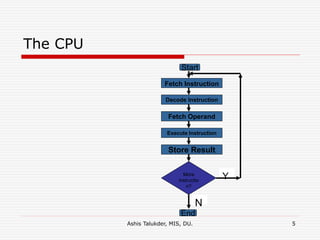
 Fetches instruction from
main memory.
 Decodes instruction to
determine which action is
required to be done.
 Based on instruction,
fetches data from
memory or I/O.
 Execution of instruction.
 Stores Result
Start
Fetch Instruction
Decode Instruction
Fetch Operand
Execute Instruction
Store Result
More
instructio
n?
Y
N
End
Ashis Talukder, MIS, DU. 5
The CPU
Start
Fetch Instruction
Decode Instruction
Fetch Operand
Execute Instruction
Store Result
More
instructio
n?
Y
N
End
Ashis Talukder, MIS, DU. 6
The Control Unit
 It selects and interprets program instructions
and then sees that they are executed.
 Contains:
 Special purpose registers.
 instruction register (IR)
 program control register (PCR).
 A decoder to perform various activities.
 IR holds the current instruction to be executed.
 PCR holds the address of the next instruction
to be executed.
Ashis Talukder, MIS, DU. 7
The Control Unit
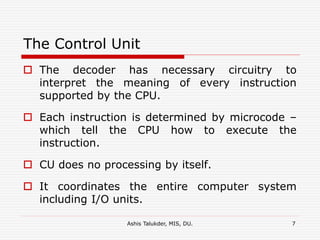
 The decoder has necessary circuitry to
interpret the meaning of every instruction
supported by the CPU.
 Each instruction is determined by microcode –
which tell the CPU how to execute the
instruction.
 CU does no processing by itself.
 It coordinates the entire computer system
including I/O units.
Ashis Talukder, MIS, DU. 8
The Control Unit
 Basic task – summary:
 Obtain instructions from program stored in
memory.
 Interpret/decode those instructions.
 Issue signals.
 The signals cause other units of the system to
do their tasks.
Ashis Talukder, MIS, DU. 9
The ALU
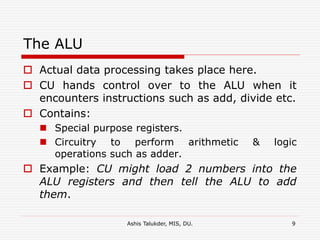
 Actual data processing takes place here.
 CU hands control over to the ALU when it
encounters instructions such as add, divide etc.
 Contains:
 Special purpose registers.
 Circuitry to perform arithmetic & logic
operations such as adder.
 Example: CU might load 2 numbers into the
ALU registers and then tell the ALU to add
them.
Ashis Talukder, MIS, DU. 10
Instruction Set
 A set of machine instructions supported by the
processor such as add, compare etc.
 Each different processor has different
instruction set. So machine language programs
for one processor will not execute in another
processor.
 When a manufacturer develops a CPU, they try
to maintain upward compatibility.
Ashis Talukder, MIS, DU. 11
Registers
 Temporary storage of data. Not a part of main
memory.
 CPU always puts data from RAM to internal
register before it processes that data
 Most CPU registers of today are of 32 or 64
bits. Known as word size.
 The bigger the word size the faster the CPU
can process data.
Ashis Talukder, MIS, DU. 12
Registers
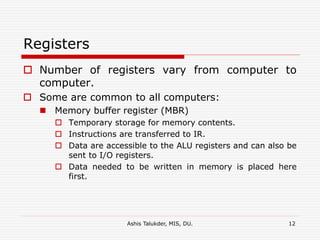
 Number of registers vary from computer to
computer.
 Some are common to all computers:
 Memory buffer register (MBR)
 Temporary storage for memory contents.
 Instructions are transferred to IR.
 Data are accessible to the ALU registers and can also be
sent to I/O registers.
 Data needed to be written in memory is placed here
first.
Ashis Talukder, MIS, DU. 13
Registers
 Memory address register (MAR)
 Holds address of active memory location.
 Loaded from PCR.
 Accumulator register (A)
 Holds data and result after processing.
 Mostly used.
 Result that is to be written in memory is
transferred from here to MBR.
Ashis Talukder, MIS, DU. 14
Registers
 Program control register (PCR)
 Holds memory address of next instruction to be
executed.
 Instruction register (IR)
 Holds current instruction to be executed.
 The operation part is sent to CU.
 Address is part sent to MAR.
 I/O register (I/O)
 Used to talk to I/O devices.
 Data & instruction from/to I/O devices are first put
in this register.
Ashis Talukder, MIS, DU. 15
Processor Speed
 Operations of ALU and CU are synchronized by
an internal clock called system clock.
 Generates electrical pulses.
 Several clock cycles are needed to execute a
single instruction. (fetch, decode, execute).
 Measured in megahertz. MHz and now-a-days
GHz.
Ashis Talukder, MIS, DU. 16
Types of Processor
 CISC (complex instruction set computer)
 Supports a large number of instructions.
 Makes it easier to translate high level languages.
 Adds more circuitry and complexity to the overall
design of the CPU.
 Supports variable length instructions.
 Supports various addressing modes.
 Expensive.
 Makes the job of machine level programmer easier.
 Most processors of today are CISC. Intel’s Pentium.
Ashis Talukder, MIS, DU. 17
Types of Processor
 RISC (reduced instruction set computers)
 Low design complexity.
 Supports few number of instructions.
 Complex instructions are performed by the basic
instructions. E.g. multiplication is performed by
repeated addition.
 Fixed length instructions.
 Supports small number of addressing modes.
 Puts extra burden on machine language
programmers.
 Less expensive.
 Faster for most applications.
 Motorola’s processors.

Lec 8 alu_cu

  • 1.
    Ashis Talukder, MIS,DU. 1 Lecture 8 The Processor and Its Component
  • 2.
    Ashis Talukder, MIS,DU. 2 The CPU  The brain.  Performs all major calculations.  Controls and manages the operations of other components of the computer.  Determines much of the performance of the computer.  The two basic components of the CPU are:  The Control Unit (CU).  The Arithmetic Logic Unit (ALU).
  • 3.
    Ashis Talukder, MIS,DU. 3 The CPU
  • 4.
    Ashis Talukder, MIS,DU. 4 The CPU  Fetches instruction from main memory.  Decodes instruction to determine which action is required to be done.  Based on instruction, fetches data from memory or I/O.  Execution of instruction.  Stores Result Start Fetch Instruction Decode Instruction Fetch Operand Execute Instruction Store Result More instructio n? Y N End
  • 5.
    Ashis Talukder, MIS,DU. 5 The CPU Start Fetch Instruction Decode Instruction Fetch Operand Execute Instruction Store Result More instructio n? Y N End
  • 6.
    Ashis Talukder, MIS,DU. 6 The Control Unit  It selects and interprets program instructions and then sees that they are executed.  Contains:  Special purpose registers.  instruction register (IR)  program control register (PCR).  A decoder to perform various activities.  IR holds the current instruction to be executed.  PCR holds the address of the next instruction to be executed.
  • 7.
    Ashis Talukder, MIS,DU. 7 The Control Unit  The decoder has necessary circuitry to interpret the meaning of every instruction supported by the CPU.  Each instruction is determined by microcode – which tell the CPU how to execute the instruction.  CU does no processing by itself.  It coordinates the entire computer system including I/O units.
  • 8.
    Ashis Talukder, MIS,DU. 8 The Control Unit  Basic task – summary:  Obtain instructions from program stored in memory.  Interpret/decode those instructions.  Issue signals.  The signals cause other units of the system to do their tasks.
  • 9.
    Ashis Talukder, MIS,DU. 9 The ALU  Actual data processing takes place here.  CU hands control over to the ALU when it encounters instructions such as add, divide etc.  Contains:  Special purpose registers.  Circuitry to perform arithmetic & logic operations such as adder.  Example: CU might load 2 numbers into the ALU registers and then tell the ALU to add them.
  • 10.
    Ashis Talukder, MIS,DU. 10 Instruction Set  A set of machine instructions supported by the processor such as add, compare etc.  Each different processor has different instruction set. So machine language programs for one processor will not execute in another processor.  When a manufacturer develops a CPU, they try to maintain upward compatibility.
  • 11.
    Ashis Talukder, MIS,DU. 11 Registers  Temporary storage of data. Not a part of main memory.  CPU always puts data from RAM to internal register before it processes that data  Most CPU registers of today are of 32 or 64 bits. Known as word size.  The bigger the word size the faster the CPU can process data.
  • 12.
    Ashis Talukder, MIS,DU. 12 Registers  Number of registers vary from computer to computer.  Some are common to all computers:  Memory buffer register (MBR)  Temporary storage for memory contents.  Instructions are transferred to IR.  Data are accessible to the ALU registers and can also be sent to I/O registers.  Data needed to be written in memory is placed here first.
  • 13.
    Ashis Talukder, MIS,DU. 13 Registers  Memory address register (MAR)  Holds address of active memory location.  Loaded from PCR.  Accumulator register (A)  Holds data and result after processing.  Mostly used.  Result that is to be written in memory is transferred from here to MBR.
  • 14.
    Ashis Talukder, MIS,DU. 14 Registers  Program control register (PCR)  Holds memory address of next instruction to be executed.  Instruction register (IR)  Holds current instruction to be executed.  The operation part is sent to CU.  Address is part sent to MAR.  I/O register (I/O)  Used to talk to I/O devices.  Data & instruction from/to I/O devices are first put in this register.
  • 15.
    Ashis Talukder, MIS,DU. 15 Processor Speed  Operations of ALU and CU are synchronized by an internal clock called system clock.  Generates electrical pulses.  Several clock cycles are needed to execute a single instruction. (fetch, decode, execute).  Measured in megahertz. MHz and now-a-days GHz.
  • 16.
    Ashis Talukder, MIS,DU. 16 Types of Processor  CISC (complex instruction set computer)  Supports a large number of instructions.  Makes it easier to translate high level languages.  Adds more circuitry and complexity to the overall design of the CPU.  Supports variable length instructions.  Supports various addressing modes.  Expensive.  Makes the job of machine level programmer easier.  Most processors of today are CISC. Intel’s Pentium.
  • 17.
    Ashis Talukder, MIS,DU. 17 Types of Processor  RISC (reduced instruction set computers)  Low design complexity.  Supports few number of instructions.  Complex instructions are performed by the basic instructions. E.g. multiplication is performed by repeated addition.  Fixed length instructions.  Supports small number of addressing modes.  Puts extra burden on machine language programmers.  Less expensive.  Faster for most applications.  Motorola’s processors.